Dust of Snow Poem by Robert Frost is a short yet profoundly symbolic poem that highlights the transformative power of nature. The poem shows how a seemingly insignificant and accidental moment—a crow shaking snow from a hemlock tree onto the poet—can bring about a meaningful change in one’s emotional state. At the beginning, the poet is weighed down by regret and gloom, but the unexpected fall of snow refreshes his mind and lifts his spirits. This brief interaction with nature alters his perspective, proving that even the smallest experiences can have a deep emotional impact. Through this simple incident, Frost conveys the idea that no day is entirely wasted, as a minor moment of awareness or joy can redeem even a day filled with sorrow.
Also Read: The Road Not Taken by Robert Frost
Dust of Snow by Robert Frost
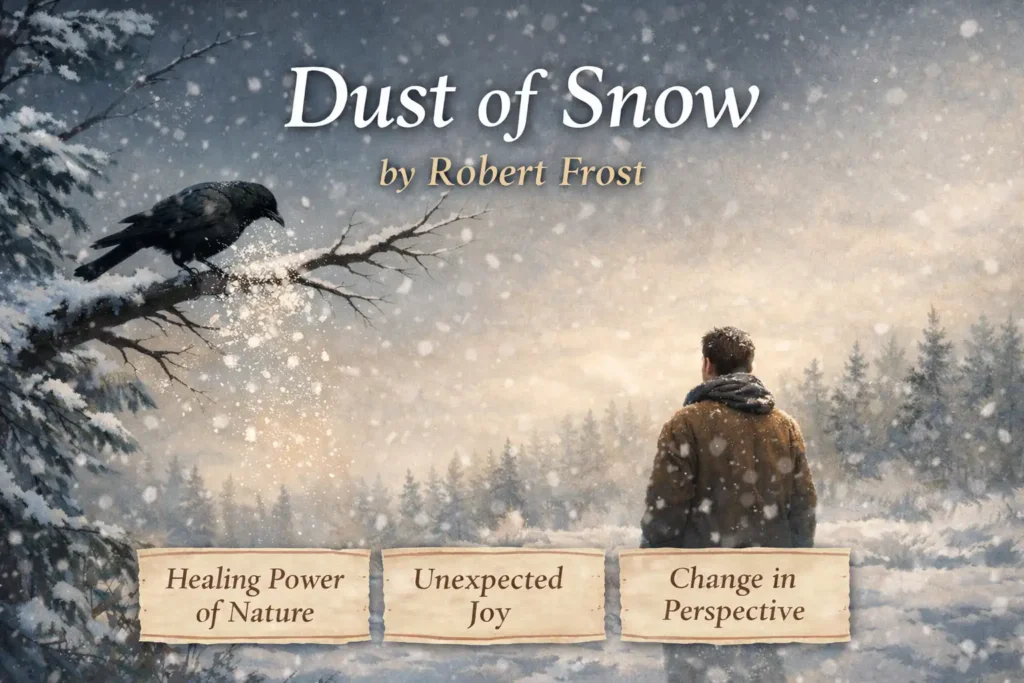
The Poem: Dust of Snow by Robert Frost
The way a crow
~ Dust of Snow Poem by Robert Frost (Public Domain)
Shook down on me
The dust of snow
From a hemlock tree
Has given my heart
A change of mood
And saved some part
Of a day I had rued.
Stanza-wise Meaning of Dust of Snow
Stanza 1
The way a crow
Shook down on me
The dust of snow
From a hemlock tree
- The poet is walking under a hemlock tree when a crow accidentally shakes snow onto him.
- Both the crow and hemlock traditionally symbolize negativity, death, or bad luck.
- The setting suggests the poet is already in a gloomy or troubled mood.
Stanza 2
Has given my heart
A change of mood
And saved some part
Of a day I had rued.
- The sudden fall of snow refreshes the poet’s mind.
- His mood improves instantly.
- What seemed like a completely wasted or regrettable day is now partially redeemed.
Central Themes of Dust of Snow
1. Nature as a Quiet Healer
In Dust of Snow, nature does not arrive as a grand force but as a gentle interruption. A light fall of snow, shaken loose by chance, becomes enough to soften the poet’s heavy mood. Frost suggests that healing does not always come through dramatic change; sometimes, it comes through brief, silent encounters with the natural world that gently reset the mind and heart.
2. Joy in the Unlikeliest Moments
The poem reminds us that joy often appears where we least expect it. The crow and the hemlock tree—both symbols of darkness and ill-omen—become the instruments of renewal. This contrast underlines an important truth: happiness does not always emerge from pleasant circumstances; it often arrives disguised, quietly reshaping our emotions without warning.
3. A Shift in How We See the Day
Rather than changing the poet’s situation, the falling snow changes how he views the day. What was once filled with regret is no longer entirely lost. Frost highlights the power of perspective—the idea that a single, small moment can alter how we interpret time, disappointment, and loss. The day remains the same, but the meaning of it changes.
Sometimes, it takes only a moment—small and accidental—to save a day we thought was already lost.
Symbols Used
| Symbol | Meaning |
|---|---|
| Crow | Negativity, gloom |
| Hemlock tree | Poison, death |
| Dust of snow | Purity, freshness, renewal |
👉 Frost intentionally uses negative symbols to show that positivity can emerge even from dark or unlikely sources.
Message of the Poem
Dust of Snow gently reminds us that no day is ever entirely lost. Even when time seems weighed down by regret or disappointment, a single, unexpected moment can restore balance to the heart. The poem suggests that emotional renewal does not always arrive through major events or conscious effort; sometimes, it comes quietly, through chance and simplicity.
By focusing on a small natural incident, Robert Frost shows how a brief shift in awareness can change our outlook. The day itself remains unchanged, yet the poet’s response to it transforms. This subtle renewal highlights the power of openness—to moments, to nature, and to life’s unplanned gestures.
Ultimately, the poem invites readers to remain receptive, reminding us that even the smallest experience can carry the strength to soften sorrow and restore meaning to an otherwise regretted day.
No day is completely lost.
A small moment can change our outlook and bring emotional renewal.
Why This Poem Matters
Dust of Snow matters because it captures Robert Frost’s faith in ordinary moments. Instead of relying on dramatic scenes or life-altering events, Frost turns to a brief, almost accidental experience to reveal how meaning often hides in simplicity. The poem suggests that life does not always announce its turning points loudly; sometimes, change arrives quietly, through moments we might otherwise overlook.
The poem also encourages readers to stay open to small joys, especially during difficult or regret-filled days. It reminds us that emotional relief does not always come from solving problems or escaping situations, but from allowing ourselves to notice the subtle beauty and unpredictability of the world around us.
Finally, Dust of Snow stands as a graceful example of how nature reflects human emotion. The falling snow mirrors the poet’s inner shift from heaviness to lightness, showing how the natural world and the human mind often move in quiet harmony. In this way, the poem remains timeless—speaking to anyone who has ever found comfort in an unexpected, fleeting moment.
- Shows Frost’s belief in simple moments rather than grand events.
- Encourages readers to remain open to small joys.
- Ideal example of how nature mirrors human emotions.
Dust of Snow Poem by Robert Frost (FAQ)
Q1. What is the significance of the crow and the hemlock tree in the poem?
Answer:
The crow and the hemlock tree are symbols of negativity, gloom, and misfortune. Traditionally, a crow is associated with bad luck and a hemlock tree with poison and death. By using these symbols, the poet shows that even unpleasant or negative things can bring about a positive change in life.
Q2. How did the dust of snow change the poet’s mood?
Answer:
The dust of snow falling on the poet was an unexpected natural incident. It refreshed his mind and brought a sudden change in his mood. As a result, the poet felt relieved and emotionally uplifted.
Q3. What does the poet mean by “saved some part of a day I had rued”?
Answer:
The poet means that although he had started the day in regret and sadness, the small incident of snow falling on him improved his mood. This change helped him feel that the day was not entirely wasted.
Q4. What is the central idea of the poem?
Answer:
The central idea of the poem is that even a small and seemingly insignificant incident can bring a positive change in one’s life. Nature has the power to heal and uplift human emotions.
Q5. Why is the poem titled Dust of Snow?
Answer:
The poem is titled Dust of Snow because the falling snow acts as the turning point of the poem. It symbolizes purity, freshness, and emotional renewal that changes the poet’s mood.
Summary and Conclusion
Dust of Snow is a brief yet deeply resonant poem that reveals the quiet healing power of nature. Robert Frost narrates a simple moment in which a crow, perched on a hemlock tree, accidentally shakes snow onto him. Though both the crow and the hemlock are traditionally linked with darkness and negativity, the incident leads to an unexpected emotional shift.
This small, unplanned encounter refreshes the poet’s mind and alters the course of a day he had been regretting. The poem gently suggests that transformation does not always require grand events or conscious effort; even the most ordinary moments can restore balance and perspective. In its simplicity, Dust of Snow leaves readers with a lasting reminder that openness to life’s small gestures can turn sorrow into quiet renewal.

Get the ThePoemStory App — Read Poems Anywhere