Motivational Poems to Reignite Your Inner Fire — read 4 original inspirational poems about life, resilience, and success that will awaken courage and help you begin again.
There are days when motivation feels like a distant memory. Days when the alarm rings, but the heart refuses to rise. Days when past failures echo louder than present possibilities. We all experience such seasons — moments when we question our strength, our direction, and sometimes even our worth.
And yet, beneath all that noise, something quiet remains.
A pulse.
A breath.
A small but persistent reminder that life has not given up on us.
Motivational poems are not magic spells. They do not erase struggle. They do not promise instant transformation. What they do is subtler and, perhaps, more powerful. They gently rearrange the chaos inside us. They help us see that failure is not the end of the road but a bend in it. They remind us that the moon may seem far, but the sky is still within reach. They whisper that as long as we are alive, nothing is entirely lost.
Poetry has always been a companion in human struggle. In moments of doubt, it gives language to feelings we cannot articulate. In moments of exhaustion, it lends rhythm to our tired steps. And in moments when we feel defeated, it quietly insists: Begin again.
The four poems below are not grand declarations from mountaintops. They are conversations. They speak to the person who feels behind. To the student overwhelmed by expectations. To the dreamer discouraged by delays. To the soul that believes it has already lost too much time.
Each poem carries a simple but essential truth:
- Every day is a new beginning.
- Even if you cannot reach the moon, you can still rise.
- As long as you have life, you have possibility.
- The journey itself is the real reward.
Take your time with them. Read slowly. Let the lines settle. Let them speak not just to your mind but to the quieter places within you.
Because sometimes, all it takes to reignite the inner fire is a single reminder:
You are not finished yet.
Explore more on ThePoemStory in the Poetry Section.
Also Read these Poems:
- Silent Struggle and Emotional Pressure – A Dark Motivational Poem About Discipline
- Built in the Dark | A Black Motivational Poem
- From Ash I Rise | A Black Motivational Poem
- 10 Empowering and Inspirational Poems for Women | Motivational Poetry for Her
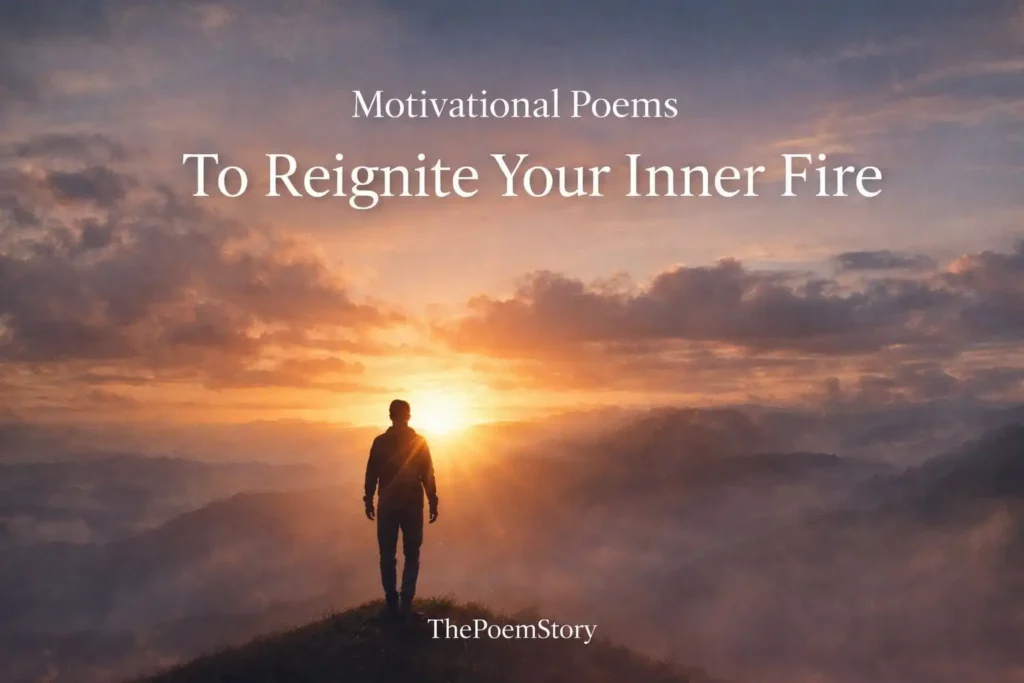
Motivational Poems to Reignite Your Inner Fire
1. You have got a chance to begin again.
Do not feel broken by yesterday’s pain,
~ Nitesh Sinha (ThePoemStory)
The storm has passed, you still remain,
Each sunrise washes away the stain,
Each breath dissolves the hidden chain,
You have got a chance to begin again.
Every morning writes a brand-new page,
Life is not a prison, it’s an open stage,
Wisdom grows with every age,
Courage rises from silent rage,
You have got a chance to begin again.
Failures were teachers dressed in disguise,
They shaped your strength, they made you wise,
Tears once fell from weary eyes,
Now hope within your spirit lies,
You have got a chance to begin again.
Moments whisper, “Start right now,”
Do not ask the future how,
Stand up firm, take the vow,
The present is your sacred plough,
You have got a chance to begin again.
Let not regret your heart restrain,
Release the guilt, release the chain,
Sunlight follows every rain,
Loss and effort are never vain,
You have got a chance to begin again.
Begin before the doubt can speak,
Strength is found when you feel weak,
Climb the mountain peak by peak,
Greatness favors those who seek,
You have got a chance to begin again.
Summary of the Poem “You have got a chance to begin again“
“Begin Again” speaks directly to the part of us that feels weighed down by yesterday. It opens with a compassionate acknowledgment of pain — not denying it, not dismissing it — but gently reminding us that survival itself is strength. The poem challenges the common human habit of carrying past failures like permanent labels. Instead, it reframes them as lessons disguised as setbacks.
The repeated line, “You have got a chance to begin again,” acts as both anchor and affirmation. Its repetition mirrors the daily opportunity life offers us. No matter how difficult yesterday was, today still arrives. That simple truth becomes the poem’s heartbeat.
A key idea woven through the stanzas is renewal. Every sunrise is presented as a symbolic cleansing. The past may have left marks, but the present moment remains untouched. This perspective encourages readers to shift from regret to action. The poem insists that waiting for perfect clarity is unnecessary. Beginning does not require perfection; it requires courage.
Another powerful element in the poem is the redefinition of failure. Instead of treating mistakes as evidence of weakness, it presents them as teachers. The pain, the embarrassment, the disappointment — all become part of growth. In this light, falling is not proof of inadequacy but proof of participation. You tried. You learned. You are still here.
The poem also emphasizes immediacy. It urges the reader not to delay action out of fear or self-doubt. The present moment is described almost as sacred ground — the only place where transformation can truly occur. By calling the reader to “begin before the doubt can speak,” the poem highlights how hesitation often grows stronger the longer we entertain it.
Emotionally, this poem offers reassurance without false promises. It does not guarantee that the next attempt will succeed instantly. Instead, it focuses on agency. You cannot control outcomes entirely, but you can control the decision to begin again.
Ultimately, “Begin Again” is about reclaiming momentum. It acknowledges weakness yet refuses to let weakness define identity. It recognizes pain but refuses to let pain write the future. Its message is simple but profound: the power to restart lies within the present moment, and as long as you are alive, that moment keeps arriving.
“The past may have shaped you, but it does not own you. Every sunrise quietly whispers — try once more.”
2. Rise and Touch the Sky
They said the moon was far away,
~ Nitesh Sinha (ThePoemStory)
Too distant for a soul to sway,
Yet dreamers dared to light the way,
And turned their night into their day,
Through faith that would not die,
They learned at least to touch the sky.
What if you stumble on the climb?
What if the clock defeats your time?
Each effort writes a verse sublime,
Each fall prepares a rise in rhyme,
The brave do more than try,
They rise again and touch the sky.
Perhaps you may not reach the moon,
Or plant your flag upon it soon,
But effort makes a different tune,
And changes fate’s reluctant rune,
Ambition learns to fly,
When hearts decide to touch the sky.
The distance shrinks with every stride,
When fear no longer walks beside,
When doubt and courage both collide,
And hope becomes your only guide,
Limits slowly say goodbye,
As spirits stretch to touch the sky.
Those who tried rewrote their fate,
They did not pause, they did not wait,
They turned each locked and rusted gate,
Before it ever grew too late,
They chose to amplify,
Their burning wish to touch the sky.
So if the moon seems far tonight,
Remember stars were born of light,
Great dreams demand relentless fight,
And faith transforms the darkest night,
Even if you never fly high,
You still can rise and touch the sky.
Summary of the Poem “Rise and Touch the Sky“
“Touch the Sky” explores ambition, distance, and the courage to aim high even when success seems uncertain. It begins with a powerful metaphor: the moon. The moon represents impossible dreams, goals that feel unreachable, and aspirations that invite skepticism from others.
The poem does not deny that the moon is far. Instead, it highlights the human spirit’s history of attempting what once seemed impossible. The emphasis is not on guaranteed success but on courageous effort. Those who try may not always reach the exact destination they imagined, but the act of striving elevates them regardless.
A central theme of this poem is redefining success. It suggests that even if one does not land on the moon, touching the sky is still extraordinary. This idea dismantles the all-or-nothing mindset that often discourages people from pursuing bold goals. Progress, growth, and expansion of capacity are victories in themselves.
The poem also acknowledges setbacks. It anticipates questions like: What if I fall? What if I fail? What if I run out of time? Instead of offering unrealistic reassurance, it reframes falling as part of rising. Each attempt strengthens resilience. Each setback prepares the individual for greater heights.
Another meaningful aspect is the rejection of passivity. The poem praises those who “did not wait” and who chose action over hesitation. Ambition is portrayed as a flame that must be actively protected and nurtured. Fear may accompany the climb, but it should not dictate the journey.
Emotionally, the poem encourages boldness without arrogance. It recognizes human limitation but refuses to let limitation become a cage. There is humility in acknowledging that the moon may remain distant. Yet there is power in realizing that aiming high stretches the spirit.
The final takeaway is deeply empowering: you are not required to achieve the impossible to live a meaningful life. What matters is your willingness to stretch, to rise, and to try. The sky, in this context, becomes symbolic of expanded potential. Even partial ascent transforms the dreamer.
“Touch the Sky” ultimately invites readers to challenge the boundaries they have unconsciously accepted. It asks: What if your fear of falling is the only thing keeping you grounded?
“You may not reach the moon, but every brave step upward changes who you become.”
3. You Still Have Life
Why do you feel that all is lost?
~ Nitesh Sinha (ThePoemStory)
Why count the pain, why fear the cost?
The storms have shaken, have they tossed?
Yet you still breathe—no matter the frost,
Life waits beyond the strife,
You still are gifted life.
You have a heartbeat strong and clear,
A mind that dreams, a soul sincere,
A future waiting somewhere near,
A path that forms when you persevere,
Do not surrender to the knife,
You still are gifted life.
The past is done, it will not stay,
It cannot steal your bright today,
The sun still finds its golden way,
Though clouds attempt to block its ray,
Stand tall in joy and strife,
You still are gifted life.
Let’s live it fully, breath by breath,
Not half in fear, not half in death,
Let courage be your living wreath,
Let gratitude replace regret,
Rise above the inner strife,
You still are gifted life.
No loss can claim your inner flame,
No scar can strip your noble name,
No fall can lock you into shame,
Unless you quit the greater game,
Step forward from the knife,
You still are gifted life.
So walk again beneath the sun,
Your story is not nearly done,
The race is long, you’ve just begun,
Your battles fought, your victories won,
Embrace both joy and strife,
You still are gifted life.
Summary of the Poem “You Still Have Life”
“You Still Have Life” addresses despair more directly than the previous poems. It speaks to moments when a person feels they have already lost too much — time, opportunities, relationships, confidence. Instead of arguing aggressively against that feeling, the poem responds gently but firmly.
Its central truth is almost startling in its simplicity: if you are alive, possibility remains.
The poem begins by questioning the assumption of total loss. What does it truly mean to have lost everything? If breath continues, if the heart still beats, if thought and desire still exist — then something invaluable remains untouched. Life itself is the foundation upon which all rebuilding can occur.
The repeated closing line, “You still are gifted life,” shifts the perspective from burden to blessing. It frames existence not as a weight to endure but as a gift to engage. This subtle reframing changes the emotional landscape of the poem. Instead of focusing on what has been taken, it focuses on what still stands.
The poem also emphasizes the present. The past is acknowledged but stripped of its power to dictate the future. Regret is portrayed as heavy, but not permanent. Each new day becomes an invitation rather than a reminder of failure.
Importantly, the poem encourages active living. It does not suggest simply surviving. It calls for living fully, breathing deeply, stepping forward despite scars. Pain is recognized, but it is not glorified. Instead, it becomes part of the human story — something that shapes but does not destroy.
There is also a strong element of self-worth woven into the verses. No loss can erase identity unless one chooses to surrender it. The poem insists that dignity and potential remain intact unless consciously abandoned.
Emotionally, this poem may resonate most with those feeling exhausted or defeated. It does not demand extraordinary ambition. It begins with something simpler: gratitude for life itself. From that gratitude, strength grows naturally.
In essence, “You Still Have Life” reminds readers that as long as there is breath, there is space for change. The story is not over. The next chapter has not yet been written.
“As long as you are breathing, possibility is breathing with you.”
Poem 4: The Road Is the Reward
The journey you must dare to take,
~ Nitesh Sinha (ThePoemStory)
For growth is found in each mistake,
The winding paths your spirit wake,
The silent strength they slowly make,
The road becomes your guide,
Where deeper truths reside.
Success is not a distant throne,
Not marble halls or crowns alone,
It’s in the seeds that you have sown,
In miles of ground your feet have known,
Not waiting at the side,
But walking with your stride.
For when you reach the shining gate,
The thrill you sought may hesitate,
The cheers grow faint, the rush won’t wait,
And glory bends to quiet fate,
The peak is brief and wide,
Then fades like turning tide.
But every sunrise on the way,
Each weary step at break of day,
Each doubt you chose not to obey,
Each price you bravely chose to pay,
Those moments stay beside,
They never truly hide.
The laughter shared along the climb,
The scars that turned to strength in time,
The rhythm of your steady rhyme,
The struggle that became sublime,
Are treasures you can’t hide,
They walk with you in pride.
So walk the road with open eyes,
Find wonder under changing skies,
Let gratitude within you rise,
For there the truest victory lies,
Before you reach the side,
The journey is your guide.
Summary of the Poem “The Road Is the Reward”
“The Road Is the Reward” challenges one of the most common misconceptions about success — that fulfillment lies solely at the destination. The poem gently dismantles this belief by exploring the temporary nature of arrival.
It begins by emphasizing growth through the journey. Mistakes, effort, and daily persistence shape character far more than the final moment of recognition. The road becomes a teacher, molding strength and resilience through repetition.
A significant idea within this poem is the fleeting nature of external success. The applause fades. The excitement softens. The long-anticipated achievement often feels shorter than expected. This does not diminish the value of success, but it reframes it. The peak is real — but brief.
In contrast, the journey offers continuous meaning. Every early morning, every small step, every moment of doubt overcome — these become lasting memories. They build identity. They create depth.
The poem also highlights relationships and experiences formed along the way. Shared laughter, lessons learned, and inner transformation become treasures that outlast trophies. The journey shapes the person; the destination simply marks a milestone.
Emotionally, this poem encourages presence. It invites readers to notice beauty in the climb rather than postponing happiness until arrival. Gratitude becomes central. Appreciation for effort replaces obsession with outcome.
The deeper message is that success is not a place — it is a process. It lives in daily discipline, in consistent effort, and in the courage to continue walking. When you finally reach the summit, what truly matters is who you became while climbing.
“The Road Is the Reward” reminds us that life itself is not a race to a finish line. It is a series of experiences meant to be lived, not rushed.
“Success fades, but the person you become along the way stays with you forever.”
Final Reflection on these “4 Original Motivational Poems“
Motivation is often misunderstood. We think it must be loud, dramatic, and constant. We imagine it as a roaring fire that never flickers. But in reality, motivation is usually quieter. It is the small decision to try once more. The simple choice to wake up and continue. The willingness to begin again without certainty.
These four poems revolve around that quiet strength.
The first reminds us that every day resets the clock. The past does not own us unless we allow it to. The second challenges us to stretch beyond fear, to aim high even when success is not guaranteed. The third grounds us in gratitude for life itself — the most fundamental gift. And the fourth teaches us that fulfillment is not waiting at the end of the road; it is woven into every step we take.
Together, they form a simple philosophy:
Start.
Stretch.
Live.
Walk.
When you feel behind, remember that comparison is often illusion. When you feel tired, remember that rest is not surrender. When you feel lost, remember that direction can be rediscovered. And when you feel like quitting, remember that the act of continuing is already an act of courage.
You do not need extraordinary talent to move forward. You need willingness. You do not need perfect clarity to begin. You need decision. You do not need the moon. You need the courage to reach for the sky.
Most importantly, as long as you are alive, your story is unfinished.
There will be more mornings. More opportunities. More chances to redefine yourself. The fire within you may dim at times, but it does not disappear easily. It waits — sometimes beneath doubt, sometimes beneath fatigue — for a single spark of belief.
Let these poems be that spark.
Not because they solve everything.
But because they remind you of something essential:
You are still here.
You can still rise.
And the road ahead is still yours to walk.
*Do not fear the days when you feel behind.
Do not fear the nights when doubt grows louder than hope.
These moments are not proof of your weakness —
they are proof that you are still fighting.A person who continues despite uncertainty,
who rises despite exhaustion,
who dreams despite disappointment —
is already living a story of quiet greatness.And as long as your heart continues to beat,
your journey is not ending.
It is unfolding.*
Also Read these Poems:
- Silent Struggle and Emotional Pressure – A Dark Motivational Poem About Discipline
- Built in the Dark | A Black Motivational Poem
- From Ash I Rise | A Black Motivational Poem
- 10 Empowering and Inspirational Poems for Women | Motivational Poetry for Her
Get the ThePoemStory App — Read Poems Anywhere