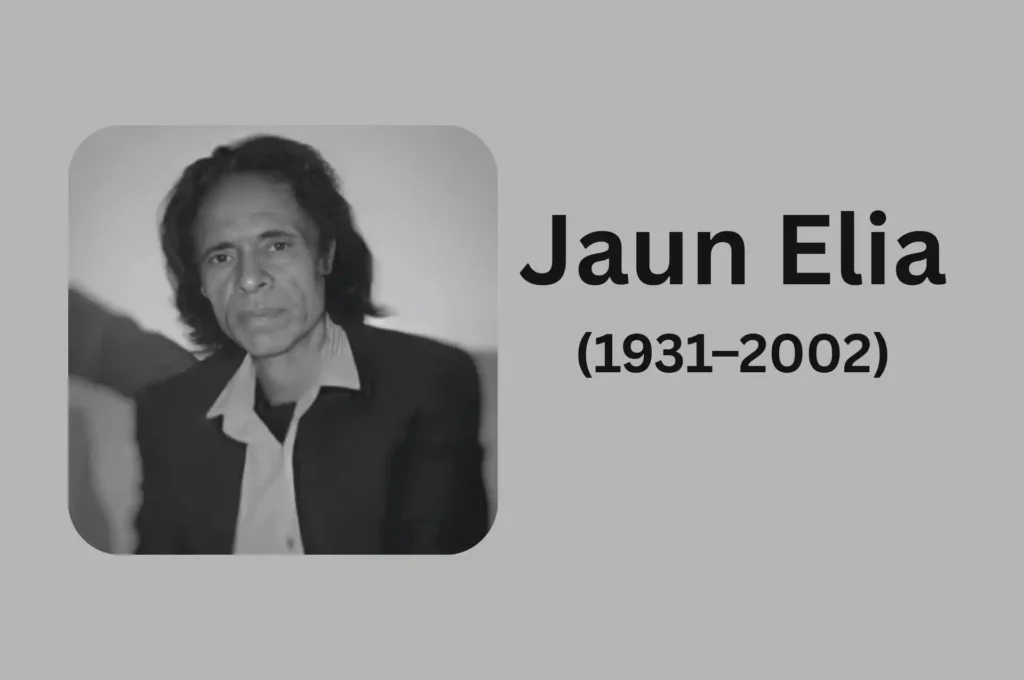
Jaun Elia was not destroyed by love, alcohol, or failure.
He was undone by an excess of consciousness —
a mind that refused consolation, compromise, or closure.
When recognition finally came—when his books sold, his verses circulated, his name echoed across mushairas and later across digital screens—he was already exhausted. The applause did not redeem the years of neglect, nor did fame soften the conclusions he had reached long ago. If anything, it confirmed them. To be understood late is not consolation; it is proof that one has lived ahead of one’s moment, without shelter.
Jaun Elia is often remembered as a poet of sorrow, of failed love, of bitterness and irony. This memory is incomplete. His despair was not emotional alone; it was intellectual. He did not merely feel unhappy—he thought his way into unhappiness. His tragedy was not excess of emotion but excess of awareness. Consciousness, for him, was not illumination. It was a sentence.
From early on, he possessed a mind unwilling to accept ready-made meanings. Born into a family steeped in learning, languages, and religious scholarship, he inherited not faith but inquiry. Where others found comfort in belief, he encountered contradiction. Where tradition offered continuity, he perceived fracture. He learned early that ideas do not always heal; often, they only sharpen the pain of living.
This book does not treat Jaun Elia as a victim of circumstance, nor as a romantic martyr of sensitivity. Such narratives do him a disservice. He was not crushed by fate, nor defeated by society alone. He resisted consolation deliberately. He rejected the lies that make existence tolerable. In doing so, he also rejected many of the structures—religious, emotional, institutional—that allow human beings to survive without collapse.
The Partition of the subcontinent marked a visible rupture in his life, but it did not create his alienation; it merely confirmed it. Migration displaced him geographically, but his deeper exile was internal. Pakistan was not a promised land, nor was India a lost paradise. For Jaun Elia, belonging itself was the illusion. Once history exposed the fragility of nations, faiths, and ideologies, he no longer trusted any collective narrative to hold meaning.
Unlike many intellectuals of his generation, he did not seek refuge in activism, careerism, or institutional authority. He knew too much to pretend. Philosophy did not save him; it burdened him. Marxism did not give him hope; it only sharpened his critique. Religion did not console him; it demanded a surrender his mind could not perform. Love, too, suffered under the weight of this consciousness. Intimacy requires a degree of forgetting, and forgetting was not among his talents.
His poetry, deceptively simple, bears the marks of this refusal. The language is conversational, stripped of ornament, often ironic, sometimes cruel—most often toward himself. These verses are not performances of despair; they are records of diagnosis. Each line exposes a condition rather than dramatizing it. He accuses himself before accusing the world. He does not ask for sympathy. He demands recognition of the truth as he sees it—bare, unsoftened, unredeemed.
It is tempting to romanticize his self-destructive tendencies, to frame alcohol and loneliness as symbols of artistic depth. This book resists that temptation. Jaun Elia was fully aware of his decline. He did not mistake destruction for rebellion. He recognized it as consequence. Consciousness without illusion, carried for decades, exacts a cost. His life demonstrates not the glamour of suffering, but its erosion—slow, untheatrical, and final.
What makes Jaun Elia profoundly modern is not merely his themes, but his position. He stands at a crossroads where inherited certainties collapse and no new faith convincingly replaces them. He represents the individual left alone with history, reason, and memory—unable to unsee what he has seen. In this sense, his growing relevance among younger generations is no accident. As inherited narratives weaken and the burden of self-definition increases, his voice sounds less like poetry and more like diagnosis.
This biography approaches Jaun Elia neither as a saint nor as a cautionary tale. It approaches him as a case study in intellectual honesty taken to its extreme. His life poses an uncomfortable question: What happens when consciousness outpaces the structures designed to contain it? When awareness refuses compromise, does it produce freedom—or paralysis?
The chapters that follow do not aim to resolve these questions. Jaun Elia himself did not resolve them. They trace instead the formation of a mind, the costs of its clarity, and the poetry that emerged as both expression and evidence. His verses are treated here not as decorative quotations, but as primary documents—records of a man thinking in public, often against his own survival.
To read Jaun Elia carefully is to encounter a life lived without anesthesia. He offers no solutions, no uplift, no final wisdom. What he offers is something rarer and more unsettling: an uncompromising account of what it means to remain awake in a world that rewards sleep.
This book is written in the belief that Jaun Elia does not need to be defended, forgiven, or redeemed. He only needs to be read—slowly, seriously, and without consolation.
To be understood late is not consolation; it is proof that one has lived ahead of one’s moment, without shelter.
Read more Biographies in Biographies section.
Life of Jaun Elia
**Chapter 1: A Mind Before a Life (Amroha, 1931–1947)**
Jaun Elia was born into thought before he was born into the world.
Amroha, the town of his birth, did not impose obscurity upon him, nor did it provide grandeur. It offered something subtler and far more decisive: an atmosphere saturated with language, learning, and disputation. Books were not rare objects in his household; they were assumed presences. Ideas were not ornaments; they were tools. Conversation did not exist merely to pass time—it existed to test claims, to question premises, to argue.
This environment did not produce comfort. It produced vigilance.
From an early age, Jaun Elia was exposed to systems of meaning that most people encounter only in fragments—religion articulated through theology, history framed as argument, language treated as structure rather than decoration. Arabic, Persian, Urdu: these were not foreign acquisitions but living inheritances. Yet inheritance, in his case, did not produce loyalty. It produced interrogation.
He learned quickly that ideas do not arrive as neutral gifts. They demand allegiance. And allegiance, once given, restricts movement.
What distinguished Jaun Elia even as a child was not precocity alone, but a refusal to rest inside conclusions. Where others absorbed belief, he examined it. Where others accepted continuity, he noticed contradiction. Faith was presented to him not as coercion but as coherence—and it was precisely coherence that troubled him. Systems that explained too much appeared suspect. Certainty, rather than calming him, provoked resistance.
This was not rebellion in the dramatic sense. There is no evidence of youthful defiance, no early posture of iconoclasm. His resistance was quieter, internal, and therefore more enduring. He listened carefully. He read attentively. And then he withheld assent.
In this sense, his solitude began early. Not because he lacked company, but because thinking separated him from those who lived more easily inside shared assumptions. He was surrounded by intellect, yet increasingly alone with its implications.
The balance between mind and life, once disturbed early, is rarely restored. In Jaun Elia’s case, thinking arrived before the structures necessary to contain it. He encountered questions long before he developed the habits—emotional, social, practical—that allow one to live alongside unanswered ones. This sequence matters. A mind that matures too early often lacks the patience required for ordinary existence.
Partition would later be described as the great rupture of his life, but the deeper rupture preceded it. Even before geography was fractured, certainty had already begun to erode. The world did not collapse for him in one moment; it loosened gradually, under sustained scrutiny.
Amroha gave him a language-rich past but no stable future. The traditions he inherited were intellectually dense but emotionally demanding. They offered meaning, but at the cost of surrender. Jaun Elia’s temperament could not accommodate surrender without remainder. Something in him always remained unconvinced.
This remainder—this refusal to be fully persuaded—became the core of his consciousness.
It is tempting, when looking backward, to treat this early formation as destiny. That would be inaccurate. Nothing in these years guaranteed despair, alienation, or self-destruction. What they guaranteed was tension. A mind sharpened early must either learn to dull itself—or accept the fatigue of remaining alert. Jaun Elia never learned to dull himself.
His early reading did not produce ambition. He did not dream of achievement, position, or recognition. Knowledge, for him, was not a ladder. It was an exposure. The more he learned, the more difficult it became to inhabit simplified narratives of progress, faith, or purpose.
This absence of ambition is significant. It explains much of what followed: his discomfort with institutions, his resistance to careerism, his suspicion of authority. He was not uninterested in influence; he was uninterested in the compromises influence required. Even as a young man, he sensed that success often demands selective blindness.
The town he left behind in 1947 is often described nostalgically, as though it represented a lost coherence. For Jaun Elia, it represented something more ambiguous: an origin that sharpened the mind but offered no refuge from it. Amroha did not betray him. It prepared him—for a life in which belonging would remain provisional and certainty permanently deferred.
By the time he migrated, the essential structure of his consciousness was already in place. Partition would alter circumstances, intensify displacement, and confirm suspicion—but it did not create the mind that encountered those changes. That mind had already been formed: alert, unsheltered, and unwilling to rest.
What emerges from these early years is not tragedy, but imbalance. A consciousness too awake for the consolations available to it. A boy trained to question before he learned how to endure uncertainty without injury.
The life that followed would test this imbalance relentlessly. And it would not correct itself.
**Chapter 2: Partition Without Promise**
Jaun Elia did not experience Partition as a sudden calamity.
He experienced it as confirmation.
For many who lived through 1947, Partition was an event that shattered an otherwise stable world. It arrived violently, displaced bodies, rearranged borders, and forced identities into hardened categories. For Jaun Elia, however, the ground had already been unstable. The rupture did not introduce uncertainty; it merely made visible what he had already suspected—that continuity, whether cultural or moral, was fragile, and that collective narratives could fracture overnight.
Migration removed him from Amroha, but it did not remove him from himself. If anything, it placed him inside a larger demonstration of impermanence. Nations, like beliefs, could be dismantled. Histories could be rewritten. Loyalties could be demanded overnight. The logic of belonging revealed itself to be contingent, enforced, and reversible.
Pakistan, for him, was not a destination charged with hope. It was an outcome of history—one more structure erected in response to anxiety and fear. He did not arrive with the illusion of arrival. There was no promised coherence waiting on the other side of the border, no moral clarity that migration would resolve. The move displaced geography, not doubt.
Partition is often narrated through loss—homes abandoned, relationships severed, violence endured. Jaun Elia did not deny these realities, but they did not form the core of his response. His reaction was intellectual before it was emotional. What unsettled him most was not the brutality of the moment, but the ease with which identities were reassigned and meanings recalibrated. If faith, language, and nation could be reorganized so quickly, what exactly anchored them?
This question did not seek an answer. It functioned as a solvent.
In Pakistan, the pressure to belong intensified. A new nation requires affirmation; it depends on shared belief to stabilize itself. Jaun Elia encountered not merely a country, but a demand—to align, to commit, to participate in collective optimism. He was ill-equipped for this demand. His temperament resisted unanimity. Where others sought reassurance in shared purpose, he perceived the mechanisms of persuasion at work.
He did not oppose Pakistan as an idea. He simply did not accept it as meaning.
This distinction matters. His distance from nationalism was not ideological rebellion; it was epistemic skepticism. He had seen how narratives are assembled under pressure. He had watched certainty being manufactured. Once seen, such processes cannot be unseen.
The result was a peculiar form of exile: present, but unanchored. He lived in Pakistan without internalizing its consolations. He spoke its language without surrendering to its certainties. He observed its culture with intimacy, yet without allegiance. Belonging, once framed as obligation, became suspect.
This posture carried consequences. In societies emerging from rupture, skepticism is often mistaken for betrayal. Jaun Elia’s refusal to perform belief—religious, national, or ideological—did not endear him to institutions or communities eager for affirmation. Yet he did not seek provocation. He simply refused the comfort of alignment.
Partition also altered his relationship to history. The past no longer appeared as continuity; it appeared as interruption. Traditions once assumed to be durable now seemed provisional. He began to view history not as progress, but as a series of corrections—each one revealing the instability of the previous certainty. This view would later inform both his political skepticism and his resistance to utopian thinking.
What Partition ultimately provided him was not trauma, but evidence. Evidence that collective identities are fragile agreements. Evidence that belief systems survive not because they are true, but because they are needed. Evidence that meaning, once exposed to power, becomes negotiable.
For someone already inclined toward doubt, this evidence was decisive.
It is important to resist the temptation to portray this period as the origin of his alienation. Alienation implies a loss of something once possessed. Jaun Elia had never fully possessed the ease of belonging. Partition did not take it from him; it removed the pretense that it was ever secure.
In Pakistan, his intellectual solitude deepened. The public language of optimism—nation-building, cultural revival, moral clarity—rang hollow to a mind trained to listen for contradiction. He did not counter these narratives with alternatives. He simply stood apart, attentive and unconvinced.
This distance would later be misread as bitterness, even nihilism. In truth, it was consistency. He did not abandon belief because of disappointment; he withheld belief because he had learned how quickly it could be demanded and rearranged.
Partition also intensified his inward turn. External structures appeared unreliable; internal scrutiny became unavoidable. If no collective narrative could be trusted fully, then responsibility returned to the individual mind. This was not liberation. It was burden. Meaning, stripped of inheritance, had to be carried alone—or not at all.
The young man who emerged from this period was not radicalized, but clarified. His skepticism hardened into orientation. He no longer expected history to offer redemption. He no longer expected nations to resolve identity. He no longer expected faith to survive inspection.
What he carried forward was not anger, but vigilance.
Partition, for Jaun Elia, was not a wound that demanded healing. It was a lesson that refused erasure. It taught him that belonging is conditional, that meaning is enforced, and that certainty often arrives accompanied by violence—symbolic or otherwise.
This lesson would follow him everywhere.
It shaped his refusal of institutions, his discomfort with authority, his resistance to optimism, and his insistence on speaking without accommodation. The promise that Partition held for others—renewal, clarity, collective future—never persuaded him. He saw only another structure asking for allegiance without evidence.
And so he remained where he had always been: inside history, but not at home in it.
The life ahead would deepen this condition, but it would not reverse it. Partition did not break Jaun Elia. It simply removed the last reason to expect coherence from the world.
**Chapter 3: Knowledge Without Institution**
Jaun Elia possessed the habits of a scholar without accepting the shelter of scholarship.
By the time his intellectual life began to take shape, it was already clear that knowledge, for him, would not be a means to position or authority. He read widely and deeply—not to accumulate credentials, but to test ideas against one another. Philosophy, history, religion, linguistics: these were not disciplines he entered sequentially, but territories he moved across restlessly. He did not specialize because specialization requires faith in boundaries, and boundaries, to him, were provisional.
In another temperament, such learning might have found its way into academia. Institutions exist precisely to absorb such minds—to formalize inquiry, discipline doubt, and translate thought into career. Jaun Elia resisted this translation. He sensed early that institutions do not merely house knowledge; they regulate it. They reward certain questions, discourage others, and quietly enforce intellectual etiquette.
Etiquette was never his strength.
What he sought from knowledge was clarity, not acceptance. And clarity, when pursued honestly, often leads away from consensus. The more he learned, the less convinced he became that truth aligned comfortably with authority. Institutions, by necessity, stabilize meaning. Jaun Elia was drawn to its instability.
This refusal was not dramatic. He did not stage exits or declare opposition. He simply did not enter. The academic world requires patience with procedure, compromise with hierarchy, and tolerance for repetition. His mind moved too quickly, and his standards of honesty were too severe. To teach what one does not fully believe, or to defer questions for the sake of continuity, felt to him like an abdication.
As a result, his learning remained informal but intense—unsupervised, uncredentialed, and unprotected. He belonged to no department, no movement, no school of thought. This independence granted him freedom, but it also stripped him of insulation. Without institutional frameworks, doubt has no buffer. Questions echo longer. Conclusions carry no external validation.
He paid this price knowingly.
Jaun Elia’s relationship with Marxism illustrates this tension clearly. He was drawn to its analytical power—its critique of history, power, and material conditions. Yet he did not submit to its orthodoxies. Where others found promise, he noticed presumption. Where theory offered direction, he observed dogma forming. He accepted Marxism as a tool, not as a shelter. It sharpened his critique, but it did not console him.
The same pattern repeated with philosophy. He read it not as inheritance, but as confrontation. Each system was examined for coherence, then held against lived reality. When fractures appeared—and they always did—he refused to look away. Philosophy did not reconcile him to the world. It estranged him further by exposing the gap between explanation and experience.
This position—deeply informed yet institutionally unaffiliated—placed him in a difficult space. Without institutional affiliation, knowledge loses its currency. It circulates privately, without authority, often without audience. Jaun Elia spoke from this position: learned, but unsanctioned. His voice carried insight, but not endorsement.
Such voices are easily misread. They are mistaken for arrogance, eccentricity, or bitterness. In reality, they often emerge from an unwillingness to dilute thought for the sake of belonging. Jaun Elia did not distrust institutions because he lacked discipline; he distrusted them because he understood their function too well.
Institutions require continuity. They survive by smoothing rupture. Jaun Elia was drawn to rupture precisely because it revealed truth. Where institutions seek resolution, he lingered in contradiction. Where they offer frameworks, he noticed exclusions.
This stance deepened his isolation. Knowledge, when shared through institutions, becomes social. Knowledge held outside them becomes solitary. Without colleagues, students, or formal peers, his intellectual life unfolded largely in private. Reading replaced affiliation. Writing replaced debate. Thought turned inward, recursive, often unforgiving.
There is a cost to such solitude. Without the corrective friction of dialogue, ideas can harden. Without institutional rhythms, inquiry can become obsessive. Jaun Elia was aware of these risks, but he accepted them. He preferred the danger of excess honesty to the safety of managed thought.
This choice also shaped his relationship with poetry. Poetry offered him what institutions could not: a space where thought did not need authorization. Verse allowed compression without simplification, irony without explanation, doubt without resolution. It permitted him to speak without submitting to intellectual protocols.
His poetry, therefore, should not be read as a retreat from philosophy, but as its continuation by other means. Where essays demand coherence, poetry tolerates fracture. Where arguments must conclude, verses can remain unresolved. Poetry became the form in which his uncontained knowledge could exist without compromise.
Yet even poetry did not fully protect him. The absence of institutional anchoring meant that recognition came late, unevenly, and without structure. He did not build a career; he accumulated insight. He did not cultivate disciples; he unsettled readers. The world rarely knows how to reward such figures.
This chapter of his life reveals a central paradox: Jaun Elia sought knowledge for its truth, but truth offered him no shelter. He refused institutions to preserve intellectual honesty, but honesty came at the cost of stability. He gained freedom, but lost the scaffolding that allows freedom to be lived without collapse.
What emerges is not a portrait of failure, but of refusal. He did not fail to enter institutions; he declined them. And in declining them, he accepted the consequences—obscurity, isolation, and a mind left alone with its conclusions.
The life that followed would test this choice repeatedly. Knowledge without institution sharpens perception, but it does not teach endurance. Jaun Elia would spend years living with insights that offered no relief, carrying awareness without infrastructure.
This was not ignorance. It was the burden of knowing without a place to put that knowledge.
And it would shape everything that followed.
**Chapter 4: Faith as an Impossible Surrender**
For Jaun Elia, the problem of faith was never emotional.
It was structural.
He did not reject belief because it disappointed him. He rejected it because it required a kind of surrender his mind could not perform without residue. Faith, as it was offered to him, demanded acceptance before explanation, obedience before inquiry. This order was intolerable to someone whose thinking had already been trained to move in the opposite direction.
Jaun Elia’s upbringing placed religion close, not distant. It was not an abstraction encountered later in rebellion; it was part of his intellectual environment from the beginning. Theology, ritual, history, and interpretation were not foreign territories. He knew the language of belief well enough to recognize where it asked for silence.
And it was precisely this request for silence that he could not honor.
Disbelief, in his case, was not an act of defiance. It was a consequence of inquiry left unfinished. Where faith offered closure, he found unresolved contradiction. Where belief systems promised coherence, he noticed selective attention—certain questions absorbed, others quietly excluded. He did not accuse religion of falsehood; he accused it of premature certainty.
This distinction matters. Jaun Elia was not interested in replacing religion with another system of belief. He distrusted systems that arrived fully formed, complete with moral confidence and historical justification. To him, belief that survives scrutiny by forbidding scrutiny is not belief—it is discipline.
Faith asks the believer to step beyond doubt. Jaun Elia refused that step, not out of arrogance, but out of consistency. Once doubt is allowed entry, it cannot be dismissed selectively. If reason is granted authority in some domains, it must be allowed to operate everywhere. To exempt God from examination felt arbitrary.
This refusal did not liberate him. It isolated him.
In societies where belief structures community, disbelief is not neutral. It marks the individual as incomplete, unfinished, even suspect. Jaun Elia did not attempt to soften this position. He did not adopt ambiguity as camouflage. His skepticism was visible, sometimes blunt, often uncomfortable. He spoke as though clarity were owed no apology.
Yet he also understood the cost of this clarity. Without belief, suffering does not acquire meaning automatically. Loss does not transform into purpose. Death does not resolve into promise. Consciousness remains exposed to contingency without shelter.
This exposure is what distinguishes his atheism from fashionable disbelief. He did not celebrate the absence of God as freedom. He experienced it as weight. Without transcendence, the burden of meaning returns entirely to the human mind—and the human mind, he knew, is poorly equipped for such responsibility.
Jaun Elia did not replace God with humanity, history, or progress. Those substitutions struck him as evasions. He had already seen how history justifies cruelty, how progress disguises repetition, how humanity romanticizes its own violence. To believe in these abstractions required the same suspension of doubt he had already rejected.
Thus, disbelief did not lead him toward optimism. It led him inward.
This inward turn intensified his loneliness. Faith creates community even when it fails intellectually. Disbelief, when lived honestly, dissolves shared language. There are no rituals for doubt, no collective ceremonies for uncertainty. The unbeliever carries questions alone.
His writing reflects this solitude. When he speaks of God, it is not with mockery, but with an almost procedural clarity. He examines belief as one would examine a structure—testing its claims, observing its supports, noting where it asks for compliance. His tone is rarely triumphant. There is no pleasure in disbelief, only insistence.
Importantly, Jaun Elia never pretended that belief was foolish. He understood why people believe. He understood its psychological necessity, its emotional utility, its social function. What he refused was participation without conviction. He could not inhabit belief as a role.
This refusal hardened over time. As institutions, nations, and ideologies failed to offer coherence, faith might have provided refuge. Many intellectuals retreat into belief when reason exhausts itself. Jaun Elia did not. He remained where reason leaves you: exposed, unsheltered, awake.
The cost of this position is visible throughout his life. Without divine arbitration, failure remains failure. Without forgiveness guaranteed from above, guilt remains unresolved. Without metaphysical justice, suffering demands no explanation beyond itself. Such a worldview offers no relief—only accuracy.
This accuracy, he believed, mattered more than comfort.
Faith, for Jaun Elia, was not an enemy. It was an impossible surrender. To believe would have required him to unsee what he had already seen, to silence questions he considered ethically non-negotiable. That silence felt more dishonest than disbelief.
What remains after faith is not peace. It is responsibility.
And Jaun Elia carried that responsibility without delegation.
This chapter does not conclude with resolution because there was none. His disbelief did not evolve into reconciliation. It deepened into position. By refusing God, he did not escape meaning; he inherited it fully—and without mediation.
The chapters that follow will show how this burden shaped intimacy, language, and self-destruction. Faith’s absence did not simplify his life. It complicated it irreversibly.
But it did not contradict him.
It completed the logic of a mind that refused to kneel where it could not believe.
**Chapter 5: Love Under Excess Awareness**
For Jaun Elia, love was never a refuge.
It was another site of interrogation.
Where faith had demanded surrender to the unseen, love demanded surrender to another person. Both required a suspension of scrutiny. Both asked for trust to precede certainty. And both, for Jaun Elia, failed for the same reason: awareness arrived too early and stayed too long.
He did not approach love naively. He understood its promise—intimacy, recognition, the temporary easing of solitude. But he also understood its structure. Love depends on selective blindness. It survives on exaggeration, on the willingness to overlook contradiction, on the ability to accept incomplete knowledge of the other. Jaun Elia possessed none of these abilities in durable form.
He saw too clearly.
This clarity did not make him incapable of feeling. On the contrary, his emotional intensity was genuine. He desired connection deeply. But desire, once examined relentlessly, begins to erode itself. Every gesture invites interpretation. Every silence demands explanation. Every disappointment becomes evidence. Love, placed under such scrutiny, loses its elasticity.
Marriage, for him, did not resolve this tension; it exposed it. The domestic space, which demands routine and compromise, intensified his discomfort. Intimacy became another system with expectations, rituals, and unspoken rules. And as with religion and institutions, he sensed the cost of participation: the quiet acceptance of roles, the tolerance of ambiguity, the postponement of doubt.
He could not maintain these postponements.
The failure of love in his life should not be read as emotional inadequacy alone. It was philosophical in nature. Love requires the ability to live with partial truths—to accept that understanding another person fully is neither possible nor necessary. Jaun Elia did not accept this limit. He demanded coherence where human relationships offer only proximity.
This demand exhausted both him and those close to him.
His poetry records this exhaustion without self-pity. He does not portray himself as betrayed or wronged. More often, he implicates himself as the source of collapse. Love, in his verses, fails not because the beloved is cruel, but because the self is unable to stop thinking. Awareness interrupts intimacy. Analysis replaces presence.
There is a recurring pattern in his treatment of love: longing followed by withdrawal. He approaches, then retreats—not out of indifference, but out of recognition. Recognition that love, like belief, asks for a kind of innocence he cannot recover. Once awareness dismantles illusion, returning to it feels dishonest.
This does not make him superior. It makes him incompatible.
Excess awareness does not deepen love indefinitely. Beyond a certain point, it fractures it. Affection becomes diagnosis. Memory becomes evidence. Desire becomes a question mark. Jaun Elia lived on the far side of that point.
Importantly, he did not romanticize this condition. He did not present his inability to sustain love as moral purity or intellectual heroism. His tone is often accusatory—directed inward. He recognizes the loneliness this posture produces. He understands that the refusal to participate fully carries consequences, and he does not evade them.
Love, when it failed, did not turn into hatred. It turned into knowledge.
This knowledge did not heal him. It compounded his solitude. Without faith, without institutional belonging, and now without durable intimacy, the individual mind stood exposed. Relationships that might have softened his life instead confirmed its difficulty. Love became another arena where the cost of consciousness revealed itself.
What distinguishes Jaun Elia’s treatment of love from sentimentality is restraint. He does not indulge in nostalgia or grievance. He examines loss with the same severity he applies elsewhere. There is no appeal to destiny, no blaming of circumstance. Love failed because the conditions required for its survival were incompatible with his way of seeing.
This incompatibility deepened over time. As awareness hardened into habit, spontaneity became increasingly difficult. Presence requires a suspension of judgment; he remained alert even in moments that demanded surrender. Love, stripped of illusion, became unsustainable.
Yet he never dismissed love as meaningless. He did not deny its value. He denied his capacity to inhabit it without contradiction. This distinction matters. His writing does not mock love; it mourns the distance between what love requires and what he could offer.
In this sense, love did not betray Jaun Elia. He betrayed love’s conditions.
The aftermath of failed intimacy did not produce renewal. It produced repetition. Patterns repeated because the underlying structure remained unchanged. Awareness did not diminish with experience; it intensified. Each failure confirmed the diagnosis. Each attempt reinforced the conclusion.
By the time love receded from his life as a sustaining force, it had already been transformed into material for thought. What remained was memory, sharpened by irony and regret, but never softened into consolation. Love, like faith, became another proof of the burden he carried.
This chapter does not end with closure because there was none. Love did not redeem him, nor did it destroy him entirely. It revealed a limit—one he could not cross without abandoning the clarity he considered non-negotiable.
The chapters that follow will show how this clarity found expression elsewhere: in language, in poetry, and eventually in self-erasure. Love failed not because it was false, but because consciousness refused to make peace with its necessary illusions.
Jaun Elia understood this.
And he accepted the cost.
**Chapter 6: Poetry as Diagnosis**
For Jaun Elia, poetry was never an escape from thought.
It was thought, stripped of protection.
He did not turn to poetry because philosophy failed him. He turned to it because philosophy demanded coherence, and coherence—when pursued honestly—often collapses under its own weight. Poetry offered a different kind of rigor. It allowed contradiction to remain visible. It permitted insight without reconciliation. Where arguments must conclude, verses can stop—unfinished, unresolved, intact in their tension.
This distinction explains the peculiar clarity of his poetry. The language is simple, almost conversational. There is no ornamentation to distract from the claim. Metaphor appears sparingly, often reluctantly. He does not hide behind symbolism. He states conditions directly, sometimes brutally, as though reporting a diagnosis rather than crafting an aesthetic object.
Poetry, for him, became a method of record.
What he documented was not emotion in isolation, but the structure beneath it. His verses expose the mechanics of despair, the logic of alienation, the processes by which belief dissolves and attachment fractures. He does not ask the reader to feel with him. He asks the reader to see what he has seen.
This is why his poetry resists consolation. There is no promise embedded in the lines, no quiet assurance that suffering leads elsewhere. Pain does not mature into wisdom; loss does not become meaningful by repetition. The poems refuse redemption not out of bitterness, but out of accuracy. To promise relief would be to falsify the condition being described.
In this sense, his poetry functions like a clinical report. The voice is controlled, often ironic, sometimes self-accusing. He does not spare himself. If others disappoint him, he records it. If he disappoints himself—and he often does—he records that too. There is no external judge. Consciousness itself performs the evaluation.
The simplicity of his diction is frequently misunderstood as accessibility. In truth, it is severity. Complex language can obscure responsibility. Simple language leaves no shelter. Each line stands exposed, unable to retreat into ornament. The effect is disarming. Readers encounter not crafted beauty, but a voice that sounds like it is speaking from the middle of thought.
This immediacy explains why his poetry feels contemporary across generations. It does not rely on cultural codes that expire. It does not ask for interpretive initiation. It confronts the reader directly, often uncomfortably, with conclusions that feel less like art and more like recognition.
Importantly, Jaun Elia did not treat poetry as therapy. Writing did not heal him. It clarified him. The act of articulation sharpened awareness rather than dulling it. Each poem named the condition more precisely, reducing the space for denial. Poetry did not relieve the burden of consciousness; it distributed it.
This distribution is key. In writing, he transferred part of his awareness to the reader. The poems do not invite admiration; they invite participation in diagnosis. To read him carefully is to share his conclusions, at least temporarily. This is why casual quotation often fails him. Removed from context, lines appear melancholic or romantic. Within context, they are structural statements about living without illusion.
His relationship with poetic tradition further reinforces this point. He did not reject classical forms out of ignorance. He knew them intimately. He rejected their consolatory tendencies. Traditional lyricism often elevates suffering into beauty. Jaun Elia refused this elevation. Beauty, when it softens truth, becomes complicit.
Instead, he adopted a tone closer to confession than performance. But even confession is an imperfect term, because confession seeks absolution. His poems do not. They present facts without expectation of forgiveness. If there is regret, it is not redemptive. It remains regret.
This approach unsettled audiences, especially in public recitations. Mushaira culture often thrives on affirmation—recognition, applause, shared sentiment. Jaun Elia’s verses disrupted this economy. They demanded attention without offering comfort. Listeners were compelled, but rarely reassured. His presence was magnetic precisely because it resisted gratification.
The late arrival of recognition can be partly understood through this resistance. His poetry did not fit neatly into prevailing expectations. It neither celebrated tradition nor announced rebellion in fashionable terms. It occupied an uncomfortable middle: deeply informed by the past, yet unwilling to preserve its illusions.
Poetry, then, became the space where all prior refusals converged. Without nation, without institution, without faith, and without sustaining intimacy, language remained the last site where honesty could be practiced without negotiation. Verse allowed him to exist publicly without surrendering privately.
Yet even here, the cost remained. To speak with such clarity is to forgo refuge. Readers may admire the precision, but admiration does not equal relief. Poetry extended his life intellectually, but it did not simplify it. The burden of consciousness remained intact—now articulated, not alleviated.
What distinguishes Jaun Elia’s poetry is not despair, but discipline. He resisted the temptation to turn suffering into spectacle. He refused the aesthetics of self-pity. He wrote as someone accountable to his own standards of truth, even when those standards isolated him.
This chapter does not present poetry as culmination. It presents it as function. Poetry did not resolve the contradictions of his life; it made them visible. It served as a diagnostic tool—naming conditions that could not be cured without illusion.
The chapters that follow will show what happens when such clarity persists without mitigation. Language can carry awareness for a time. Eventually, the weight seeks other outlets.
Jaun Elia understood this.
He did not expect poetry to save him.
He expected it to remain honest.
**Chapter 7: Against Hope, Against Progress**
For Jaun Elia, hope was not a virtue.
It was a narrative device.
This distinction places him at odds with much of modern thought. Where others turn to history, politics, or progress as substitutes for lost faith, Jaun Elia refused the substitution. He did not abandon religion only to kneel before optimism. He did not reject God in order to believe in tomorrow. The architecture of hope itself appeared suspect to him—too eager, too consoling, too willing to convert uncertainty into promise.
Hope, as it was offered, demanded belief without evidence. Progress required trust in direction. Both asked for patience with suffering in exchange for an eventual arrival. Jaun Elia distrusted arrivals. History had already taught him how easily destinations are redefined after the fact.
He was not ignorant of political thought. On the contrary, he engaged it seriously. He understood revolutionary language, historical materialism, and the rhetoric of emancipation. What he refused was their optimism. Movements that promised justice tomorrow often justified cruelty today. Narratives of progress smoothed over repetition, disguising old violences in new vocabulary.
He noticed how history congratulates itself.
For Jaun Elia, progress was not an observable fact; it was an interpretation imposed on continuity. Wars were renamed struggles. Exploitation became transition. Failure was reframed as delay. Each generation announced itself as corrective, while reproducing familiar hierarchies. To call this progress required selective memory—and selective memory, once identified, becomes impossible to maintain.
His skepticism did not make him reactionary. He did not advocate return. He simply refused forward motion as moral proof. The future, in his view, possessed no inherent virtue. It was merely another present waiting to disappoint.
This position isolated him further. Modern societies are organized around expectation. They require belief in improvement to sustain participation. To reject hope is to opt out of the shared tempo. Jaun Elia lived out of sync with this rhythm. Where others endured hardship with an eye toward reward, he endured without promise.
This endurance was not stoic. It was exacting.
He understood why people cling to hope. Without it, suffering stands naked. There is no metaphysical compensation, no historical guarantee, no deferred justice waiting to redeem loss. To live without hope is to accept contingency without anesthesia. Jaun Elia accepted this condition, but he did not celebrate it.
His writing reflects this refusal clearly. He does not predict collapse, nor does he announce redemption. He records stagnation, repetition, and exhaustion. Time moves forward, but meaning does not accumulate. Experience deepens awareness, not optimism. The future remains structurally uncertain.
This is why his work resists inspirational reading. Attempts to turn his verses into motivation misunderstand their function. He did not write to energize action or sustain morale. He wrote to preserve accuracy. Hope, when it distorts perception, becomes another illusion requiring maintenance. Jaun Elia refused maintenance.
Importantly, he did not replace hope with cynicism. Cynicism still depends on belief—belief in the inevitability of failure. Jaun Elia made no such claims. He did not predict outcomes. He declined predictions altogether. The refusal to hope was not the embrace of despair; it was the suspension of narrative.
This suspension came at a cost. Without progress as horizon, life loses directionality. Days do not build toward resolution. Effort does not guarantee meaning. To live in this condition requires constant recalibration. Jaun Elia lived with that recalibration until it exhausted him.
He recognized that hope functions socially as glue. It binds individuals to systems that cannot otherwise justify themselves. Progress narratives legitimize patience. They ask the present to suffer for a future that never fully arrives. Once this function is exposed, participation becomes ethically complicated.
Jaun Elia chose complication over comfort.
This choice did not make him politically irrelevant. It made him politically inconvenient. He could not be mobilized easily. He offered critique without program, clarity without instruction. Such positions rarely find institutional homes. They linger on the margins, articulating limits without proposing alternatives.
His refusal of hope also explains his resistance to consolation in later life. Recognition, when it came, did not restore optimism. Fame did not signal arrival. It simply arrived as another fact—belated, insufficient, and incapable of altering prior conclusions. Progress, even personal progress, did not persuade him.
This chapter marks an important turning point. Up to now, Jaun Elia has been defined by refusals—of belonging, of institutions, of faith, of sustaining intimacy. Here, the refusal becomes temporal. He withdraws not only from structures, but from expectation itself.
What remains after hope is stripped away is endurance without narrative. Life continues, but it does not promise to improve. Consciousness persists, but it offers no horizon beyond accuracy. This condition clarifies thought, but it also drains vitality.
The chapters that follow will show how this drain manifests. Without hope, social life thins. Humor hardens into defense. Solitude deepens. And eventually, awareness seeks relief—not through belief or progress, but through numbing.
Jaun Elia did not oppose hope to shock or provoke. He opposed it because he believed false hope to be a greater cruelty than honest uncertainty.
Against hope, against progress, he chose to remain awake.
And wakefulness, sustained too long, exacts its own price.
Against Hope, Against Progress**
For Jaun Elia, hope was not a virtue.
It was a narrative device.
This distinction places him at odds with much of modern thought. Where others turn to history, politics, or progress as substitutes for lost faith, Jaun Elia refused the substitution. He did not abandon religion only to kneel before optimism. He did not reject God in order to believe in tomorrow. The architecture of hope itself appeared suspect to him—too eager, too consoling, too willing to convert uncertainty into promise.
Hope, as it was offered, demanded belief without evidence. Progress required trust in direction. Both asked for patience with suffering in exchange for an eventual arrival. Jaun Elia distrusted arrivals. History had already taught him how easily destinations are redefined after the fact.
He was not ignorant of political thought. On the contrary, he engaged it seriously. He understood revolutionary language, historical materialism, and the rhetoric of emancipation. What he refused was their optimism. Movements that promised justice tomorrow often justified cruelty today. Narratives of progress smoothed over repetition, disguising old violences in new vocabulary.
He noticed how history congratulates itself.
For Jaun Elia, progress was not an observable fact; it was an interpretation imposed on continuity. Wars were renamed struggles. Exploitation became transition. Failure was reframed as delay. Each generation announced itself as corrective, while reproducing familiar hierarchies. To call this progress required selective memory—and selective memory, once identified, becomes impossible to maintain.
His skepticism did not make him reactionary. He did not advocate return. He simply refused forward motion as moral proof. The future, in his view, possessed no inherent virtue. It was merely another present waiting to disappoint.
This position isolated him further. Modern societies are organized around expectation. They require belief in improvement to sustain participation. To reject hope is to opt out of the shared tempo. Jaun Elia lived out of sync with this rhythm. Where others endured hardship with an eye toward reward, he endured without promise.
This endurance was not stoic. It was exacting.
He understood why people cling to hope. Without it, suffering stands naked. There is no metaphysical compensation, no historical guarantee, no deferred justice waiting to redeem loss. To live without hope is to accept contingency without anesthesia. Jaun Elia accepted this condition, but he did not celebrate it.
His writing reflects this refusal clearly. He does not predict collapse, nor does he announce redemption. He records stagnation, repetition, and exhaustion. Time moves forward, but meaning does not accumulate. Experience deepens awareness, not optimism. The future remains structurally uncertain.
This is why his work resists inspirational reading. Attempts to turn his verses into motivation misunderstand their function. He did not write to energize action or sustain morale. He wrote to preserve accuracy. Hope, when it distorts perception, becomes another illusion requiring maintenance. Jaun Elia refused maintenance.
Importantly, he did not replace hope with cynicism. Cynicism still depends on belief—belief in the inevitability of failure. Jaun Elia made no such claims. He did not predict outcomes. He declined predictions altogether. The refusal to hope was not the embrace of despair; it was the suspension of narrative.
This suspension came at a cost. Without progress as horizon, life loses directionality. Days do not build toward resolution. Effort does not guarantee meaning. To live in this condition requires constant recalibration. Jaun Elia lived with that recalibration until it exhausted him.
He recognized that hope functions socially as glue. It binds individuals to systems that cannot otherwise justify themselves. Progress narratives legitimize patience. They ask the present to suffer for a future that never fully arrives. Once this function is exposed, participation becomes ethically complicated.
Jaun Elia chose complication over comfort.
This choice did not make him politically irrelevant. It made him politically inconvenient. He could not be mobilized easily. He offered critique without program, clarity without instruction. Such positions rarely find institutional homes. They linger on the margins, articulating limits without proposing alternatives.
His refusal of hope also explains his resistance to consolation in later life. Recognition, when it came, did not restore optimism. Fame did not signal arrival. It simply arrived as another fact—belated, insufficient, and incapable of altering prior conclusions. Progress, even personal progress, did not persuade him.
This chapter marks an important turning point. Up to now, Jaun Elia has been defined by refusals—of belonging, of institutions, of faith, of sustaining intimacy. Here, the refusal becomes temporal. He withdraws not only from structures, but from expectation itself.
What remains after hope is stripped away is endurance without narrative. Life continues, but it does not promise to improve. Consciousness persists, but it offers no horizon beyond accuracy. This condition clarifies thought, but it also drains vitality.
The chapters that follow will show how this drain manifests. Without hope, social life thins. Humor hardens into defense. Solitude deepens. And eventually, awareness seeks relief—not through belief or progress, but through numbing.
Jaun Elia did not oppose hope to shock or provoke. He opposed it because he believed false hope to be a greater cruelty than honest uncertainty.
Against hope, against progress, he chose to remain awake.
And wakefulness, sustained too long, exacts its own price.
**Chapter 8: The Loneliness of Seeing Clearly**
For Jaun Elia, loneliness was not an accident of circumstance.
It was the social shape of clarity.
Once belief, hope, and institutional shelter were removed, what remained was not freedom in the celebratory sense, but exposure. Life without shared illusions does not merely feel solitary; it becomes solitary. Conversation depends on agreement at some level—about meaning, direction, or value. Jaun Elia’s refusals left him without that common ground. He did not withdraw from people so much as find fewer places where language still worked.
This loneliness did not arrive suddenly. It accumulated.
In public settings, he was present yet apart. He spoke, but not always in ways that invited continuation. Humor became a strategy—not to charm, but to create distance. Irony allowed him to say what could not be said directly, and to retreat before intimacy demanded response. Laughter, when it occurred, often arrived edged with discomfort. It signaled recognition without reassurance.
Social life requires small acts of faith: agreement to overlook, willingness to defer, tolerance for approximation. Jaun Elia found these acts increasingly difficult. Accuracy interrupted flow. Precision slowed exchange. The more clearly he saw, the less easily he moved among others.
This was not a failure of empathy. He understood people well. He recognized their needs for belief, hope, and belonging. What he could not do was participate in those needs without falsifying his own conclusions. Compassion, without complicity, has limits. He reached those limits early and lived with their consequences.
Mushaira culture made this tension visible. Public recitation thrives on shared sentiment and collective affirmation. Poets often meet their audience halfway, offering emotion that can be received and returned. Jaun Elia did not meet halfway. He spoke from where he stood. The result was a strange mixture of attraction and unease. Audiences listened intently, sometimes rapt, sometimes unsure how to respond.
Applause followed, but it did not resolve the distance.
He was admired, but not absorbed. Recognized, but not integrated. This form of visibility can intensify loneliness rather than relieve it. To be seen without being accompanied is to feel one’s separateness sharpen.
In private life, the effects were quieter but more enduring. Friendships require maintenance through compromise—allowing misunderstandings to pass, accepting partial alignment, forgiving intellectual imprecision. Jaun Elia’s standards made such maintenance costly. He preferred honesty to continuity, even when honesty thinned connection.
Over time, solitude ceased to be episodic. It became habitual.
Importantly, this solitude was not romantic. He did not cultivate it as an identity. He experienced it as absence. Without faith to provide community, without institutions to structure belonging, without sustained intimacy to anchor daily life, the individual mind stood alone with its assessments. There was no chorus to dilute the voice of awareness.
Loneliness, in this context, is not merely emotional pain. It is cognitive isolation. Ideas echo longer when unshared. Doubts deepen when unanswered. Humor hardens when it no longer anticipates response. Jaun Elia lived inside this echo.
His writing reflects this condition with restraint. He does not dramatize isolation as tragedy. He records it as consequence. To see clearly is to see alone, because clarity dissolves the agreements that make togetherness possible. He does not ask to be spared this result. He accepts it.
Yet acceptance does not equal ease.
As solitude deepened, fatigue followed. Remaining alert requires energy. Without social reinforcement, vigilance becomes exhausting. The mind, left entirely to itself, begins to circle. Thoughts return, sharpened but unchanged. Insight accumulates without release.
This is the point at which loneliness shifts from condition to pressure.
Jaun Elia did not respond by seeking new communities or softer beliefs. He did not lower his standards to regain company. He endured. Endurance, without hope or companionship, is a demanding discipline. It thins patience. It narrows tolerance. It makes relief appear not as weakness, but as necessity.
The next chapter will show how this necessity found expression. Loneliness did not drive him toward rebellion or reinvention. It drove him toward numbing—toward ways of quieting awareness when no shared structure remained to carry it.
Chapter 8 marks the human cost of the intellectual clarity traced so far. It shows how a life can become isolated not through arrogance or withdrawal, but through consistency. Jaun Elia did not lose people because he despised them. He lost them because he could not pretend.
To see clearly is to stand apart.
To stand apart for too long is to grow tired.
And tired minds, left alone, seek silence by whatever means are available.
**Chapter 9: Alcohol, Decline, and Self-Knowledge**
For Jaun Elia, alcohol was not rebellion.
It was anesthesia.
This distinction matters. Much has been made—often lazily—of his drinking, as though it were an emblem of artistic excess or romantic despair. Such readings miss the point. Jaun Elia did not drink to dramatize suffering, nor to escape responsibility. He drank to interrupt awareness. After belief, hope, intimacy, and community had all withdrawn, consciousness remained uninterrupted—and relentless. Alcohol offered what nothing else could: temporary silence.
This silence was not peace. It was suspension.
By the time alcohol entered his life as a regular presence, the intellectual structure was already complete. His conclusions had settled. The world, as he understood it, offered no compensations that could bear scrutiny. Drinking did not create this understanding; it responded to it. Cause and effect are often reversed in popular narratives. Jaun Elia did not think deeply because he drank. He drank because thinking never stopped.
Importantly, he did not mistake numbing for solution. There is no evidence that he believed alcohol would save him, transform him, or resolve anything. He understood its limits. He knew it dulled clarity without dismantling it. The relief was partial and temporary, followed by return—often sharper than before.
This knowledge did not prevent repetition.
Alcohol, in his case, functioned as a management strategy. It lowered the volume of awareness just enough to make daily existence tolerable. It allowed the body to rest when the mind refused to. In this sense, it was less an indulgence than a concession—a way of continuing without altering convictions.
Yet concessions accumulate cost.
As drinking deepened, physical decline followed. Energy thinned. Health deteriorated. Routine suffered. None of this surprised him. He did not frame decline as tragedy or injustice. He recognized it as consequence. Choices, once made consistently, produce outcomes. He did not appeal to fate.
What distinguishes his self-destruction from romantic myth is precisely this recognition. He did not glorify it. He did not disguise it as freedom. He observed it with the same clarity he applied elsewhere. In his writing and speech, there is an unsparing awareness of damage—inflicted and endured. He indicts himself before allowing any external explanation.
Self-knowledge, in his case, did not prevent harm. It accompanied it.
This is perhaps the most unsettling aspect of his life. Awareness did not function as safeguard. Knowing what he was doing, and why, did not stop him. The assumption that insight automatically leads to correction fails here. Jaun Elia understood the trajectory and continued along it, not out of nihilism, but out of exhaustion. To change would have required new illusions. He refused to acquire them.
Alcohol also altered his social presence. Where loneliness had once been structural, it now became visible. Interactions thinned. Dependability weakened. The gap between public brilliance and private fragility widened. Admiration did not translate into care. Applause does not substitute for support.
Still, he did not ask to be rescued.
There is a temptation to read this period as decline alone. That would be incomplete. Alongside physical deterioration, his clarity sharpened. There is no evidence of confusion, incoherence, or ideological collapse. If anything, his positions became more consistent. He did not drift into sentimentality or soften conclusions. Decline affected the body more than the mind.
This persistence complicates judgment. It denies the comfort of a cautionary tale. He was not undone by ignorance, nor by delusion. He was undone by carrying conclusions without shelter for too long. Alcohol entered not as temptation, but as compromise with survival.
The cost of that compromise was cumulative.
As health failed, time narrowed. The future, already stripped of promise, contracted further. Yet even here, he did not perform despair. He did not seek absolution. He did not convert suffering into meaning. He continued to speak plainly, sometimes with humor sharpened into cruelty, often directed at himself.
This chapter resists moral framing because he did. There is no lesson offered here beyond accuracy. Alcohol did not make Jaun Elia tragic; it made visible the limits of endurance without consolation. Self-knowledge did not save him; it accompanied him faithfully to the end.
The world often prefers narratives where awareness redeems. Jaun Elia offers a harder truth: awareness, when isolated, can exhaust rather than liberate. Numbing becomes attractive not because one denies truth, but because one knows it too well.
This chapter marks the point where intellectual burden becomes bodily cost. The next chapter will show what happens when recognition arrives at this stage—when understanding comes after damage, and visibility follows exhaustion.
It will ask a final, uncomfortable question:
What does it mean to be heard when it no longer changes anything?
**Chapter 10: Late Arrival**
For Jaun Elia, recognition did not arrive as rescue.
It arrived as evidence.
When his work finally reached a wider audience—when books circulated, verses were quoted, and his voice became unmistakable—it did not reverse the conclusions he had already drawn. Fame did not interrupt decline. Applause did not reorganize the past. Understanding, when delayed, does not function like justice. It confirms rather than compensates.
The timing matters.
Recognition came after belief had been refused, after institutions had been declined, after intimacy had fractured, and after the body had begun to fail. The architecture of his life was already complete. There was nothing left for success to rearrange. To be heard at this stage was not vindication; it was belated alignment.
He had spoken clearly for decades. The world had simply not been ready to listen.
This delay is often framed as tragedy, but it is more precise to call it asymmetry. Jaun Elia’s voice matured earlier than the cultural conditions required to receive it. His skepticism, once marginal, became legible only after collective certainties weakened. By the time audiences recognized themselves in his clarity, he no longer needed recognition to confirm his position.
Late fame carries a peculiar emptiness. It acknowledges accuracy without offering repair. It validates perception without restoring what perception cost. Jaun Elia did not mistake attention for transformation. He understood that being right does not retroactively heal.
Public appearances during this period reflect this understanding. He did not soften his tone to accommodate admiration. He did not reframe his past as struggle rewarded. His presence remained edged, ironic, often uncomfortable. He accepted recognition as fact, not as redemption.
This acceptance did not produce gratitude in the conventional sense. Gratitude assumes benefit. Recognition offered visibility, not relief. It brought readers, not shelter. Applause does not lower the volume of consciousness. If anything, it can intensify it by placing one’s conclusions under brighter light.
There is also the matter of misreading. Late recognition often arrives simplified. Complex positions are reduced to quotable fragments. Irony is mistaken for despair. Precision is repackaged as attitude. Jaun Elia became popular in a culture increasingly prone to extraction—lines lifted from context, conclusions admired without the burden that produced them.
He was aware of this risk.
Yet he did not correct it. Correction would have required participation in the very mechanisms he distrusted. He allowed misunderstanding to coexist with recognition. To intervene would have meant explaining himself again—and explanation had never been his project.
What emerges here is not bitterness, but finality. Recognition came too late to function as incentive. There was no future it could meaningfully reorganize. His health had declined. His routines were established. His conclusions were settled. Success, arriving now, could not persuade him to revise his assessment of life.
This is why late arrival does not read as climax in his story. It reads as confirmation. The world eventually caught up to a voice that had never adjusted itself for acceptance. The alignment happened, but it did not converge into harmony.
Late recognition also reveals something uncomfortable about cultural listening. Societies often recognize clarity only after illusion erodes. Voices like Jaun Elia’s become audible not because they change, but because the surrounding noise diminishes. What once sounded excessive begins to sound accurate.
This accuracy, however, offers no comfort to the one who carried it early.
Jaun Elia did not use recognition to rewrite himself. He did not turn backward to justify suffering, nor forward to promise renewal. He remained where he had always been: attentive, unsheltered, unwilling to decorate truth. Fame neither softened nor sharpened him. It simply illuminated what had been present all along.
This chapter matters because it denies a false ending. There is no arc of redemption here, no narrative payoff where suffering is redeemed by applause. To insist on such an ending would betray the very clarity this book has traced. Late arrival is not reward. It is lag.
What recognition did do was make his voice portable. It allowed his conclusions to travel beyond the confines of his life, into contexts he would never see. In that sense, it did not save him—but it preserved the record.
The final chapter must now address what remains after death—not legacy as celebration, but inheritance as responsibility. If Jaun Elia’s voice survives, the question is not how to admire it, but how to read it without removing its cost.
The epilogue will not close his story.
It will return the burden to the reader.
**Epilogue: What Jaun Elia Leaves Unanswered**
Jaun Elia does not leave behind a system.
He leaves behind a condition.
This matters, because it determines how he should be read. His life does not resolve into instruction, nor does his work crystallize into advice. There is no method here that can be adopted without cost, no posture that can be imitated safely. What remains after reading him carefully is not clarity of direction, but an unease about direction itself.
That unease is intentional.
Throughout this book, Jaun Elia has been traced not as a figure to be admired, but as a mind carried to its limits. He refused belief without evidence, belonging without scrutiny, love without illusion, hope without honesty. Each refusal was coherent. Together, they formed a life stripped of shelter. What followed—loneliness, exhaustion, decline—was not contradiction, but consequence.
This is where the reader must pause.
It is tempting to turn Jaun Elia into a symbol: of honesty, of rebellion, of intellectual courage. Symbols are convenient. They allow distance. But Jaun Elia resists symbolic safety. To admire him without confronting the cost of his clarity is to misread him. He did not offer a heroic alternative to ordinary life. He exposed what happens when ordinary consolations are refused consistently.
The unanswered question he leaves us with is not whether he was right.
It is whether being right is enough.
His life suggests that accuracy alone does not sustain existence. Consciousness, when isolated, can exhaust rather than liberate. Insight, carried without mitigation, can narrow rather than expand. None of this invalidates his refusals. It complicates them. It demands that we consider not only what we believe, but what belief allows us to endure.
This is not a call to return to faith, illusion, or optimism unexamined. Jaun Elia would reject such a reading. It is, instead, an insistence on responsibility. If we reject consolation, we must ask what replaces it. If we dismantle narratives, we must ask how life is carried afterward. Awareness removes shelter; it does not build one.
Jaun Elia never pretended otherwise.
He also does not ask to be followed. There is no invitation here to live as he lived. His writing offers no encouragement, no warning labels, no disclaimers. It simply records what one mind discovered when it refused to look away. To read him honestly is to recognize both the integrity of that refusal and its cost.
What he leaves unanswered, deliberately, is how to live after clarity.
That question does not belong to him anymore. It belongs to the reader. Each person must decide how much illusion they are willing to relinquish, and how much they are willing to carry alone. Jaun Elia’s work sharpens this choice, but it does not resolve it.
This is why his legacy cannot be reduced to influence or popularity. His voice persists not because it comforts, but because it remains accurate in moments when comfort feels dishonest. As collective certainties weaken, his conclusions become legible. That does not make them easier to live with. It only makes them harder to ignore.
To read Jaun Elia without romanticism is to accept this difficulty.
He does not teach despair. He does not teach hope. He teaches attention. And attention, sustained, is demanding. It asks for discipline without promise, endurance without narrative, and honesty without reward. Most people will—and should—temper such attention with forms of belief, belonging, or affection that make life livable.
Jaun Elia chose not to.
This book does not ask the reader to choose as he did. It asks only that his life be read without consolation. Not softened into tragedy, not elevated into martyrdom, not extracted into quotable fragments. Read whole, he remains what he always was: a mind unwilling to lie to itself, and a life shaped by that refusal.
What you do with that understanding is no longer his responsibility.
It is yours.
You’re done writing.
Now publish it as one piece.
No apology for length.
No closing call to action.
Let it stand.
What Jaun Elia Leaves Unanswered**
Jaun Elia does not leave behind a system.
He leaves behind a condition.
This matters, because it determines how he should be read. His life does not resolve into instruction, nor does his work crystallize into advice. There is no method here that can be adopted without cost, no posture that can be imitated safely. What remains after reading him carefully is not clarity of direction, but an unease about direction itself.
That unease is intentional.
Throughout this book, Jaun Elia has been traced not as a figure to be admired, but as a mind carried to its limits. He refused belief without evidence, belonging without scrutiny, love without illusion, hope without honesty. Each refusal was coherent. Together, they formed a life stripped of shelter. What followed—loneliness, exhaustion, decline—was not contradiction, but consequence.
This is where the reader must pause.
It is tempting to turn Jaun Elia into a symbol: of honesty, of rebellion, of intellectual courage. Symbols are convenient. They allow distance. But Jaun Elia resists symbolic safety. To admire him without confronting the cost of his clarity is to misread him. He did not offer a heroic alternative to ordinary life. He exposed what happens when ordinary consolations are refused consistently.
The unanswered question he leaves us with is not whether he was right.
It is whether being right is enough.
His life suggests that accuracy alone does not sustain existence. Consciousness, when isolated, can exhaust rather than liberate. Insight, carried without mitigation, can narrow rather than expand. None of this invalidates his refusals. It complicates them. It demands that we consider not only what we believe, but what belief allows us to endure.
This is not a call to return to faith, illusion, or optimism unexamined. Jaun Elia would reject such a reading. It is, instead, an insistence on responsibility. If we reject consolation, we must ask what replaces it. If we dismantle narratives, we must ask how life is carried afterward. Awareness removes shelter; it does not build one.
Jaun Elia never pretended otherwise.
He also does not ask to be followed. There is no invitation here to live as he lived. His writing offers no encouragement, no warning labels, no disclaimers. It simply records what one mind discovered when it refused to look away. To read him honestly is to recognize both the integrity of that refusal and its cost.
What he leaves unanswered, deliberately, is how to live after clarity.
That question does not belong to him anymore. It belongs to the reader. Each person must decide how much illusion they are willing to relinquish, and how much they are willing to carry alone. Jaun Elia’s work sharpens this choice, but it does not resolve it.
This is why his legacy cannot be reduced to influence or popularity. His voice persists not because it comforts, but because it remains accurate in moments when comfort feels dishonest. As collective certainties weaken, his conclusions become legible. That does not make them easier to live with. It only makes them harder to ignore.
To read Jaun Elia without romanticism is to accept this difficulty.
He does not teach despair. He does not teach hope. He teaches attention. And attention, sustained, is demanding. It asks for discipline without promise, endurance without narrative, and honesty without reward. Most people will—and should—temper such attention with forms of belief, belonging, or affection that make life livable.
Jaun Elia chose not to.
This book does not ask the reader to choose as he did. It asks only that his life be read without consolation. Not softened into tragedy, not elevated into martyrdom, not extracted into quotable fragments. Read whole, he remains what he always was: a mind unwilling to lie to itself, and a life shaped by that refusal.
What you do with that understanding is no longer his responsibility.
It is yours.
Continue Reading History
History often reveals itself slowly—through patterns, pauses, and questions that refuse simple answers. If this exploration stayed with you, there are more essays waiting, tracing civilizations, ideas, and the human stories behind them.

Get the ThePoemStory App — Read Poems Anywhere