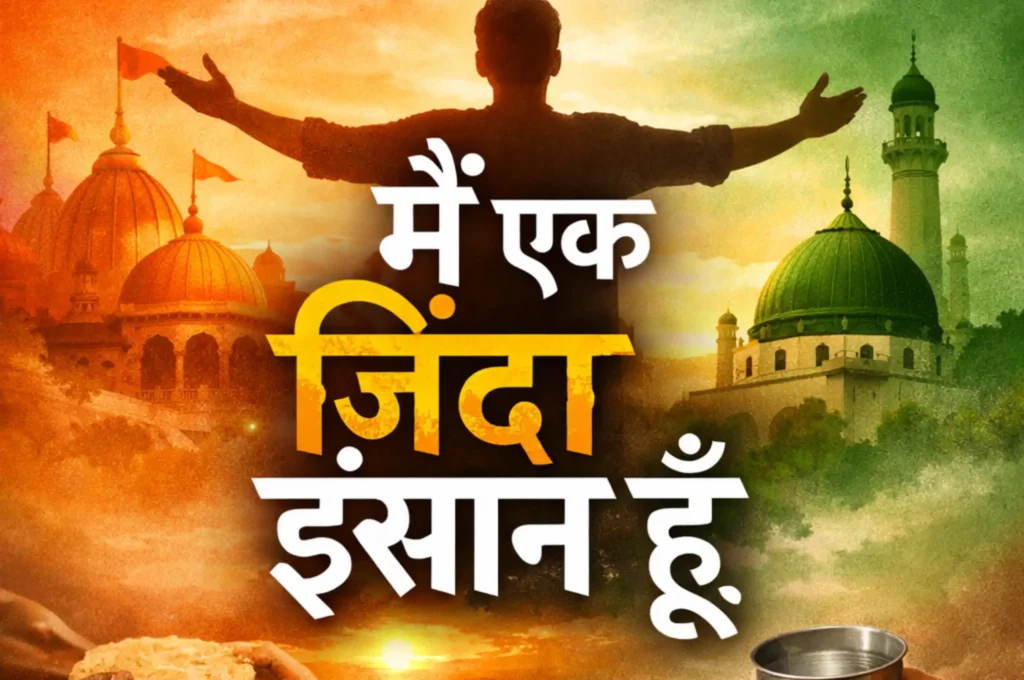
Before Any Religion, I Am a Living Human Being is not written in opposition to faith, nor does it seek to diminish religious belief. Instead, it questions the habit of placing religious identity above human existence.
In a time when identity is often reduced to labels, and belief is frequently used as a dividing line rather than a bridge, this poem emerges as a quiet but firm assertion of humanity. Through simple, direct imagery drawn from everyday life—breath, hunger, thirst, and emotion—the poem asks the reader to reconsider what truly defines us. It invites reflection on a fundamental truth that is easy to forget in polarized times: before we belong to any religion, ideology, or color, we exist first and foremost as living human beings, bound by the same needs, vulnerabilities, and capacity for compassion.
Read in Hindi: मैं एक ज़िंदा इंसान हूँ।
Explore More: Poetry That Speaks to the Heart
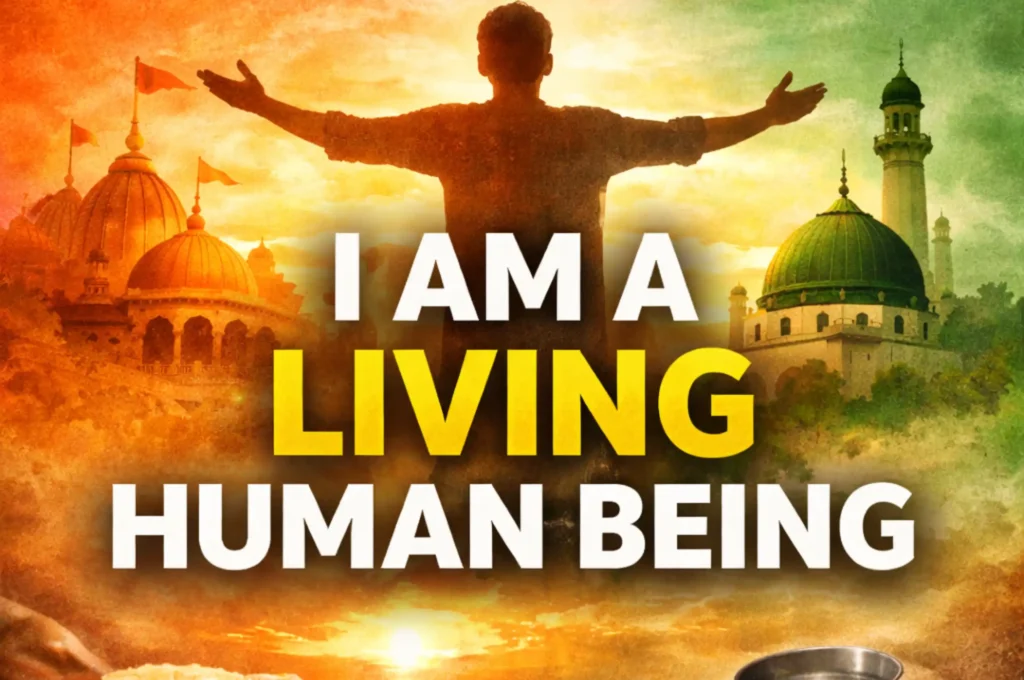
I am a Living Human Being
I am a Living Human Being – Hindi Poem
मंदिर का हनुमान चालीसा,
मस्जिद की अज़ान हूँ।
ना हिंदू, ना मुस्लिम हूँ
मैं एक ज़िंदा इंसान हूँ।मैं धर्म से पहले एक साँस हूँ
प्यार, अमन, मुहब्बत का अरमान हूँ
ना हिंदू, ना मुसलमान हूँ
मैं एक ज़िंदा इंसान हूँअगर रोश मेरी बातों पे आ जाए
अगर आहत तुम्हाती भावना हो जाए
जो काटना चाहो एक ही वार में काट देना
मत्त सवाल करना, मत्त पूछना
के हिंदू हूँ, के मुसलमान हूँ
मैं एक ज़िंदा इंसान हूँभूख लगे तो भगवा खाकर,
पेट नहीं भर पाऊँगा
गले की प्यास मैं हरे रंग से,
भी तो नहीं बुझा पाऊँगाफिर रंग पे कैसे धर्म टिका है,
~ Nitesh Sinha
इस बात से हैरान हूँ
ना मैं हिंदू, ना मुसलमान हूँ
मैं एक ज़िंदा इंसान हूँ
I am a Living Human Being – English Version
I am the Hanuman Chalisa of a temple,
I am the call to prayer from a mosque.
I am neither Hindu nor Muslim—
I am a living human being.Before religion, I am a breath,
An aspiration of love, peace, and compassion.
I am neither Hindu nor Muslim—
I am a living human being.If anger rises at my words,
If your sentiments feel hurt,
Then strike me once, strike me fully—
But do not question me, do not ask
Whether I am Hindu or Muslim.
I am a living human being.If I am hungry, saffron cannot feed me,
My stomach will not be filled by a color.
If I am thirsty, green cannot quench it either,
No color can ease that thirst.Then how can religion stand upon colors?
~ Nitesh Sinha (ThePoemStory)
This question leaves me unsettled.
I am neither Hindu nor Muslim—
I am a living human being.
Understanding the Poem – I am a Living Human Being
Before Any Religion, I Am a Living Human Being is a reflective poem that places humanity at the center of identity, questioning the tendency to define individuals primarily through religious labels. Rather than rejecting religion, the poem challenges the way religion is often used to categorize, judge, and divide people, sometimes at the cost of empathy and understanding.
The opening lines establish balance and inclusivity by referencing both the Hanuman Chalisa and the Islamic call to prayer. These symbols are not presented in opposition but in harmony, suggesting that different faiths can coexist without conflict. By aligning both within a single voice, the poem emphasizes that spiritual expressions may differ, but the human experience beneath them remains the same.
A central idea of the poem is the prioritization of life over ideology. The speaker describes themselves as “a breath” before being a follower of any religion. Breath is universal and instinctive—it does not require belief, permission, or identity. Through this metaphor, the poem reminds the reader that existence itself precedes doctrine. Love, peace, and compassion are portrayed as natural human aspirations, not religious possessions.
The poem then confronts emotional resistance. It acknowledges that such thoughts may provoke anger or discomfort, especially in environments where religious identity is tightly guarded. By stating “do not ask whether I am Hindu or Muslim,” the speaker exposes a painful social reality: that empathy is often conditional, offered only after identity is confirmed. The poem rejects this condition outright, insisting that suffering does not need religious justification.
One of the strongest sections uses hunger and thirst as metaphors. The poet points out that colors associated with religion cannot satisfy basic human needs. Food and water, not symbols, sustain life. This imagery strips ideology of abstraction and grounds the discussion in physical reality. It highlights the emptiness of arguments that elevate symbols above survival and dignity.
The concluding lines return to the core question: how can religion be built on colors or external markers when human needs are universal? The poem does not provide a confrontational answer; instead, it leaves the reader with discomfort and introspection. Its repetition of “I am a living human being” functions as both declaration and reminder.
Ultimately, the poem calls for a reordering of values. Faith is not dismissed, but it is placed after humanity, not above it. The poem urges readers to see people first as human beings—with shared needs, emotions, and vulnerabilities—before assigning them identities. In doing so, it advocates for compassion, coexistence, and a more humane way of understanding one another in a divided world.
Conclusion
Before Any Religion, I Am a Living Being concludes not with a demand for agreement, but with a call for awareness. The poem leaves the reader with a simple yet profound realization: identity should never overshadow humanity. By repeatedly returning to the assertion of being a living human being, the poem reinforces the idea that life itself is the most fundamental truth—one that exists before belief, tradition, or symbolism.
The poem does not argue against faith, nor does it seek to replace it. Instead, it asks for balance. It reminds us that religion finds its highest purpose when it nurtures compassion, not division; when it recognizes human suffering without conditions. Hunger, thirst, fear, and love do not belong to any one community—they belong to all.
In the end, the poem serves as a mirror rather than a verdict. It invites readers to examine their own responses, their own priorities, and the order in which they place identity and empathy. If it unsettles, it does so gently, urging reflection rather than confrontation. Its final message is clear and timeless: before any name, color, or creed, we are—above all else—living human beings.
Get the ThePoemStory App — Read Poems Anywhere