Palanquin Bearers by Sarojini Naidu is one of the most musical and graceful poems. It presents a simple moment—the carrying of a bride in a palanquin—but transforms it into a gentle celebration of movement, beauty, and emotion. The bearers speak in a soft, rhythmic voice, turning their physical labor into a lyrical act of devotion. Instead of describing the bride directly, the poem surrounds her with images of wind, flowers, birds, stars, and tears, creating an atmosphere of tenderness and reverence. Through this delicate imagery, Sarojini Naidu captures both the joy of a wedding and the quiet emotional depth that accompanies such a life-changing transition.
“This poem by Sarojini Naidu is one of her well-known lyrical works.”
Read more Poems by Sarojini Naidu / Explore Poetry Section of ThePoemStory
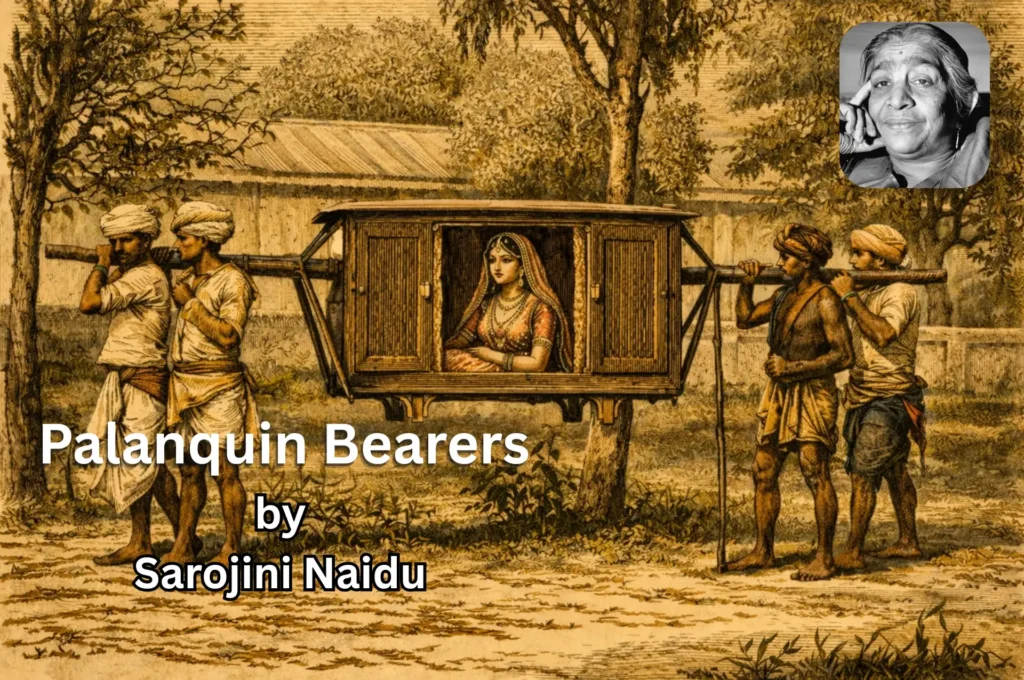
Palanquin Bearers by Sarojini Naidu
Palanquin Bearers Poems by Sarojini Naidu
Lightly, O lightly we bear her along,
~ Palanquin Bearers by Sarojini Naidu (Public Domain)
She sways like a flower in the wind of our song.
She skims like a bird on the foam of a stream,
She floats like a laugh from the lips of a dream.
Gaily, O gaily we glide and we sing,
We bear her along like a pearl on a string.
Softly, O softly we bear her along,
She hangs like a star in the dew of our song;
She springs like a beam on the brow of the tide,
She falls like a tear from the eyes of a bride.
Lightly, O lightly we glide and we sing,
We bear her along like a pearl on a string.
Summary of Palanquin Bearers and Reflection
In Palanquin Bearers, the speakers of the poem are not kings, priests, or members of a royal household. They are ordinary working men whose daily life is shaped by physical labour, obedience, and social distance from privilege. The palanquin bearers belong to the invisible working world that supports ceremonies, traditions, and comfort for others, while remaining unnoticed themselves. Yet, in this poem, their voices are given beauty, rhythm, and emotional depth.
The lady in the palanquin is a bride. She is being carried toward her new home, her new family, and an unfamiliar future. Although she remains unseen and unnamed, her presence becomes the emotional centre of the poem. She represents both celebration and quiet loss — the joy of marriage and the silent sorrow of leaving one life behind. The bearers sense this emotional fragility, even though their role is only to carry her physically.
What is striking is that the bearers do not describe their own fatigue, hardship, or social position. Instead, they focus entirely on the grace of the woman they carry. They move “lightly” and “softly,” not because their work is easy, but because they choose to honour the moment. Their comparisons — to flowers, birds, stars, laughter, and tears — show a gentle sensitivity that contradicts the roughness usually associated with manual labour. Through their language, they transform an exhausting task into an act of quiet reverence.
The repeated line, “We bear her along like a pearl on a string,” becomes deeply symbolic when viewed through the life of the bearers. A pearl is precious, but it does not belong to them. They are entrusted with its safety for a brief moment and must pass it on without claim. In the same way, the bride passes through their hands only for a short distance, yet they treat her with care, dignity, and almost devotional attention.
The lady in the palanquin, therefore, is not only a bride. She becomes a symbol of fragile transitions in human life — moments when a person is suspended between what they were and what they are about to become. The bearers stand at the edge of this transformation. Though they remain socially distant from her world, they are emotionally present in this intimate passage.
Sarojini Naidu subtly reveals a quiet truth through their voices: even those who carry the weight of society on their shoulders — the workers who remain unseen — possess tenderness, imagination, and emotional intelligence. The poem gently reminds us that dignity does not belong only to those being celebrated. It also belongs to those who carry others through their most delicate moments.
Critical Analysis of Palanquin Bearers by Sarojini Naidu
The poem is built around gentle, flowing images of movement. The bride is never described directly. Instead, she is compared to flowers, birds, stars and even tears. These images make her presence feel light, delicate and almost unreal. The repeated references to floating, swaying and gliding remove the physical weight of the palanquin and replace it with emotional and symbolic weightlessness. The moment becomes ceremonial rather than practical.
The voices of the palanquin bearers operate on two levels. On the surface, they are simply workers singing as they carry the bride. Symbolically, however, they represent how human labour can become graceful and meaningful when it is connected to shared emotion and ritual. Their song transforms physical effort into collective beauty.
Gender and labor
A quiet contrast runs through the poem between movement and silence. The bearers sing, glide and act. The woman inside the palanquin remains unseen and voiceless. She becomes the emotional centre of the poem without ever speaking. This reflects the social reality of the early twentieth century, where women—especially brides—were often placed at the heart of ceremony while remaining passive participants in it.
At the same time, the male labourers treat her with deep care and reverence. Their respectful language gently elevates a silent female presence, even while reinforcing the traditional division between active male workers and a passive bride.
Musicality and rhythm
The poem’s rhythm is carefully shaped to echo the motion of the palanquin itself. The recurring sounds, soft stresses, and repeated words such as “lightly” and “gaily” imitate the steady rocking movement of the carriers. The refrain, “We bear her along like a pearl on a string,” works as both musical anchor and emotional centre.
The structure makes the poem feel closer to a song than to a narrative. The experience of movement matters more than any destination.
Cultural context
Written during British colonial rule, the poem presents a traditional Indian wedding scene without explaining it to an outsider’s gaze. In much colonial literature, Indian rituals were often described as exotic spectacles. Sarojini Naidu avoids that tone entirely. She presents the scene from within the rhythm of everyday ceremonial life.
This quiet choice becomes a subtle form of cultural affirmation. The beauty of the moment stands on its own, without needing interpretation or justification.
Place in Sarojini Naidu’s work
This poem belongs to Sarojini Naidu’s early lyrical phase, where her writing focuses strongly on sound, sensation and imagery rather than political struggle. Unlike her later poems that speak more openly about nationalism and freedom, Palanquin Bearers remains inward-looking and sensory.
It shows her distinctive method of using Western poetic forms while filling them with Indian settings, customs and emotional rhythms.
A modern reading
Although the poem predates literary modernism, its focus on repeated impressions rather than storyline gives it a quietly modern quality. There is no clear progression of events. Instead, the reader is invited to experience the same movement again and again through slightly shifting images.
The poem becomes an emotional loop rather than a linear journey.
A less-discussed perspective of Palanquin Bearers Poems
Most readings focus on the bride as the central figure. Yet the poem is actually shaped more by the bearers than by the woman they carry. The rhythm, voice and emotional tone belong to them. Their collective labour, coordination and sensitivity drive the poem forward.
In this sense, the poem gently shifts attention away from spectacle and toward the unseen human effort that makes ceremonial beauty possible. The bride may be the object of reverence, but it is the bearers shared rhythm and emotional investment that create the poem’s living heartbeat.

Get the ThePoemStory App — Read Poems Anywhere