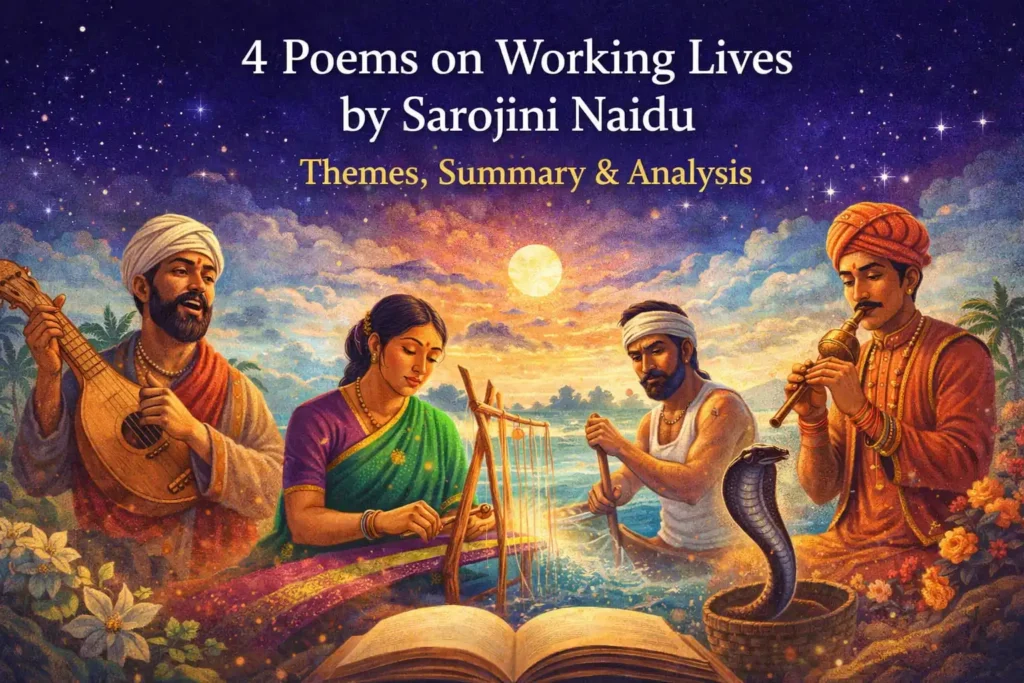
4 Poems on Working Lives by Sarojini Naidu explore the dignity, struggle, rhythm, and beauty of ordinary professions in India. In these poems, Sarojini Naidu gives voice to wandering singers, humble weavers, fearless fishers, and traditional snake-charmers — transforming overlooked labor into lyrical art.
What if poetry did not belong to kings and palaces — but to fishermen, weavers, and wandering singers?
In these 4 Poems on Working Lives by Sarojini Naidu, ordinary labor becomes lyrical, musical, and deeply human.
Sarojini Naidu (1879–1949), famously known as The Nightingale of India, was not only a poet but also a freedom fighter and orator. Her poetry stands out for its lyrical music, vivid Indian imagery, and deep empathy for ordinary people.
While many poets of her time wrote about romance or nationalism alone, Naidu turned her gaze toward the overlooked — artisans, fishermen, performers, laborers. She wrote about people whose work was “low to earth,” physically demanding, and often unrewarded — yet essential to society.
In our last post, we explored Palanquin Bearers Poem by Sarojini Naidu, where she gave dignity and rhythm to the men who carried brides in palanquins. After revisiting that poem and reflecting on her work, I felt compelled to create this post — one that brings together four more poems in which Naidu celebrates working lives often ignored by history.
These poems appear in her early collection, The Golden Threshold, and together they form a tribute to India’s traditional occupations.
4 Poems on Working Lives by Sarojini Naidu
1. Wandering Singers by Sarojini Naidu
Where the voice of the wind calls our wandering feet,
~ Wandering Singers by Sarojini Naidu (Public Domain)
Through echoing forest and echoing street,
With lutes in our hands ever-singing we roam,
All men are our kindred, the world is our home.
Our lays are of cities whose lustre is shed,
The laughter and beauty of women long dead;
The sword of old battles, the crown of old kings,
And happy and simple and sorrowful things.
What hope shall we gather, what dreams shall we sow?
Where the wind calls our wandering footsteps we go.
No love bids us tarry, no joy bids us wait:
The voice of the wind is the voice of our fate.
Summary of the poem “Wandering Singers”
In Wandering Singers, Sarojini Naidu paints a lyrical picture of travelling minstrels who move freely from forests to cities, carrying their lutes and their songs wherever the wind takes them. They do not belong to any one place, nor are they tied down by possessions or relationships. For them, the entire world is home.
“All men are our kindred, the world is our home.”
This line captures the heart of the poem. The singers see no boundaries — no divisions of caste, class, or country. Everyone they meet is family. Their life is built not on property or permanence, but on connection and movement.
They wander through echoing streets and silent forests, singing of things that outlive time — the glory of lost cities, the bravery of ancient battles, the crowns of forgotten kings, and the laughter and beauty of women long dead. Through their songs, the past remains alive. They are not merely entertainers; they are carriers of memory and history.
Yet beneath this romantic freedom lies a quiet loneliness. They confess that no love asks them to stay and no joy persuades them to wait. Their footsteps follow only one command — “the voice of the wind.” This wind becomes a powerful symbol of fate. It represents destiny, calling them forward without explanation or promise.
There is both beauty and sadness in their existence. They are free from attachment, but also free from belonging. They possess the world, yet own nothing. Their life is uncertain, unpredictable, and untethered — and still, they embrace it fully.
Through this poem, Naidu celebrates the spirit of artistic freedom while gently reminding us of its cost. The wandering singers live lightly upon the earth, guided by music and destiny, turning every road into a stage and every stranger into kin.
Deep Reflection on Wandering Singers poem
At first glance, the wandering singers seem carefree. But beneath that freedom lies sacrifice.
They have:
- No permanent shelter
- No emotional anchoring
- No social security
Their life is uncertain, dependent on the generosity of strangers. Yet, Naidu does not present them as pitiful. Instead, she elevates them as custodians of memory.
They preserve stories. They carry culture. They move like the wind — belonging everywhere and nowhere.
In today’s world, we might compare them to freelance artists or street musicians — individuals who choose passion over stability. Naidu subtly asks: Is freedom worth the price of rootlessness?
The poem celebrates artistic labor — often romanticized, yet rarely secure.
📌 Love this poem? Save it for later on Pinterest.
2. Indian Weavers by Sarojini Naidu
Weavers, weaving at break of day,
~ Indian Weavers by Sarojini Naidu (Public Domain)
Why do you weave a garment so gay? . . .
Blue as the wing of a halcyon wild,
We weave the robes of a new-born child.
Weavers, weaving at fall of night,
Why do you weave a garment so bright? . . .
Like the plumes of a peacock, purple and green,
We weave the marriage-veils of a queen.
Weavers, weaving solemn and still,
What do you weave in the moonlight chill? . . .
White as a feather and white as a cloud,
We weave a dead man’s funeral shroud.
Summary of the poem: Indian Weavers
Indian Weavers is a short yet deeply symbolic poem in which Sarojini Naidu presents the entire journey of human life through the simple, rhythmic work of village weavers. The poem unfolds across three moments of the day — morning, evening, and night — each corresponding to a significant stage in life.
In the morning, the weavers are asked why they are weaving a garment so bright and blue. They reply that it is for a newborn child. The blue color, “as the wing of a halcyon wild,” suggests freshness, hope, innocence, and the promise of a new beginning. Morning itself symbolizes birth — a fresh start filled with possibility.
In the evening, they weave a garment “bright as the plumes of a peacock, purple and green.” This is the marriage veil of a queen. Evening represents youth and celebration — the prime of life when love, beauty, and union take center stage. The rich colors reflect joy, passion, and grandeur.
Finally, in the stillness of night, the weavers create a garment “white as a feather and white as a cloud.” This is a funeral shroud. Night symbolizes the end of life — calm, quiet, and solemn. The white cloth suggests purity, peace, and the gentle return to silence.
Through these three scenes, Naidu beautifully connects the humble craft of weaving with the universal cycle of human existence — birth, marriage, and death. The weavers stand as silent witnesses to life’s most profound moments. They do not speak of their own struggles; instead, their work quietly marks the milestones of others.
The poem reminds us that ordinary labor often carries extraordinary meaning. With simple language and musical rhythm, Naidu transforms a daily occupation into a powerful reflection on the journey of life itself.
Deep Reflection on Indian Weavers Poem
The weavers do not speak about their own lives. They speak only of what they create for others.
Their work marks:
- The beginning of life
- The union of love
- The silence of death
They are present at every major milestone — yet remain invisible.
The colors carry symbolic weight:
- Blue → Innocence and new beginnings
- Purple & Green → Celebration and royalty
- White → Final peace
Naidu transforms weaving into something sacred. The loom becomes a metaphor for fate itself. Just as threads are woven into cloth, human lives are woven into time.
The weavers represent labor that sustains society quietly. No applause. No recognition. Yet without them, rituals would be incomplete.
📌 Love this poem? Save it for later on Pinterest.
3. Coromandel Fishers by Sarojini Naidu
Rise, brothers, rise, the wakening skies pray
~ Coromandel Fishers by Sarojini Naidu (Public Domain)
to the morning light,
The wind lies asleep in the arms of the dawn
like a child that has cried all night.
Come, let us gather our nets from the shore,
and set our catamarans free,
To capture the leaping wealth of the tide, for
we are the sons of the sea.
No longer delay, let us hasten away in the
track of the sea-gull’s call,
The sea is our mother, the cloud is our brother,
the waves are our comrades all.
What though we toss at the fall of the sun
where the hand of the sea-god drives?
He who holds the storm by the hair, will hide
in his breast our lives.
Sweet is the shade of the cocoanut glade, and
the scent of the mango grove,
And sweet are the sands at the full o’ the
moon with the sound of the voices we love.
But sweeter, O brothers, the kiss of the spray
and the dance of the wild foam’s glee:
Row, brothers, row to the blue of the verge,
where the low sky mates with the sea.
Summary of the poem: Coromandel Fishers
In Coromandel Fishers, Sarojini Naidu gives us a stirring and energetic call to the fishermen of the Coromandel Coast, urging them to rise at dawn and set out to sea. The poem begins with a sense of awakening — the sky is brightening, the wind is calm, and it is time for the fishermen to gather their nets and push their boats into the vast waters.
“The sea is our mother, the cloud is our brother.”
With this powerful line, the fishermen express their deep bond with nature. The sea is not something to be feared or conquered; it is a nurturing presence that feeds and sustains them. The clouds, winds, and waves are companions in their daily struggle. Nature is not separate from their lives — it is their family.
Even though the sea can be unpredictable and dangerous, the fishermen do not hesitate. They understand that storms may rise and waves may toss their boats, but they trust in a higher power that “holds the storm by the hair.” Their faith gives them courage. Risk is not an obstacle — it is part of their calling.
The poem also contrasts the comfort of land with the thrill of the sea. The shade of coconut groves and the sweetness of loved ones’ voices are pleasant, but the fishermen find even greater joy in the “kiss of the spray” and the wild dance of the waves. The sea, with all its danger, gives them purpose.
Through this poem, Naidu celebrates the bravery, unity, and resilience of the fishermen. Their life is shaped by discipline, brotherhood, and faith. Coromandel Fishers becomes more than a description of a profession — it is a tribute to those who face uncertainty every day with hope and determination.
Deep Reflection on Coromandel Fishers poem
Fishing is not just a job — it is risk.
Every journey to the sea carries uncertainty. The line “He who holds the storm by the hair” suggests faith in divine protection.
The fishermen live between:
- Beauty and danger
- Nourishment and destruction
- Hope and fear
Naidu glorifies their courage without romanticizing hardship. She shows their brotherhood — rowing together, trusting one another.
In modern terms, these are frontline workers of nature. Their livelihood depends entirely on forces beyond control.
The poem celebrates resilience — the willingness to face danger for survival.
📌 Love this poem? Save it for later on Pinterest.
4. The Snake-Charmer by Sarojini Naidu
Whither dost thou hide from the magic of my flute-call?
~ The Snake-Charmer by Sarojini Naidu (Public Domain)
In what moonlight-tangled meshes of perfume,
Where the clustering keovas guard the squirrel’s slumber,
Where the deep woods glimmer with the jasmine’s bloom?
I’ll feed thee, O beloved, on milk and wild red honey,
I’ll bear thee in a basket of rushes, green and white,
To a palace-bower where golden-vested maidens
Thread with mellow laughter the petals of delight.
Whither dost thou loiter, by what murmuring hollows,
Where oleanders scatter their ambrosial fire?
Come, thou subtle bride of my mellifluous wooing,
Come, thou silver-breasted moonbeam of desire!
Summary of the poem: The Snake-Charmer
In The Snake-Charmer, Sarojini Naidu presents a vivid and musical scene in which a snake-charmer calls out to a hidden snake through the enchanting notes of his flute. The poem unfolds like a gentle song of persuasion. The charmer does not command or threaten the snake; instead, he woos it tenderly, almost like a lover calling to his beloved.
He asks where the snake hides — in moonlit forests, among fragrant flowers, beneath the jasmine-scented trees. The imagery is rich and sensuous, filled with perfume, moonlight, and soft natural beauty. Nature becomes the setting for this delicate exchange between man and serpent.
To draw the snake out, the charmer offers tempting promises — milk, wild red honey, and a basket of green rushes. He even imagines carrying it to a palace where golden-vested maidens laugh and scatter petals. These promises are not just physical offerings; they reflect his artistry and imagination. He treats the snake not as a creature to be controlled, but as a graceful and desired companion.
The snake itself is described like a bride — “silver-breasted,” mysterious, subtle, and alluring. By comparing it to a beloved woman, Naidu transforms the dangerous act of snake-charming into a poetic ritual of courtship. The relationship between the charmer and the snake becomes one of harmony, music, and mutual attraction rather than fear.
Through this poem, Naidu highlights a traditional Indian occupation that blends art, performance, and risk. The snake-charmer’s work demands skill and courage, yet the poem focuses more on its lyrical and mystical beauty. The Snake-Charmer becomes a celebration of music’s power — the ability of melody to soften danger and turn even a fearful creature into a figure of elegance and wonder.
Deep Reflection on The Snake-Charmer poem
The snake-charmer’s work combines:
- Art
- Performance
- Risk
Handling a snake requires skill and courage. Yet Naidu transforms this act into something almost romantic.
The snake is not described as a threat — but as beauty. The charmer is not merely a performer — but a poet of persuasion.
This poem highlights occupations often labeled as “exotic” or marginal. Snake-charmers historically belonged to communities surviving on entertainment and tradition. Their art was passed down through generations, yet socially undervalued.
Naidu dignifies this work by filling it with imagery, music, and tenderness.
Common Themes Across the Four Poems
When we read these four poems together — Wandering Singers, Indian Weavers, Coromandel Fishers, and The Snake-Charmer — we begin to notice a deeper unity beneath their different professions. Though the characters belong to different worlds, they are connected by powerful shared themes.
1. Dignity in Unrewarded Labor
Each poem focuses on people whose work is often overlooked. Wandering singers have no fixed home. Weavers quietly create garments for life’s greatest moments. Fishermen risk their lives daily. Snake-charmers survive on performance and uncertainty.
These are not royal courts or wealthy merchants. These are ground-level workers — ordinary people engaged in physical, demanding, and often underappreciated labor. Yet Sarojini Naidu does not portray them as insignificant. She elevates them with lyrical language and respect.
Their work may not bring fame or fortune, but it brings meaning. The poems remind us that dignity does not depend on recognition — it lies in commitment to one’s craft.
2. Harmony with Nature
Nature is not a background setting in these poems; it is a living presence.
- The wandering singers follow the voice of the wind.
- The fishermen call the sea their mother.
- The snake-charmer performs under moonlight and fragrant flowers.
- Even the weavers’ work follows the rhythm of morning, evening, and night.
Nature shapes their schedules, their emotions, and their survival. These workers are not separated from the environment — they are woven into it. Their lives move with natural cycles, not mechanical clocks.
Naidu suggests a world where human labor and nature exist in balance — a harmony that feels increasingly rare today.
3. Music as Survival
All four poems are deeply musical. The rhythm of the verses mirrors the rhythm of work.
The wandering singers literally survive through song.
The snake-charmer uses music to enchant.
The fishermen’s call to row sounds like a chant.
Even the repetitive questioning in Indian Weavers echoes the steady movement of the loom.
Music becomes more than art — it becomes livelihood, strength, and identity. It keeps spirits alive through hardship. It transforms physical labor into something almost sacred.
In Naidu’s world, work itself becomes a song.
4. The Cycle of Fate
A quiet sense of destiny flows through all four poems.
- The wandering singers follow the wind — their fate.
- The weavers move through birth, marriage, and death.
- The fishermen trust the power that “holds the storm.”
- The snake-charmer waits patiently for the hidden serpent to respond.
From dawn to dusk, from cradle to grave, life moves in cycles. These workers accept that cycle. They do not rebel against fate; they work within it.
Naidu’s poetry suggests that human life is like weaving or rowing — we move forward thread by thread, wave by wave, guided by forces greater than ourselves.
Final Reflection on 4 Poems on Working Lives by Sarojini Naidu
When we read these four poems together, a powerful truth quietly unfolds:
Sarojini Naidu was not merely a poet of beauty or royalty — she was a poet of workers.
She chose to write about those who stand at the margins of celebration but at the center of survival.
She wrote about those:
- Who carry stories from village to village
- Who weave the fabric of human life
- Who row into uncertain waters at dawn
- Who charm danger with the music of a flute
These are not glamorous professions. They do not command wealth, titles, or applause. They are grounded, physical, uncertain — and often unrewarded. Yet in Naidu’s hands, they become luminous.
The wandering singers remind us that freedom comes with sacrifice.
The weavers show us that ordinary hands shape life’s most sacred moments.
The fishermen embody courage in the face of uncontrollable forces.
The snake-charmer reveals the fragile dance between art and danger.
In a world that measures success by status, visibility, and power, these poems gently challenge us. They suggest that true dignity lies elsewhere — in devotion to one’s craft, in resilience against hardship, and in the quiet pride of meaningful work.
Naidu does not romanticize struggle, but she dignifies it. She gives rhythm to labor and poetry to perseverance.
And perhaps that is why her work continues to resonate. It does not sing of authority or dominance. It sings of humanity.
In celebrating workers, Sarojini Naidu quietly redefined heroism — not as power, but as perseverance.

Get the ThePoemStory App — Read Poems Anywhere