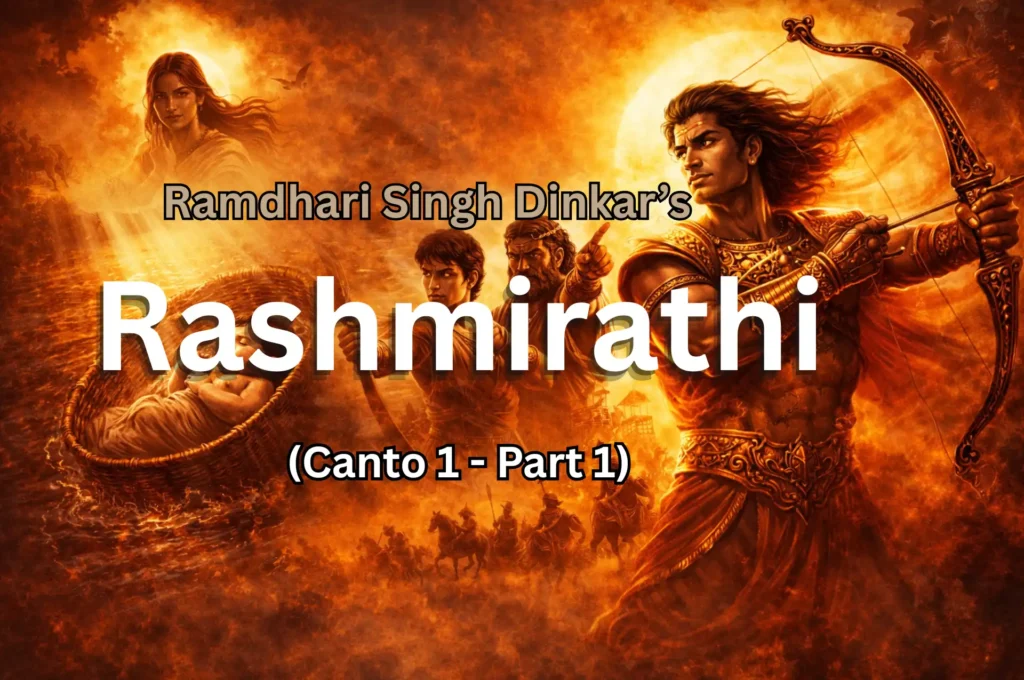
Rashmirathi Canto 1 Part 1. Introduction and Birth Story of Brave Karna. In this part we will read about how the Karna was born and what happened on his birth.
These are beautiful lines written by Ramdhari Singh Dinkar and with the birth of Karna, he places a satire on the society at the same time. His whole motto is to say that a person of high spirits and high value should not be recognized by his birth to the society he is born. Rather he should be praised for his talent.
Rashmirathi’s First Canto begins with the very first glimpse into Karna’s life, where Dinkar does not merely introduce a character from the Mahabharata, but brings forth the story of a man who becomes a symbol of struggle from the moment he is born. With the powerful invocation of “Jai Ho,” the poet bows to values like radiance, strength, compassion, righteousness, and sacrifice—establishing that greatness is not born from caste or lineage, but from action, character, and courage. On this foundation, Karna enters the narrative: the son of Surya and Kunti’s first-born, abandoned due to social fear, yet raised in a charioteer’s household to become a living example of extraordinary valor, generosity, and self-respect. This canto lays the groundwork for Karna’s birth, abandonment, and luminous personality—preparing the reader to see him not merely as a “warrior,” but as a resilient symbol of human dignity and hidden brilliance.
Rashmirathi Canto 1 Part 1
Lines of Rashmirathi Canto 1 Part 1
‘जय हो, जग में जले जहाँ भी, नमन पुनीत अनल को,
~ Ramdhari Singh Dinkar
जिस नर में भी बसे, हमारा नमन तेज को, बल को।
किसी वृन्त पर खिले विपिन में, पर, नमस्य है फूल,
सुधी खोजते नहीं गुणों का आदि, शक्ति का मूल।
ऊँच-नीच का भेद न माने, वही श्रेष्ठ ज्ञानी है,
दया-धर्म जिसमें हो, सबसे वही पूज्य प्राणी है।
क्षत्रिय वही, भरी हो जिसमें निर्भयता की आग,
सबसे श्रेष्ठ वही ब्राह्मण है, हो जिसमें तप-त्याग।
जिसके पिता सूर्य थे, माता कुन्ती सती कुमारी,
उसका पलना हुई धार पर बहती हुई पिटारी।
सूत-वंश में पला, चखा भी नहीं जननि का क्षीर,
निकला कर्ण सभी युवकों में तब भी अद्भुत वीर।
तन से समरशूर, मन से भावुक, स्वभाव से दानी,
जाति-गोत्र का नहीं, शील का, पौरूष का अभिमानी।
ज्ञान-ध्यान, शस्त्रास्त्र, शास्त्र का कर सम्यक् अभ्यास,
अपने गुण का किया कर्ण ने आप स्वयं सुविकास।
अलग नगर के कोलाहल से, अलग पुरी-पुरजन से,
कठिन साधना में उद्योगी लगा हुआ तन-मन से।
निज समाधि में निरत, सदा निज कर्मठता में चूर,
वन्य कुसुम-सा खिला कर्ण जग की आँखों से दूर।
नहीं फूलते कुसुम मात्र राजाओं के उपवन में,
अमित वार खिलते वे पुर से दूर कुञ्ज-कानन में।
समझे कौन रहस्य? प्रकृति का बड़ा अनोखा हाल,
गुदड़ी में रखती चुन-चुन कर बड़े क़ीमती लाल।
जलद-पटल में छिपा, किन्तु, रवि कबतक रह सकता है?
युग की अवहेलना शूरमा कबतक सह सकता है?
पाकर समय एक दिन आखिर उठी जवानी जाग,
फूट पड़ी सबके समक्ष पौरूष की पहली आग।
English Translation (Rashmirathi – Canto 1 Part 1)
Victory! Wherever in this world a flame may burn,
we bow to that sacred fire.
And in every human heart where brilliance lives,
we salute that radiance, that strength, that power.Even if a flower blooms on some branch deep in a forest,
it is still worthy of reverence.
The wise do not waste time searching for the “origin” of virtue—
they honor excellence and the true source of strength.One who does not believe in high or low is the greatest wise one;
the most worthy of worship is the one who lives with compassion and righteousness.
A true warrior is the one in whom the fire of fearlessness burns,
and the greatest Brahmin is the one who possesses austerity and sacrifice.His father was the Sun, his mother Kunti—pure and unmarried;
his cradle was a basket drifting on the river’s current.
Raised among charioteers, he never tasted his mother’s milk,
yet among all the youths, Karna emerged as a wondrous hero.A warrior in body, tender at heart, and generous by nature,
proud not of caste or lineage, but of character and courage.
Through true discipline—knowledge, meditation, scriptures, and weapons—
Karna shaped his own greatness, nurturing his virtues by himself.Far from the noise of cities, far from palaces and crowds,
he devoted his whole mind and body to hard training.
Absorbed in his own discipline, lost in tireless effort,
Karna bloomed like a wild flower—hidden from the world’s eyes.Flowers do not bloom only in royal gardens;
countless times they bloom in distant groves and forests.
Who can understand nature’s secret? How strange her ways—
in a ragged cloth she hides, carefully chosen, priceless jewels.Hidden behind clouds, how long can the sun remain unseen?
How long can a brave soul endure the neglect of the age?
One day, when time arrives, youth finally awakens—
and before everyone, the first fire of valor bursts forth.
Meaning of Rashmirathi Canto 1 Part 1
Stanza 1, 2, and 3 – Rashmirathi Poem Meaning (Detailed)
In the opening stanzas of Rashmirathi, Ramdhari Singh Dinkar sets the tone for the entire poem by establishing one powerful idea: true greatness is not determined by birth, caste, or social position—it is recognized through inner strength, character, and action. Through symbols like fire and flowers, Dinkar shows that value does not depend on where something comes from, but on what it truly is.
1) Fire is sacred, no matter where it burns
Dinkar begins by paying respect to fire, saying that wherever a flame burns in this world, it deserves reverence. Fire is not worshipped because of its location—it is worshipped because of its nature. Fire represents purity, power, courage, and unstoppable energy.
In the same way, any person who carries the flame of bravery within them deserves respect—no matter who they are, where they come from, or what society labels them. Dinkar is not bowing to a title or identity; he is bowing to valor itself.
This is a reminder that courage is sacred, and strength is worthy of respect wherever it appears.
2) A flower is respected wherever it blooms
After the symbol of fire, Dinkar uses the image of a flower. A flower may bloom on any branch, in any forest, or inside any royal garden. Yet the beauty and worth of the flower remains the same.
The message here is simple and profound: a flower is not valued because it grows in a palace garden—it is valued because it is a flower.
In human terms, this means that a person’s worth does not increase because of their surroundings, family background, or social status. If someone has goodness, talent, or strength, then like the flower, they deserve recognition—even if they come from an ordinary place and remain unnoticed by the world.
3) Wise people don’t chase origins—they honor qualities
Dinkar then takes this thought into society and human judgment. He says that the wise do not waste time searching for the “origin” of greatness or the source of power. They don’t ask unnecessary questions like:
- Which caste does this person belong to?
- Which religion or class were they born into?
- What family name do they carry?
Instead, truly learned people focus on what actually matters:
- character
- courage
- strength
- discipline
- integrity
This is the difference between shallow thinking and true wisdom. A shallow society judges people by their labels, but a wise mind judges people by their qualities and actions.
The one who refuses discrimination is the truly wise
According to Dinkar, the greatest wisdom is not found in knowledge alone—it is found in fairness.
A person who does not believe in “high” and “low,” who does not divide people on the basis of caste or class, is the one who is truly educated and enlightened.
In this way, Rashmirathi becomes more than a poem—it becomes a moral message. Dinkar challenges the reader to rise above social discrimination and see human beings as they truly are.
Real greatness is defined by virtue and fearless spirit
Dinkar goes even deeper and redefines social identities. He suggests that titles like “Kshatriya” and “Brahmin” should not be decided by birth, but by qualities.
- A truly respected person is one who has kindness in the heart and the power to sacrifice for what is right.
- A true fighter (Kshatriya) is one who carries fearlessness within, who does not break in difficult situations.
- The greatest Brahmin is not someone born into a certain family, but someone who possesses discipline, penance, and sacrifice.
This is a powerful shift. Dinkar is telling the world that character is higher than caste, and virtue is greater than ancestry.
Respect is earned by action, not by announcing lineage
Dinkar also reminds us that truly magnificent people do not earn honor by showing off their family background. They don’t need to declare their clan, religion, caste, or social category to demand respect.
Instead, they earn admiration through what they do—through their courage, strength, and achievements. True greatness is never proven by words. It is proven by action.
Birth and caste are the lowest measures of a human being
Finally, Dinkar strongly rejects the idea that a person should be judged by their origin. He presents caste and class as the weakest and lowest ways of measuring someone.
The world might call a person right or wrong based on these shallow values, but brave people do not live for society’s approval. Their focus is different. They don’t depend on their background to succeed—they build their identity through their own effort.
That is why history remembers them. Not because of where they came from, but because of what they became.
Stanza 4, 5, 6, 7, and 8 – Rashmirathi Poem Meaning (Karna’s Birth and Childhood)
In these stanzas, Dinkar shifts the poem from universal values to a deeply personal story—the story of Karna’s birth, abandonment, upbringing, and self-made greatness. This part establishes Karna not only as a warrior of the Mahabharata, but as a symbol of struggle, hidden talent, and inner fire. Dinkar’s language suggests that Karna’s greatness was not inherited—it was built through pain, discipline, and courage.
Karna’s birth: divine origin, human rejection
Dinkar introduces Karna as the one whose father was Surya (the Sun God) and whose mother was Kunti, a virtuous and noble woman. Yet, the moment Karna is born, his life begins with a tragedy. Instead of being welcomed, he is abandoned immediately.
His very first cradle is not a palace, not a mother’s arms, but a basket floating on the current of a river. This image is one of the most heartbreaking in the entire epic: a child of divine origin, yet treated as someone who must be erased before society finds out.
Here, Dinkar highlights a painful reality—sometimes the world fears truth more than it respects innocence.
Adopted by a charioteer family: raised without privilege
Karna is then found and adopted by a charioteer family—Adhiratha and Radha. He is nurtured with love, but he grows up without royal privilege, without the identity of a prince, and without even tasting the milk of his biological mother.
Dinkar’s point is not to create sympathy alone. His deeper purpose is to show that Karna’s greatness did not come from a crown or a royal name. It came from life’s harshness, and from his ability to rise above it.
Even though society labeled him as “a charioteer’s son,” Karna grew into one of the most extraordinary warriors of the age. In a world where status decides respect, Karna becomes proof that strength and worth exist even where society refuses to look.
A warrior by body, soft by heart, noble by nature
Dinkar describes Karna as a rare combination of opposites. He is:
- strong and battle-ready by body,
- emotional and sensitive from within,
- and generous by nature.
This is important because it makes Karna human, not mechanical. His bravery is not cold. His strength is not cruel. He carries the heart of a poet inside the armor of a warrior.
Most importantly, Karna is not proud of caste or lineage. He is proud of character and courage.
Even when people mocked him and reminded him that he was “only a charioteer’s son,” he did not collapse under insult. He refused to let society define him.
Karna’s self-made greatness: he became his own teacher
Dinkar then focuses on Karna’s discipline and personal growth. Karna does not simply dream of becoming great—he works for it. He studies deeply and trains relentlessly. He learns:
- knowledge and wisdom,
- meditation and mental discipline,
- scriptures and moral understanding,
- and the use of weapons—archery, sword, mace, and more.
The meaning here is powerful: Karna created himself.
He was not given greatness. He practiced it into existence.
In many ways, Dinkar presents Karna as a symbol of the self-made hero—someone who builds his worth through effort, not inheritance. Karna becomes the example of those people who do not receive opportunities easily, but still refuse to surrender.
Away from the city: solitude, practice, and inner fire
The poem then shows Karna stepping away from crowds and public attention. Instead of seeking praise, he chooses isolation. Away from city noise and royal gatherings, he gives himself entirely to rigorous practice.
This is not ordinary training—it is discipline that demands the whole being. Karna trains with such focus that Dinkar compares him to a wild flower blooming in silence:
He grows far from the world’s eyes, far from celebration, yet he becomes stronger and brighter every day.
This tells us something deep: real growth often happens in silence.
The world sees success when it shines, but it does not see the loneliness and effort that created it.
Nature’s secret: priceless jewels are often hidden
Dinkar then expands the meaning into a broader truth about life. Flowers don’t bloom only in royal gardens. Many bloom in dense forests, unknown to the world. Nature does not announce where it keeps its treasures. Sometimes, it hides priceless jewels in places nobody expects.
This is a direct metaphor for Karna.
The world may think greatness belongs only to palaces and kings, but nature proves otherwise. Karna, raised among charioteers, becomes a “priceless jewel” hidden in what society calls “ordinary.”
Like the sun, Karna cannot remain hidden forever
Finally, Dinkar ends this section with the image of the sun. The sun may hide behind clouds or beyond the horizon for a while, but it cannot remain unseen forever. The same applies to a brave soul—how long can the world ignore real power?
There comes a time when talent rises, regardless of society’s rejection.
Similarly, Karna’s youth awakens. The fire of his manhood and courage bursts forward. The warrior within him comes into the world—not to beg for acceptance, but to prove his worth through action.
This becomes the turning point: Karna is no longer only a boy shaped by abandonment. He is now a force shaped by discipline, strength, and unstoppable inner fire.
Summary of Rashmirathi Canto 1 Part 1
In this part of “Rashmirathi Canto 1 Part 1“, I have included 7 stanzas that introduce the powerful values and ideas with which Ramdhari Singh Dinkar begins this epic poem. These verses strongly convey that a person should be recognized and respected for their qualities, not for their caste, social class, or the clan they are born into. Dinkar makes it clear that true greatness is never inherited—it is earned through character, courage, and action.
The poem also highlights that wise and thoughtful people do not waste their time questioning someone’s background or origin. Instead, they respect what truly matters—qualities such as bravery, valor, courage, sacrifice, discipline, and noble nature. Through symbols like fire and flowers, Dinkar beautifully shows that value remains valuable wherever it exists—whether it appears in a royal garden or in a distant forest.
As the chapter progresses, these stanzas gradually lead us toward Karna’s story. We begin to see the early hints of Karna’s birth and the struggles that shaped him. Even though he was born with a divine origin, he was abandoned at birth and raised away from privilege. Yet, Karna grows into greatness through his own effort. Living in solitude, he practices his skills, studies scriptures, and strengthens his battle abilities with complete dedication. This self-made journey is what makes Karna deeply respected in Dinkar’s vision—not just as a warrior, but as a symbol of dignity, perseverance, and hidden brilliance.
Below, I have provided the links to the parts that are already published. You can read each part to understand the stanza-by-stanza meaning in detail. Since Rashmirathi is a long and deeply layered epic, writing the complete meaning will take time. I hope you enjoy this series, and your comments will motivate me to continue publishing more and more parts consistently.
Thank you for reading!
All Upcoming posts on Rashmirathi Translation into English will be posted in Rashmirathi Series.

Get the ThePoemStory App — Read Poems Anywhere