Silent struggle and emotional pressure are not about dramatic collapse or public triumph.
The Anvil Beneath My Tongue | A Dark Motivational Poem is about the kind of struggle you might be living through right now — the one you carry into meetings, into family dinners, into ordinary conversations while pretending your chest isn’t tight with pressure. It is for the person who nods when asked, “Are you okay?” and answers, “Yeah,” because explaining would take too much energy.
This poem explores silent struggle and emotional pressure as lived realities shaped by discipline, endurance, and quiet strength.
Maybe you know this feeling. The constant demand to perform. The weight of expectations no one sees pressing against your ribs. The discipline it takes to keep going when stopping would be easier. Silent struggle is not glamorous. It does not win applause. But it builds something inside you — something hard, precise, and unbreakable.
This poem stands beside you in that quiet furnace. It understands the exhaustion of holding yourself together. It recognizes the private negotiations you make with doubt. And it speaks to the kind of strength that does not shout.
Explore poetry at ThePoeStory’s – Poetry that speaks to the heart
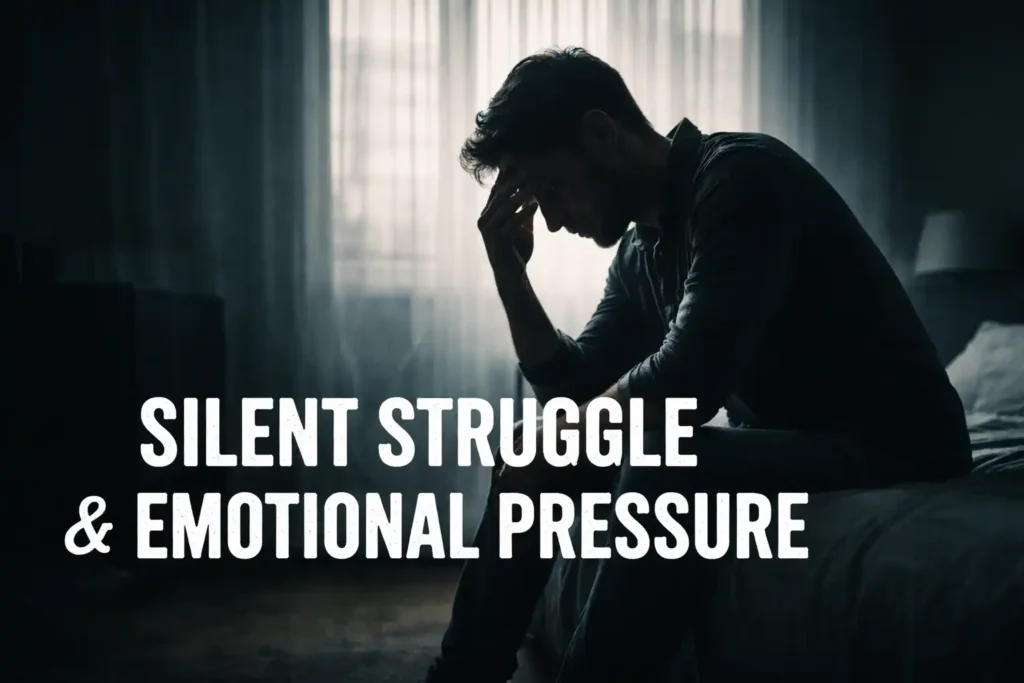
The Anvil Beneath My Tongue | A Dark Motivational Poem About Silent Struggle and Emotional Pressure
I learned to swallow storms without a sound,
~ The Anvil Beneath My Tongue (ThePoemStory)
To let the thunder grind against my teeth,
While expectation pressed me to the ground,
A steady weight that pulsed beneath belief.
No witness saw the fractures in my will,
Yet still I stood — and forced myself be still.
The air grew thick with everything unsaid,
Each doubt a coal I held against my chest,
The words I never spoke lived in my head,
Like iron bars refusing me my rest.
I could have shattered under what I knew,
But discipline is what the silent do.
My pulse became a hammer in the dark,
Relentless in its rhythm, hard and plain,
Each failure left a disciplined new mark,
A measured scar I carried without shame.
Pressure did not ask if I was strong —
It simply stayed, and dared me to belong.
There were no cheers when I refused to break,
No hands that reached to lift the unseen load,
Just quiet vows I tightened for my sake,
And narrower became the path I strode.
Each step was carved from stubborn, aching breath,
A conversation held with doubt and death.
I trained my fear to answer to my name,
To kneel instead of dragging me below,
I fed my weakness discipline, not blame,
And watched it starve where it had used to grow.
The mirror did not show a brighter man —
It showed a will that would not leave its plan.
So let the world applaud the louder fight,
The victories declared in open air —
I know the worth of wrestling at night,
Of forging calm from pressure and despair.
For strength is not the noise that others hear,
But what survives when no one else is near.
Summary of the Poem: The Anvil Beneath My Tongue
This poem explores the hidden dimension of resilience — the internal, disciplined resistance that unfolds without applause. The speaker is not battling a single catastrophic event, but rather the accumulated weight of expectation, doubt, and emotional compression. The struggle is silent not because it is small, but because it is private and chosen.
At the heart of the poem lies pressure. It is depicted not as a sudden force, but as something persistent and grinding — something that settles into the body and refuses to leave. The speaker feels it in the jaw, the breath, the pulse. The imagery of iron, coal, hammer, and anvil reinforces the idea that this pressure is not merely endured; it is used. It becomes a forging tool.
Discipline functions as the central transformation. Instead of exploding under the strain or collapsing into self-pity, the speaker commits to structure and restraint. There is no dramatic triumph. There are no witnesses offering validation. The victory is internal: choosing composure over chaos, choosing endurance over surrender.
An important emotional shift occurs when fear is no longer treated as an enemy to destroy, but as something to train and command. This marks the turning point. The struggle does not disappear, but it changes relationship with the speaker. Weakness is not denied; it is disciplined.
The final movement of the poem reframes strength entirely. It challenges the idea that power must be visible to be real. The loud, celebrated battles may impress others, but the quiet fight — the one waged in isolation — is where true fortitude is born.
Ultimately, the poem affirms that silent struggle is not emptiness. It is construction. It is the long, unseen labor of becoming unshakeable.
If you are interested in how silent struggle and emotional pressure shape emotional resilience, this article explains the psychology behind resilience and coping strategies.
Visit: American Psychological Association Page
(This is the American Psychological Association – very safe, high-quality source.)

Get the ThePoemStory App — Read Poems Anywhere