This was our 3rd day of travel to Gokarna, and we went to Mirjan Fort, Yana Caves and Vibhuti falls. You have already read the previous blog on Trip To Gokarna. After enjoying the seaside and beaches, it was time to go deeper in Karnataka and see these natural Wonders (Vibhuti Falls and Yana Caves). In this post we will talk about Yana Caves explicitly.
You’ve already read about the earlier part of our journey in the previous blog on Trip to Gokarna. This post is different. Here, we slow down and focus on one place alone—Yana.
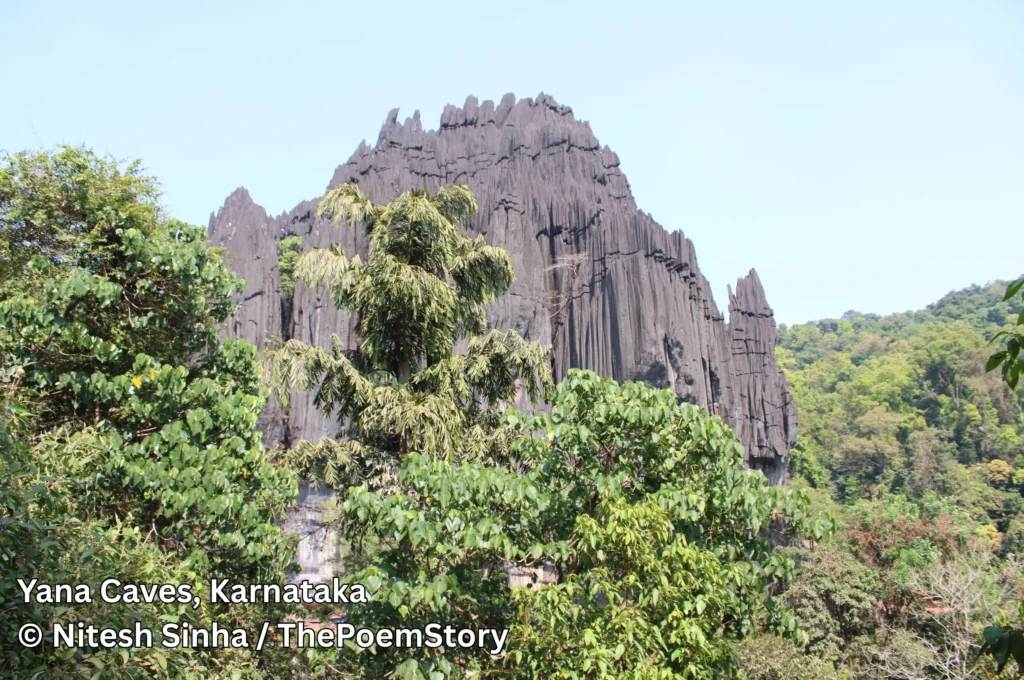
Hidden deep within the dense forests of Karnataka’s Uttara Kannada district, Yana Caves are not “caves” in the conventional sense. There are no long underground tunnels or chambers carved by human hands. Instead, Yana consists of two massive, tower-like black limestone monoliths, rising dramatically from the forest floor, with natural hollows and sacred spaces formed at their base.
What makes Yana truly extraordinary is not just its spiritual significance, but the rare geological process that gave birth to these towering rock formations. Over millions of years, natural erosion, weathering, and mineral composition worked together to sculpt structures that feel both ancient and otherworldly. Standing before them, it’s hard to decide whether you’re witnessing a geological marvel—or something timeless, quietly sacred.
In the sections ahead, we’ll explore how Yana was formed, why it holds deep religious importance, and what it feels like to walk through this forested landscape, where nature and belief seem to coexist effortlessly.
Must Explore the Section: Travel Documents and Tips
Yana Caves of Karnataka
Yana Caves of Karnataka: Location and setting
Yana Caves lie in the foothills of the Western Ghats, one of the most ecologically rich regions in the world. The landscape here is defined by dense evergreen forests, seasonal streams, and laterite-rich soil, giving the entire area a deep reddish-brown base beneath its lush green canopy.
This region receives heavy monsoon rainfall every year, and that rainfall is not just a seasonal event—it is a geological force. Over millions of years, continuous water flow, chemical weathering, and erosion have interacted with limestone deposits beneath the surface. The result is the slow but persistent sculpting of rock, gradually carving out the unusual vertical formations that define Yana today.
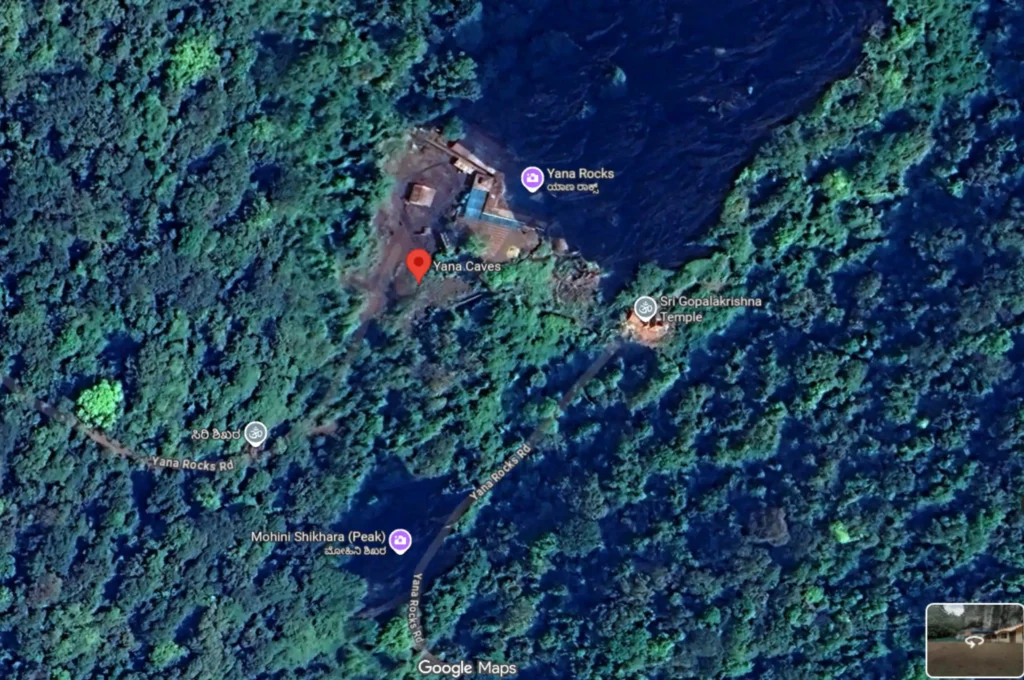
At the heart of the site stand two massive, almost surreal rock towers, dominating the forest clearing:
- Bhairaveshwara Shikhara – the taller and more imposing of the two, associated with Lord Shiva and housing a small temple at its base. Its sheer vertical rise and dark surface give it a commanding, almost intimidating presence.
- Mohini Shikhara – slightly smaller but more graceful in appearance, named after the Mohini avatar of Vishnu. Its curves appear softer, shaped by centuries of water runoff and wind erosion.
Both monoliths rise abruptly from the forest floor, nearly vertical, with minimal tapering—an uncommon feature in limestone formations. Their blackened surfaces, streaked by rainwater and mineral deposits, make them look less like natural rock and more like structures deliberately sculpted by time itself.
Standing beneath these formations, surrounded by forest silence broken only by birds and flowing water, it becomes clear why Yana is viewed as both a geological anomaly and a sacred space. Here, nature does not just create—it preserves, reshapes, and quietly commands reverence.
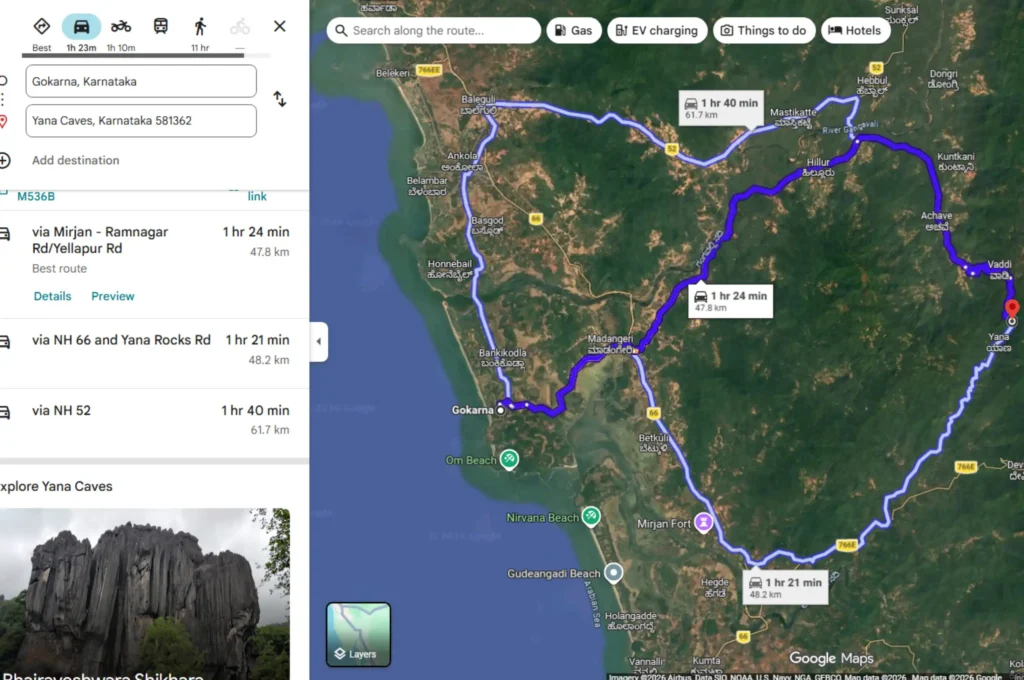
How to Reach Yana Caves
Reaching Yana Caves requires a bit of planning, as the site lies deep within the forests of Uttara Kannada. However, the journey itself is scenic and adds to the overall experience.
By Road
The most convenient way to reach Yana Caves is by road. Local taxi packages are easily available from Gokarna, especially for travelers looking to cover nearby attractions like Vibhuti Falls on the same day.
Since we were staying in Ankola, we hired a local taxi from there. Ankola is well connected by road and serves as a practical base if you’re exploring the inland side of the district rather than just the coast.
Private taxis are preferable, as public transport options are limited and may not take you all the way to the forest entrance.
Final Stretch
From the parking area, visitors must walk a forest trail to reach the caves. The path is well-defined but slightly uneven, so comfortable footwear is recommended. During monsoon and post-monsoon months, the trail can be slippery.
What exactly are the Yana rocks made of?
Unlike most rock outcrops found in the Western Ghats, which are predominantly basaltic and volcanic in origin, the formations at Yana Caves tell a very different geological story.
The towering structures here are composed mainly of hard, crystalline limestone, more specifically dolomitic limestone—a rock type that is extremely rare in Karnataka.
This single fact alone places Yana in a unique geological category.
The dramatic vertical towers seen today are the outcome of a slow, patient, and highly selective process known as karst erosion. To understand how these free-standing monoliths came into existence, it helps to break the process down step by step.
1. Limestone and the Role of Rainwater
Rainwater may appear harmless, but over geological time it becomes a powerful sculpting force. As rain falls, it absorbs carbon dioxide from the atmosphere and soil, turning slightly acidic. When this weakly acidic water flows across limestone surfaces, it reacts chemically with the rock and begins to dissolve it.
This gradual process is known as chemical weathering by solution.
Unlike mechanical erosion, which breaks rock apart physically, chemical weathering works silently and invisibly—slowly removing minerals grain by grain.
2. Vertical Joints Shaped the Towers
The limestone mass at Yana did not originally exist as isolated pillars. It began as a large, continuous block of rock. Over millions of years, natural stresses within the Earth caused cracks and fractures, known in geology as joints, to develop throughout the limestone.
These joints became pathways for rainwater to seep deep into the rock. As acidic water flowed downward along these fractures, dissolution progressed vertically and inward, rather than uniformly across the surface.
Because erosion followed these natural lines of weakness, the rock was not worn away evenly. Instead, steep walls and narrow vertical faces began to emerge—laying the foundation for the dramatic shapes seen today.
3. Survival of the Hardest Rock
Not all limestone is equally resistant. At Yana, variations in mineral composition meant that some portions of the rock were softer and more fractured, while others were harder and more compact.
As karst erosion continued:
- Softer sections dissolved faster
- Harder cores resisted weathering
Over time, the surrounding material disappeared completely, leaving behind only the most resilient sections of the original limestone mass. These resistant cores now stand alone as towering, free-standing monoliths.
This selective removal is why the formations appear almost sculpted—like pillars deliberately carved and left behind.
4. Creation of Cave-Like Hollows at the Base
While vertical erosion shaped the towers, a different process was at work near their base. Rainwater tended to collect, drip, and linger around the lower sections of the rock, increasing contact time with the limestone.
Over long periods, this persistent moisture caused:
- Localized dissolution
- Formation of natural cavities
- Gradual widening of openings
The result was the creation of shallow cave-like chambers and hollows near ground level. These spaces are what give Yana its name as “caves,” though they are not deep tunnel systems like conventional caves. Instead, they are erosional chambers formed entirely by water.
Many of these natural hollows were later adapted into temple spaces, seamlessly blending geology with spiritual practice.
5. Why Do the Rocks Appear Black?
One of the most striking features of Yana is the dark, almost metallic appearance of its rock surfaces. This color often leads to the assumption that the rocks are volcanic—but they are not.
The black coloration is caused by:
- Long-term surface weathering
- Organic staining from forest runoff
- Growth of algae and micro-organisms on constantly moist limestone
These biological and chemical coatings darken the surface over time, giving the monoliths their distinctive black sheen. Beneath this stained exterior lies pale limestone—quiet proof that Yana is shaped by water, not fire.
Yana stands today as a reminder that geological wonders do not need violence or catastrophe to form. Sometimes, all it takes is rain, time, and patience—working together over millions of years.
Why are such tall limestone towers rare in Karnataka?
The towering formations of Yana Caves are rare in Karnataka for a simple but crucial reason: limestone itself is uncommon in this region.
Most of the Western Ghats are dominated by Deccan basalt, a hard volcanic rock formed from ancient lava flows. Basalt behaves very differently from limestone when exposed to rain, wind, and time. Instead of dissolving chemically, basalt primarily undergoes mechanical weathering, breaking down into slopes, steps, and rounded hill forms rather than sharp, vertical structures.
Limestone, on the other hand, is uniquely vulnerable to chemical dissolution. When rainwater becomes weakly acidic, it reacts with limestone and slowly removes it in a highly selective manner—along cracks, joints, and fractures. This process, known as karst erosion, is what allows limestone to form dramatic vertical features such as towers, pinnacles, and caves.
Because large, continuous limestone deposits are scarce in Karnataka, the conditions required to create tall karst towers are almost never met. This makes Yana an exception within the regional geological landscape—a place where the rock type, climate, and time aligned perfectly.
In essence, Yana stands as a geological anomaly: a pocket of karst terrain rising unexpectedly from a landscape otherwise shaped by volcanic forces. It is this contrast that makes the site not only visually striking, but scientifically significant as well.
The Yana Cave shrine and spiritual importance
At the base of Bhairaveshwara Shikhara, within a naturally formed hollow of the rock, lies a simple yet deeply revered shrine dedicated to Lord Shiva. Unlike temples built by human hands, this sacred space feels discovered rather than constructed—shaped by nature and quietly adopted into worship.
Inside the hollow rests a small stone linga, which is worshipped as a manifestation of Shiva. The shrine attracts pilgrims throughout the year, but it becomes especially significant during Maha Shivaratri, when devotees undertake the forest journey to offer prayers, water, and flowers.
What makes this shrine unique is that the rock itself is considered sacred. The towering form of Bhairaveshwara Shikhara is not merely a backdrop to worship; it is part of the worship. For many devotees, the natural shape, immense presence, and ancient silence of the rock embody Shiva more powerfully than any sculpted idol.
This seamless merging of geology and devotion is what gives Yana its spiritual depth. There is no sharp boundary between the natural and the sacred here—only a shared reverence for something older than both belief and explanation.
Standing inside the hollow, surrounded by stone shaped over millions of years, one understands why Yana is not just visited—it is approached with humility.
Yana Caves Photo Gallery – Original Photos
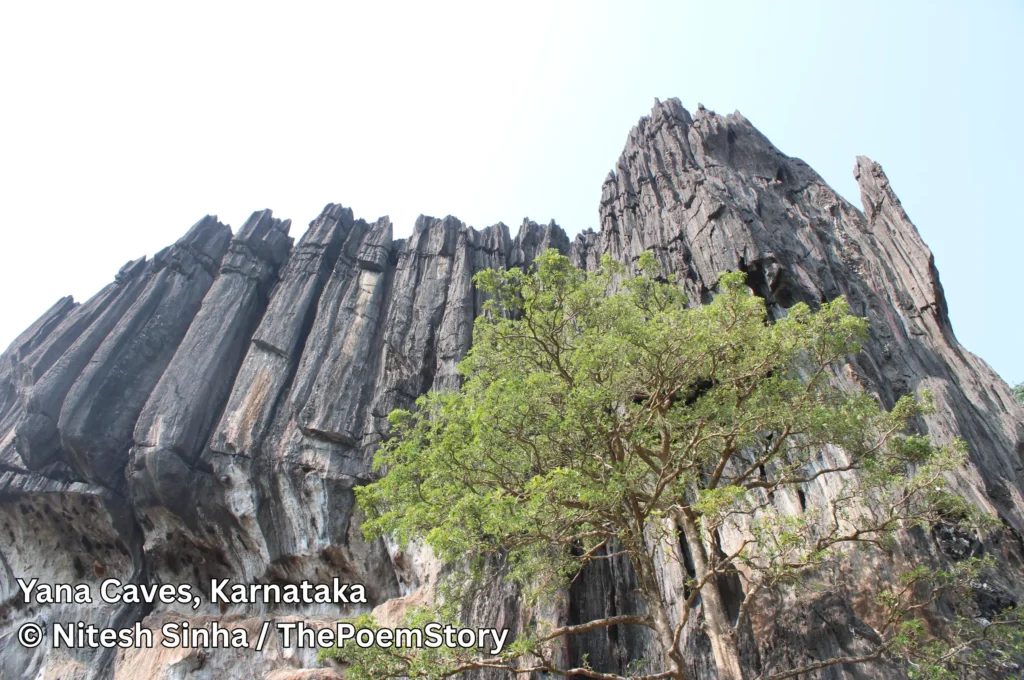
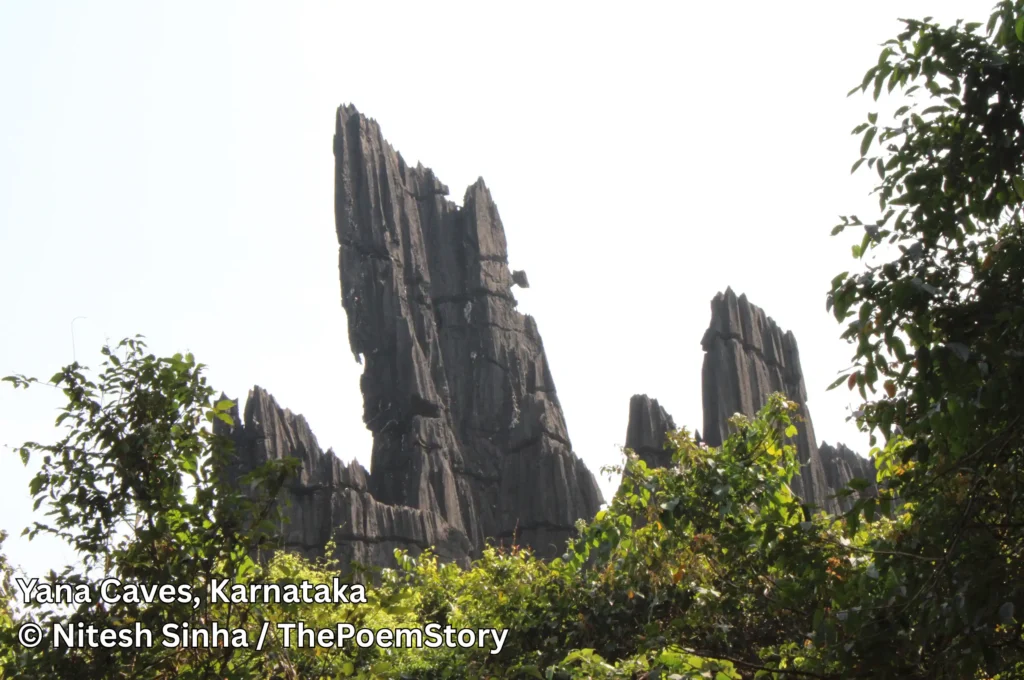
I’ve shared the complete photo set from Yana Caves on Facebook here:
👉 Facebook photo album: ThePoemStory Facebook Page
The ancient story of Shiva and Bhasmasur
Local tradition connects Yana with the legend of Bhasmasura.
Read the Story of Shiva and Bhasmasur
The story in brief
Bhasmasura was an asura who performed severe penance and received a powerful boon from Shiva.
The boon was dangerous:
Anyone whose head Bhasmasura touched would instantly turn to ashes.
The legend says that:
- Bhasmasura later attempted to test this power on Shiva himself.
- Shiva fled and sought divine help.
- The divine enchantress Mohini appeared and tricked Bhasmasura into placing his own hand on his head.
- He was instantly destroyed.
Because of this legend, the two rock towers are locally associated with:
- Bhairaveshwara – representing Shiva
- Mohini Shikhara – representing the Mohini form
Does the Shiva–Bhasmasur story actually relate to Yana caves?
From a historical and archaeological perspective:
There is no inscription, ancient text, or material evidence linking the Bhasmasura legend directly to the formation of Yana.
The association is:
purely cultural and devotional, not geological or historical.
However, such associations are extremely common across Indian sacred landscapes.
Whenever a striking or unusual natural structure exists, local tradition often attaches:
- a divine event,
- a mythological episode,
- or a sacred narrative
to explain and sanctify the place.
In Yana’s case, the dramatic vertical rocks and naturally formed shrine space made it an ideal setting for a Shiva-related legend.
Did the legend influence the naming of the rock towers?
Yes — the commonly used names:
- Bhairaveshwara Shikhara
- Mohini Shikhara
are clearly derived from the mythological narrative rather than from geological classification.
The names are devotional, not scientific.
Science and belief – two parallel stories
It is important to understand Yana through two parallel lenses:
The scientific story
- limestone deposition
- fracture development
- karst dissolution
- differential erosion
- long-term weathering under heavy monsoon climate
The cultural story
- Shiva worship
- Bhasmasura legend
- Mohini’s divine intervention
- local pilgrimage tradition
One explains how the rocks were formed.
The other explains how the place became meaningful to people.
They do not contradict each other — they simply belong to different human needs:
knowledge and faith.
Why Yana Caves are truly special
Yana is special not because it has large underground caverns, but because:
- it represents a rare karst landscape inside the Western Ghats,
- it shows how water alone can sculpt massive vertical stone towers,
- and it demonstrates how natural geology becomes woven into living mythology.
Final reflection
The towering limestone monoliths of Yana were not shaped by gods or demons.
They were shaped by:
rain, time, fractures, chemistry and gravity — working patiently over millions of years.
Yet the story of Shiva and Bhasmasura gave those silent rocks a human voice, memory and spiritual presence.
That blend of earth science and ancient imagination is what makes Yana Caves far more than just another scenic destination.
Visited on: Saturday, January 25
Road condition: Bad in parts
Traffic: Heavy — buses jam the narrow road; weekdays are better
Entry fees:
- ₹30 per person (forest entry)
- ₹10 per person (cave entry)
Payment: Cash only
Network: No mobile network; limited Wi-Fi available near the temple
Overall, a unique and memorable place, especially if you enjoy nature, geology, and peaceful locations. Best visited on a weekday and with some patience for the road conditions.
Visited in January 2026.
Yana is not loud. It reveals itself slowly—to those willing to walk, observe, and wait.

Get the ThePoemStory App — Read Poems Anywhere