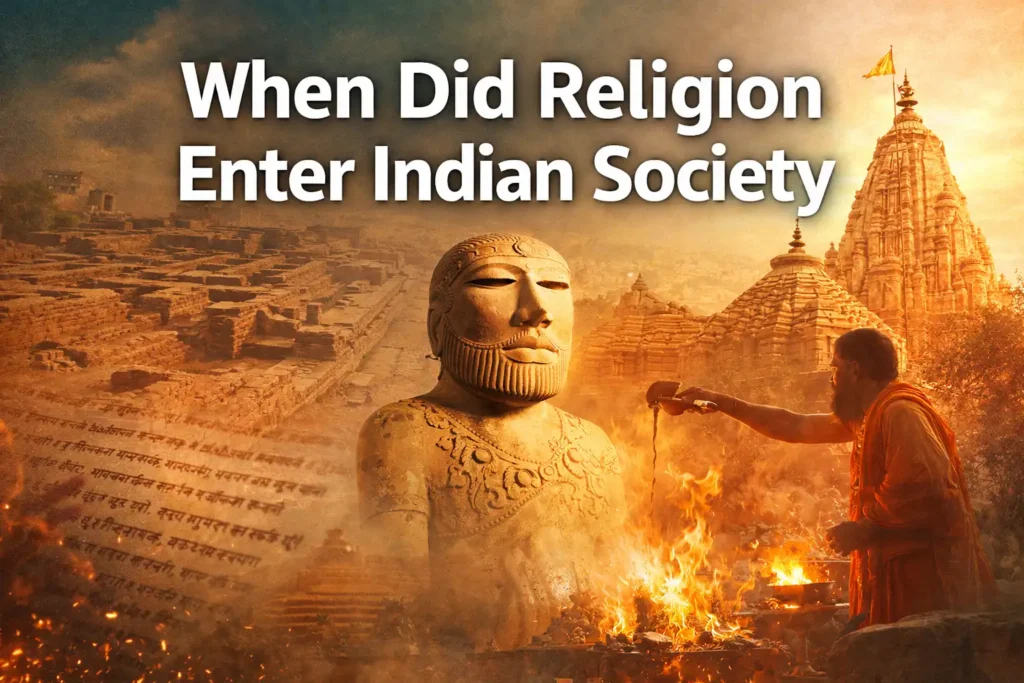
I often asked multiple times “Did the Indus Valley Civilization Have Religion” and later I researched through the sources and creating this post. Did Indus Valley People Follow Religion? or Was it a society without religion.
When we speak of ancient civilizations, we almost instinctively speak of religion. We imagine temples rising above cities, priests mediating between humans and gods, rituals defining daily life, and sacred texts anchoring belief systems. From Mesopotamia to Egypt, from Greece to Rome, religion is often the most visible and monumental feature of early societies.
But the Indus Valley Civilization—one of the world’s earliest and largest urban cultures—presents us with a puzzle. Despite more than a century of archaeological excavation, scholars still debate a deceptively simple question:
Did the Indus Valley Civilization practice religion in the way we understand it today?
This article does not attempt to deny belief, nor does it seek to provoke. Instead, it asks what the evidence allows us to say—and where responsible history must remain silent.
On ThePoemStory Explore: History and Biography Section
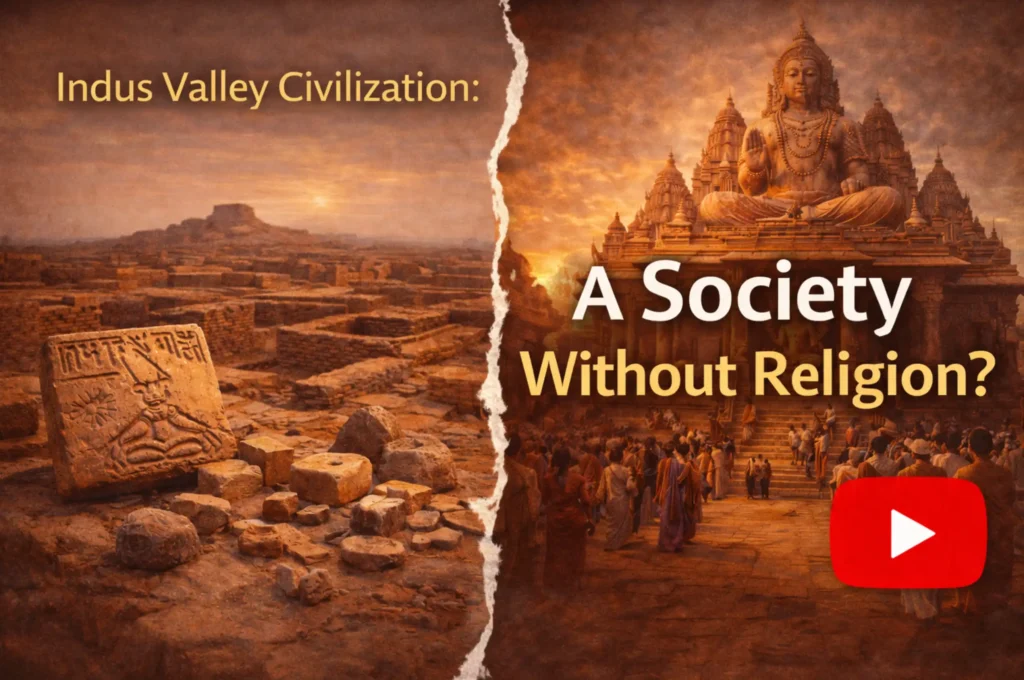
Did the Indus Valley Civilization Have Religion?
The Indus World: Order Without Spectacle
Between roughly 3300 and 1900 BCE, a vast urban network flourished across the Indus basin. Cities such as Harappa, Mohenjo-daro, and Dholavira were not isolated settlements but part of a connected system spanning hundreds of miles.
What immediately distinguishes the Indus world is planning.
Streets followed grid patterns.
Homes were aligned with mathematical precision.
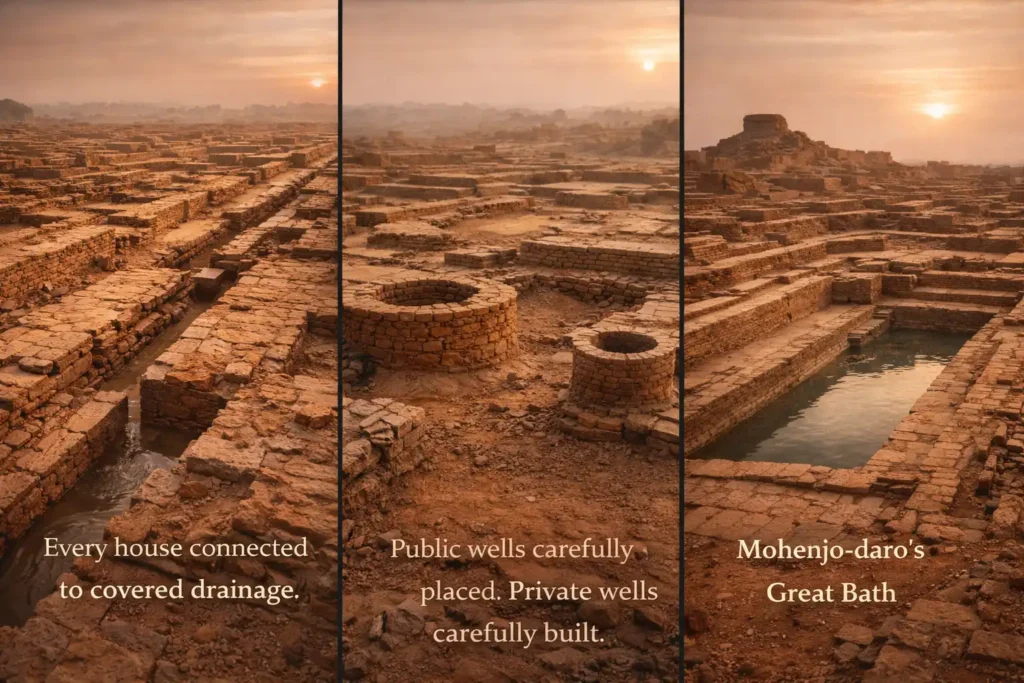
Drainage systems ran beneath houses, carefully covered and maintained.
Bricks were standardized in size across distant sites.
Weights and measures followed uniform ratios, enabling regulated trade.
This level of coordination suggests shared rules, agreement, and civic discipline.
What it does not immediately suggest is a society dominated by religious spectacle.
There are no towering temples defining city skylines.
No massive sanctuaries commanding ritual authority.
No obvious priestly quarters controlling belief or worship.
This absence is not trivial. In archaeology, what is missing can be as meaningful as what is present.
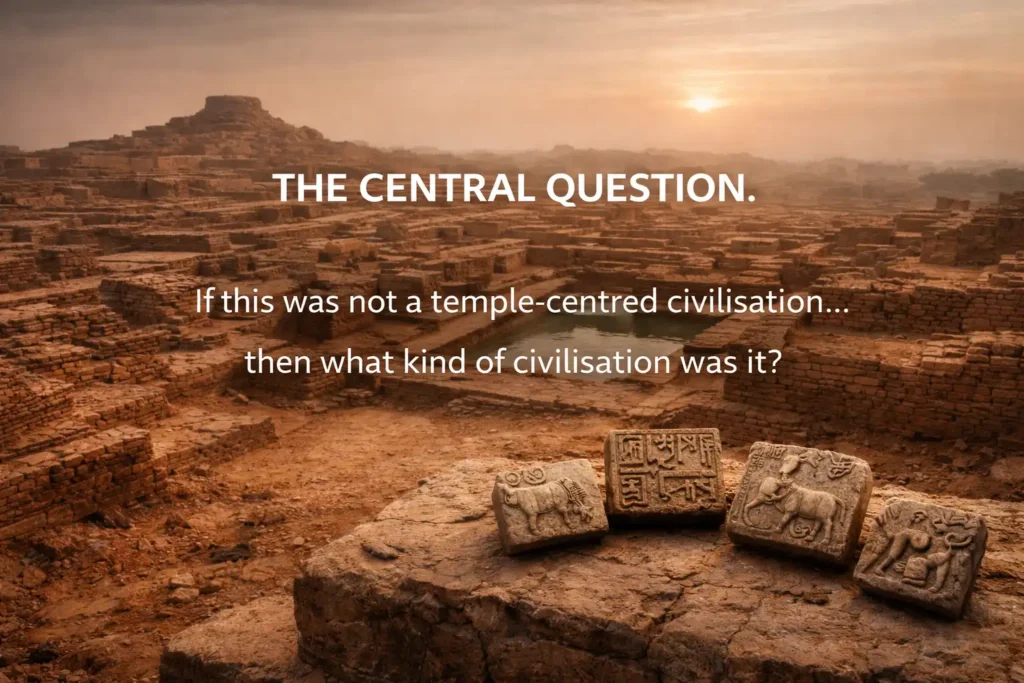
Public Infrastructure Over Sacred Monuments
Perhaps the most famous structure from the Indus world is the Great Bath of Mohenjo-daro.
It is a massive, waterproof tank, sealed with precision and built to endure. Its construction required advanced engineering, coordinated labor, and long-term civic responsibility.
Ritual bathing may well have occurred there. But ritual alone does not constitute organized religion.
Across civilizations, institutional religion leaves consistent signatures:
- Dedicated temples
- Altars and sanctuaries
- Priest-led ritual spaces
- Architectural separation between sacred and secular life
In the Indus case, what dominates the archaeological record is not sacred authority—but urban intelligence.
The civilization invested enormous effort not in monuments to gods or kings, but in systems that served everyone: sanitation, water access, storage, and planning.
This raises an uncomfortable but necessary question:
What kind of civilization prioritizes systems over shrines?
Seals, Figurines, and the Problem of Interpretation
Much of what people believe about Indus religion rests on small artefacts, not large structures.
The most cited example is the so-called “Pashupati seal”, often described as a proto-Shiva figure seated in a yogic posture. Terracotta female figurines are frequently labeled as “mother goddesses.”
But these labels are interpretations, not facts.
Early archaeologists in the early twentieth century made bold identifications based on visual resemblance and later religious traditions. Modern scholarship is far more cautious.
The seated figure on the seal could represent:
- Authority
- Meditation
- Symbolism
- Or something no longer culturally recognizable
The figurines may reflect:
- Fertility symbolism
- Domestic ritual
- Household objects
- Toys
- Artistic expression
Without explanatory texts, equating these objects directly with later Hindu deities is speculative.
Similarity is not identity.
The Silence of the Script
One of the greatest barriers to understanding Indus belief is not what has been found—but what cannot be read.
The Indus people left behind hundreds of inscriptions carved onto seals and objects. They are short, carefully composed, and repeated across sites.
And yet, the script remains undeciphered.
Because of this, we lack access to:
- Myths
- Prayers
- Ritual instructions
- Priesthood titles
- Sacred narratives
Later religious traditions explain themselves through texts.
The Indus civilization does not.
What remains is material culture—powerful, sophisticated, and incomplete. It tells us how people built, traded, governed, and lived together. It does not tell us what they believed.
This forces historians to do something uncomfortable: accept uncertainty.
When evidence is quiet, belief speaks loudly. Responsible history must learn to listen instead.
Continuity or Transformation?
A central debate in Indian history concerns continuity.
Did Indus culture evolve smoothly into Vedic and later Hindu traditions? Or did major transformations occur?
Some scholars argue for partial continuity, pointing to:
- Agricultural practices
- Symbolic motifs
- Possible ritual echoes
Others note that many defining features of Vedic religion appear after the decline of Indus cities:
- The Brahmin priesthood
- Fire sacrifices
- Sanskrit hymns
- Elaborate ritual hierarchies
These elements do not dominate the Indus record. They emerge centuries later, in a different historical context.
The most responsible conclusion is balanced:
- Some cultural threads may persist
- Memory and practice may adapt
- But the system that later becomes Hinduism was not fully formed in the Indus age
What we see is not a single unbroken line, but a long process of transformation.
Sanātana Dharma and Modern Projection
Today, the phrase “Sanātana Dharma” is often presented as an eternal, unchanged system stretching back to the dawn of civilization.
Historically, this is misleading.
What we now call Hinduism developed over long periods:
- Through the Vedas and Upanishads
- Through epics and Puranas
- Through devotional movements
- Through regional and local traditions
It argued with itself.
It reinterpreted itself.
It transformed.
To claim that the Indus cities practiced the same scripture-based, priest-led, philosophically defined system is to project later frameworks onto much earlier evidence.
History does not move backward.
Archaeology does not confirm belief. It records remains.
When continuity is confused with certainty, we stop studying the past and begin rewriting it.
What the Indus Civilization Actually Shows Us
When we step back from assumptions and look only at evidence, the Indus civilization reveals something clear.
Not rigid theology—but functional intelligence.
Standardized weights indicate regulated trade.
Granaries suggest organized food management.
Craft workshops reveal specialized labor.
Urban design reflects collective planning on a massive scale.
Nothing here is accidental.
This was a society that thought in systems, valued balance over spectacle, and coordination over domination.
Spiritual life likely existed—as it does in all human communities—but it was not visibly dominant. Not carved into monuments. Not enforced through architecture or administration.
The Indus world does not shout belief.
It quietly demonstrates order.
Responsible History
Early archaeologists, working with limited tools and immense curiosity, sometimes overstated connections between Indus symbols and later religious traditions.
Modern historians emphasize restraint.
Archaeology can suggest possibilities.
It can reveal patterns.
It can raise questions.
But without texts, it cannot confirm theology.
Good history does not rush to certainty. It allows space for doubt and resists the urge to force conclusions where evidence remains silent.
The goal of history is not to defend belief—but to understand the past as honestly as possible.
Conclusion: Let Evidence Lead
The Indus Valley Civilization was sophisticated, urban, and remarkably practical.
It does not provide a clear archaeological blueprint for the religious systems that emerged much later in South Asia.
Continuity is not impossible—but it is not proven.
The most responsible approach is to treat the Indus civilization as an independent and extraordinary chapter in human history.
Not a preface.
Not a projection.
A civilization worthy of being understood on its own terms.
Let evidence lead belief—not the other way around.
🎥 Watch the Video
(FAQ) Indus Valley Civilization: A Society Without Religion?
Did the Indus Valley Civilization have religion?
Archaeology does not provide clear evidence of an institutional, temple-based religious system in the Indus Valley Civilization. While ritual practices may have existed, there is no definitive material proof of organized priesthoods, monumental temples, or codified theology comparable to later religious traditions.
Were Indus people atheists?
There is no evidence to suggest that the people of the Indus civilization were atheists. Archaeology cannot determine belief or disbelief. The absence of temples or texts simply means we cannot confidently reconstruct their religious worldview.
Is the Indus Valley Civilization Hindu?
The Indus Valley Civilization predates the Vedic period and classical Hindu traditions by several centuries. While some cultural elements may show continuity, there is no proven evidence that the Indus people practiced Hinduism as it developed later.
What about the “Pashupati seal” and proto-Shiva claims?
The identification of the Pashupati seal as a proto-Shiva figure is debated among scholars. Without deciphered inscriptions or contextual texts, such interpretations remain speculative and cannot be treated as confirmed evidence of deity worship.
Why haven’t archaeologists found temples in Indus cities?
Despite extensive excavation, no large, clearly identifiable temple structures have been found in major Indus cities. This contrasts sharply with other ancient civilizations where religious architecture is prominent and unmistakable.
Did the Indus people perform rituals?
It is likely that the Indus people engaged in rituals, as ritual behavior is common in human societies. Structures like the Great Bath may have had ritual significance, but ritual activity alone does not equate to organized religion.
Why is the undeciphered script so important?
The Indus script remains undeciphered, which means historians lack access to myths, prayers, ritual instructions, or sacred narratives. Without texts, interpretations of belief systems remain limited and uncertain.
Is there continuity between the Indus civilization and later Indian traditions?
Some scholars argue for partial cultural continuity in practices or symbols, while others emphasize significant transformation. The most responsible position is that continuity is possible but not proven, and major religious systems developed later.
What does “Sanātana Dharma” mean in this historical context?
“Sanātana Dharma” is a term used in later historical and philosophical contexts. Applying it directly to the Indus civilization is a modern interpretation rather than a conclusion supported by archaeological evidence.
What is the main takeaway from studying the Indus civilization?
The Indus civilization demonstrates exceptional urban planning, civic organization, and practical intelligence. It challenges the assumption that religion must always be the central organizing force of early societies.
The following frequently asked questions address common queries about the Indus Valley Civilization, religion, and archaeological evidence.
- Sources & References
Kenoyer, Jonathan Mark. Ancient Cities of the Indus Valley Civilization. Karachi: Oxford University Press, 1998.
Possehl, Gregory L. The Indus Civilization: A Contemporary Perspective. Walnut Creek, CA: AltaMira Press, 2002.
Singh, Upinder. A History of Ancient and Early Medieval India: From the Stone Age to the 12th Century. New Delhi: Pearson Education India, 2008.
Parpola, Asko. Deciphering the Indus Script. Cambridge: Cambridge University Press, 1994.
Marshall, John. Mohenjo-daro and the Indus Civilization. 3 vols. London: Arthur Probsthain, 1931.
Srinivasan, Doris Meth. “The So-Called Proto-Śiva Seal from Mohenjo-Daro: An Iconological Assessment.” Journal of Asian Studies 43, no. 1 (1984): 77–89.
Archaeological Survey of India. Excavation Reports and Publications on Harappa, Mohenjo-daro, and Dholavira. New Delhi: Government of India.
Encyclopaedia Britannica. “Indus Valley Civilization” and “Religion of the Indus Valley Civilization.” Accessed 2025.
British Museum. “Indus Valley Script and Seals.” Collection and research notes. Accessed 2025.
Wikipedia contributors. “Religion of the Indus Valley Civilization” and “Pashupati Seal.” Wikipedia, The Free Encyclopedia. Accessed 2025.
(Used as secondary reference and cross-checked with academic sources.) ↩︎
Also Read:
Ahilyabai Holkar: The Philosopher Queen
The Hoysala Empire: A Comprehensive Historical Analysis