The Vedic Period in India marks a quiet but profound turning point in the history of Indian thought. It was not a continuation of the grand, brick-laid cities of the Indus world, nor was it the fully formed Hinduism of temples, idols, and personal devotion that many recognize today. This was an in-between age—an era learning how to understand existence itself.
Life during the Vedic period was organized around action, sound, and balance. Religion was not something one believed in privately or emotionally. It was something one performed. Sacredness did not reside in images or scriptures, but in correct action—in speaking the right words, in precise gestures, in rituals carried out without error. The universe, it was believed, responded not to intention alone, but to accuracy.
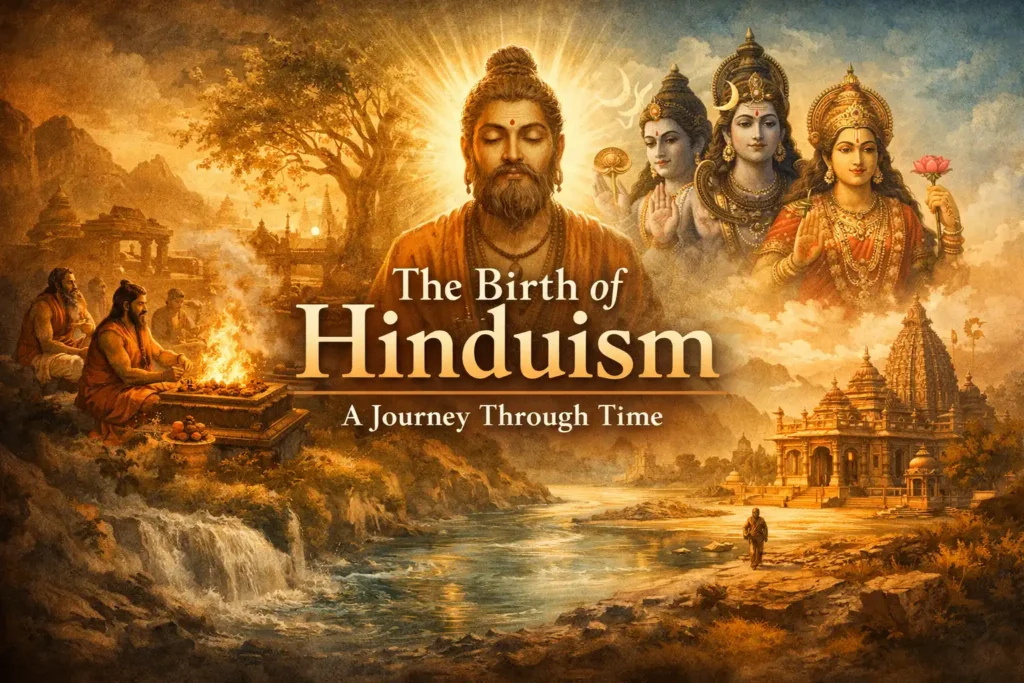
Between 1500 and 600 BCE, religious life unfolded around open skies and fire altars. Hymns were not read; they were memorized, spoken, and heard. Knowledge survived not in stone or ink, but in living voices. Fire became the bridge between humans and unseen forces, carrying offerings upward and maintaining harmony between earth, sky, and moral order. To perform a ritual correctly was not merely a religious act—it was a way of keeping the world itself in balance.
This period laid the foundations of what would later become Hindu tradition, but not through philosophy or introspection. Its foundation was discipline. Structure. Repetition. Order. Only slowly—almost reluctantly—did deeper questions begin to arise. When rituals multiplied and precision reached its peak, some began to wonder whether action alone was enough. Who was the one performing the ritual? What remained when the fire went out?
Those quiet questions would eventually pull Indian thought away from sacrifice and outward performance, and toward reflection, dialogue, and self-inquiry. But that transformation had not yet arrived. In the Vedic world, religion still lived in action—and meaning was something yet to be discovered.
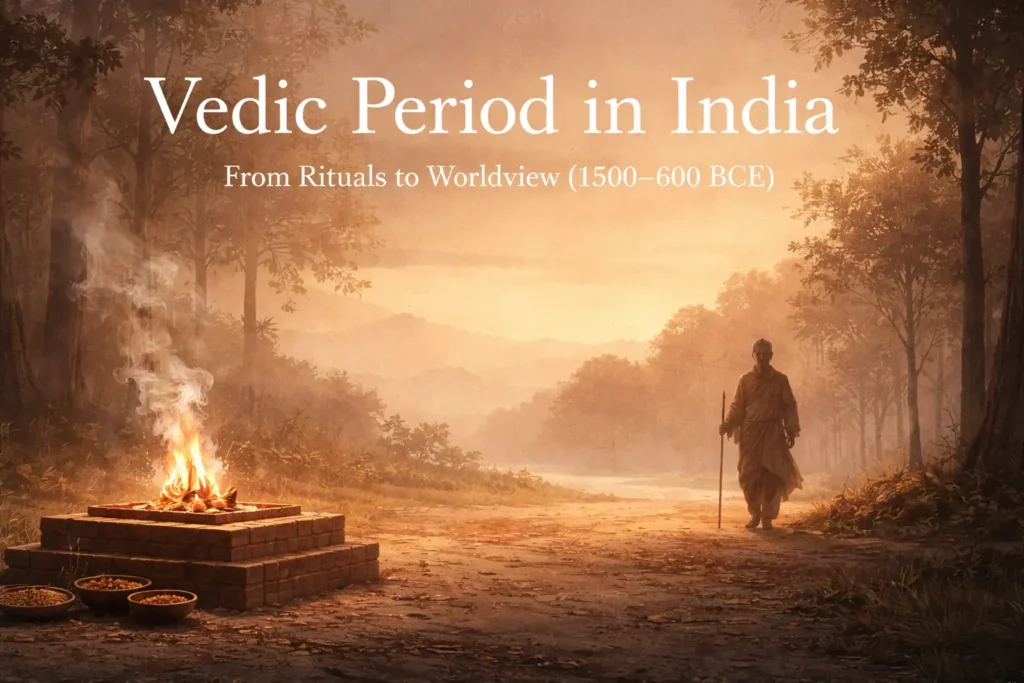
Vedic Period in India
Life After the Indus World: A New Cultural Beginning
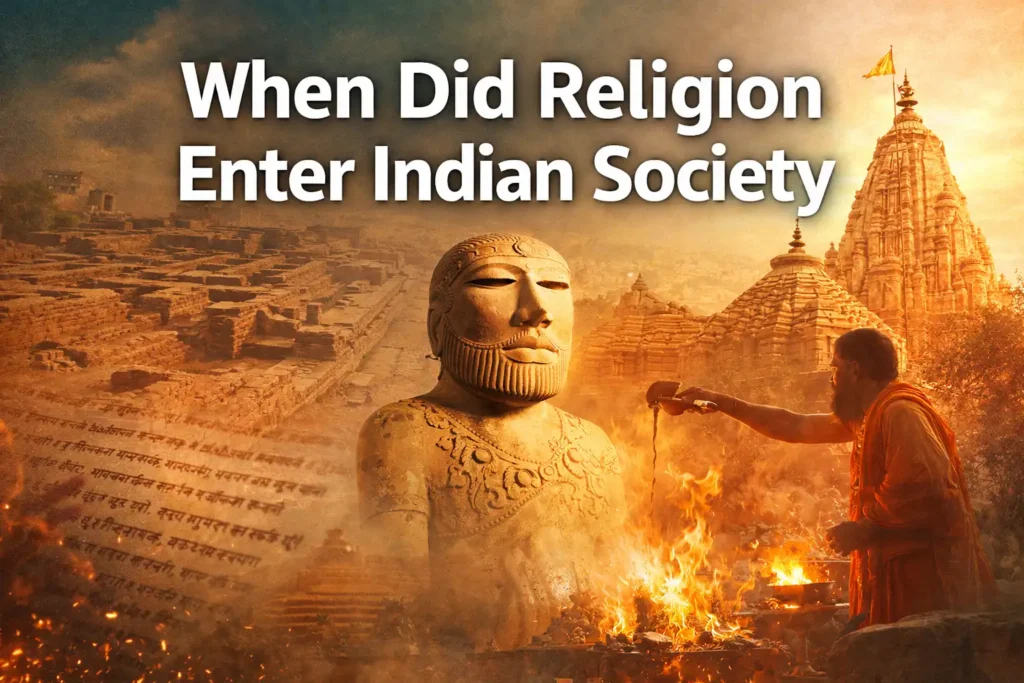
The decline of the Indus Valley’s great urban centers did not merely mark the end of a civilization—it marked a profound shift in how life was organized and understood. The carefully planned cities, baked-brick architecture, standardized seals, and uniform streets gradually faded from the landscape. What followed was not sudden collapse, but transformation.
Northern India entered a quieter, more fluid phase of history. Communities became pastoral or semi-settled, moving with seasons, herds, and rivers. Life spread outward across open plains and fertile valleys rather than clustering within fortified cities. Social structures loosened. Authority was no longer expressed through monumental buildings or civic planning, but through shared practices and collective memory.
Religion changed along with this new way of life.
In the absence of grand architecture and permanent temples, the sacred could no longer be fixed in stone. Instead, it became mobile, living, and spoken. Knowledge was carried by people rather than places. What mattered was not what could be seen, but what could be remembered and repeated. Sacred understanding lived in memory, voice, and performance.
Hymns were not written down. They were learned by listening, preserved through disciplined recitation, and passed from teacher to student with exacting care. A single mispronounced sound was believed to weaken a ritual’s power. In this world, sound itself became sacred. Speech was not merely a tool for communication—it was an instrument capable of shaping reality.
This shift—from visual symbols to spoken ritual—fundamentally shaped the Vedic worldview. Meaning was no longer anchored in objects or structures, but in action and utterance. To speak correctly was to act correctly. To act correctly was to maintain harmony between humans, nature, and the unseen order of the cosmos.
It was within this living, oral culture that the foundations of Vedic religion took root—a religion designed not for cities and monuments, but for movement, memory, and the spoken word.
The Rigveda and the Nature of Early Vedic Religion
At the heart of early Vedic religion lies the Rigveda, the oldest surviving layer of Vedic literature and one of the earliest records of human religious expression anywhere in the world. Yet to approach it with modern expectations is to misunderstand it entirely. The Rigveda is not a theological handbook, not a moral rulebook, and not a philosophical inquiry into the nature of existence. It does not tell its listeners what to believe or how to live.
Instead, it speaks in hymns—poetic invocations addressed to forces believed to sustain the natural and social order. These hymns praise fire, storm, dawn, rain, and cosmic law. They do not explain the universe; they participate in it. The gods of the Rigveda are not distant creators issuing commandments, but powers actively present in the rhythms of life.
Crucially, these hymns were never meant to be read silently or studied as text. They were composed for sound. Their authority did not rest on written preservation but on perfect oral transmission. Each verse had to be pronounced with exact precision—its rhythm, pitch, and sequence carefully maintained. A misplaced syllable was not a minor error; it was believed to weaken the ritual itself.
In this world, language was not symbolic—it was effective. Speech did not describe reality; it shaped it.
Meaning mattered, but performance mattered more. The power of a hymn lay not only in what it said, but in how flawlessly it was spoken. Religion, therefore, was not an inner conviction or emotional faith. It was a disciplined act, repeated with care, meant to sustain cosmic balance.
To follow the Vedic path was not to believe something to be true, but to do something correctly. Order was not assumed—it had to be continuously enacted. Ritual was the mechanism through which the universe was kept stable, seasons returned, and society held together.
While the Rigveda captures this earliest Vedic worldview in its most fluid and poetic form, it was not the end of the tradition. Over time, this ritual vision became more structured and specialized. The Samaveda transformed hymns into musical recitations. The Yajurveda systematized sacrifice into precise procedures and manuals. The Atharvaveda brought ritual thinking into daily concerns—health, protection, fear, and hope.
Together, these later texts show how an early poetic ritual tradition gradually expanded—becoming musical, technical, and socially embedded. But at its core, the Rigveda preserves a moment when religion was still an act before an idea, a performance before a belief, and a way of maintaining order before questioning its meaning.
While the Rigveda captures the earliest Vedic worldview, later Vedic texts—the Samaveda, Yajurveda, and Atharvaveda—reflect how this ritual vision became musical, procedural, and eventually embedded in everyday life.
Yajna: The Ritual That Held the Universe Together
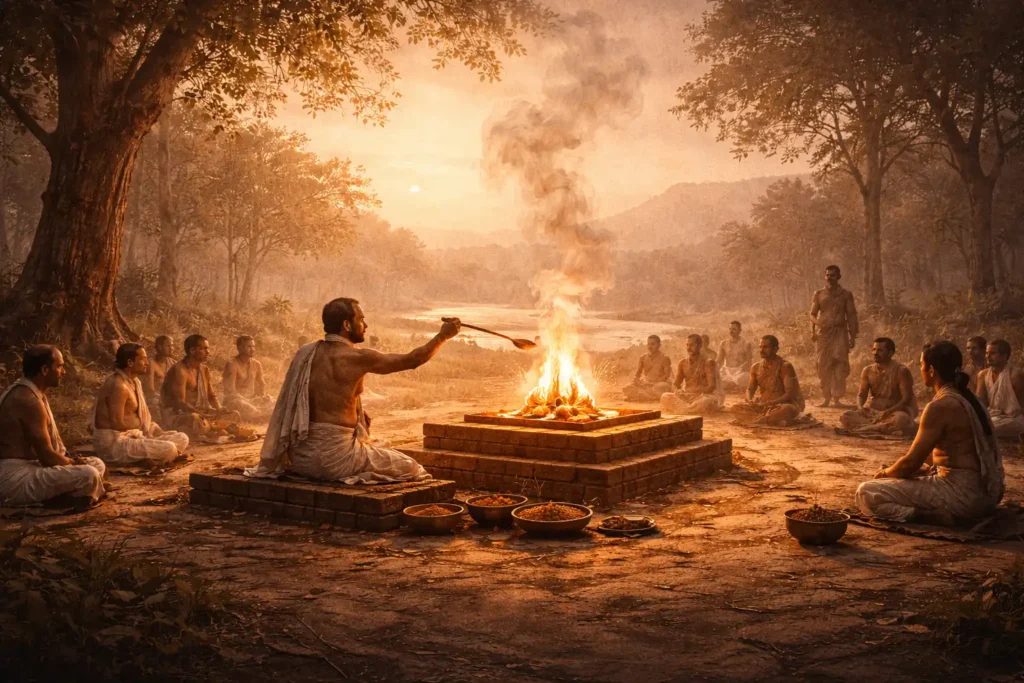
At the center of Vedic religious life stood yajna—the ritual sacrifice that shaped how the universe itself was understood. Far from being symbolic gestures or acts of personal devotion, sacrifices were seen as cosmic operations. To perform a yajna was not merely to worship; it was to participate directly in the functioning of reality.
Fire occupied a sacred and central role in this process. It was not simply a physical flame, but a living mediator between worlds. Through fire, offerings were transformed—solid becoming smoke, visible becoming invisible. What was placed into the flames was believed to travel upward, carried beyond human reach into the unseen realm where cosmic forces resided.
In this way, fire connected earth and sky, humans and gods, action and consequence.
A yajna was rarely a private act. It was communal, structured, and precise. Participants gathered under open skies, following strict sequences of chants and gestures. Every movement mattered. Every word had to be spoken correctly. The ritual unfolded like a carefully maintained rhythm—one mistake was believed to disrupt the entire process.
Yajna served several purposes at once.
It reinforced social unity, bringing communities together in shared action and responsibility.
It maintained cosmic rhythm (ṛta), the invisible order believed to govern seasons, morality, and natural law.
It ensured prosperity and continuity—rain for crops, health for people, stability for the world itself.
Nothing about yajna was abstract. If rains failed or misfortune struck, the cause was often sought not in belief or morality, but in ritual imbalance. Something, somewhere, had not been done correctly.
At its deepest level, the Vedic imagination saw the universe itself as sacrificial. The sun gave its light. Rain gave itself to the earth. Fire consumed offerings to release energy. Life continued because everything participated in a cycle of giving and receiving. Existence was sustained not by intention, but by reciprocal action.
In this worldview, the universe did not run on faith.
It ran on performance.
To act correctly was to keep existence itself in motion. To stop acting—or to act carelessly—was to risk disorder. Meaning, morality, and identity would come later. In the Vedic world, action sustained existence, and ritual was the thread that held the cosmos together.
Gods as Forces, Not Personal Deities
The gods of the Vedic world were not intimate, personal beings who listened to silent prayers or offered forgiveness for moral failings. They were not saviors, companions, or objects of emotional devotion. Instead, they were forces woven into the structure of reality itself—powers that governed nature, order, and survival.
To invoke a Vedic god was not to form a personal relationship. It was to recognize a force already at work.
Indra was not simply a heroic figure; he embodied strength, storm, and victory. He was invoked in times of conflict and uncertainty, not because he loved humanity, but because power itself needed to be aligned correctly. Agni was not merely a god of fire; he was fire—the visible presence that carried offerings from the human realm into the unseen. Without Agni, no ritual could function. Varuna represented moral and cosmic order, the unseen law that governed truth, oath, and balance across the universe.
These gods did not demand belief. They demanded acknowledgment through action.
Worship in the Vedic sense was public, collective, and precise. It took place around fire altars, through spoken hymns and ritual offerings. There was no concept of a private prayer whispered in solitude. What mattered was not emotional sincerity, but ritual correctness. If the rite was performed properly, the cosmic forces would respond—not out of compassion, but out of order.
Because of this, Vedic religion had no developed idea of eternal heaven or hell. Nor did it promise personal liberation or salvation. The concern was not the fate of the soul after death, but the continuity of life here and now—rainfall, harvests, social stability, and cosmic balance.
Religion addressed this world, not the next.
The gods ensured that the universe continued to function. Humans participated by performing rituals correctly. Meaning, morality, and personal transformation were not yet central concerns. Those questions would arise later, when ritual began to feel insufficient.
In the Vedic worldview, gods were not loved.
They were aligned with.
And alignment—not belief—was what kept the world intact.
Social Order and the Rise of Ritual Authority
As Vedic rituals grew more elaborate, the society that sustained them began to change as well. Sacrifice was no longer a simple communal act; it became a highly specialized discipline. Hymns had to be memorized perfectly. Meters had to be maintained without error. Ritual sequences had to unfold in exact order, often involving multiple participants performing different roles simultaneously.
This growing complexity created a new kind of authority—authority based on knowledge.
Those who mastered the sacred hymns, the rhythms of speech, and the precise mechanics of sacrifice gained influence. Their power did not come from political rule or divine revelation, but from their ability to make rituals work. In a world where cosmic balance depended on correct performance, expertise became indispensable.
Out of this environment emerged varna, not as a rigid caste hierarchy, but as a functional division of roles necessary for maintaining order.
- Priests preserved ritual knowledge, memorized hymns, and ensured sacrifices were performed correctly.
- Warriors protected communities, defended resources, and maintained physical order in an uncertain landscape.
- Producers—farmers, herders, artisans—sustained daily life through labor and exchange.
Each role was understood as essential. None was meaningful in isolation. Social harmony depended on each function being performed properly, just as ritual harmony depended on precision.
At this early stage, varna was not fixed by birth. It reflected what one did, not who one was. A person’s place in society was tied to capability, training, and responsibility rather than ancestry. Only much later would these roles harden into hereditary identities.
Religion during this period did not attempt to answer existential questions about suffering, purpose, or liberation. It did not ask why life exists or what happens after death. Its concern was far more practical and immediate.
Religion organized society.
It distributed responsibility.
It stabilized life.
Meaning would come later. For now, order was enough.
When Ritual Becan to Feel Incomplete
For a long time, ritual worked.
Sacrifices were performed. Hymns were recited with increasing precision. Fire altars multiplied, and ritual expertise reached remarkable levels of refinement. The system functioned exactly as it was designed to—maintaining social order, reinforcing cosmic rhythm, and offering a sense of stability in an uncertain world.
Yet repetition has a way of revealing limits.
As rituals became more frequent and more exacting, something subtle began to change. The outward form remained intact, but an inner unease surfaced quietly, almost unnoticed at first. The very discipline that perfected ritual also created space for reflection.
If the power of a ritual lay in sound, sequence, and correctness, who was it really for?
If order could be maintained through external action alone, what of the inner experience of the one performing it?
If the universe responded to action, was action itself sufficient to explain existence?
These were not rebellious questions. They did not arise in opposition to the Vedic system. They arose because of it.
Those who asked them were often the most deeply trained ritual practitioners—the very people who understood sacrifice best. Having mastered outward precision, they began to notice what ritual could not address. The chants brought order, but not insight. The sacrifices sustained rhythm, but not understanding. Something essential remained untouched.
Slowly, attention began to shift—from the fire altar to the mind, from performance to awareness, from what is done to who is doing it.
This was the moment religion began to turn inward.
Not abruptly. Not violently. But thoughtfully.
The Vedic tradition did not collapse under doubt; it evolved through questioning. The realization dawned that maintaining the universe externally did not automatically explain the self internally. A new kind of search was beginning—one that no longer relied on offerings or chants, but on silence, dialogue, and inquiry.
The age of ritual had reached its fulfillment.
The age of questioning was about to begin.
From Fire Altars to Inner Inquiry
The Vedic worldview achieved remarkable mastery over the external order of existence. Through ritual, it aligned human action with cosmic rhythm. Through sacrifice, it sustained balance between nature, society, and unseen forces. Through discipline, it preserved continuity across generations. In many ways, it worked exactly as intended.
But one domain remained unexplored.
Ritual could regulate the world, but it could not explain consciousness itself. It could preserve order, but it could not reveal the nature of the one experiencing that order. The chants described forces outside; they did not illuminate awareness within.
Gradually, a quiet shift began.
Some seekers stepped away from public fire altars and collective ceremonies. They moved toward forests, riverbanks, and hermitages—not in rejection, but in pursuit of deeper clarity. What they sought was not a new ritual, but a new way of knowing.
In these spaces, dialogue replaced sacrifice.
Silence replaced chant.
Listening became as important as speaking.
The central question was no longer what must be done, but who is the one doing it. Attention turned inward—to breath, thought, perception, and the sense of self that remained even when action ceased. The sacred was no longer something enacted outwardly; it became something experienced directly.
This transition did not destroy the Vedic tradition. It fulfilled it.
The discipline of ritual had prepared the mind for inquiry. The precision of chant had sharpened attention. The order imposed on the external world now made it possible to explore the inner one. What emerged was not a rejection of the Vedas, but their transformation into reflection.
The fire altar did not vanish.
It moved inward.
And with that movement, Indian thought stood on the threshold of philosophy—ready to ask not how the universe is maintained, but what it truly is, and who we are within it.
Conclusion: The Threshold of Philosophy
The Vedic Period stands at a profound threshold in the history of Indian thought. It represents a civilization that believed the universe could be sustained through correct action, disciplined speech, and ritual precision. Order was not assumed; it was continuously created through human participation. Hymns were spoken, fires were lit, and sacrifices were performed—not as symbols, but as acts believed to keep existence itself in balance.
In perfecting this system, the Vedic world achieved extraordinary mastery over the outer dimensions of life. It organized society, aligned human effort with natural forces, and offered a coherent way to live within a vast and unpredictable universe. But mastery brought with it an unexpected realization.
Ritual could maintain order, but it could not explain experience.
It could regulate action, but it could not reveal awareness.
As rituals became more refined, their limits became more visible. The most essential questions remained unanswered:
Who is the self behind the action?
What remains when ritual stops?
These were not questions of rebellion or disbelief. They arose from sincerity—from thinkers who had fully lived the Vedic discipline and now sensed that something deeper awaited discovery. The recognition that action alone could not explain existence marked a turning point.
The search for these answers would give rise to a new body of thought—one that shifted attention from fire altars to inner awareness, from performance to perception, from cosmic order to conscious experience. This shift did not abandon the Vedic tradition; it completed it by transcending it.
At this threshold, religion in India was about to become philosophy.
What followed would not ask how the universe is maintained, but what it truly is, and who we are within it. That journey would unfold in dialogues, silences, and reflections preserved in the Upanishads—where the sacred was no longer performed, but realized.
Upanishads: When Hinduism Turned Inward
The Vedic world mastered the outer order of life—ritual, rhythm, and social balance. But it left one question unresolved: Who is the experiencer behind the ritual?
The Upanishads emerged as a response to this uncertainty. They did not reject the Vedas; they questioned them. Moving away from fire altars and public sacrifice, they explored silence, dialogue, and introspection. In doing so, Indian thought took a radical turn—from maintaining the universe through action to understanding reality through knowledge.
Where the Vedic ritual asked how to act, the Upanishads asked who we are. (See you in the next post)
Frequently Asked Questions (FAQ)
What was the Vedic Period in Indian history?
The Vedic Period (roughly 1500–600 BCE) was an early phase of Indian civilization marked by the composition and transmission of the Vedas. During this time, religious life focused on ritual action, oral hymns, and maintaining cosmic order rather than philosophy or personal devotion.
How was Vedic religion different from later Hinduism?
Vedic religion emphasized ritual performance over belief, temples, or personal gods. Later Hinduism developed philosophy (Upanishads), devotion (bhakti), temples, and concepts like liberation (moksha), which were not central during the early Vedic period.
Why is the Rigveda considered the most important Vedic text?
The Rigveda is the oldest Vedic text and preserves the earliest form of Vedic religion. It reflects a worldview centered on hymns, natural forces, and ritual action before later systematization and philosophy emerged.
What is yajna in the Vedic tradition?
Yajna refers to ritual sacrifice performed around a fire altar. In the Vedic worldview, yajna was believed to sustain cosmic balance (ṛta), ensure prosperity, and maintain harmony between humans, nature, and unseen forces.
What did Vedic people believe about gods?
Vedic gods were understood as forces of nature and order, not personal deities offering salvation or forgiveness. Gods like Indra, Agni, and Varuna represented power, mediation, and cosmic law, and were acknowledged through ritual rather than private prayer.
Did Vedic religion believe in heaven, hell, or salvation?
Early Vedic religion did not emphasize eternal heaven, hell, or personal salvation. Its primary concern was maintaining balance and continuity in this world—through ritual correctness and social harmony.
What was varna during the Vedic period?
During the early Vedic period, varna functioned as a division of roles, not a rigid caste system. Social roles were based on function—ritual specialists, protectors, and producers—rather than strictly on birth, which developed later.
Why did ritual begin to feel insufficient in the Vedic period?
As rituals became more complex and repetitive, thinkers began to question whether action alone could explain existence. This dissatisfaction did not reject Vedic religion but arose from within it, leading to deeper inquiry.
How did the Upanishads emerge from the Vedic tradition?
The Upanishads emerged when attention shifted from external ritual to inner awareness. They questioned who performs action, what consciousness is, and what remains when ritual stops—marking the birth of Indian philosophy.
Is the Vedic period the beginning of Hindu philosophy?
The Vedic period laid the foundation for Hindu philosophy but was not philosophical in itself. Philosophy truly began with the Upanishads, which transformed ritual religion into a system of self-inquiry and metaphysical thought.
Why is the Vedic period important for understanding Indian thought today?
Understanding the Vedic period shows that Indian religion evolved gradually—from ritual order to philosophical inquiry. It challenges the idea that Hinduism began as a fixed belief system and reveals its dynamic intellectual history.
Continue Reading History
History often reveals itself slowly—through patterns, pauses, and questions that refuse simple answers. If this exploration stayed with you, there are more essays waiting, tracing civilizations, ideas, and the human stories behind them.

Get the ThePoemStory App — Read Poems Anywhere