The Real Bhagavad Gita is not about escape or ritual devotion, but about conscious action, responsibility, and inner freedom. The Bhagavad Gita was spoken on a battlefield, not in a temple. Discover its real message beyond bhakti and spiritual escape.
The Bhagavad Gita is often treated as a book of comfort—recited for peace, quoted for motivation, and reduced to selective verses on devotion and surrender. Over time, it has been softened into a spiritual lullaby, stripped of its original tension and urgency. But the Gita was never meant to help us escape life; it was spoken at the very moment when escape was impossible.
Delivered on a battlefield to a man paralysed by moral confusion, it confronts the hardest human questions: How do I act without losing my conscience? How do I fulfil my duty without becoming cruel? How do I live with myself after making irreversible choices? This is the real Bhagavad Gita—not a manual for withdrawal, but a guide for conscious action amid conflict, responsibility, and uncertainty.
It is not about choosing bhakti over karma, but about remembering Krishna while standing in the middle of responsibility, conflict, and consequence.
Explore more in Mythological Stories
The Real Bhagavad Gita
Introduction: A Misunderstood Scripture
The Bhagavad Gita is often approached as a book of devotion—associated with chanting, surrender, and emotional solace. For many readers, it becomes a spiritual shelter, a place to retreat when life feels overwhelming, confusing, or unfair. This is not wrong; the Gita does offer reassurance and depth. But when it is reduced only to comfort and devotion, something essential is lost. The Gita is not meant to soothe us into passivity; it is meant to wake us up.
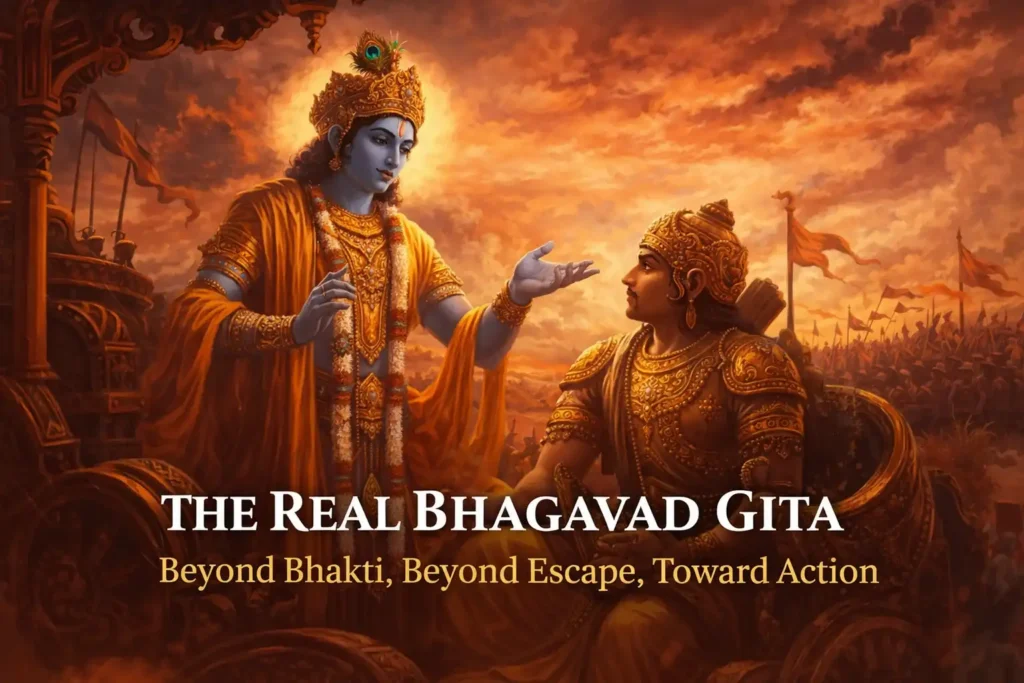
What is frequently overlooked is the context in which the Gita was spoken. It did not emerge in the quiet of a temple, nor in the detachment of monastic life. It was not offered to those who had renounced the world or stepped away from responsibility. It was spoken at the most inconvenient moment imaginable—on a battlefield, just before violence, consequence, and irreversible action. This setting is not symbolic decoration; it is the heart of the teaching.
Arjuna, the listener, is not a seeker asking abstract philosophical questions. He is a man trapped in a moral crisis, unable to reconcile his sense of compassion with his sense of duty. He does not doubt the existence of God; he doubts how to live rightly when every choice carries harm. His breakdown is not weakness but clarity—an honest recognition that ethical decisions are rarely clean or painless.
Krishna chooses this moment deliberately. Not after the war, not in retreat, and not in reflection—but at the precise point where action cannot be postponed. Through Arjuna, the Gita speaks to anyone who has stood at the edge of a difficult decision, torn between values and consequences. To understand the real Bhagavad Gita, we must see it not as a text that helps us avoid life, but as one that teaches us how to stand firmly within it. Arjuna’s doubt is our doubt, because the battlefield has never disappeared—it has only changed its form.
For me, knowing Krishna is the path of action. I cannot sit in one place chanting names on beads; that does not help me live rightly.
Arjuna Is Not a Hero — He Is Us
Arjuna is often portrayed as a mighty warrior who suddenly becomes weak. This is a shallow reading. His collapse is not born of fear, but of clarity. He sees the full cost of action, and that vision overwhelms him. Arjuna does not hesitate because he cannot fight; he hesitates because he understands what fighting will demand of him.
He stands between two impossible choices. If he fights, he will cause suffering—to teachers who shaped him, to relatives he loves, to lives he once shared. If he withdraws, he will betray his duty, abandon the role he was trained for, and allow injustice to stand unchallenged. There is no path without loss. This is not cowardice. This is ethical paralysis—the moment when morality itself feels heavy.
On the battlefield of Kurukshetra, Arjuna faces visible enemies and irreversible consequences. In modern life, the battlefield is quieter but no less brutal. Our conflicts rarely involve weapons, yet they demand the same inner strength. Where Arjuna faced arrows and chariots, we face choices that threaten relationships, careers, and self-respect.
For Arjuna, fighting meant breaking bonds of blood and loyalty. For us, honesty can fracture relationships we have spent years protecting. For Arjuna, retreat meant abandoning his responsibility as a warrior. For us, silence often feels safer—but slowly becomes a betrayal of our values. For Arjuna, action meant immediate destruction. For us, action can mean standing alone, risking reputation, or choosing integrity when compromise is rewarded.
This is why Arjuna breaks. Not because he is unsure of what is right, but because he knows exactly what doing right will cost him. Every modern human has stood in this space—when integrity slows career growth, when truth endangers harmony, when silence preserves comfort, and when both action and inaction feel equally wrong.
Arjuna’s battlefield is Kurukshetra. Ours is daily life—our workplaces, families, social systems, and inner conscience. The setting has changed. The conflict has not.
Arjuna stands between two impossible choices:
- If he fights, he causes suffering.
- If he withdraws, he betrays his duty.
This is not cowardice. This is ethical paralysis.
Every modern human knows this space:
- When honesty may destroy relationships
- When integrity costs career growth
- When silence feels safer than truth
- When action and inaction both feel wrong
Arjuna’s battlefield is Kurukshetra. Our battlefield is daily life.
The setting has changed. The conflict has not.
For me, Krishna is realized through karma—through conscious action, not through inaction or wasted time in His name.
For me, Krishna is not reached by withdrawing from life, but by acting within it—without ego, fear, or attachment.
The Central Mistake: Bhakti as Escape
Many people today are drawn toward a bhakti-only understanding of spirituality. They chant, sing, worship, and immerse themselves emotionally in devotion. This form of bhakti can be sincere, healing, and even necessary at certain stages of life. There is nothing inherently wrong with devotion itself.
The problem arises when devotion quietly begins to replace responsibility.
When bhakti becomes an emotional refuge rather than a force of inner change, it starts to function as a shelter from life instead of preparation for it. It turns into a way to avoid difficult conversations, painful decisions, and moral accountability. Devotion then becomes a substitute for ethical action—a comfort that soothes, reassures, and asks nothing in return.
At that point, bhakti stops transforming the individual and starts protecting them from discomfort. What looks like spirituality on the surface becomes, at its core, a refined form of escape.
The Bhagavad Gita does not support this version of spirituality. Krishna never asks Arjuna to lay down his bow and withdraw into meditation. He does not praise emotional overwhelm or moral hesitation disguised as compassion. Instead, Krishna confronts Arjuna sharply, because Arjuna is attempting to use morality itself as a justification for inaction.
This is the most unsettling aspect of the Gita. Krishna does not merely challenge violence or aggression; he challenges avoidance disguised as virtue. He exposes the tendency to retreat into emotion when action becomes ethically difficult.
That is why this teaching remains deeply relevant. The Gita is not a reassurance for those who wish to step away from responsibility—it is a confrontation for those who wish to remain human, conscious, and accountable within it.
When devotion becomes:
- an emotional shelter from life
- a way to avoid difficult decisions
- a substitute for ethical action
- a comfort that asks nothing in return
…it stops being transformation and becomes escape.
The Bhagavad Gita was spoken on a battlefield, not in a temple. To know the Gita, one must enter the war of life. Those who only sit and chant may memorize it—but may never live it.
Karma Is Not the Enemy — Attachment Is
A common misunderstanding of the Bhagavad Gita is the belief that Krishna places karma (action) and bhakti (devotion) in opposition, as if one must be chosen at the expense of the other. This false division has shaped much of modern spiritual thinking. The Gita, however, does not present an either-or path. It presents a union.
Krishna’s teaching is radical not because it rejects action, but because it redefines how action is performed. He does not ask us to withdraw from the world or suspend responsibility. Instead, he asks us to act fully, responsibly, and ethically—while refusing to be enslaved by the outcome of our actions.
This distinction is crucial. Action itself does not bind us; attachment to results does. When outcomes become the center of our attention, intention slowly corrodes. Ego enters quietly, measuring success and failure as personal validation. Fear of loss and hunger for reward begin to justify cruelty, compromise, and self-deception. What begins as duty eventually turns into burden.
Krishna does not remove action from life. He removes the psychological bondage created by expectation. By shifting focus from result to responsibility, he restores clarity, balance, and inner freedom.
This is Karma Yoga—not passive detachment, but conscious engagement. And when action is performed with surrender, humility, and inner remembrance, it naturally transforms into bhakti in motion. Devotion is no longer confined to prayer or ritual; it flows through work, decision-making, and moral courage. In this union, karma finds its meaning, and bhakti finds its expression.
The bhakti-only interpretation and religious labeling of the Bhagavad Gita have confined it to a Hindu spiritual text. In truth, it is a way of life. To make the Gita accessible to everyone, remove the bhakti tag and restore the action it demands—just as all humans, regardless of religion, breathe the same air, eat the same food, and face the same death.
Why Remembering Krishna During Action Is So Hard
A common question arises when reading the Bhagavad Gita: Why not remember Krishna constantly while performing one’s duties? If devotion is the goal, shouldn’t remembrance be effortless and continuous? In truth, this is the highest path Krishna offers—but also the most demanding.
Remembering the divine in stillness is easy. Silence calms the mind, and distance from conflict creates the illusion of understanding. But remembrance is truly tested not in peace, but in pressure. It becomes difficult precisely when it matters most—when you are insulted, when your ego is wounded, when you face injustice, or when sincere effort goes unrewarded. In those moments, remembrance must compete with anger, fear, pride, and disappointment.
Faced with this inner resistance, human beings naturally choose remembrance away from friction. Devotion is sought in protected spaces—rituals, repetition, and withdrawal—where nothing questions the self. But Krishna’s path is not about preserved purity; it is about tested clarity.
That is why the Gita is spoken just before action, not after renunciation. Because remembering Krishna in silence may calm you—but remembering Him while acting is what transforms you.
The Bhagavad Gita never instructs us to abandon action. It instructs us to abandon attachment. Krishna does not say, do not do karma; he says, do nishkama karma—act without craving, fear, or obsession over results. Action is unavoidable as long as life continues. Even inaction is a form of action, carrying its own consequences. What binds us is not work itself, but the desire, ego, and expectation we attach to it.
To withdraw from karma in the name of spirituality is not liberation; it is avoidance. The Gita’s wisdom lies in teaching us how to act fully while remaining inwardly free. Nishkama karma is not passivity—it is disciplined engagement with life, where effort is sincere, conscience is clear, and results are surrendered. Krishna’s message is not an invitation to escape the world, but a demand to participate in it consciously.
When understood correctly, remembering Krishna during action becomes simpler, not harder. It begins with a clear inner stance: I will do my duty sincerely, and I will not allow the result—positive or negative—to define me. This shift removes anxiety from action. Effort remains honest, but expectation loosens its grip. In that space, remembrance becomes natural, not forced.
Good and bad, however, are rarely universal. What appears right to one person may seem wrong to another. Perspectives differ, contexts change, and moral judgments often clash. Yet beneath these differences lies a constant—the necessity of action. Action may succeed or fail, yield fruit or none at all, be judged right or wrong by others. But inaction is never neutral. It is always a choice, and more often than not, a surrender of responsibility.
The Gita does not ask us to guarantee perfect outcomes or moral unanimity. It asks us to act with clarity and conscience, and then release the burden of control. Krishna’s teaching is not about being flawless; it is about being present and accountable. Action keeps life moving. Detachment keeps the mind free. Together, they form the essence of Nishkama Karma—where remembrance flows not from withdrawal, but from participation.
Remembering Krishna is not about holding His name in the mind,
but holding one’s duty without fear of result.
Arjuna’s Real Question (Often Ignored)
Arjuna is not standing on the battlefield asking a strategic question. He is not confused about military tactics, nor is he uncertain about what must be done. His real question is far more unsettling. He is not asking, “Should I fight?” He is asking, “How do I live with myself if I do?”
This is the most human question of all. It arises whenever action threatens our sense of self. How do I act without becoming cruel? How do I pursue success without losing my soul? How do I fulfil my duty without hardening my heart? These questions do not belong to warriors alone; they belong to anyone who has faced a decision where doing what is necessary feels dangerously close to becoming someone they do not want to be.
Krishna does not respond with instructions or strategies. His answer is not tactical—it is existential. He shifts Arjuna’s attention away from the immediate act and toward the deeper confusion about identity. Arjuna’s suffering does not come from action itself, but from the belief that action will define who he is.
Krishna dismantles this fear gently but firmly. He reminds Arjuna that he is not merely the doer of actions, not the outcome they produce, and not the role he temporarily occupies. These are functions, not identities. When identity collapses into action, every decision becomes unbearable.
That is why Krishna’s guidance is subtle and profound: act, but do not let action define your worth. Care deeply, but do not possess the results of your care. Fight if you must, but do not let hatred enter your heart. In separating action from identity, Krishna offers Arjuna a way to move forward without losing himself.
This is the real teaching of the Gita—not how to choose action or renunciation, but how to act without self-destruction.
The Highest Bhakta Is Not Loud
The Bhagavad Gita does not glorify loud devotion, nor does it reward public displays of piety. It does not measure faith by volume, ritual, or visibility. The Gita points instead toward something far more demanding and far more subtle.
The highest form of bhakti is quiet alignment—an inner steadiness where action, intention, and conscience move together without announcement. The true devotee is not defined by symbols or slogans, but by how they meet responsibility.
Such a devotee does not advertise spirituality or seek recognition for faith. They do not escape difficult duties under the guise of devotion, nor do they weaponize morality to judge others or excuse inaction. Their spirituality is not something to be displayed; it is something to be lived.
They simply do what is right, accept the consequences of their choices, and surrender the results without resentment or pride. There is no need for performance, because the work itself becomes the offering.
This is bhakti that has matured into wisdom—where devotion is no longer emotional dependence, but disciplined presence in the world.
Why the Bhagavad Gita Still Disturbs Us
The Bhagavad Gita has survived centuries not because it comforts us, but because it refuses to comfort our excuses. It does not soothe moral confusion with easy answers, nor does it offer escape disguised as spirituality. Instead, it insists that we look directly at life as it is—demanding, conflicted, and unavoidable.
The Gita does not promise peace as the absence of struggle. It promises freedom within conflict—the ability to act without being internally fractured by fear, desire, or attachment. It does not remove responsibility from human life; it removes the illusions that make responsibility unbearable. By dissolving false identities and expectations, it restores clarity where confusion once ruled.
Most unsettling of all, the Gita never tells us to leave the battlefield. It does not suggest retreat, withdrawal, or renunciation as a universal solution. It asks us to see clearly while standing in the middle of action, where consequences are real and choices cannot be postponed.
That is why the Gita continues to disturb us. It does not meet us where we wish to hide; it meets us where we must decide.
Conclusion: The Real Bhagavad Gita
The real Bhagavad Gita is not a book of escape. It is a manual for conscious living under pressure—spoken not to those who had withdrawn from life, but to one who could no longer avoid it. Its wisdom does not offer comfort through distance; it offers clarity within responsibility.
The Gita teaches us that bhakti without karma dissolves into sentiment, while karma without bhakti hardens into burden. It reminds us that detachment is not indifference, and love is not avoidance. These distinctions are not philosophical wordplay; they are instructions for survival in a world where every choice carries consequence.
Arjuna’s doubt is our doubt because life itself places us between values and outcomes, intention and impact. We are rarely asked to choose between right and wrong—more often, we are forced to choose between two costs. Krishna’s answer to this dilemma is not easy, reassuring, or gentle. But it is honest.
And it is this honesty that allows the Gita to endure. It continues to speak not to saints removed from struggle, but to ordinary human beings trying to live rightly, act responsibly, and remain inwardly free in an imperfect world.

Get the ThePoemStory App — Read Poems Anywhere