Aeneas: The Last Hope of Troy and the Man Who Carried Rome Out of the Fire
In Aeneas: The Last Hope of Troy, a man escapes a burning city with his father on his back and the gods of his people in his arms, and spends the rest of his life trying to find a place to put them down. This is a story of mythological stories, heroes and mortals, fate and prophecy, and the Roman identity and legacy that turned a defeated Trojan into the ancestor of an empire.
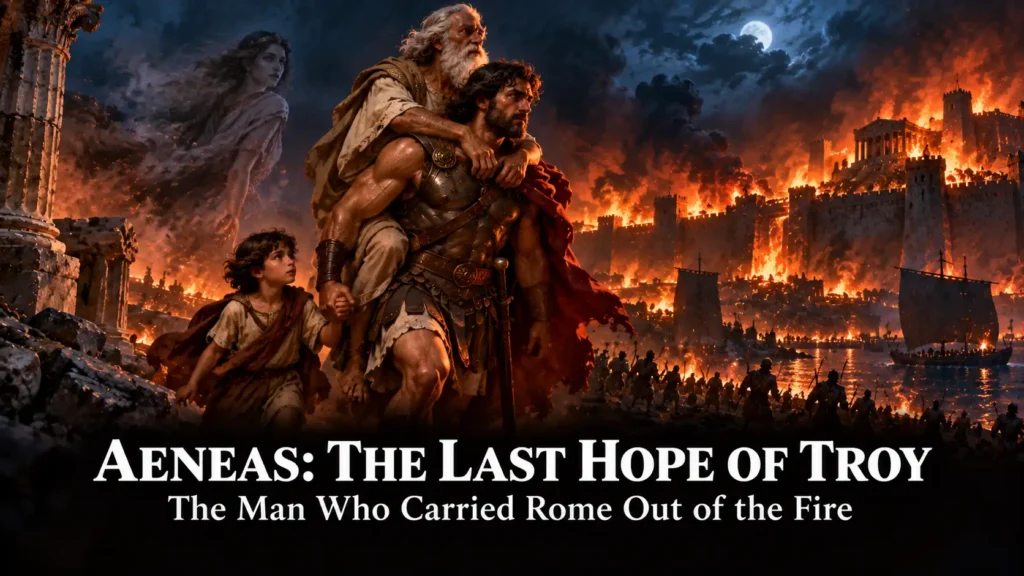
Aeneas – The Last Hope of Troy
Introduction: The Man Who Carried His Father
Every Roman schoolchild knew the image. A man in armour, his city burning behind him, his elderly father on his shoulders, his small son holding his hand, his wife following at a distance. The man is Aeneas. The city is Troy. The image is the beginning of Rome.
Aeneas: The Last Hope of Troy is not a story about a hero who wins a war. It is a story about a hero who loses one and has to keep going anyway. He loses his home, his wife, his king, and his place in the world. He gains a mission that he does not fully understand, given to him by gods he cannot see, and he spends years sailing toward a country he has never visited. The Romans called his defining virtue pietas, and they meant something harder than piety. They meant the willingness to carry a duty even when it costs you everything else.
The hero comes from Greek mythology. Aeneas appears in Homer’s Iliad as a Trojan prince, the son of Anchises and the goddess Aphrodite, a warrior of great piety who is saved from Achilles by Poseidon because he is destined to survive. The Romans inherited the figure and made him their own. In Virgil’s Aeneid, written under Augustus, Aeneas becomes the founder of the Roman race, the son of Venus, and the ancestor of Julius Caesar. Aeneas: The Last Hope of Troy is a Greek hero rewritten as a Roman destiny.
Aeneas and the Fall of Troy: The Night the City Died
The Horse and the Fire
Virgil tells the story in Aeneid Book 2, and he tells it as a survivor’s memory. Aeneas narrates the fall of Troy to Dido, the queen of Carthage, and his account is not a triumphal narrative. It is a story of confusion, noise, and the slow realization that the city is lost. The Greeks have left a wooden horse. The Trojans drag it inside. At night, the soldiers come out, and the city burns.
Aeneas wakes to find his house under attack. He arms himself and goes into the streets, not because he can save the city, but because he cannot bear to do nothing. He sees Cassandra dragged from the temple of Minerva. He sees the old king Priam killed at his own altar. He sees the city collapsing around him, and he understands that Troy is no longer a place. It is a memory.
This is the first lesson of Aeneas and the Fall of Troy. The hero is not defined by victory. He is defined by what he does when victory is impossible. Aeneas does not win the Trojan War. He survives it, and he carries what is left of it with him.
The Flight
The escape is the most famous scene in the Aeneid. Aeneas goes back to his house and finds his father Anchises refusing to leave. Anchises is old and lame, and he has decided to die in Troy. Aeneas begs him. His wife Creusa begs him. His son Ascanius begs him. Then a flame appears above Ascanius’s head, a sign from the gods, and Anchises finally agrees to go.
Aeneas puts his father on his shoulders. He takes his son by the hand. He tells Creusa to follow at a distance. They move through the burning streets, and when they reach the meeting place outside the city, Creusa is gone. Aeneas goes back into Troy to look for her, and her ghost appears to him. She tells him that she cannot go with him, that a new wife and a new kingdom await him in the west, and that he must not grieve for her. He tries to embrace her three times, and three times she slips through his arms like smoke.
The image of the man carrying his father and losing his wife is the emotional centre of Aeneas: The Last Hope of Troy. Aeneas does not leave Troy as a conqueror. He leaves as a refugee, and the Roman story begins with a family broken by war.
Aeneas and Dido: The Queen Who Loved and Lost
The Storm and the Cave
Aeneas and his fleet are blown to Carthage by a storm sent by Juno, who hates the Trojans and knows that their descendants will one day destroy Carthage. Dido, the queen of Carthage, welcomes the refugees. She is a widow, a exile from Tyre, and a woman who has built a city on a foreign coast. She and Aeneas share the experience of losing a home and starting again.
Juno and Venus arrange a union between them. A storm drives them into a cave, and they become lovers. For a time, Aeneas seems to forget his mission. He helps Dido build her city. He wears Carthaginian clothes. He stops being the man who carries Troy and becomes the husband of a queen.
Virgil does not present this as a happy interlude. It is a distraction, and the gods will not allow it. Jupiter sends Mercury to remind Aeneas of his destiny. Aeneas must leave Carthage and go to Italy. He does not ask Dido’s permission. He does not explain. He orders the fleet to prepare in secret, and when Dido discovers the plan, he tells her that he never promised to stay.
The Funeral Pyre
Dido does not accept the departure. She begs, she rages, and she curses Aeneas and his descendants. Then she builds a funeral pyre, climbs onto it, and kills herself with a sword. Virgil makes her death slow and terrible. She is not a villain. She is a woman who has been used by the gods and abandoned by the man she loved.
The Roman poet does not let Aeneas off the hook. Aeneas is pius, but his piety costs Dido her life. He sees her ghost in the underworld later, and she turns away from him without a word. Aeneas and Dido is not a love story with a happy ending. It is a story about what duty does to the people who are left behind.
For a Roman reader, the affair had a political meaning as well. Carthage was Rome’s great enemy, and the Aeneid explains the Punic Wars as the consequence of Dido’s curse. The personal tragedy becomes a historical prophecy. Aeneas’s abandonment of Dido is the origin of the enmity between Rome and Carthage, and the Aeneas and Dido episode is the moment the myth turns into history.
Aeneas in the Underworld: The Future of Rome
Before Aeneas can found his new city, he has to see his father. Anchises has died in Sicily, and Aeneas goes to the Sibyl at Cumae, who tells him that he must descend to the underworld to speak with him. Aeneas in the Underworld is the turning point of the Aeneid, and it is where the Trojan refugee learns what his suffering is for.
Virgil’s underworld is not a simple place of punishment. It is a place of judgment, purification, and waiting. Aeneas sees the souls of the dead, the fields of mourning, and the fortress of Tartarus where the wicked are punished. He sees Dido, and she turns away. He sees the heroes of Troy, and they ask him why he is there. Then he reaches the Elysian Fields, and he finds Anchises.
Anchises shows him the souls of the future Romans. He points to the kings of Alba Longa, to Romulus, to Julius Caesar, and to Augustus. He tells Aeneas that the Romans will be a people of law and empire, that their arts will be to rule, to spare the defeated, and to war down the proud. The prophecy covers more than a thousand years, and it turns Aeneas’s personal journey into a national destiny.
Aeneas in the Underworld is the moment the hero understands why he has lost everything. He is not sailing for himself. He is carrying a future that he will not live to see. The Romans are not yet a people. They are a prophecy, and Aeneas is the man who has to make the prophecy possible.
The Roman Aeneas and Pietas: Duty Above Everything
The word that defines Aeneas in the Aeneid is pius. He is pius Aeneas, the dutiful man, and the Roman Aeneas and Pietas are inseparable. Pietas is not a vague religious feeling. It is the discipline of doing what you owe to the gods, to your family, and to your city, even when it is painful. Aeneas obeys the gods when they tell him to leave Dido. He carries his father out of Troy. He accepts a mission that costs him his home and his happiness.
The Romans admired pietas because they believed it was the virtue that held their state together. A soldier who obeys orders, a magistrate who serves the law, and a citizen who puts the common good before his own life are all acting with pietas. Aeneas is the model of that virtue, and the Aeneid is a poem about how much it costs to be a model.
There is a tension in the poem that Roman readers recognized. Aeneas’s pietas is admirable, but it is also cold. He leaves Dido, and she dies. He kills Turnus at the end of the poem, and the killing is not a clean act of justice. The Aeneid does not resolve the tension. It asks the reader to hold both things at once: the duty is necessary, and the cost is real. The Roman Aeneas and Pietas are not a simple moral. They are a problem that the poem makes us feel.
The War in Italy: Lavinia, Turnus, and the Last Enemy
Aeneas finally reaches Latium, the region of Italy where the Tiber flows into the sea. The local king, Latinus, welcomes him and offers him the hand of his daughter, Lavinia. But Lavinia has already been promised to Turnus, the king of the Rutuli, and Turnus is not willing to give her up. Juno, still hostile to the Trojans, stirs up a war.
The second half of the Aeneid is a war epic, and it is not a simple story of good Trojans and bad Italians. Turnus is brave, and his cause is understandable. He is defending his home and his promised bride against a foreigner who has arrived with a fleet and a claim to the land. Virgil gives Turnus some of the poem’s finest speeches, and he does not make him a villain.
Livy, writing as a historian, gives a simpler version. He says that Aeneas arrived in Italy, was welcomed by Latinus, married Lavinia, and founded the city of Lavinium. When Latinus died, Aeneas became king. He later died in battle against the Rutuli, or disappeared in the river Numicus, and was worshipped as Jupiter Indiges. The historical tradition does not dwell on the killing of Turnus. The epic does.
At the end of the Aeneid, Aeneas kills Turnus. It is not a triumphant moment. Turnus is wounded and on the ground, and he asks for mercy. Aeneas hesitates, and then he sees the belt of Pallas, a young ally who was killed by Turnus, and he kills him in anger. The poem ends with Turnus’s soul fleeing to the underworld, and with Aeneas standing over him. The last word of the Aeneid is not peace. It is a killing.
“These are your arts: to rule the nations with your empire,
to impose the ways of peace, to spare the defeated and to war down the proud.”
— Virgil, Aeneid 6.851–853
Aeneas does not found Rome. He founds Lavinium, and his son founds Alba Longa, and Romulus founds Rome centuries later. But the Romans looked back to him as the beginning, because he carried the gods out of Troy and refused to let them die. He is the last hope of a burning city, and the first hope of a city that did not yet exist.
So the question the myth leaves us with is not whether Aeneas was a hero. He was. It is whether a hero can ever be a good man. He obeys the gods, and Dido dies. He founds a nation, and Turnus dies. He carries his father to safety, and he loses his wife in the smoke. Aeneas: The Last Hope of Troy is a story about duty, and the Romans loved it because duty is what they believed made them great. But the poem never stops asking what duty costs, and who pays for it. Was Aeneas the founder of Rome, or was he the first Roman to discover that founding a city means leaving people behind?
Sources and Further Reading
Primary texts online. Virgil, Aeneid (Loeb Classical Library), Books 1–12, for the full narrative. Book 2 for the fall of Troy, Book 4 for Dido, Book 6 for the underworld, and Books 7–12 for the war in Italy. Homer, Iliad (Loeb Classical Library), for the earliest appearance of Aeneas. Livy, Ab Urbe Condita 1.1–3 (Loeb Classical Library), for the Roman historical tradition of Aeneas’s arrival in Italy and his cult as Jupiter Indiges.
Further reading. The Oxford Classical Dictionary entry on Aeneas summarises the Greek and Roman traditions. Ovid, Metamorphoses 13.623–14.608, gives a Latin account of Aeneas’s wanderings. Dionysius of Halicarnassus, Roman Antiquities 1.45–64, preserves a detailed prose version. The archaeological site of Lavinium, south of Rome, has yielded altars and votive offerings associated with the cult of Aeneas and the Penates, and the annual visit of Roman magistrates to Lavinium is recorded in ancient sources.
Read the previous story: The Twelve Labors of Hercules: The Hero Who Became a God by Finishing the Job

Get the ThePoemStory App — Read Poems Anywhere
