The Stolen Spring: Pluto, Proserpina, and the Pomegranate That Made Winter
In The Stolen Spring, a girl picking flowers in a Sicilian meadow disappears into the earth, and her mother tears the world apart looking for her. This is a story of mythological stories, Roman gods, love and desire, and the underworld and mortality.
The Stolen Spring: The Roman Myth of Spring
Introduction: The Meadow and the Chariot
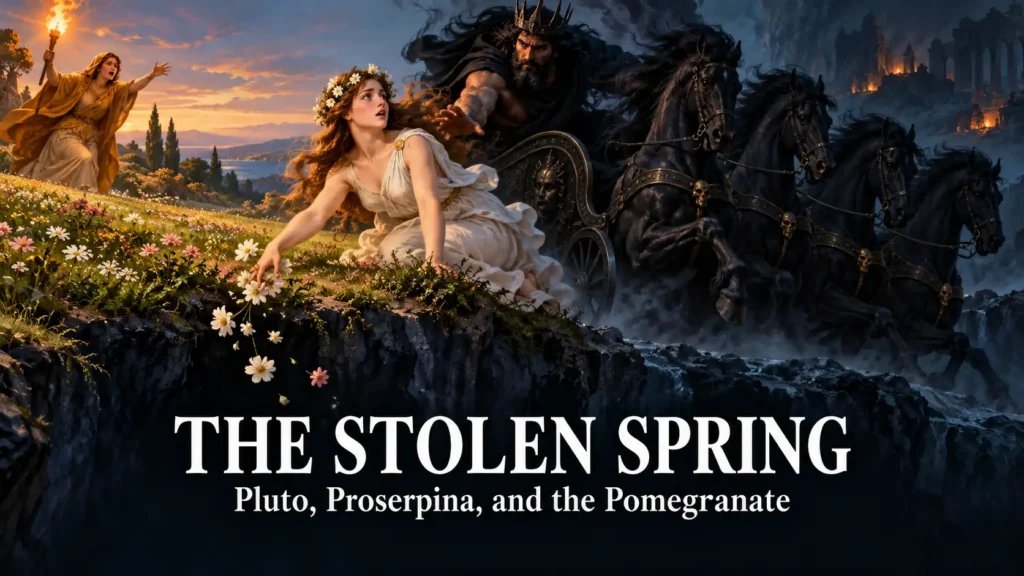
Most Roman myths begin with a god who wants something. This one begins with a girl who is not thinking about gods at all. Proserpina is in a meadow near Enna, in Sicily, picking flowers with her companions. Ovid gives her a child’s delight in the work: violets, lilies, and the narcissus that will be her undoing. The ground is warm. The light is soft. And then the ground opens.
Pluto comes up in a chariot drawn by black horses. He does not ask. He does not court. He takes her. What follows is not a love story, whatever later painters made of it. It is a story about a mother who loses a daughter, a husband who has a claim, and a girl who eats seven seeds in Ovid’s poem, three in his Fasti, and a single seed in the older Greek Homeric Hymn to Demeter. The Stolen Spring is the Roman name for the moment the world learned that spring can be taken away.
The story comes from Greek mythology, where the girl is Persephone and the god is Hades. Ovid retells it in Latin, and in his telling Hades becomes Pluto, Persephone becomes Proserpina, and Demeter becomes Ceres. The Romans did not invent the myth. They inherited it, translated it, and made it their own. Cicero, writing about Roman religion, notes that Proserpina is really a Greek name for Persephone, and that the Romans understood her as the seed of corn hidden beneath the earth[reference:0].
Pluto and Proserpina: The Abduction in the Meadow
Who Pluto Is
Pluto is the brother of Jupiter and Neptune. When the three brothers divided the universe, Pluto received the underworld as his share. He is not evil. He is not a devil. He is a king with a kingdom nobody wants to visit, and in Ovid’s account he is also a man who has been struck by Cupid’s arrow. Venus, worried that her power is shrinking, sends her son to make Pluto fall in love. The abduction is not a random act of violence. It is the result of a divine scheme, and that detail matters because it makes the story stranger and sadder.
Proserpina is the daughter of Ceres and Jupiter. She is young, protected, and happy in the meadow. When Pluto takes her, Ovid does not let the reader forget the witnesses. Cyane, a nymph of the pool, tries to stop the chariot. She rises from the water and appeals to Pluto as a kidnapper rather than a suitor. Pluto does not answer. He strikes the pool with his sceptre, opens the earth, and drives his horses down into the dark. Cyane dissolves into tears and becomes part of the water she tried to defend[reference:1].
The Greek and Roman Origins
In Greece, the story is about a mother and a daughter and the cycle of the seasons. In Rome, it is also about grain, harvest, and the food that keeps a city alive. Ceres is not a distant goddess in Rome. She has a temple, a festival, and a priesthood. Cicero, in his prosecution of Verres, calls Sicily sacred to Ceres and Libera, and says that Libera, whom the Romans also call Proserpina, was carried off from a wood near Henna[reference:2]. When Ovid tells the story of her daughter’s abduction, he is telling a story that Roman readers already knew in their fields and their calendars.
That Roman reading is important. Proserpina is not only a girl who was taken. She is the seed that goes into the ground and comes back. Her mother is not only a grieving parent. She is the goddess who makes the harvest possible. The Roman myth of spring is not a pretty story about flowers. It is a story about survival, about the bargain between the upper world and the lower one, and about what has to be buried before anything can grow.
Ceres and the Search for Her Daughter
The Mother Who Stops the World
Ceres hears nothing at first. She searches Sicily, then the whole earth, carrying torches lit from the fires of Mount Etna[reference:3]. Ovid describes her wandering by land and sea, asking every nymph and every farmer the same question. When she returns to the pool where Cyane tried to stop Pluto, the nymph can no longer speak, but she shows Ceres the girdle of Proserpina floating on the water. Ceres understands. Her daughter has been taken[reference:4].
What follows is one of the most human passages in Roman poetry. Ceres stops being a goddess of agriculture and becomes a mother who has lost a child. She refuses to let the fields produce. The crops fail. The earth goes dry. Famine spreads. The gods begin to worry, because a world without grain is a world without worshippers. Ceres has the power to make the whole planet mourn with her, and she uses it.
Arethusa and the Truth
Eventually the nymph Arethusa tells Ceres what she saw while flowing underground. Proserpina is alive. She is in the underworld, and she is now the wife of Pluto. Arethusa is a strange messenger: she is a spring that travels under the sea from Elis to Sicily, and she has seen Proserpina in the halls of the dead[reference:5]. Her news is not comfort. It is confirmation. Ceres goes to Jupiter and demands her daughter back.
Jupiter listens, but he does not simply grant the request. He tells Ceres that the abduction was not an insult. It was love, or at least what the gods call love. He also points out that Pluto is his brother, and that being the wife of a king is not a small thing. Then he adds the condition that changes everything: Proserpina may return, but only if no food has touched her lips in the lower world. That is the law, decreed by the Fates[reference:6].
Ceres is sure she has won. The reader already knows she has not.
The Pomegranate Seeds: Seven, Three, or One
What Ovid Says
Ovid is precise. Proserpina is wandering in a well-tended garden in the underworld, and she pulls down a reddish-purple pomegranate hanging from a tree. She peels off the yellow rind and takes seven seeds from it, and squeezes them in her mouth[reference:7]. She is not tricked in Ovid’s version. She is not forced. She is a girl in a garden, and she eats.
The number matters because the sources disagree. In Ovid’s Metamorphoses, it is seven. In his Fasti, it is three. In the older Greek Homeric Hymn to Demeter, Hades secretly gives Persephone a single honey-sweet pomegranate seed to eat, so that she will not remain forever with her mother[reference:8][reference:9]. In Apollodorus, Pluto gives her a seed as an assurance that she will not stay too long with her mother[reference:10]. The pomegranate seeds are not a fixed number. They are a variable in a story that every teller adjusts.
What does not vary is the consequence. Food in the underworld creates a bond. Once Proserpina eats, she belongs to the lower world as well as the upper one. The seeds are small, but they are enough to make her a wife and a queen.
Ascalaphus and the Witness
Ovid adds a witness who is not in the Greek hymn. Ascalaphus, a son of Acheron and the nymph Orphne, sees Proserpina eat the pomegranate. He tells. His disclosure prevents her return[reference:11]. Proserpina does not forgive him. She sprinkles his head with water from the Phlegethon and turns him into a screech owl, a bird of ill omen, torpid by day and fearful by night.
The detail is typical of Ovid. The story is not only about a girl and a mother. It is also about the people around them, the witnesses, the informers, and the companions who are changed by what they see. The pomegranate seeds are the cause of the separation, but Ascalaphus is the reason the separation becomes permanent.
The Sirens
Ovid also explains the Sirens. They were Proserpina’s companions when she was gathering flowers. After she disappeared, they searched for her on land and then asked the gods for wings so they could search the sea as well. Their bodies became birds, but their faces and voices remained human[reference:12][reference:13]. The Roman myth of spring is full of these transformations. The world is not repaired after Proserpina is taken. It is rearranged, and the people who loved her are rearranged with it.
The Roman Myth of Spring: Why Winter Happens
The Division of the Year
Jupiter intervenes between his brother and his grieving sister. Ovid says he divides the turning year equally. Proserpina spends so many months with her mother and so many months with her husband[reference:14]. The Homeric Hymn gives her a different share, and the Fasti gives her another. The Greeks and the Romans did not agree on the calendar of the myth, because the myth was always a way of explaining a cycle that people could see in the fields.
What the Roman myth of spring explains is not only the seasons. It explains why the earth is fertile and why it goes barren. Ceres is the grain. Proserpina is the seed. When the seed is below the ground, the world is cold and hungry. When the seed comes back, the world turns green. The story is a calendar in narrative form, and the pomegranate is the clause in the contract that makes the calendar work.
Cicero’s Seed of Corn
Cicero gives the Roman interpretation plainly. Proserpina represents the seed of corn. She is hidden away, and her mother searches for her[reference:15]. This is not a poet’s decoration. It is a philosophical reading that turns the story into an allegory of agriculture. The girl in the meadow is the grain that is buried in the earth. The mother with the torch is the farmer who waits for the harvest. The pomegranate is the moment the seed becomes part of the ground.
For a Roman reader, the story had a public dimension as well as a private one. Ceres was worshipped at the Cerealia, and her temple stood near the Circus Maximus. The Roman myth of spring was not only a story about a family. It was a story about the food supply, the calendar, and the relationship between the city and the land.
What The Stolen Spring Means
The story is often read as a happy compromise. Proserpina gets to be with her mother for part of the year. The earth gets its seasons. Ceres gets her daughter back, at least for a while. But the compromise is not happy for everyone. Proserpina is a wife before she is a daughter. She is a queen of a kingdom she did not choose. The pomegranate seeds are not a trick in Ovid, but they are still a bond that she cannot undo.
The Stolen Spring is also a story about what a mother will do. Ceres stops the harvest. She lets the world starve. She is not a gentle goddess in this story. She is a force that will not be ignored, and her grief is indistinguishable from the failure of the crops. The myth does not separate the personal and the agricultural. It makes them the same thing.
And it is a story about a girl who becomes a queen by eating. Proserpina is not passive, but she is not free either. She makes a choice in a garden, and that choice becomes the shape of her life. The Roman myth of spring is not a simple explanation of winter. It is a story about appetite, belonging, and the price of return.
"She had plucked a purple pomegranate hanging from a bending bough,
and peeling off the yellowish rind, she had eaten seven of the seeds."
— Ovid, Metamorphoses 5.535–537
The pomegranate is small, but it is enough. One seed, three seeds, seven seeds—the number changes with the teller, but the bond does not. Proserpina eats, and the world learns that spring can be lost and found and lost again.
So the question the myth leaves us with is not whether Ceres was right to demand her daughter back. It is whether a compromise that divides a girl between two worlds can ever be called a happy ending. Proserpina returns to the upper world, but she always goes back. The pomegranate seeds are eaten, but they are never digested. Was the division of the year a rescue, or was it a sentence that even a god could not overturn?
Sources and Further Reading
The primary account in Roman literature is Ovid, Metamorphoses Book 5, lines 385–571. The Loeb Classical Library edition and the A. S. Kline translation are both widely available. Ovid gives a different number of seeds in Fasti 4.607–608. The Greek version is the Homeric Hymn to Demeter, lines 370–374, in the Evelyn-White translation. Apollodorus, Library 1.5.3, gives the version in which Pluto gives Persephone a single seed. Cicero, De Natura Deorum 2.26–27, gives the Roman allegorical reading of Proserpina as the seed of corn, and In Verrem 2.4.106–107 places the abduction near Henna in Sicily. Hyginus, Fabulae 145–146, preserves the Latin summary of the search and the division of the year.
Read the previous story: The Thunderer’s Judgement: Lycaon, the Wolf, and the Flood That Followed

Get the ThePoemStory App — Read Poems Anywhere