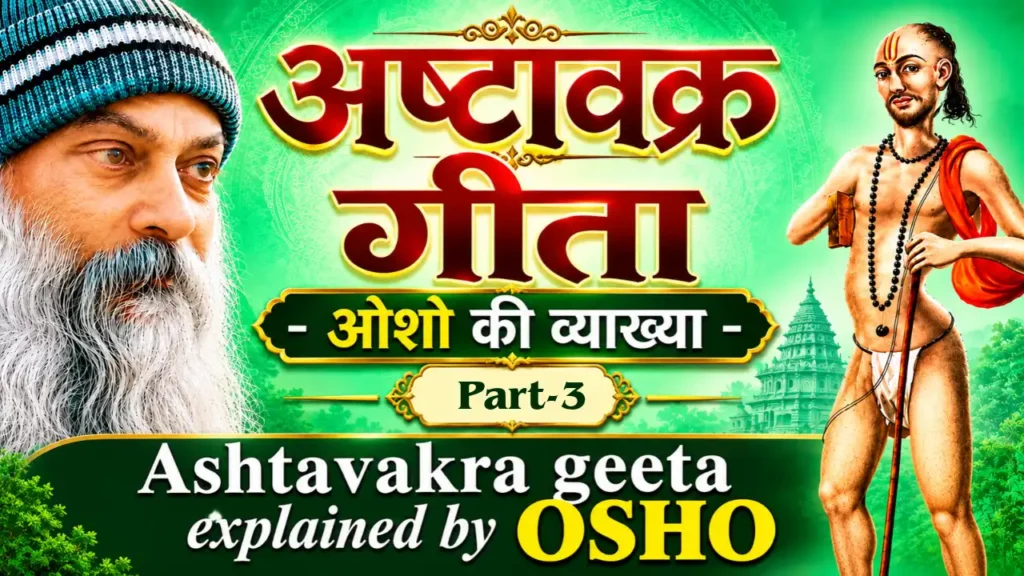
In Ashtavakra Maha Geeta 01, Osho begins a journey through the most radical spiritual text ever spoken—a scripture that demands everything from the seeker and offers nothing in return but the truth. This is a discourse on Self-Realization, Witness Consciousness, Moksha / Liberation, and the Non-Duality (Advaita) that Ashtavakra declared without compromise.
Watch the discourse: Ashtavakra Maha Geeta 01 – Osho Discourse
Ashtavakra Maha Geeta 01: The Purest Declaration of Truth
Introduction: An Unparalleled Journey Begins
We are embarking on a unique journey. Humanity possesses many scriptures, but nothing quite like the Ashtavakra Gita. The Vedas are faded. The Upanishads speak in whispers. Even the Bhagavad Gita lacks the grandeur found in Ashtavakra’s samhita. There is something truly extraordinary here.
The most remarkable thing is that no society, no politics, no system of life has left any imprint on Ashtavakra’s words. Such a pure, trans-rational statement—beyond time and era—exists nowhere else. Perhaps this is why the Ashtavakra Gita has never had the widespread influence it deserves.
This first discourse in the Ashtavakra Maha Geeta series sets the stage for all ninety-one posts to come. Osho explains why this scripture has been neglected, why Krishna’s Gita became popular while Ashtavakra remained obscure, and why the time has now come for this purest of teachings to reach those ready to receive it.
Why Ashtavakra Is Unlike Any Other Scripture
The Gita of Synthesis vs. The Gita of Truth
Krishna’s Gita had a tremendous impact. The first reason: Krishna’s Gita is synthesis. It is not as concerned with truth as it is with harmony. The insistence on synthesis is so deep that if a little truth is lost, Krishna is willing to allow it. Krishna’s Gita is like khichdi—a mixed dish—and therefore appeals to everyone, because everyone finds something of their own in it.
It is difficult to find any sect that does not discover its own voice in the Gita. It is difficult to find any person who does not find support for themselves there. For all these people, Ashtavakra’s Gita would be very difficult.
Ashtavakra is not a synthesizer—he is a truth-teller. He has spoken truth as it is, without any wrapping. He has no concern for the listener. Whether the listener understands or not—that too is not his concern. Such a purest statement of truth was never made before, nor could it ever be made again.
Poetry vs. Mathematics: The Nature of the Statement
Krishna’s Gita is dear to people because it is very easy to extract your own meaning from it. Krishna’s Gita is poetic: two plus two can equal five, two plus two can equal three. With Ashtavakra, no such play is possible. There, two plus two equals exactly four.
Ashtavakra’s statement is the statement of pure mathematics. There is no room for poetry there. Not even the slightest allowance for verse. He has said it as it is. There is no compromise of any kind.
Read Krishna’s Gita and the devotee extracts his own meaning, because Krishna has spoken of devotion too. The karma-yogi extracts his own meaning, because Krishna has spoken of karma-yoga too. The jnani extracts his own meaning, because Krishna has spoken of knowledge too. Krishna sometimes says devotion is supreme, sometimes says knowledge is supreme, sometimes says action is supreme.
Krishna’s statement is very political. He was a politician—a skilled politician! To say only politician is not quite right—he was a cunning diplomat. In his statement, many things have been carefully considered. That is why everyone likes the Gita. That is why there are thousands of commentaries on the Gita; no one worries about Ashtavakra.
Because to agree with Ashtavakra, you will have to leave yourself behind. Unconditionally! You will not be able to take yourself with you. Only if you remain behind will you be able to go. With Krishna, you can take yourself along. With Krishna, you need not change at all. With Krishna, you can fit right in.
The Ink Blot and the Clear Sky
Krishna’s statement is like clouds gathering in the rainy season: see whatever you want to see. Someone sees an elephant’s trunk; someone may see Lord Ganesha. Someone sees nothing at all—they say, what nonsense are you talking about? These are clouds! Smoke—what shapes are you seeing in this?
In the West, scientists place ink blots on blotting paper to test the mind and tell the person, “Look, what do you see in this?” The person looks carefully; they see something or the other. There is nothing there—just ink blots on blotting paper, scattered randomly, not even placed thoughtfully, just a bottle poured out. But the viewer finds something. What the viewer seeks is in their mind; they project it.
Krishna’s Gita is like this—whatever is in your mind will appear. So Shankara sees knowledge, Ramanuja sees devotion, Tilak sees action, and everyone returns home satisfied that Krishna says exactly what our belief is.
Emerson wrote that once a neighbor borrowed Plato’s books. Plato lived two thousand years ago—one of the world’s rare unique thinkers. After some days Emerson asked for the books back. The neighbor returned them. Emerson asked, “How did you find them?” The man said, “Fine. This fellow Plato’s thoughts match mine. Several times I felt—how did this man come to know my thoughts! Plato lived two thousand years ago; he began to suspect that perhaps this man had stolen his ideas!”
This kind of suspicion happens often with Krishna. That is why, over centuries, commentaries on Krishna continue. Every century finds its own meaning; every person finds their own meaning. Krishna’s Gita is like ink blots. It is the statement of a skilled politician.
In Ashtavakra’s Gita, you will not be able to find any meaning of your own. Only if you leave yourself behind will Ashtavakra’s Gita become clear. Ashtavakra’s message is crystal clear. You cannot insert even a little of your own interpretation into it. That is why people have not written commentaries on it. There is no space for commentary; there is no way to twist and turn it; there is no convenience for your mind to add something.
Ashtavakra has made his statement in such a way that centuries have passed, and no one has been able to add anything to it or subtract anything from it. It is very difficult to make such a statement. Such skill with words is very rare.
That is why I say: you are beginning a unique journey.
The Life and Stories of Ashtavakra
The Voice from the Womb
The first event concerning Ashtavakra comes from before his birth—the event in the womb. His father was a great pandit. Ashtavakra was in his mother’s womb. The father recited the Vedas daily, and Ashtavakra listened from the womb. One day, suddenly, a voice came from the womb: “Stop! All this is nonsense. There is no knowledge in this—just a collection of words. Where is knowledge in scriptures? Knowledge is in oneself. Where is truth in words? Truth is in oneself.”
The father was naturally angry. First a father, then a pandit! And a son hidden in the womb speaking like this! Not even born yet! He became enraged, furious. The father’s ego was wounded. Then the pandit’s ego! He was a great pandit, a great debater, a scriptural scholar. In anger, he cursed: “When you are born, you will be crooked in eight places.” Hence the name—Ashtavakra. Born crooked in eight places. Like a camel, twisted and bent in eight places! The father, in anger, deformed the body.
There are other such stories. They say when Buddha was born, he was born standing. His mother stood beneath a tree. Standing… his mother stood… he was born standing. He did not fall to the ground but walked seven steps. At the eighth step he stopped and declared the Four Noble Truths: that life is suffering—having walked only seven steps on earth—that there is a possibility of freedom from suffering; that there is a way to freedom from suffering; that there is a state of freedom from suffering, the state of nirvana.
About Lao Tzu, the story is that he was born old—born at eighty years of age. For eighty years he remained in the womb. There was no desire to do anything, so there was no desire to leave the womb either. There was no desire at all, so there was no desire to enter the world either. When he was born, he had white hair; he was an eighty-year-old old man.
About Zarathustra, the story is that when he was born, he laughed heartily right at birth. But Ashtavakra surpassed all these. These are all events after birth. Ashtavakra gave his entire statement before being born.
These stories are important. In these stories is the entire essence, the extract of these beings’ lives. What Buddha said throughout his life… Buddha taught the Eightfold Path… so he walked seven steps and stopped at the eighth. There are eight limbs in total. The final stage of arrival is right samadhi. Only in that state of samadhi is the entire truth of life known. He declared those Four Noble Truths.
Lao Tzu was born old. People take eighty years and even then such understanding does not come. Even becoming old, how do people become wise! Being old and being wise are not synonymous. Hair can be ripened in the sun too.
Lao Tzu’s story says only this: if there is urgency in life, intensity, then what happens in eighty years can happen in a single moment. If there is intensity of wisdom, it can happen in a single moment. If the intellect is dull, where does it happen even in eighty years!
Zarathustra laughed at birth. Zarathustra’s religion is the only religion in the world that can be called a “laughing religion.” Extremely earthly, a religion of the earth! That is why Parsis do not seem religious to other religious people. Dancing, singing, joyful! Zarathustra’s religion is a laughing religion; a religion of acceptance of life; not denial, not renunciation. Have you seen a Parsi monk—standing naked, renouncing, standing in the sun, sitting in penance? No, in Parsi religion there is no system of torturing life, giving pain. Zarathustra’s entire message is: when God can be found laughing, why find him crying? When you can reach that temple dancing, why sow thorns unnecessarily? When you can go with flowers, why this pessimism? So it is right, the symbol is right that Zarathustra laughed at birth.
Do not look for history in these stories. It happened like this—it did not happen like this. But in these stories there is a very deep meaning.
The Seed and the Flower: Two Ways of Seeing
You have a seed lying before you. When you look at the seed, you get no news of the flower that will be born from it. Not even a hint of what this could become. That this will become a lotus, will bloom, will remain in water and remain untouched by water, will dance on the sun’s rays and the sun will be envious—of its beauty, its softness, its unprecedented dignity, its grace; its fragrance will fly into the sky—looking at the seed, none of this is known. Looking at the seed, one cannot even imagine this, cannot even infer it. But one day it happens.
So we can think in two ways. Either we grasp the seed tightly and say, “What is not visible in the seed cannot happen in the flower either. This is illusion. This is deception. This is a lie.”
This is the basis of those we call rational, skeptical. They say, “What is not visible in the seed cannot be in the flower; somewhere there is illusion.”
That is why the skeptical person cannot accept Buddha; cannot accept Mahavira; cannot accept Jesus. Because they say, “We have known them.”
Jesus came to his village and was greatly surprised: the village people paid no attention. Jesus’s statement is that a prophet is not worshipped in his own village. What could be the reason? Why is the prophet not worshipped in the village? The village people had seen him since childhood: he is the son of Joseph the carpenter! They saw him carrying wood, saw him working the plane, saw him cutting wood, saw him drenched in sweat, saw him playing on the roads, saw him quarreling. The village people have known him since childhood—seen him like a seed. Today, suddenly, how can it be that he has become the son of God!
No, one who has seen the seed cannot accept the flower. They say, “There must be deception, dishonesty. This man is a fraud.”
When Buddha returned home, his father… what the whole world was seeing, the father could not see! The whole world was experiencing a light, news was spreading far and wide, people were coming from distant lands; but when Buddha returned home after twelve years, the father said: “I can still forgive you, although you did wrong, you tortured us, you committed a crime; but I have a father’s heart. I will forgive. The doors are open for you. But throw away this begging bowl! Remove this monk’s garb! This will not do. Come back. This kingdom is yours. I have grown old—who will take care of it? Enough childishness, now stop all this play!”
Buddha said: “Please look at me! The one who went has not returned. Someone else has come. The one who was born in your house has not returned. Someone else has come. The seed has come as a flower. Look carefully.”
The father said, “You are trying to teach me? From the first day, when you were born, I have known you. Deceive someone else. Convince someone else, put someone else in illusion. You cannot put me in illusion. I say again: I know you perfectly. Do not try to teach me anything. I am willing to forgive.”
Buddha said: “You, and you know me! I did not even know myself. Just now rays have descended and I have known myself. Forgive me! But I must say this: what you have seen, that I am not. And as far as you have seen, that I am not. Outside, outside you have seen—where have you seen inside? I was born from you, but you did not create me. I came through you, as a traveler comes through a road; but what does the road have to do with the traveler? Tomorrow if the road says, ‘I know you, you came through me’—that is what you are saying. I was before you too. For births and births my journey has been going on. I have certainly passed through you, as I have passed through others too. There were other fathers, other mothers too. But my being is quite separate.”
It is difficult, very difficult! If you have seen the seed, you cannot trust the flower.
One way is that of the faithless, the logician, the skeptic: they say we know the seed, so the flower cannot be. We know the mud—how can a lotus come from that mud? All wrong! It must be a dream. An illusion. You must have fallen into some web of attachment. Someone deceived you. Some magic, some trickery… This is one path.
There is another path—of the faithful, the lover, the devotee, the heart full of sympathy—they see the flower and travel backward from the flower. They say, “When there is such fragrance in the flower, when such splendor has manifested in the flower, when there is such genius, such virgin freshness in the flower, then it must have been in the seed too. Because what is in the flower could not be if it were not in the seed.”
These stories did not happen exactly as told. Those who saw Ashtavakra’s flower felt that what is today must have been yesterday too—hidden, veiled, behind a curtain. What is at the end must have been at the beginning too; otherwise how would it be born! What is visible at the moment of death must have been present at the moment of birth too; otherwise how would it be born!
So one way is to look backward from the flower, and another is to look forward from the seed. Look carefully—the essence is the same in both, the foundation is the same; but what a difference of earth and sky! The seed-person also says, “What is not in the seed, how can it be in the flower!” That is their logic. The flower-person also says the same. They say, “What is in the flower must have been in the seed too.” Both have the same logic. But their ways of seeing are different. What a difficulty!
Janaka’s Three Questions and the One Answer
The Seeker’s Inquiry
The first sutra begins with Janaka’s question:
जनक उवाच।
कथं ज्ञानमवाप्नोति कथं मुक्तिर्भविष्यति।
वैराग्यं च कथं प्राप्तमेतद् ब्रूहि मम प्रभो।। 1।।
“Janaka said: How does one attain knowledge? How will liberation happen? And how is detachment attained? Tell me this, O Lord.”
A twelve-year-old boy, and Emperor Janaka says to him: “O Lord! Bhagwan! Explain to me! Enlighten this ignorant one!”
Three questions have been asked:
“Katham jnanam! How will knowledge happen?”
Normally we would think, “Is this something to ask? It is filled in books.” Janaka knew that too. What is filled in books is not knowledge; it is only the dust of knowledge, the ashes! When the flame of knowledge burns, ashes are left behind. Ashes accumulate and become scriptures. The Vedas are ashes—they were once burning embers. The sages burned them in their souls. Then they became ashes. Then ashes are assembled, collected, organized. Like when a man dies, we collect his ashes and call them flowers. What funny people! One whom we never called a flower in life, whose bones we collect and say, “We have gathered flowers”! Then we preserve them, make caskets.
Similarly, when a Buddha is alive, you do not listen. When a Mahavira passes by you, you become angry. It seems this man is breaking your dreams, or interfering with your sleep. “Is this the time to wake up? Just now the dream started; just now I began to win in life; just now the arrow began to hit the target, and these gentlemen have arrived! They say everything is meaningless! Just now I won the election, the path to the position was made, and these great souls have come! They say this is all a dream, nothing in it; death will come and take everything! And leave it—when death comes we will see; in the meantime do not raise such matters!”
But when Mahavira dies, when Buddha dies, then we collect their ashes. Then we make Dhammapada, make Vedas. Then we offer flowers of worship.
Janaka also knew that information is filled in scriptures. But he asked: “Katham jnanam? How will knowledge happen?” Because however much you know, knowledge does not happen. Keep knowing, keep knowing, memorize scriptures, become parrots, remember every sutra, let the entire Vedas be imprinted in memory—even then knowledge does not happen.
“Katham jnanam? How will knowledge happen? Katham mukti? How will liberation happen?”
Because what you call knowledge binds you instead—where does it liberate? Knowledge is only that which liberates. Jesus said, truth is that which liberates. Knowledge is only that which liberates—this is the criterion of knowledge. The pandit does not appear liberated, he appears bound. He talks of liberation but does not appear liberated; he seems bound in a thousand bonds.
Have you ever noticed, your so-called saints appear more bound than you! You may be a little free, but your saints are more bound than you. They are fixed in grooves; they cannot rise freely, cannot sit freely, cannot live freely.
Some days ago news came to me that some Jain sadhvis wanted to meet me, but the shravaks do not allow them. This is also a great joke! A sadhu means one who has dropped concern for society; who has set out on the forest journey; who has said, now I need neither your respect nor your honor. But the sadhu-sadhvis say, “The shravaks do not allow! They say do not go there by mistake. If you go there, this door will be closed!” Is this sadhuta? This is dependence, this is slavery. This is upside down. This is as if the sadhu should change the shravak, but instead the shravak is changing the sadhu.
A friend came and told me that a Jain sadhvi reads my books, but secretly; wants to listen to tapes, but secretly. And if someone mentions my name in front of her, she acts as if she never heard it.
Is this liberation?
Janaka asked: “Katham mukti? How does liberation happen? What is liberation? Explain to me that knowledge which liberates.”
Freedom is humanity’s most important aspiration. Get everything, but if slavery remains, it hurts. Get everything, but if freedom is not found, nothing is found. Man wants open sky. No limit! That is man’s innermost, most secret aspiration—where there is no limit, no obstacle. Call it the aspiration to be God, call it the aspiration for moksha.
We have chosen the right word—”moksha.” No other language in the world has such a beautiful word. Heaven, paradise—there are such words, but they do not have the music of moksha. The music of moksha is unique. Its meaning is simply this: such supreme freedom that has no obstacle; freedom so pure that has no limit.
The Four Types of Seekers
Ashtavakra must have looked carefully at Janaka; because the guru’s first task is, when someone asks, to look carefully: “From what source does this inquiry come? Why has the asker asked?” The answer can only be meaningful when why the question was asked is understood, becomes clear.
Remember, one who has attained right knowledge, the true guru, does not answer your question—he answers you! What you ask is less of a concern; why you have asked, what web is hidden in your unconscious behind your asking, what aspiration is actually hidden behind your questions…!
There are four types of people in the world: the knowing, the seeker of liberation (mumukshu), the ignorant, and the foolish. And there are only four types of inquiries in the world.
The inquiry of the knowing one is wordless. It should be said, the inquiry of the knowing one is not even an inquiry—known, nothing remains to know; arrived, the mind became pure, became peaceful, returned home, came to rest! So the inquiry of the knowing one is not like an inquiry at all. This does not mean the knowing one is not ready to learn. The knowing one becomes simple, like a small child—always ready to learn.
The more you learn, the more the readiness to learn increases. The simpler and more guileless you become, the more you open to learning. Winds come, they find your doors open. The sun comes, it does not have to knock on your door. God comes, he always finds you ready.
The knowing one does not accumulate knowledge; the knowing one only attains the capacity for knowing. Understand this properly, because it will be useful later. The knowing one only means: one who is completely open to knowing; who has no prejudice; who has no curtain before knowing; who has no pre-planned scheme, structure for knowing. The knowing one means the meditative one who is mindful.
So Ashtavakra must have looked carefully, peering into Janaka: this person is not a knowing one. He has not attained meditation. Otherwise his inquiry would be silent; there would be no words in it.
There is a mention in Buddha’s life: a fakir came to meet him. A sadhu came. A wandering ascetic. He came and said to Buddha: “I do not have words worthy of asking. I do not have the skill to bind what I want to ask into words. You know already—understand. Whatever is worthy for me, say it.”
This is the inquiry of the knowing one.
Buddha sat silently, he said nothing. After an hour, something happened! That man who was sitting quietly looking at Buddha—tears began to stream from his eyes, he bowed at the feet, saluted and said, “Thank you! I am most fortunate! What I came to receive, you gave.” He got up and left. His face had an unparalleled radiance. He went dancing.
Buddha’s disciples were very surprised. Ananda asked: “Bhante! Bhagwan! A puzzle has happened. First this man says he does not know how to ask; does not know in what words to ask; does not even know what he came to ask; then you know everything—look at me; whatever is necessary for me, say it. First this man himself was a puzzle…what kind of asking is this! And when you do not even know what to ask, why ask at all? Ask what? Very good! Then the matter did not end here; you sat silently, so you remained sitting silently! We have never seen you so silent; when someone asks, you answer. Sometimes it happens that even if no one asks, you answer. Your compassion always flows. What happened suddenly that you became silent and closed your eyes? And then what mysterious thing happened that the man began to transform. We saw him changing. We saw him drowning in some other color. We saw joy coming into him. He is going dancing—filled with tears, overflowing, delighted! He bowed at the feet. His fragrance touched us too. What happened? You said nothing—how did he hear? And we have been with you for so many days, for years—is your grace less upon us? This prasad that was given to him, why do we not receive it?”
But remember, you receive only as much as you can take.
Buddha said, “Listen. Horses…” He spoke of horses to Ananda, because Ananda was a kshatriya, Buddha’s cousin, and from childhood he had a great passion for horses, he was a horseman. A famous horseman, a great competitor! He said, “Listen Ananda!” Buddha said: “There are four types of horses. One—even if you beat them, they do not budge. The worst of horses! The more you beat them, the more they become hatha-yogis, they stand with absolute stubbornness. You beat them and they make it a challenge—let us see who wins! Then there is a second type of horse: beat them and they move, do not beat and they do not move. At least better than the first. Then there is a third type of horse: crack the whip, no need to beat. Just crack the whip, the sound is enough. Even more noble—better than the second. Then Ananda, you must surely know there are also horses that run at the very shadow of the whip, no need even to crack it. This was such a horse. The shadow is enough.”
Ashtavakra must have looked carefully.
When you come and ask me something, the more important question than your question is you. Sometimes you may feel that I have answered what you did not ask. And sometimes you may feel that perhaps I avoided your question, evaded it, answered something else. But always your inner need is more important; what you ask is not so important. Because you yourself do not know properly what you ask, why you ask. The answer given is what you need. Your asking does not decide anything.
Ashtavakra must have seen: Janaka is not a knowing one. Is he ignorant then? Not ignorant either. Because the ignorant one is stiff, full of arrogance. The ignorant one does not know how to bow. This man bowed at the feet of a twelve-year-old boy, did prostration. This is impossible for the ignorant. The ignorant one thinks I already know—who will explain to me! If the ignorant one ever asks, he asks to prove you wrong. Because the ignorant one proceeds with the assumption that I already know; let us see if these people know! The ignorant one asks for examination.
No, Janaka’s eyes are very clear. To me, a twelve-year-old unknown, unfamiliar boy—despite being emperor—he said, “Etad mam bruhi prabho! O Lord, explain to me!” No, he is humble, not ignorant. Is he foolish then? The foolish do not ask. The foolish do not even know that there is any problem in life.
There is a similarity between the foolish and the buddhas. For buddhas there is no problem left; for the foolish the problem has not yet arisen. Buddhas have gone beyond the problem; the foolish are still outside the problem. The foolish one is so unconscious—where is the question for him? “Katham jnanam”—will the foolish ask? “Katham mukti”—will the foolish ask? “How will detachment happen”—will the foolish ask? Impossible!
If the foolish one asks at all, he asks: how to succeed in attachment? If the foolish one asks at all, he asks: how to remain in the world a few more days? Liberation…! No, the foolish one asks: how to make bondage golden? How to stud diamonds and jewels in bondage? If the foolish one asks at all, he asks such things. Knowledge! The foolish one does not even believe that knowledge can happen. He does not accept the possibility. He says, what knowledge? The foolish one lives like an animal.
No, this Janaka is not foolish either—he is a mumukshu.
The word “mumukshu” must be understood. The aspiration for moksha is mumuksha! Not yet reached moksha—not a knowing one; not standing with back turned to moksha—not foolish; not sitting holding conceptions about moksha—not ignorant either—he is a mumukshu. Mumukshu means: simple is his inquiry; neither polluted by foolishness, nor distorted by ignorant conceptions. Pure is his inquiry. He has asked with a simple mind.
Witness Consciousness: The Direct Path to Liberation
Ashtavakra’s Answer: Poison and Nectar
Ashtavakra said:
मुक्तिमिच्छसि चेत्तात विषयान् विषवत्त्यज।
क्षमार्जवदयातोषसत्यं पीयूषवद् भज।। 2।।
“O beloved, if you desire liberation, abandon sense objects as poison, and practice forgiveness, straightforwardness, compassion, contentment, and truth as nectar.”
The word “vishaya” (sense objects) is very valuable—it comes from “visha” (poison). Poison means that which causes death when eaten. Sense objects mean that which causes us to die again and again. Again and again enjoyment, again and again food, again and again ambition, jealousy, anger, envy—eating these again and again, we have died! Because of these again and again, we have died!
Until now, where have we known life in life? We have only known dying. Until now, where is our life a blazing flame of life? It is only the smoke of death. From birth to death, we are simply dying slowly—where are we living? Dying daily! What we call life is a continuous process of dying. We do not yet know life—so how will we live? This body diminishes daily. This strength diminishes daily. These enjoyments and sense objects drain us daily, make us old and decrepit daily. These sense objects and desires are like holes; through them our energy and soul flow daily. In the end the pot becomes empty—that we call death.
Have you ever seen: if you put a pot with holes into a well, as long as the pot is submerged in water it seems full; lift it, pull the rope above water—it begins to empty! There is a loud noise. That you call life? Water streams fall—that you call life? And as the pot comes closer to the hand, it goes on emptying. When it comes into the hand, it is an empty pot! Not a single drop of water! Such is our life.
The child is not yet born, seems full; once born, began to empty. The first day of birth is the first day of death. Began to empty. One day died, two days died, three days died! What you call “birth-day”—it would be better to call “death-day” for greater truth. You have died one year, you say, “One birthday has come!” Fifty years died, you say, “We have lived fifty years, let us celebrate the golden jubilee!” Fifty years died. Death is coming closer, life is going farther. The pot is emptying! Based on what is going away do you think of life, or based on what is coming closer? What inverted mathematics! We are dying daily. Death is creeping closer.
Ashtavakra says: sense objects are like poison, because eating them we only die; life is never obtained from them.
The Five Nectars: Kshama, Arjava, Daya, Santosha, Satya
“If you desire liberation, O beloved, abandon sense objects as poison, and practice forgiveness, straightforwardness, compassion, contentment, and truth as nectar.”
Nectar means that from which life is obtained; from which immortality is obtained; from which that is known which will never die again.
So, Kshama (forgiveness)! Anger is poison; forgiveness is nectar.
Arjava (straightforwardness)! Crookedness is poison; simplicity, straightforwardness is nectar.
Daya (compassion)! Hardness, cruelty is poison; compassion, mercy is nectar.
Santosha (contentment)! The worm of discontent eats away. The worm of discontent is like cancer in the heart; it spreads; it spreads poison.
Contentment—satisfaction with what is; no aspiration for what is not. What is, is more than enough. It is always more than enough. Open your eyes, just look!
Contentment is not something imposed on top of life. Look carefully—what you have received is always more than your need! What you needed has always been received. What you asked for, you always got. You asked for pain, you got pain. You asked for pleasure, you got pleasure. You asked for wrong, you got wrong. Your asking has created your life. Asking is the seed; then life is its harvest. For births and births, what you have been asking for, that you have been receiving. Sometimes you think we are asking for something else, when it comes something else comes—then there was no mistake in your asking; you simply chose the wrong word for asking. For example—you want success, failure comes. You say failure is coming; you asked for success.
But one who asks for success has already accepted failure; he is already afraid of failure inside. Because of failure he is asking for success. And whenever he asks for success, the thought of failure will come. The thought of failure will become stronger. Success may come sometime; but the journey on the path will pass in failure-failure. The feeling of failure will accumulate. It will accumulate so much that one day it will manifest. Then you say we asked for success. But in asking for success, you asked for failure.
Lao Tzu said: ask for success, failure will come. If you really want success, do not ask for success at all; then no one can make you fail.
You say: we asked for respect, insult is coming. Only one who has no respect for himself asks for respect. Only he asks for respect from others. One who is insulted within himself wants to fill his insult from others, to cover it. The aspiration for respect is news that you are feeling insulted within yourself; you are feeling that I am nothing—let others make me something, seat me on a throne, unfurl banners, raise flags in my name—let others do something!
You are a beggar! You have insulted yourself when you asked for respect. And this insult will deepen.
Lao Tzu says, no one can insult me, because I do not ask for respect. This is having already received respect. Lao Tzu says, no one can defeat me, because we have dropped the talk of victory. Now how will you defeat me! You can defeat only one who wants to win—now this is a slightly tangled calculation.
In this world, respect comes to those who did not ask for respect. Success comes to those who did not ask for success. Because those who did not ask for success have already accepted that we are already successful; what more is there to ask? Respect is already in our soul; what more is there to ask? God gave you respect by creating you; whose respect do you want now? God gave you enough dignity! Gave life! Gave this fortune—that you open your eyes, see green trees, flowers, birds! Gave ears—listen to music, the murmur of waterfalls! Gave understanding—that you can become a Buddha! Now what more do you want? You are already honored! God gave you a certificate. Like a beggar, from whom are you asking for certificates? From those who are asking you for certificates?
This is a very funny matter: two beggars standing before each other begging! How will this alms be received? Both are beggars. From whom are you asking respect? Before whom are you standing? You are insulting yourself. And this insult will deepen.
Contentment means: look at what you have. Open your eyes a little, look at what you have already received.
This is Ashtavakra’s very valuable key. This will gradually become clear to you. Ashtavakra’s vision is very revolutionary, very unique—a revolution from the very root.
“Practice contentment and truth as nectar.” Because one who lives with untruth becomes untrue. One who speaks untruth, lives untruth, naturally becomes surrounded by untruth. Their connections with life are severed, roots are broken.
If you want roots in God, those roots can only be through truth. Through authenticity and truth alone can you connect with God. If you want to break from God, create the smoke of untruth, create clouds of untruth around you. The more untrue you become, the farther from God you go.
The Core Sutra: You Are Not the Body
न पृथ्वी न जलं नाग्निर्न वायुद्यौर्न वा भवान्।
एषां साक्षिणमात्मानं चिद्रूपं विद्दि मुक्तये।। 3।।
“You are not earth, water, fire, air, or sky. For liberation, know yourself as the witness consciousness of all these.”
Direct, simple statements; not even an introduction. Ashtavakra has not spoken even two words before meditation arrives, before samadhi is mentioned. One who knows has nothing to convey except samadhi. He spoke those two words too because if suddenly samadhi is mentioned, perhaps you would be startled, would not understand. But two words—and directly samadhi’s matter arrives!
Ashtavakra does not even take seven steps; Buddha walked seven steps, samadhi is at the eighth step. Ashtavakra takes the very first step as the step of samadhi.
“You are not earth, water, air, or sky”—establish yourself in such perception. “For liberation, know yourself as the witness consciousness of all these.”
“Witness” is the sutra. No sutra is more important than this. Become the seer! Let what is happening happen; no need to interfere. This body is water, earth, fire, sky. You are the lamp within which all these—water, fire, earth, sky, air—are illuminated. You are the seer. Deepen this.
This is the most valuable sutra in the world. Become the witness! Through this will come knowledge! Through this will come detachment! Through this will come liberation!
Three questions were asked, one answer is given.
The Immediate Recognition
यदि देहं पृथक्कृत्य चिति विश्राम्य तिष्ठसि।
अधुनैव सुखी शांतः बंधमुक्तो भविष्यसि।। 4।।
“If you separate yourself from the body and rest in consciousness, you will immediately be happy, peaceful, and liberated.”
That is why I say: this is a revolution from the very root. Patanjali does not have the courage to say “immediately.” Patanjali says, “Practice—yama, niyama; cultivate—pranayama, pratyahara, asana; purify. Births and births will pass, then attainment.”
Mahavira says, “Five great vows! And then births and births will pass, then nirjara will happen; then the web of karmas will be cut.”
Listen to Ashtavakra: “Adhunaiva!” Now, here, this very moment! “If you separate yourself from the body and rest in consciousness…” If you begin to see one thing—that this body I am not; I am not the doer and enjoyer; this seer hidden within me who sees everything—childhood was once, so childhood was seen; then youth came, so youth was seen; then old age came, so old age was seen. Childhood is gone, so I cannot be childhood—it came and went; I am! Youth is gone, so I cannot be youth—it came and went; I am! Old age came, is going—so I cannot be old age. Because what comes and goes, how can I be that! I am always. That upon which childhood came, upon which youth came, upon which old age came, upon which a thousand things came and went—I am that eternal one.
Like stations changing—childhood, youth, old age, birth—the traveler keeps moving. You do not consider yourself one with the station! At Poona station you do not think “I am Poona”! Then you reach Manmad, you do not think “I am Manmad”! You know Poona came, went; Manmad came, went—you are the traveler! You are the seer—who saw Poona, Poona came; who saw Manmad, Manmad came! You are the seer!
So the first thing: separate the seer from what is happening!
“Separate the body from yourself and rest in consciousness…” And there is nothing to do. As Lao Tzu’s sutra is—surrender, so Ashtavakra’s sutra is—rest. Nothing to do.
People come to me, they ask, “How to meditate?” They are asking the wrong question. They ask wrongly, so I tell them, “Do it.” Now what will you do! So I tell them to do something, because now you have the itch to do, it must be fulfilled. There is an itch—what will you do! Without scratching it does not happen. But gradually I tire them out by making them do and do. Then they say, “Now free us from this! How long will we keep doing this?” I say, “I was willing from the beginning; but it took you a little time to understand. Now rest!”
The ultimate meaning of meditation is rest.
Chiti vishramya tishthasi—one who settles consciousness in rest; who simply stops in being…!
Nothing is to be done. Because what you are seeking is already found. Because what you are seeking, you never lost. It cannot be lost. It is your very nature. Ayam atma brahma! You are Brahman! Anal haq! You are truth! Where do you search? Where do you run? Where do you run to search for yourself? Stop, stay! God is not found by running, because God is hidden in the runner. God is not found by doing something, because God is hidden in the doer. For God to be, there is no need to do anything—you are!
So Ashtavakra says: Chiti vishramya! Rest! Let go of yourself! Drop this tension! Where are you going? There is nowhere to go, nowhere to reach.
And resting in consciousness… then you will immediately, this very moment, adhunaiva, become happy, peaceful, and liberated.
Unique is this statement! No other scripture rivals it.
Beyond All Identities
न त्वं विप्रादिको वर्णो नाश्रमी नाक्षगोचरः।
असंगोऽसि निराकारो विश्वसाक्षी सुखी भव।। 5।।
“You are not a brahmin or any other caste, nor are you in any ashram, nor are you the object of the senses. You are unattached, formless, the witness of the universe. Be happy!”
Now how can brahmins write a commentary! “You are not a brahmin or any other caste…” Now how can Hindus raise this scripture on their heads! Because their entire religion stands on caste and ashram. And Ashtavakra begins cutting at the very root. He says, you are not a brahmin, not a shudra, not a kshatriya. All this is nonsense! These are all impositions from above. This is all the play of politics and society. You are simply Brahman; not brahmin, not kshatriya, not shudra!
“You are not a brahmin or any other caste, nor are you in any ashram.” Nor is it that you are in any brahmacharya ashram or grihastha ashram, or vanaprastha or sannyas—you are not in any ashram. You are the seer, the witness, passing through all these places.
The Ashtavakra Gita—Hindus cannot claim it is ours. The Ashtavakra Gita belongs to all. If there had been Muslims, Hindus, Christians in Ashtavakra’s time, he would have said, “You are not Hindu, not Christian, not Muslim.” Now such an Ashtavakra…who would build a temple for him! Who would raise his scripture on their heads! Who would become a claimant! Because he is denying everyone. But this is the direct declaration of truth.
“Unattached and formless, you are the witness of all, of the universe—knowing this, be happy!”
Ashtavakra does not say that if you know this, then become happy. Listen to the statement carefully. Ashtavakra says, knowing this, be happy!
Sukhi bhava! Be happy now!
Janaka asks, “How will happiness happen? How will bondage-liberation happen? How will knowledge happen?”
Ashtavakra says, it can happen now. There is no need to delay even a moment. There is no reason to leave it for tomorrow, no need to postpone. This event does not happen in the future; either it happens now or it never happens. When it happens, it happens now. Because there is no time other than “now.” Where is the future? When it comes, it comes as now.
So whoever has attained knowledge—has attained it “now.” Never leave it for “sometime”—that is the mind’s trick. The mind says, how can it happen so soon; let us prepare first!
People come to me. They say, “We want to take sannyas…we will take it sometime.” “Sometime!” You will never take it! If you postpone to sometime, you postpone forever. “Sometime” never comes. If you want to take it, take it now. There is no time other than now. Now is life. Now is liberation. Now is ignorance, now is knowledge. Now is sleep, now awakening can happen. Why sometime? It is difficult for the mind, because the mind says let me prepare first! The mind says, “How can any work happen without preparation? A person has to get a certificate from university—years are needed. To do a doctorate, twenty-five years pass, working hard, then a person becomes a doctor. How can it happen now?”
Ashtavakra also knows: to run a shop, it will not open right now! You have to gather, arrange, bring goods, build the shop, find customers, send advertisements—years pass! In this world, no thing happens “now”; it happens in sequence. True. Ashtavakra also knows, I also know. But there is one event here that happens now—that is God. That is not your shop, not your examination hall, not your university. God does not happen in sequence. God has already happened. It is just a matter of opening your eyes—the sun has already risen. The sun did not wait for your eyes, that when you open your eyes, then it will rise. The sun has already risen. Light is already filled everywhere. Day and night its sound is resounding! The sound of Omkar is resounding everywhere! The continuous unstruck sound is resounding all around! Open your ears! Open your eyes!
How long does it take to open your eyes? Not even that much time does it take to attain God. A moment is what it takes for the eyelid to blink. A moment means as much time as it takes for the eyelid to blink. But to attain God, not even a moment is needed.
Vishvasakshi, asango’si nirakaro. Sukhi bhava!
Be happy now! Ashtavakra’s religion is not on credit—it is cash…!
The Final Declaration: You Are Always Free
धर्माऽधर्मौ सुखं दुःखं मानसानि न तो विभो।
न कर्ताऽसि न भोक्ताऽसि मुक्त एवासि सर्वदा।। 6।।
“Dharma and adharma, pleasure and pain—these are of the mind, not of you. You are neither the doer nor the enjoyer. You are always liberated.”
Liberation is our nature. Knowledge is our nature. God is the way of our being; our center; the fragrance of our life; our being.
Ashtavakra says, “O all-pervading one, O abundant one, O one rich with splendor! Dharma and adharma, pleasure and pain are of the mind.” These are all waves of the mind. Did bad, did good, committed sin, committed virtue, built temples, gave charity—all of the mind.
“You are not the doer, not the enjoyer. You are always liberated.”
Liberation is not an event that we have to make happen. Liberation has already happened in our being! This existence is made of liberation. Every atom, every particle of it is constructed of liberation. Liberation is the metal from which all existence is made. Freedom is nature. This proclamation—just understood, and the revolution happens. Nothing is to be done except understanding. Let this matter enter your mind, listen to it with a full heart—that is all!
Sources and Further Reading
Primary text. The Ashtavakra Gita, also known as the Ashtavakra Samhita, is a classical Advaita Vedanta scripture in the form of a dialogue between the sage Ashtavakra and King Janaka of Mithila. The Sanskrit verses cited in this discourse are from the opening chapter. The complete text has been translated and commented upon by numerous scholars of Indian philosophy.
Osho’s discourses. This synopsis is based on the first discourse in Osho’s Ashtavakra Maha Geeta series, in which he introduces the radical nature of Ashtavakra’s teaching and its contrast with Krishna’s Bhagavad Gita. The full discourse is available on the Osho World YouTube channel.
Further reading. For a deeper exploration of the themes in this discourse, readers may explore works on Advaita Vedanta, witness consciousness (sakshi bhava), and the direct path teachings of Ashtavakra. Osho’s other commentaries on the Ashtavakra Gita, as well as his discourses on the Upanishads and the Bhagavad Gita, provide rich context for understanding the uniqueness of this scripture.
Read the next discourse: Ashtavakra Maha Geeta 02: The Poison and the Nectar – A Synopsis

Get the ThePoemStory App — Read Poems Anywhere