In The Forge of Vulcan, a baby is thrown from heaven because he is not beautiful enough, and the gods spend the rest of eternity depending on what he makes with his hands. This is a story of mythological stories, Roman gods, divine relationships, and the transformation and justice that fire makes possible.
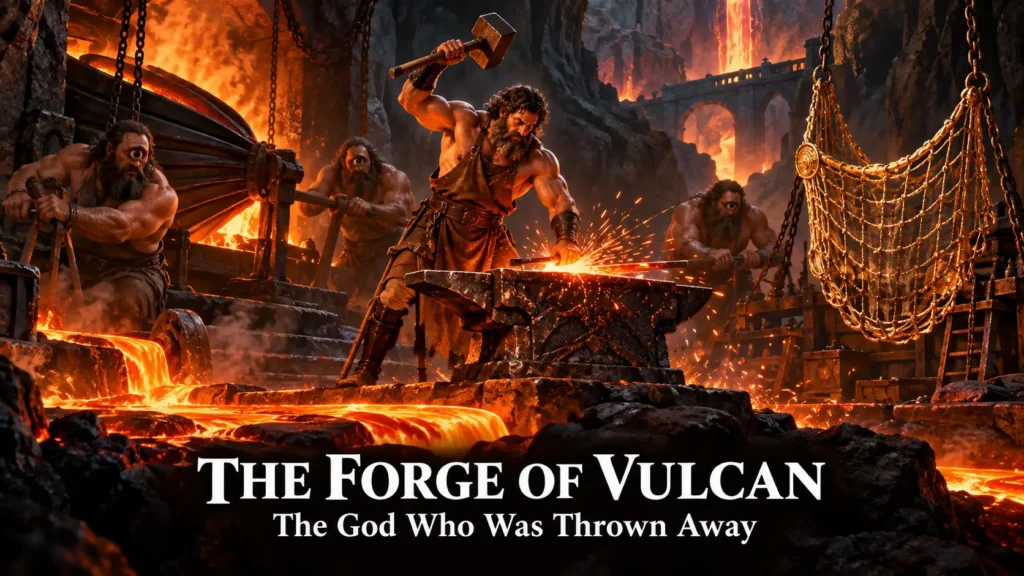
The Forge of Vulcan
Introduction: The God the Gods Needed
Roman mythology is full of gods who are admired. Jupiter is feared. Juno is obeyed. Minerva is listened to. Vulcan is not admired in the same way. He is limping, soot-stained, and covered in the evidence of hard work. He is the god who makes things, and the things he makes are the reason the other gods can do what they do.
The Forge of Vulcan is not a story about a hero who wins a battle. It is a story about a god who is thrown away as a baby, raised by the sea, and then becomes indispensable. He forges the thunderbolts that Jupiter uses to rule the cosmos. He builds the furniture of Olympus. He makes the armour of heroes and the jewellery of goddesses. And he builds one object that turns his own marriage into a public spectacle. The forge is where the world gets its weapons, and it is also where Vulcan gets his revenge.
The story comes from Greek mythology, where the smith god is Hephaestus. The Romans identified Vulcan with Hephaestus at an early date, but they did not simply copy him. Vulcan was already a Roman god of destructive fire, worshipped at the Volcanal in the Forum and at the Volcanalia on 23 August. When the Romans told the Greek stories about Hephaestus, they told them about a god who belonged to their own city, their own calendar, and their own fear of fire.
Vulcan and the Cyclopes: The Workshop Under the Mountain
The Birth and Rejection
Vulcan is the son of Juno, and in some versions of the story he has no father at all. Hesiod says that Hera gave birth to Hephaestus without Zeus, as a response to Zeus having produced Athena without her. Apollodorus preserves the same tradition. The child is born lame, and Juno is ashamed of him. She throws him from Olympus.
This is the first fact of The Forge of Vulcan: the god who will later make the most beautiful objects in the cosmos is rejected because his body is not beautiful. He falls for a day and a night, and he lands in the sea. The sea goddesses Thetis and Eurynome find him and raise him in a cave. He learns to work metal. He makes jewellery for Thetis, and the necklace is so beautiful that Juno notices it and asks where it came from. That is how the mother discovers that the baby she threw away has become a craftsman.
Ovid does not dwell on the rejection in the Metamorphoses, but he does not need to. The Roman Vulcan is a god who has already been thrown away before the poem begins. His lameness is not a decorative detail. It is the mark of the mother who did not want him, and it is the reason he belongs to the margins of Olympus rather than its throne room.
The Forge Under Etna
Vulcan’s workshop is in a cave under Mount Etna, in Sicily. The ancients could see the smoke and the sparks coming from the mountain, and they explained the eruptions as the work of the smith god and his assistants. His workmen are the Cyclopes, the one-eyed giants who forge the thunderbolts of Jupiter. Virgil, in the Aeneid, describes the Cyclopes working in the caverns under Etna, and he names three of them: Brontes, Steropes, and Pyracmon.
The forge is not only a workshop. It is a natural phenomenon that the Romans could see with their own eyes. The Forge of Vulcan is a myth that explains a volcano, and it does so by turning the volcano into a factory. The smoke is the smoke of the furnace. The sparks are the sparks of the hammer. The roar is the roar of the bellows. When a Roman looked at Etna, they saw the workplace of a god who had been thrown away and had made a home in the fire.
The Net of Vulcan: Venus, Mars, and the Trap
The Marriage to Venus
Vulcan’s marriage to Venus is not a love story. In the version preserved in later mythographers, Juno is trapped in a chair that Vulcan made, and Jupiter promises him Venus as a reward if he releases her. Vulcan agrees. He marries the goddess of love and beauty, and the marriage is unequal from the beginning. Venus is the most desirable figure in the cosmos. Vulcan is the smith who works in the dark.
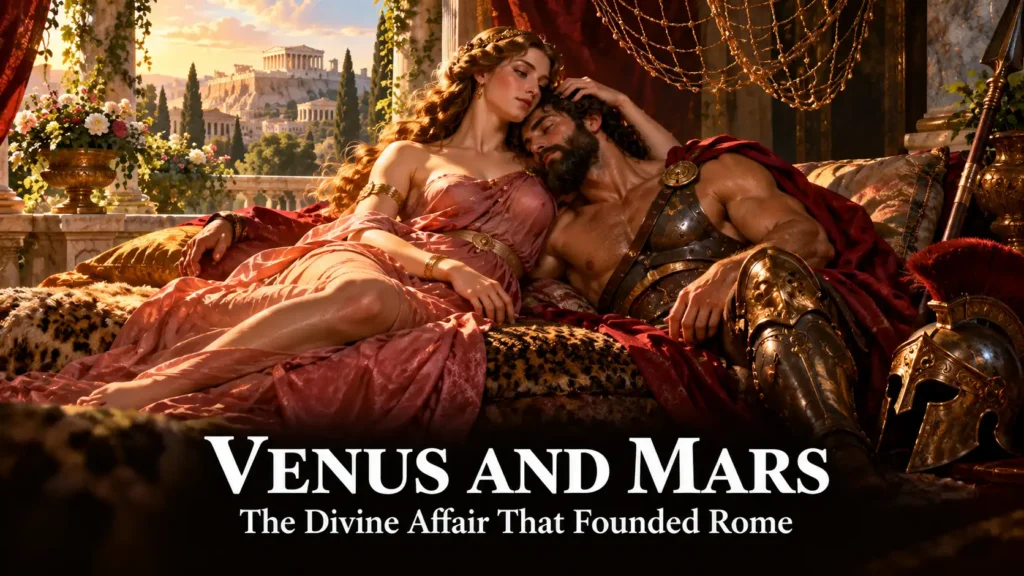
The marriage is also the setup for The Forge of Vulcan‘s most famous object. Ovid tells the story in Metamorphoses Book 4. The Sun sees Venus committing adultery with Mars, and he tells Vulcan. Vulcan does not rage. He does something more dangerous. He goes to his forge and makes a net.
The Invisible Net
Ovid’s description is precise and unsettling. Vulcan fashions tiny links of bronze, a net invisible to the eye, finer than the finest thread, finer than a spider’s web hanging from a ceiling. He arranges it above the bed so that it will drop at the slightest touch. When Venus and Mars lie together, the net falls. They are caught in each other’s arms, stuck fast, unable to move.
Then Vulcan throws open the ivory doors and lets in the gods. The lovers are displayed, body bound to body. Ovid says the gods laughed, and that for a long time this was the most repeated story in all of heaven. The Net of Vulcan is a masterpiece of craft, but it is also a public humiliation. Vulcan does not punish his wife in private. He turns her into a spectacle, and the gods enjoy the show.
The story does not end with a happy marriage. In Ovid, Mars and Venus continue their affair openly after they are caught, because they no longer have anything to hide. The net does not restore Vulcan’s honour. It exposes the fact that he never had it. The god who can make anything cannot make his wife love him.
Vulcan, Venus, and Mars: What the Affair Means
Vulcan, Venus, and Mars is not only a story about a jealous husband. It is a story about three kinds of power. Venus is desire. Mars is violence. Vulcan is craft. The affair puts desire and violence in bed together, and craft builds the trap that catches them. The myth is a triangle of forces that the Romans saw in the world: love, war, and the skill that makes weapons and jewellery.
There is also a Roman political reading. Venus is the ancestor of the Roman people through Aeneas. Mars is the father of Romulus and Remus. Vulcan is the god of the fire that can destroy a city or build its walls. When these three are entangled, the myth is not only about a marriage. It is about the forces that make and unmake Rome.
And there is a human reading that is harder to ignore. Vulcan is the husband who is mocked. He is the worker among gods who are beautiful and idle. He is the one who makes the bed and then catches his wife in it. The Forge of Vulcan is a story about a god whose skill is admired and whose person is not. That is a very old story, and it is not only a Roman one.
The Volcanalia: Fire, Fear, and the Roman Calendar
The Romans did not only tell stories about Vulcan. They built him a shrine and gave him a festival. The Volcanal, the oldest sanctuary of Vulcan in Rome, stood at the foot of the Capitoline Hill, in the north-west corner of the Forum. It was an open-air precinct with a perennial fire, and Roman tradition attributed its foundation to Romulus. The Volcanalia was held on 23 August, at the hottest and driest time of the year, when the risk of fire was greatest.
The Volcanalia was not a celebration of craftsmanship. It was a ceremony to avert fire. The Romans sacrificed live fish from the Tiber by throwing them into a fire, an offering of creatures that are usually safe from flame, to persuade Vulcan to spare the things that were not. The Forge of Vulcan is a myth about the god who works with fire, but the Roman cult was about the god who can take fire away. Vulcan is both the maker and the threat. He is the god of the forge and the god of the volcano, and the Romans prayed to him to keep his own element under control.
This is the Roman difference. In Greece, Hephaestus is the divine craftsman, the comic cuckold, the god of the workshop. In Rome, Vulcan is also a god of destructive fire, worshipped outside the city walls, associated with volcanic forces, and invoked to prevent the burning of houses and harvests. When Ovid tells the story of Venus and Mars, he is telling a Greek story. When a Roman prayed at the Volcanal, they were praying to a god who belonged to their own city and their own fear.
“He fashioned from bronze tiny links of bronze,
a net invisible to the eye, finer than a spider’s web.”
— Ovid, Metamorphoses 4.176–177
The forge is where the world gets its weapons, and it is also where Vulcan gets his revenge. He can make a net that no god can see, but he cannot make a marriage that holds. The god who was thrown away becomes the god the others cannot do without, and that is the shape of his story.
So the question the myth leaves us with is not whether Vulcan was a good craftsman. He was the best. It is whether craft can ever be enough. He makes the thunderbolts that keep Jupiter on his throne, and he makes the net that turns his own marriage into a joke. The gods laugh at Venus and Mars, but the laugh is also at him. Was The Forge of Vulcan a place of power, or was it a place where a rejected god learned to make things that could never make him loved?
Sources and Further Reading
Primary texts online. Ovid, Metamorphoses Book 4 (Loeb Classical Library), lines 167–189, for the net of Vulcan. Virgil, Aeneid Book 8 (Loeb Classical Library), lines 416–453, for the forge under Etna and the Cyclopes.
Further reading. Apollodorus, Library 1.3.5, for the birth of Hephaestus and the rejection by Hera. Hesiod, Theogony 927, for the parthenogenesis of Hephaestus. Hyginus, Fabulae 166, for the trap and the marriage to Venus. The Oxford Classical Dictionary entry on Volcanus (Rose and Scheid) summarises the Roman cult, the Volcanal, and the Volcanalia of 23 August. Ovid, Fasti 6.235–256, mentions the games of the Volcanalia in the Campus Martius.
Read the previous story: The Stolen Spring: Pluto, Proserpina, and the Pomegranate That Made Winter
Read the story before that: The Thunderer’s Judgement: Lycaon, the Wolf, and the Flood That Followed

Get the ThePoemStory App — Read Poems Anywhere