The Story of the Hare on the Moon from Jataka Tales: The Selfless Hare Who Offered His Body in Charity
A timeless tale of selfless charity and sacrifice from the Buddha Jataka Tales, exploring the depths of Jataka Stories Buddhism, the profound lessons of the Buddha Life Story, and the transformative power of ancient Buddhist Stories.
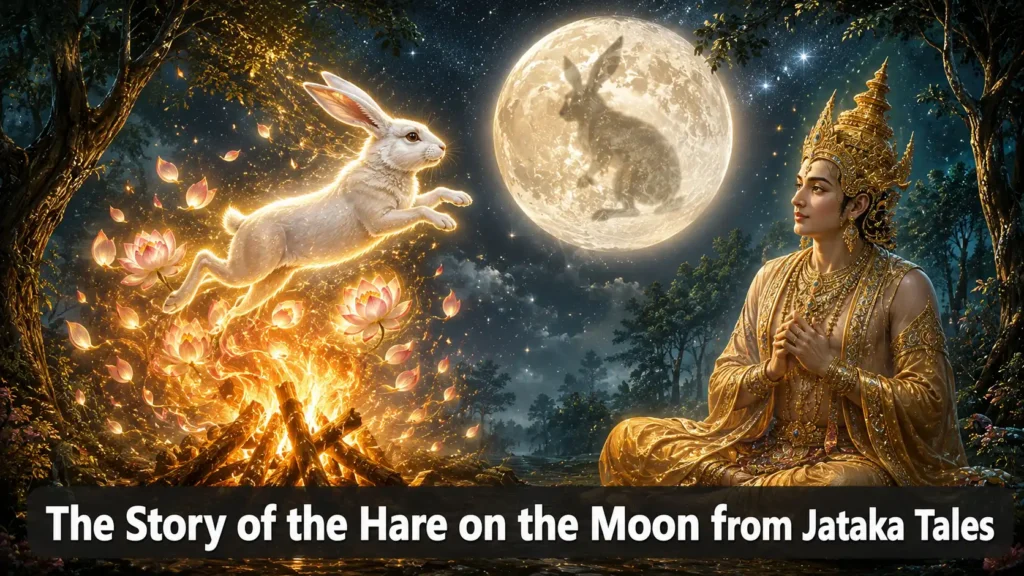
Introduction: The Hare Who Offered Himself
The Story of the Hare on the Moon from Jataka Tales is one of the most beloved and inspiring tales in the Buddhist tradition. It tells of a hare who, driven by boundless compassion, resolved to offer his entire body in charity. The Story of the Hare on the Moon from Jataka Tales explains the origin of the shadow on the moon that resembles a hare—a symbol of selfless giving.
This beautiful Jataka illustrates the perfection of generosity (dana paramita) at its highest level. The Story of the Hare on the Moon from Jataka Tales teaches that true charity is not measured by the value of what is given but by the purity of the heart behind the gift. The hare had nothing to offer but himself—and he offered that without hesitation.
As we journey through The Story of the Hare on the Moon from Jataka Tales, we discover that even the humblest being can achieve the highest virtue. The Story of the Hare on the Moon from Jataka Tales reminds us that the mark on the moon is not merely a celestial phenomenon but a testament to the power of selfless love.
Table of Contents
The Story of the Hare on the Moon from Jataka Tales
The Three Friends
In one of his previous births, the Bodhisatta was born as a hare in Varanasi. He was no ordinary hare—he possessed the wisdom of countless past lives and a heart overflowing with compassion. Despite being a humble creature of the forest, he lived a life of remarkable virtue, always seeking opportunities to help others and practice generosity.
The hare had three close companions: a monkey, a jackal, and an otter. Despite their different natures, they shared a bond of friendship and mutual respect. Together, they roamed the forests, played in the meadows, and lived in harmony with all creatures. The hare, with his wisdom, often guided his friends toward virtuous actions and taught them the value of compassion.
These four friends—so different yet so united—became the subject of The Story of the Hare on the Moon from Jataka Tales. Their shared commitment to virtue would soon lead them to an act of extraordinary generosity. This was the beginning of The Story of the Hare on the Moon from Jataka Tales.
The Day of Charity
One day, the hare gathered his friends and spoke to them about the importance of charity. “My friends,” he said, “the Uposatha day—the sacred day of fasting and alms-giving—will occur tomorrow. It is believed that one who stands fast in moral practice and gives alms on this day earns a great reward. Let us resolve together to practice charity with all our hearts.”
His friends agreed enthusiastically. They each pledged to give whatever they could to any beggar who might come their way. The otter, the jackal, and the monkey went their separate ways, preparing for the sacred day. The hare, too, began his preparations, but his thoughts were of a different kind.
The next day dawned bright and clear. The otter, true to his word, went to the banks of the Ganga River. There, he found seven red fishes that had been abandoned on the shore. He gathered them carefully and brought them back, ready to offer them to any needy visitor. “These fish will make a fine meal for a hungry soul,” he thought with satisfaction.
The jackal, a clever creature, ventured near a human settlement. There, he found a lizard and a pot of milk-curd that had been carelessly left behind. Although he had taken them without permission, he justified his actions by thinking, “This will feed a hungry beggar. My intention is pure.”
The monkey climbed the tallest trees and gathered a bunch of ripe, golden mangoes. He carried them back triumphantly, proudly displaying his gift. “These mangoes are sweet and nourishing,” he declared. “Any beggar will be delighted to receive them.”
But the hare, when he went to browse the grass, felt a deep sense of unease. The Story of the Hare on the Moon from Jataka Tales was about to reach its most poignant moment. This was the crisis that The Story of the Hare on the Moon from Jataka Tales would ultimately resolve through supreme sacrifice.
The Hare’s Resolve
As the hare nibbled on the grass, a thought troubled him deeply. “What can I offer? Grass is not a fit gift for a beggar. It has no value, no nourishment. It cannot satisfy hunger. My friends have gathered fine gifts—fish, milk-curd, mangoes. But I have nothing of worth.”
He sat in deep contemplation, his heart heavy. Then, suddenly, a brilliant idea illuminated his mind. “I do not have external possessions to give,” he realized, “but I have something far more precious. I can offer my own body. My flesh can feed a hungry beggar. My life can nourish another being.”
This was the question at the heart of The Story of the Hare on the Moon from Jataka Tales—what is the greatest gift one can offer? The hare’s answer was simple yet profound: one can offer oneself.
“I will give my entire body in charity,” the hare declared. “If a beggar comes to me seeking food, I will offer myself without hesitation. Let my flesh be his meal. Let my life be his sustenance. This is the highest act of giving.”
His resolve was unshakable. The hare had transcended ordinary charity and embraced the perfection of generosity. The Story of the Hare on the Moon from Jataka Tales would now demonstrate the ultimate expression of giving.
Sakka’s Test
In the celestial realms, Lord Sakka (Indra), the king of the devas, sensed the hare’s extraordinary resolve. He was deeply moved—but also curious. “Is this hare truly ready to give his life?” Sakka wondered. “Or is his resolve merely words spoken in the heat of emotion?”
To test the hare’s virtue, Sakka descended from the heavens in the guise of a weary, aged ascetic. His robes were tattered, his face was gaunt with hunger, and his steps were slow with exhaustion. He approached the hare and spoke in a trembling voice.
“O wise and compassionate hare,” the disguised Sakka said, “I am a poor ascetic who has wandered for many days without food. I have heard of your virtue and your commitment to charity. Please, I beg you, give me something to eat so that I may regain my strength.”
The hare’s heart leapt with joy. “At last,” he thought, “an opportunity to fulfill my vow!” He looked at the ascetic with eyes full of compassion and said, “Noble sir, I have nothing to offer you but myself. Please, kindle a fire, and I will leap into it. When my body is roasted, you may eat my flesh and be satisfied.”
This was the moment of supreme testing in The Story of the Hare on the Moon from Jataka Tales. The hare’s willingness to offer himself would soon inspire even the king of the gods.
Sakka, still disguised, created a heap of burning coals with his divine power. The flames rose high, crackling with intense heat. He watched the hare closely, waiting to see if he would falter.
The hare did not hesitate. He approached the fire, but paused briefly. Not out of fear—but out of compassion. He shook himself three times, ensuring that no insects were clinging to his fur. “I must not harm any creature, even by accident,” he thought. “If insects are on my body, they will burn too. I must ensure their safety.”
This act of compassion, even in the face of his own death, revealed the purity of the hare’s heart.
The Leap of Faith
With his body free of insects and his heart filled with boundless love, the hare looked at the fire. His eyes held no fear—only determination and joy. He was about to perform the greatest act of charity a mortal being could ever perform.
“Let this act of selfless giving be my offering to all beings,” the hare prayed. “May my sacrifice inspire others to practice generosity. May my body nourish this hungry ascetic. May my death bring life to another.”
Offering his whole body, the hare leapt into the blazing fire. The flames rose to receive him, and the heat was intense. The Story of the Hare on the Moon from Jataka Tales teaches us that true courage comes not from the absence of fear but from the presence of love.
But then, a miracle occurred. The fire, instead of burning him, became cool and gentle. The flames transformed into petals of lotus flowers, and the heat became a soothing warmth. The hare landed in the fire unharmed, his body radiant with an inner light.
This was the question at the heart of The Story of the Hare on the Moon from Jataka Tales—how can supreme sacrifice be rewarded with divine protection?
Sakka, unable to contain his amazement, revealed his true form. His divine radiance filled the forest, and his voice echoed across the heavens. “O wise and noble hare! Your virtue is beyond measure. I came to test you, but instead, you have tested me. Your compassion, your courage, and your selflessness have moved even the gods.”
Sakka continued, “O wise hare! Be thy virtue known throughout this whole aeon! Your sacrifice shall never be forgotten. I will make your deed eternal.”
He then squeezed the mountain and extracted its essence. With this divine substance, he daubed the sign of the hare on the orb of the moon.
Thus, The Story of the Hare on the Moon from Jataka Tales was immortalized in the night sky, where the mark of the hare still shines bright today.
The Mark on the Moon
From that day forth, the mark of the hare has been visible on the face of the moon. When we look up at the night sky, we see the shadow that resembles a hare—a living reminder of the Great Sacrifice.
The Story of the Hare on the Moon from Jataka Tales has been told and retold across centuries and cultures. In Buddhist tradition, it stands as the ultimate example of generosity—the willingness to give not only possessions but one’s very life for the benefit of another.
The hare’s sacrifice was not an act of desperation or despair. It was an act of supreme compassion—a conscious choice to offer his body for the well-being of a fellow being. He did not expect reward or recognition. He gave freely, joyfully, and without reservation.
And yet, the reward came—not in the form of material riches, but in the form of eternal remembrance. The hare’s deed became a celestial monument, forever reminding humanity of the power of selfless love.
The mark on the moon is not just a shadow—it is a teaching. It tells us that even the humblest creature can achieve the highest virtue. It tells us that generosity knows no boundaries. It tells us that love, when offered without condition, can transform the world.
Thus, The Story of the Hare on the Moon from Jataka Tales continues to inspire countless generations. The hare’s legacy shines bright in the night sky, a beacon of compassion for all who gaze upon it.
Moral of the Story: The Perfection of Selfless Generosity
The Story of the Hare on the Moon from Jataka Tales is one of the most profound teachings on generosity in Buddhist literature. It illustrates the perfection of giving (dana paramita) at its highest level—the willingness to offer one’s own life for the benefit of another.
In Buddhist philosophy, generosity is the first of the perfections (paramitas) and the foundation of all spiritual progress. Without the willingness to give—to let go of attachment—one cannot progress on the path to enlightenment. The hare’s sacrifice is the ultimate expression of non-attachment. He had nothing to give but himself, and he gave that without hesitation.
The hare’s compassion was not limited to his own kind. He shook himself three times to ensure that no insects would be harmed. This act reveals the Bodhisattva’s commitment to non-harming (ahimsa)—a commitment that extends even to the smallest creatures. True generosity, The Story of the Hare on the Moon from Jataka Tales teaches, is not only about giving but also about ensuring that our giving does not cause harm.
Sakka’s test reminds us that the universe responds to genuine virtue. The fire that should have consumed the hare instead became a bed of flowers. This is not magic—it is the natural law of karma at work. Virtuous actions create virtuous results. The hare’s selfless act generated a response of protection and honor from the divine realm.
The mark on the moon is a teaching device. Whenever we gaze at the moon, we are reminded of the hare’s sacrifice. The Story of the Hare on the Moon from Jataka Tales transforms a celestial phenomenon into a timeless lesson. It tells us that even the smallest being can achieve the greatest virtue.
This Jataka is unique in its explanation of a natural phenomenon. The hare’s mark on the moon is not just a story—it is a living reminder of compassion, visible to all who look up. In a world often driven by greed and selfishness, the hare’s example calls us to a higher path.
The Story of the Hare on the Moon from Jataka Tales teaches us that our gifts need not be grand to be meaningful. A heartfelt smile, a kind word, a moment of attention—these are all forms of generosity. But when we are called to give more, The Story of the Hare on the Moon from Jataka Tales shows us that the greatest gift we can offer is ourselves.
In our world of self-interest, The Story of the Hare on the Moon from Jataka Tales invites us to examine our capacity for giving. By exploring The Story of the Hare on the Moon from Jataka Tales, we gain timeless wisdom about the power of selfless generosity and the eternal reward of pure-hearted giving.
Read the previous story: The Story of Two Swans from Jataka Tales – The Loyal Commander Who Refused to Abandon His King

Get the ThePoemStory App — Read Poems Anywhere