The Story of Chaddanta Elephant from Jataka Tales: The Six-Tusked King Who Forgave His Hunter
A timeless tale of forgiveness and non-hatred from the Buddha Jataka Tales, exploring the depths of Jataka Stories Buddhism, the profound lessons of the Buddha Life Story, and the transformative power of ancient Buddhist Stories.
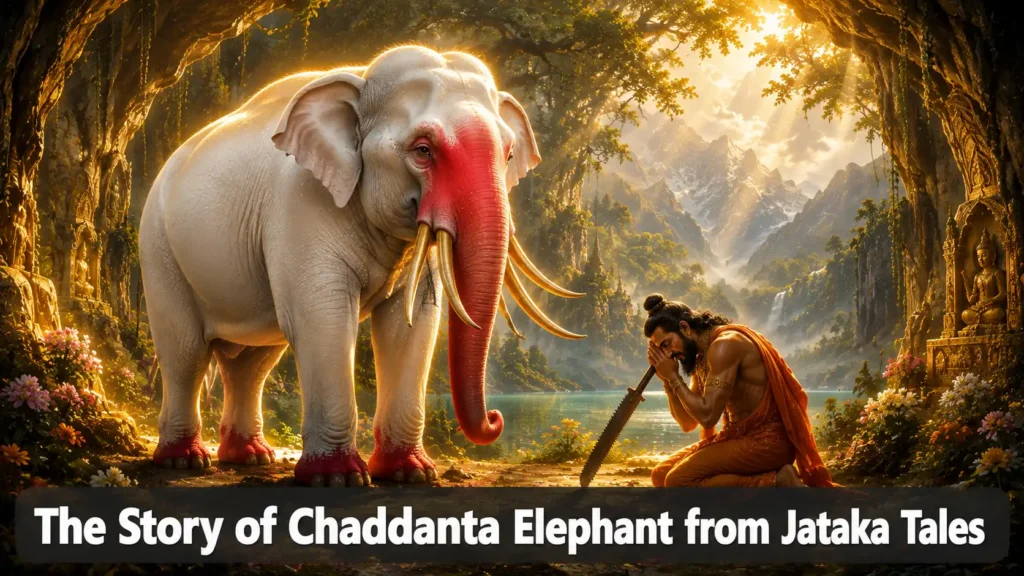
Introduction: The Six-Tusked King
The Story of Chaddanta Elephant from Jataka Tales is one of the most powerful and emotionally complex tales in the Buddhist canon. It recounts the life of the Bodhisatta as Chaddanta, a magnificent six-tusked elephant king whose virtue was tested by jealousy, revenge, and ultimately, forgiveness. The Story of Chaddanta Elephant from Jataka Tales explores themes of karmic consequence, the danger of resentment, and the liberating power of non-hatred.
This Jataka is unique in its portrayal of the Bodhisatta’s forbearance in the face of betrayal. The Story of Chaddanta Elephant from Jataka Tales shows that even when wronged, the Bodhisatta remained compassionate. The Story of Chaddanta Elephant from Jataka Tales teaches that forgiveness is not weakness but the highest form of strength.
As we journey through The Story of Chaddanta Elephant from Jataka Tales, we discover that hatred only harms the one who harbors it. The Story of Chaddanta Elephant from Jataka Tales reminds us that true peace comes from letting go of resentment.
Table of Contents
The Story of Chaddanta Elephant from Jataka Tales
The Golden Cave
In one of his previous births, the Bodhisatta was born as the king of the Chaddanta elephants. Chaddanta—literally meaning “having six tusks”—was among the highest classes of elephants in Pali sources, revered for their extraordinary size, strength, and wisdom. The elephant king’s body was pure white, radiant like fresh snow under the morning sun. His face and feet glowed with a reddish hue, and his six tusks gleamed like polished gold.
Chaddanta lived in a magnificent golden cave called Kanchana-guha, nestled on the bank of a serene lake in the Himalayas. The cave sparkled with veins of gold, reflecting the sunlight and casting a warm, luminous glow throughout the interior. The lake beside it was crystal clear, its waters fed by melting snow from the surrounding peaks. Lotuses of every color bloomed upon its surface, and the air was filled with the sweet fragrance of flowers and the gentle hum of bees.
The elephant king had two queens: Mahasubhadda and Chullasubhadda. Mahasubhadda was his chief consort, beloved for her grace and wisdom. Chullasubhadda was the younger queen, beautiful but possessed of a proud and sensitive heart. Chaddanta loved them both equally, cherishing their companionship and ruling his herd with justice and compassion.
But little did he know that The Story of Chaddanta Elephant from Jataka Tales would soon take a tragic turn. A moment of innocent play would set in motion events that would test his virtue to its limits. This was the beginning of The Story of Chaddanta Elephant from Jataka Tales.
The Incident at the Sal Tree
One beautiful day, after bathing in the cool waters of the lake, Chaddanta and his queens frolicked joyfully through the forest. The sun was warm, the sky was clear, and the elephants’ hearts were light with happiness. They splashed water at each other, trumpeted with delight, and roamed through the flowering groves.
In a moment of playfulness, Chaddanta sportingly struck a fully blossomed sal tree with his mighty trunk. The tree shook violently, showering its contents upon the elephants below. But what fell upon each queen was very different.
Upon Mahasubhadda, the flowers and golden pollen of the tree rained down like a blessing. She was covered in beautiful blossoms, their fragrance clinging to her skin like perfume. The scene was enchanting—she looked like a queen adorned by nature herself.
But upon Chullasubhadda, the dry leaves, twigs, and red ants from the tree fell. She was showered not with beauty but with debris. The dry leaves scratched her skin, the twigs tangled in her hair, and the red ants crawled upon her, causing discomfort and irritation.
Chullasubhadda felt deeply insulted. In her heart, she perceived this as a deliberate slight. “Why did he favor Mahasubhadda with flowers while I received only rubbish?” she thought bitterly. “He loves her more than me. He has humiliated me before all the elephants.”
This was the moment that would transform The Story of Chaddanta Elephant from Jataka Tales into a tale of tragic consequence. The perceived insult festered in Chullasubhadda’s heart, growing into a consuming resentment.
The Queen’s Desertion
Chullasubhadda could not contain her fury. Without a word, she turned and walked away from her husband. Chaddanta, oblivious to the depth of her distress, called out to her. “Where are you going, my queen? Come back and join our play!”
But Chullasubhadda ignored him. She marched deeper into the forest, her heart burning with indignation. She was determined to leave him forever—to abandon the golden cave, the beautiful lake, and the husband she felt had betrayed her.
Chaddanta, realizing something was wrong, followed her. “My queen, what troubles you? Have I done something to offend you? Speak to me, and I will make amends.”
But she refused to speak. She refused to listen. Her wounded pride had closed her heart to reason. She continued walking, leaving behind her home, her husband, and her life as queen of the elephants.
Chaddanta searched for her tirelessly. He roamed the forests, calling her name, hoping to find her and bring her back. But she had vanished into the wilderness, determined never to return. The loss of his queen weighed heavily on his heart, yet he bore his grief with patience and dignity. The Story of Chaddanta Elephant from Jataka Tales reminds us that resentment can destroy even the most beautiful relationships.
The incident at the sal tree was an accident—a moment of innocent play. But Chullasubhadda’s interpretation of it as a deliberate insult turned a trivial event into a lifelong grudge. The Story of Chaddanta Elephant from Jataka Tales teaches us that our perceptions shape our reality. What we choose to see in others’ actions—whether generosity or insult—determines our peace or suffering.
This was the tragedy that The Story of Chaddanta Elephant from Jataka Tales would ultimately reveal—the corrosive power of unchecked resentment.
The Rebirth and Revenge
In time, Chullasubhadda died. But her resentment did not die with her. It followed her into her next life, carried like a burning ember in her heart. She was reborn in the royal family of the Madda kingdom, into a life of privilege and status. As she grew, her beauty and grace made her the most sought-after princess in the land.
She was eventually married to the king of Varanasi, becoming his chief consort. She had everything a queen could desire—wealth, power, respect. Yet, even in her royal splendor, she could not forget her perceived humiliation in the kingdom of Chaddanta. The memory gnawed at her like a persistent wound.
“That elephant king humiliated me,” she thought bitterly. “He favored his other queen over me. He let dry leaves and ants fall upon me while showering her with flowers. I will never forgive him. I will have my revenge.”
The queen knew of Chaddanta’s magnificent six tusks. They were legendary—gleaming like gold, more beautiful than any treasure in the world. If she could not harm Chaddanta himself, she could at least deprive him of his most prized possession. She hatched a plot to have his tusks cut off and brought to her.
She went to the king of Varanasi, her husband. “My king,” she said sweetly, “I have heard of the legendary Chaddanta elephant with six golden tusks. I have dreamed of them. I cannot rest until I possess them. Please, my lord, send your hunters to capture them for me.”
The king, who adored his queen, could not refuse her. He summoned all the hunters in his kingdom. But none dared to take on the mission. The Chaddanta elephant was legendary, elusive, and dangerous. To hunt him was to court death. The king offered increasingly generous rewards, but still, no hunter came forward.
Finally, a hunter named Sonuttara volunteered. He was desperate—his family was starving, and the reward offered by the king would ensure their survival for generations. Little did he know that The Story of Chaddanta Elephant from Jataka Tales would change his life forever.
This was the question at the heart of The Story of Chaddanta Elephant from Jataka Tales—how far would a vengeful queen go to satisfy her wounded pride?
The Hunter’s Search
Sonuttara embarked on his mission with a heavy heart. He knew the task was nearly impossible. The Chaddanta elephant lived deep in the Himalayas, in a region few humans had ever seen. He traveled through dense forests, crossed raging rivers, and climbed treacherous mountain passes. The journey was long and arduous.
It took Sonuttara seven years, seven months, and seven days to find the Chaddanta’s abode. Seven years of relentless pursuit. Seven years of hardship and sacrifice. Seven years of unwavering determination.
At last, he reached the golden cave on the banks of the lake. The sight of the magnificent elephant king filled him with awe. Chaddanta was more beautiful than any legend had described—pure white body, red face and feet, and six golden tusks that gleamed in the sunlight like celestial treasures.
Sonuttara’s hands trembled. How could he harm such a noble being? But the thought of his starving family steeled his resolve. He knew what he had to do.
He stealthily dug a deep pit along the path the elephant frequented. He covered it with dry leaves and twigs, making it invisible to the eye. Then he waited.
The next morning, Chaddanta walked along his usual path, his majestic form moving with effortless grace. He did not see the trap. His foot plunged into the pit, and Sonuttara, seizing the moment, shot him with a poisoned arrow.
The arrow struck deep. The poison spread quickly through Chaddanta’s veins, causing searing pain. The mighty elephant trumpeted in agony—a sound so powerful it echoed across the mountains and struck terror into the hearts of all who heard it.
But Chaddanta’s rage was not directed at the hunter. Even in his agony, The Story of Chaddanta Elephant from Jataka Tales reveals the Bodhisatta’s extraordinary compassion. This was the moment of supreme testing in The Story of Chaddanta Elephant from Jataka Tales.
The Poisoned Arrow
As the poison coursed through his body, Chaddanta turned to face his attacker. His eyes, blazing with pain, fixed upon the hunter. He charged forward—his massive body, even wounded, was capable of crushing Sonuttara in an instant.
But then, something stopped him. He saw that Sonuttara was clad in a saffron robe—the robe of a monk, a seeker of truth, a renunciant. In that moment, Chaddanta’s rage dissolved. He recoiled, refusing to harm the man.
“You wear the robe of a monk,” Chaddanta said, his voice weak but steady. “How can I harm one who has renounced the world? You have taken refuge in the Dhamma. I cannot raise my tusks against you, even though you have wounded me.”
Sonuttara was stunned. He had expected the elephant to kill him, to crush him in a fit of rage. Instead, he was met with compassion. The elephant’s forgiveness touched his heart deeply.
“O noble king,” Sonuttara said, his voice trembling with guilt. “I have wronged you. I have shot you for a reward. I am not a monk—I am a hunter. The saffron robe is a disguise. I am the worst of men.”
Chaddanta looked at him with eyes filled not with anger but with pity. “Tell me, hunter, why have you done this? Who sent you to kill me?”
Sonuttara broke down. He confessed everything—the queen’s plot, the king’s reward, his family’s poverty. “I am so sorry, noble king. I was desperate. I did not want to do this.”
Chaddanta listened calmly. His body was failing, but his heart remained steady. “I forgive you, hunter,” he said. “Truly, I forgive you. Your suffering is no less than mine.”
This was the question at the heart of The Story of Chaddanta Elephant from Jataka Tales—what moves a being to forgive even in the face of death?
The Act of Forgiveness
Sonuttara, moved to tears by the elephant’s forgiveness, made a decision. “O noble king, I will not take your tusks. I will not complete my mission. I would rather die than harm you further.”
But Chaddanta replied, “My friend, if you return without the tusks, the king will have you executed. Your family will starve. I cannot bear to see you suffer for my sake. Listen to me. I will give you what you came for.”
Sonuttara wept. “But you are the Bodhisatta—a being of supreme virtue. How can I take your tusks? How can I profit from your suffering?”
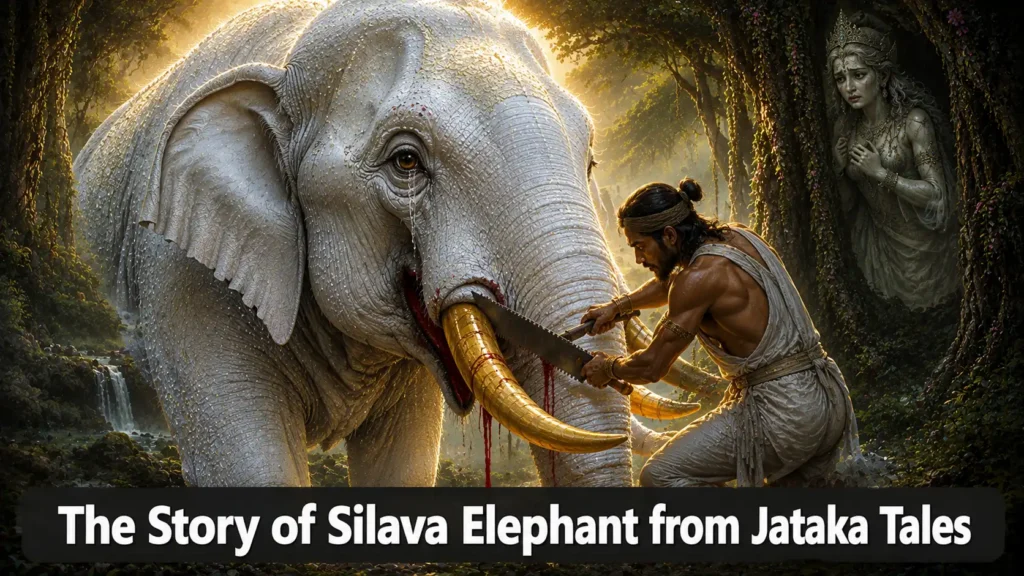
Chaddanta’s voice was gentle. “It is my wish, hunter. Take the saw from your bag. Hold it in my trunk. I will cut off my own tusks and give them to you. This is my final act of charity.”
Sonuttara could not believe what he was hearing. “You would cut off your own tusks? You would give them to the man who shot you with a poisoned arrow?”
“Yes,” Chaddanta replied. “Because I am a Bodhisatta. My purpose in this life is to perfect generosity and non-hatred. This is my opportunity to fulfill that purpose. Please, do not deny me this chance.”
Sonuttara, with trembling hands, placed the saw in Chaddanta’s trunk. The elephant king, with supreme effort, held the saw against his own tusks and began to cut. The pain was unimaginable, yet Chaddanta did not cry out. He endured in silence, his heart filled with compassion for the hunter and for all beings.
When the six golden tusks fell to the ground, Chaddanta looked at Sonuttara with eyes of boundless love. “Take them, my friend. Give them to the queen. But tell her this: I forgive her too. I forgive her for the hatred that has consumed her. May she find peace.”
Sonuttara took the tusks, his heart shattered by the elephant’s compassion. He had witnessed the greatest act of forgiveness the world had ever seen. The Story of Chaddanta Elephant from Jataka Tales had transformed him forever.
He gathered the tusks and began his journey back to Varanasi. But he was a changed man. The experience had stripped away his greed and replaced it with profound respect for the elephant’s virtue.
The Queen’s Fate
When Sonuttara finally returned to Varanasi, he was greeted with great fanfare. He was brought before the king and queen, and the six golden tusks were presented to the chief consort. The queen’s eyes gleamed with triumph.
“Finally,” she thought. “My revenge is complete. The elephant who humiliated me has lost his greatest treasure.”
But as she looked upon the tusks, something strange happened. The beauty of the tusks—their golden radiance, their perfect symmetry—filled her not with satisfaction but with a deep, inexplicable sorrow. The memory of Chaddanta’s innocence, his playfulness, his love, flooded back to her.
She had loved him once. He had been her husband, her protector, her companion. And she had destroyed him. She had let her wounded pride consume her. She had plotted against him across lifetimes. And now, looking at the tusks that had once adorned his noble head, she realized the depth of her folly.
The weight of her guilt was unbearable. She had taken the life of a being of supreme virtue. The karmic consequences were too heavy to bear. The Story of Chaddanta Elephant from Jataka Tales had reached its tragic climax.
Overwhelmed by remorse and unable to bear the shock of what she had done, the queen fainted. She collapsed to the ground, her body wracked with grief. When she was revived, she could not speak. The guilt consumed her.
In the end, she died of a broken heart. The very revenge she had sought had destroyed her. The Story of Chaddanta Elephant from Jataka Tales teaches us that hatred is a double-edged sword—it harms the one who harbors it even more than the one it targets.
The king of Varanasi, upon hearing the full story, was devastated. He had unwittingly participated in the destruction of a noble being. He ordered that the tusks be enshrined as relics and honored them with great respect. As for Sonuttara, he renounced the world and became a monk, spending the rest of his life in meditation, forever transformed by the elephant’s forgiveness.
Thus, The Story of Chaddanta Elephant from Jataka Tales concludes with a profound lesson: forgiveness is the greatest gift we can offer—to others and to ourselves.
Moral of the Story: The Power of Forgiveness and Non-Hatred
The Story of Chaddanta Elephant from Jataka Tales is a profound teaching on the perfection of forgiveness and non-hatred (khanti paramita). It illustrates the power of compassion to overcome even the most grievous wrongs. Chaddanta’s forgiveness of his hunter—and even of the queen who plotted against him—is the highest expression of the Bodhisattva’s virtue.
Chullasubhadda’s story is a warning about the dangers of resentment. Her perceived slight—the falling of dry leaves and ants upon her—was a trivial incident. But she allowed it to fester, to grow, to consume her. She carried her grievance across lifetimes, letting it poison her heart and ultimately destroy her. The Story of Chaddanta Elephant from Jataka Tales reminds us that holding onto anger is like drinking poison and expecting the other person to die.
Chaddanta’s response to his suffering is the opposite of the queen’s. He did not retaliate. He did not harbor resentment. Even when wounded by a poisoned arrow, he chose forgiveness. He recognized that the hunter was acting out of desperation, not malice. His forgiveness was unconditional—it did not depend on the hunter’s repentance or the queen’s remorse.
This Jataka also teaches the law of karma. The queen’s hatred did not harm Chaddanta—it harmed her. Her revenge was hollow. When she finally achieved her goal, she found no satisfaction, only guilt and despair. The Story of Chaddanta Elephant from Jataka Tales shows that actions motivated by hatred inevitably lead to suffering for the one who acts.
The hunter Sonuttara represents the possibility of transformation. He began as a desperate, greedy man willing to harm a noble being for reward. But witnessing Chaddanta’s virtue awakened his conscience. The Story of Chaddanta Elephant from Jataka Tales demonstrates that even the most hardened heart can be transformed by witnessing true compassion.
Chaddanta’s act of cutting off his own tusks is the ultimate expression of non-attachment. He had no attachment to his own body, no attachment to his prized possessions, no attachment even to his own life. He gave freely, without reservation, because he had completely overcome the illusion of self.
In our own lives, The Story of Chaddanta Elephant from Jataka Tales invites us to examine our relationships. Do we hold onto grievances? Do we nurse resentments? Do we plot revenge when we feel wronged? The Story of Chaddanta Elephant from Jataka Tales calls us to a higher path—to forgive, to let go, and to respond to hatred with love. This is the way of the Bodhisattva, and it is available to all of us.
In our world of conflict and resentment, The Story of Chaddanta Elephant from Jataka Tales invites us to examine our capacity for forgiveness. By exploring The Story of Chaddanta Elephant from Jataka Tales, we gain timeless wisdom about the power of non-hatred and the transformative nature of compassion.
Read the previous story: The Story of the Hare on the Moon from Jataka Tales – The Selfless Hare Who Offered His Body in Charity

Get the ThePoemStory App — Read Poems Anywhere