The Thunderer’s Judgement: Lycaon, the Wolf, and the Flood That Followed
In The Thunderer’s Judgement, Jupiter leaves Olympus to see how far the human race has fallen and finds a king who doubts him. This is a story of mythological stories, Roman gods, transformation and justice, and the terrible patience of fate and prophecy.
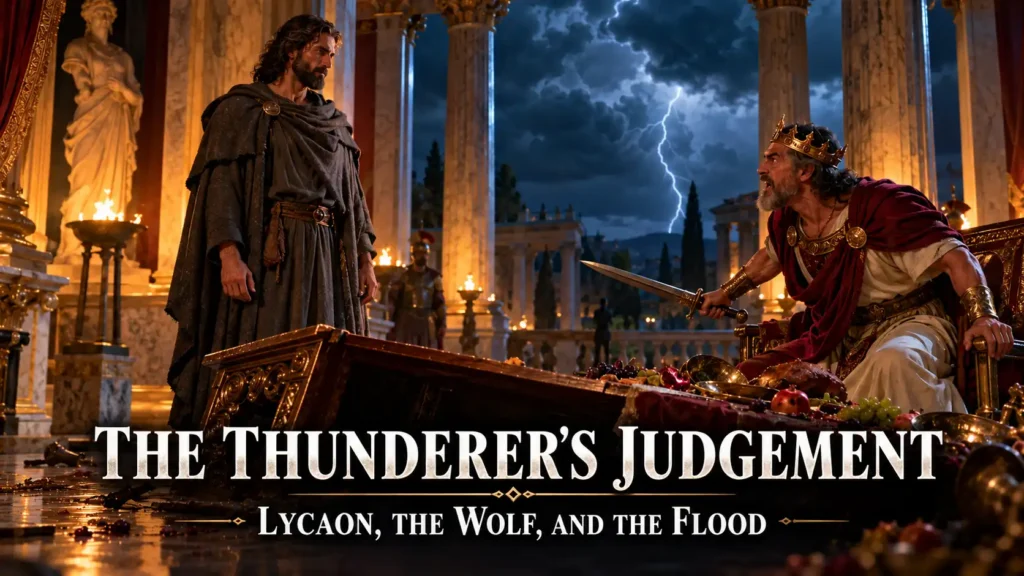
The Thunderer’s Judgement
Introduction: The God Who Came to Look
Most Roman myths keep the gods at a distance. Jupiter sits on Olympus, Juno schemes, Minerva advises, and the thunder rolls somewhere above the human world without anyone looking up. The story of Lycaon is different. Here the king of the gods comes down in a human body, walks into a king’s hall, accepts a place at the table, and waits to see what his host will do.
What the host does is try to kill him. When that fails, he serves him a meal that no host should ever serve. What follows is one of the oldest and most unsettling stories in Roman mythology, and it gives the phrase The Thunderer’s Judgement a meaning that is both literal and moral. Jupiter does not simply punish Lycaon. He reads him, exposes him, and gives him a shape that fits.
The story of Lycaon comes from Greek mythology, where Zeus is the king of the gods. In Ovid’s Roman retelling in the Metamorphoses, Zeus appears as Jupiter, bringing the tale into the literary world of Rome. That translation matters, because the Roman Jupiter is not only a sky god. He is the guarantor of oaths and the protector of the order that Lycaon is about to break.
Jupiter’s Thunderbolt and the Council of the Gods
A God in Human Form
Ovid sets the story at the end of the Iron Age, when the world has become a place of violence and broken oaths. Jupiter has heard the reports. He does not trust them. So he comes down to earth in a human shape and travels through Arcadia, where the mountains are full of wolves and the kings are not much better than the wolves.
This is the first thing that makes the myth feel different from a simple fable. Jupiter does not arrive with a thunderbolt already in his hand. He arrives curious. He wants evidence. He gives the people a sign that a god is among them, and the people pray. That detail matters, because it shows that they still know how to recognise divinity when it is close.
Lycaon does not pray. He laughs. Ovid says he laughed at their pious prayers, and that laughter is the beginning of the end. It is not the laughter of a man who has heard a good joke. It is the laughter of a man who cannot imagine that anyone, human or divine, has a claim on him.
The Sign and the Mockery
Lycaon decides to test the god. He does not test him by asking for a miracle or by demanding a sign. He tests him by planning a murder. In Ovid’s account, he waits until Jupiter is asleep and then tries to kill him with a sword. When that fails, he goes further. He kills a hostage, a Molossian, and has the body boiled and roasted and set before his guest.
The table is the crime. In the ancient world, hospitality was sacred. A host who fed a guest human flesh had broken the one bond that made civilised life possible. Lycaon is not just a murderer. He is a king who has turned his own hall into a place of cannibalism, and he has done it to a guest who came in peace.
Ovid does not linger on the meal itself. He lingers on the moment of exposure. Jupiter rises, calls down fire, and overturns the table. What the thunderbolt destroys is the house, not the king. Lycaon flees into the fields, and only then does the transformation begin. The first act of The Thunderer’s Judgement is not a death. It is a revelation, and a flight.
Lycaon and the Flood: The Crime That Tested a God
The Table at Trapezus
The place of the table is remembered in the myth. Apollodorus says that the table was overturned at a place still called Trapezus, which means “table.” The name turns the crime into geography. The land itself keeps a record of what happened there.
Apollodorus also gives a variant that Ovid does not. In his version, it is not only Lycaon who is guilty. His sons are involved, and they serve Zeus the flesh of a murdered child. Zeus overturns the table and strikes them with thunderbolts, all except the youngest, Nyctimus. Lycaon himself is turned into a wolf.
The two versions differ in who does what, but they agree on the essentials. A king with too much power decides that the gods are either absent or irrelevant. He uses his own hall to commit a crime that violates every law of hospitality. And the thunderbolt answers him.
The First Change: Man into Wolf
Ovid’s description of the transformation is short, precise, and horrible. Lycaon’s clothes become shaggy hair. His arms become legs. He tries to speak, but the words will not come. He howls. He runs into the fields, and even in his new shape he keeps the traces of his old nature. The wolf is not a stranger to Lycaon. The wolf is Lycaon with the mask removed.
This is the detail that makes the myth more than a punishment story. Jupiter does not turn a man into a wolf as a random act of cruelty. He gives him a body that matches his soul. Lycaon had already been a wolf in his hall, in his treatment of his guest, in his contempt for the gods. The transformation makes the invisible visible.
Ovid does not say that Lycaon repents. The wolf does not become a moral lesson for himself. He becomes a warning for everyone else. He keeps his ferocity, his appetite, and his inability to speak. The king who thought he could test a god is left with a throat that can only make animal sounds.
The Flood That Followed
Ovid does not end the story with the wolf. Jupiter returns to Olympus, calls the gods to a council, and argues that the human race has become a plague. He considers destroying the world with fire, but he fears that the flames might reach the heavens. So he chooses water. Neptune helps him, the rivers rise, and the earth is drowned.
This is the second judgment, and it is much larger than the first. Lycaon’s crime is one man’s crime, but Jupiter treats it as evidence of a general corruption. The flood is not a temper tantrum. It is a decision made in council, after deliberation. Only Deucalion and Pyrrha survive, and from them the human race begins again.
The sequence matters. First the individual judgment, then the general one. The Thunderer’s Judgement is not only about a single king who deserved to become a wolf. It is about a god who looks at the world, finds it wanting, and decides that the world needs to be remade.
The Roman Myth of Divine Justice
Why Jupiter Waited
Roman Jupiter is not only a sky god. He is the guarantor of oaths, the protector of boundaries, and the god who watches over the laws that hold a community together. His temple stood on the Capitol, at the centre of the city’s political and religious life. When a Roman heard a story about Jupiter judging a king, they heard a story about the order of the world.
This is why the myth does not begin with a thunderbolt. It begins with a visit. Jupiter gives Lycaon every chance to be a good host. He gives him a sign. He accepts his hospitality. The judgment only comes after the crime is unmistakable. In Roman terms, Jupiter is not arbitrary. He is patient, and his patience is part of his justice.
The contrast with Lycaon is the point. Lycaon has power, but he has no self-control. He has a kingdom, but he cannot keep faith with a guest. Jupiter has power, but he uses it to restore an order that Lycaon has mocked. The Roman myth of divine justice is not a myth about might. It is a myth about the difference between authority and appetite.
The Thunderbolt as Verdict
The thunderbolt is Jupiter’s signature, but in this story it functions as a verdict rather than a weapon. It comes after the evidence has been presented. It confirms what has already been revealed. The table is overturned, the house is set on fire, and the king is given a new shape. The thunderbolt is the moment when the truth becomes public.
This is also why the story has a Roman political edge. A king who cannot be held accountable is a danger to everyone around him. Lycaon’s hall is a small model of a state without law. Jupiter’s thunderbolt is the interruption that reminds the audience that no ruler is outside the order of the gods.
Ovid’s Metamorphoses and the Meaning of the Wolf
What the Wolf Remembers
Ovid’s Metamorphoses is a poem about bodies changing shape, but its best transformations are also moral diagnoses. Daphne becomes a tree to escape a god. Arachne becomes a spider because she will not stop weaving. Lycaon becomes a wolf because he has already become one in his heart. The new body is not an escape from the old self. It is the old self made visible.
That is why the wolf still has Lycaon’s ferocity. Ovid says he keeps the traces of his former shape. The wolf is not innocent. He is not a wild animal following its nature. He is a king continuing his cruelty in a new form. The transformation is a punishment, but it is also a kind of honesty.
For a Roman reader, the wolf had another layer of meaning. Wolves were associated with wildness, with the margins of the city, and with the founding myth of Rome itself. Romulus and Remus were suckled by a wolf. The wolf is both a danger and a beginning. Lycaon’s wolf is the danger without the beginning. He is the wildness that refuses to be civilised.
The God Who Is Also a State
Ovid wrote under Augustus, and Roman readers were used to seeing Jupiter as a model of authority. The god who judges Lycaon is not a distant philosopher’s god. He is a ruler who convenes a council, hears reports, and makes decisions. The Thunderer’s Judgement could be read as a meditation on what good rule looks like: patient, deliberate, and willing to act when the evidence is clear.
But Ovid is never that simple. The flood is excessive. It destroys the innocent along with the guilty. The poem does not let Jupiter off the hook. The judgment is just in principle, but the scale of it is terrifying. That tension is part of what makes the story last. It is not a comfortable lesson. It is a story about power that makes the reader uneasy.
The Thunderer’s Judgement in Other Roman Stories
Lycaon is not the only mortal who learns what it means to challenge Jupiter. In Hyginus, Salmoneus is a king who imitates the god. He drives a chariot across a bridge of brass to make a sound like thunder, and he throws burning torches through the air to make a show of lightning. Jupiter strikes him with a real thunderbolt. Virgil places Salmoneus in Tartarus, still being punished for having dared to counterfeit the storms of heaven.
Semele is a different case. In Ovid’s Metamorphoses, Juno disguises herself as the girl’s nurse and persuades Semele to ask Jupiter to come to her in the full glory of his divinity. Jupiter has sworn by the Styx to grant her request, so he cannot refuse. He comes with lightning, and Semele is consumed. She is not judged. She is destroyed by the sheer force of a god’s presence.
These three stories show the thunderbolt doing different work. For Lycaon, it is a verdict. For Salmoneus, it is a punishment for imitation. For Semele, it is the cost of seeing a god without a veil. The Thunderer’s Judgement is the story in which the thunderbolt is most clearly a moral sentence, because Lycaon is given every warning and chooses his crime anyway.
What the Thunderer’s Judgement Means
The story asks a question that is older than Rome. What do you do when you believe no one is watching? Lycaon’s crime is not only that he kills a hostage. It is that he tests a guest because he cannot imagine being answerable to anyone. His contempt is the real crime, and the wolf is the shape of that contempt.
There is a quieter lesson in the way Jupiter behaves before the thunderbolt. He comes down. He looks. He waits. The judgment is not a sudden explosion of divine temper. It is the end of a process that Lycaon himself began. The Thunderer’s Judgement is a story about the moment when a god stops waiting and a king runs out of chances.
The flood widens the story beyond one king, but the wolf keeps it personal. Lycaon is not forgotten in the water. He is the first example of what the flood is answering. One judgment shows what a corrupt man becomes. The other shows what a corrupt world becomes.
For a modern reader, the myth does not need to be believed literally to be useful. It is a story about accountability, about the difference between power and self-control, and about the way a person’s true nature can become visible in a single act. But it is not a tidy story, and it does not offer a tidy verdict.
"His clothes turn to shaggy hair, his arms to legs;
he becomes a wolf, and keeps the traces of his former shape."
— Ovid, Metamorphoses 1.238–239
The thunderbolt is loud, but the quiet detail is the one that lasts. Lycaon does not lose himself when he becomes a wolf. He becomes himself. The god who came to look saw a king who had already chosen his shape, and the judgment simply made it visible.
So the question the myth leaves us with is not whether Lycaon deserved his fate. It is whether one king’s guilt can justify the drowning of a world. Was Jupiter’s judgment justice, or did the punishment of one man become the destruction of everyone else? The wolf may have deserved his shape. Did humanity deserve the flood?
Sources and Further Reading
The primary account of Lycaon in Roman literature is Ovid, Metamorphoses Book 1, lines 163–312. The Loeb Classical Library edition and the A. S. Kline translation are both widely available. Apollodorus, Library 3.8.1, gives the Greek variant in which Lycaon’s sons are also involved. Hyginus, Fabulae 61, and Virgil, Aeneid 6.585–594, provide the Salmoneus parallel. Pausanias, Description of Greece 8.2, preserves the Arcadian cult context of Lycaean Zeus.
Read the previous story: The Thunderer’s Judgement: Lycaon, the Wolf, and the Flood That Followed
Read the next story: The Stolen Spring: Pluto, Proserpina, and the Pomegranate That Made Winter

Get the ThePoemStory App — Read Poems Anywhere