The Story of Nigrodha Deer from Jataka Tales: The Compassionate King Who Saved All Creatures
A timeless tale of compassion and selflessness from the Buddha Jataka Tales, exploring the depths of Jataka Stories Buddhism, the profound lessons of the Buddha Life Story, and the transformative power of ancient Buddhist Stories.
Introduction: The Golden Deer King
The Story of Nigrodha Deer from Jataka Tales is a powerful tale of compassion, selflessness, and the far-reaching power of loving-kindness. It recounts the story of Nigrodharaja, a golden deer king who, through his compassion, saved not only his own herd but all the creatures of the kingdom. This Jataka illustrates the Buddhist ideal of boundless compassion—the willingness to sacrifice oneself for the welfare of all beings.
This tale is unique in its portrayal of how one act of compassion can create a ripple effect that transforms an entire kingdom. It shows that true leadership is not about power but about service. As we journey through this story, we discover that compassion has no limits and that the virtuous can move even the hearts of kings.
Table of Contents
The Story of Nigrodha Deer from Jataka Tales
The Golden Deer Kings
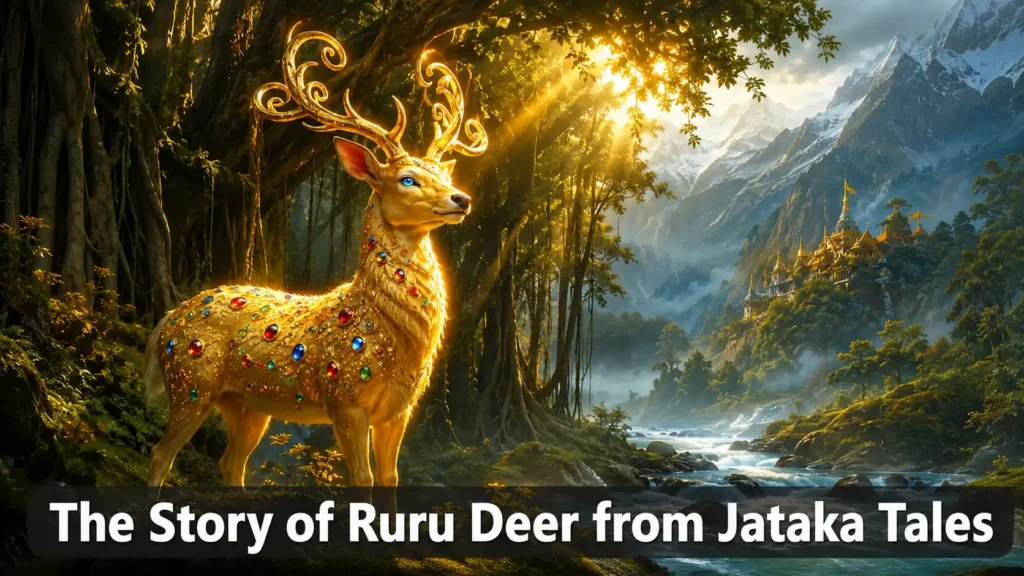
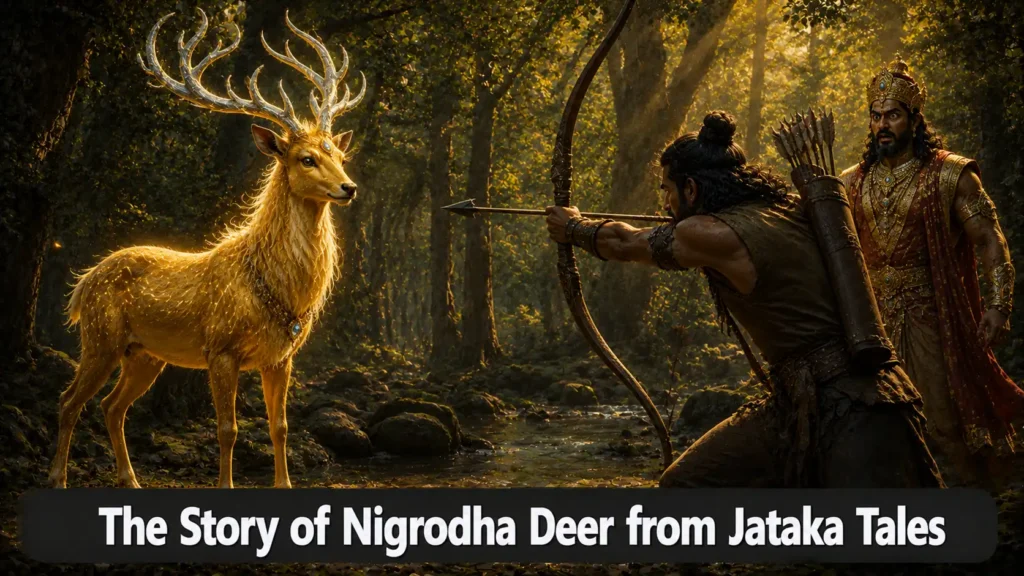
Once upon a time, in the forests of Varanasi, the Bodhisatta was born as a golden deer named Nigrodharaja. He was a magnificent creature—his eyes shone like round gems, his horns gleamed like silver, and his body was larger and more radiant than any other deer. The Story of Nigrodha Deer from Jataka Tales centres on this noble being who led a band of five hundred deer with wisdom and compassion.
In the same forest lived another golden deer named Sakha, who also led a band of five hundred deer. Sakha was proud and inconsiderate, lacking the compassion that defined Nigrodha. The two deer kings ruled their herds, but their leadership was very different.
The Story of Nigrodha Deer from Jataka Tales reveals the contrast between selfless leadership and selfish rule—a contrast that would soon become evident.
The King’s Hunt
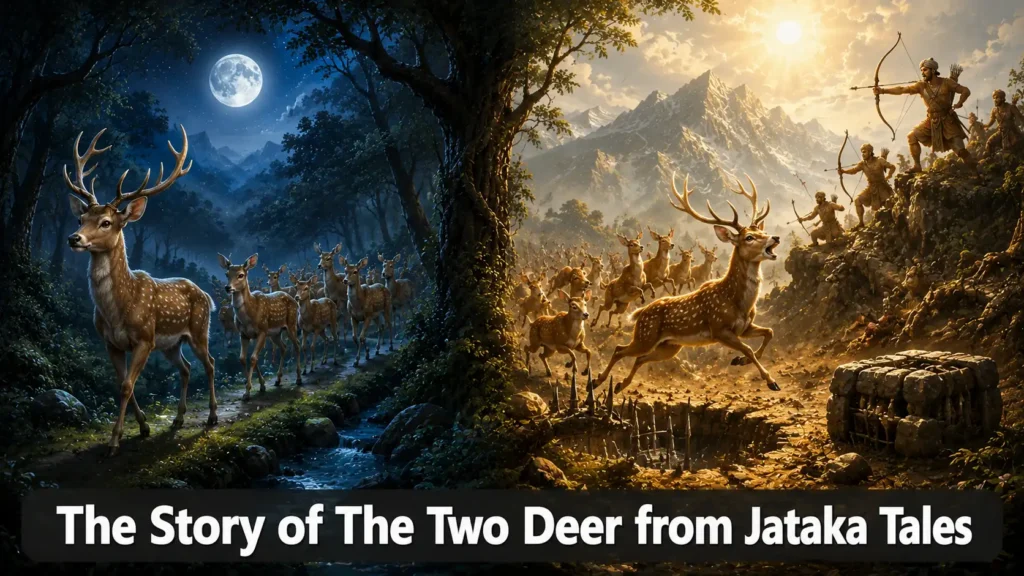
The king of Varanasi was very fond of venison. He ordered his men to bring him at least one deer every day. The hunters grew tired of their endless task, so they devised a plan to catch all the deer in the forest at once.
They besieged the forest from all directions, leaving only one path open—the path leading to the royal garden. With loud noises and drum-beating, they approached the centre of the forest. Panicked, the deer were forced to flee along the only clear path, and they ran straight into the royal park. They were caged inside the garden, trapped and helpless.
When the king saw the two golden deer among the captives, he was very pleased. Charmed by their elegance, he granted them immunity from being killed. But no other deer enjoyed the same privilege. They remained at the mercy of the royal hunters.
Thus, The Story of Nigrodha Deer from Jataka Tales takes its tragic turn.
The Agreement
Whenever a royal hunter entered the park to kill a deer, all the deer would run helter-skelter. Their panic caused more damage to the herd—some were trampled, others injured. The chaos was worse than the slaughter.
Seeing the suffering of their followers, the two deer kings convened a meeting. They resolved that one deer from each group would go to the hunter for slaughter on every alternate day. The agreement was to be followed rigorously. This way, the herd would not panic, and only one deer would die at a time.
The arrangement seemed fair. It brought order to the chaos and reduced the suffering of the herd. But it also revealed the character of the two leaders.
This was the question at the heart of The Story of Nigrodha Deer from Jataka Tales—would the agreement be followed with compassion or with cold indifference?
The Pregnant Doe
One day, a pregnant doe from Sakha’s herd had her turn for the slaughter. She was heavy with young, her body slow and her heart filled with fear. She went to her leader, Sakha, and begged him to postpone her turn until after her baby was born.
“Please, my king,” she pleaded. “I am carrying a life within me. If I die now, both my child and I will perish. Spare me until the young one is born. Then I will gladly go to the execution block.”
But Sakha was inconsiderate. He did not pay any attention to her request. He was cold, indifferent, and unwilling to bend the rules for anyone. “The agreement is clear,” he said. “You must go. There is no exception.”
The doe wept bitterly. She had no hope from her own leader. But she had heard of the compassion of Nigrodha, the other deer king. Wailing and desperate, she went to him and told him her story.
The Deer King’s Sacrifice
Nigrodha listened to the doe’s plea with a compassionate heart. He saw her distress, her fear for her unborn child, and her desperation. The Story of Nigrodha Deer from Jataka Tales reveals that compassion knows no boundaries—it extends to all beings, even strangers.
He complied with her request out of sheer compassion. He told her to go in peace and wait for her turn after her baby was born. The doe was overjoyed. Her life and the life of her child had been spared.
But there was a problem. The day that had belonged to the doe still needed to be fulfilled. Someone had to go to the execution block. If no one went, the hunters would come to the park and kill more deer. Nigrodha made a decision.
He, the king of the deer, would go in her place.
This was the moment of supreme sacrifice in The Story of Nigrodha Deer from Jataka Tales—the moment when the deer king gave his life for two others.
Next day, Nigrodha himself went to the execution block. He showed his readiness for the slaughter, bowing his head in submission to the hunter’s arrow.
The King’s Surprise
The royal hunter was astonished. He knew the golden deer had immunity from the king himself. Why would such a noble creature willingly present itself for slaughter?
Confused and curious, the hunter reported the matter to the king. “Great king,” he said, “the golden deer Nigrodha has come to the execution block. He awaits the arrow, though he has your immunity. I cannot understand it.”
The king was also surprised. He immediately went to the park to see for himself. There, at the execution block, stood the magnificent golden deer, his head bowed, his body calm, his eyes serene. The king approached him and asked, “O deer king, why are you here? You have my immunity. You cannot be killed. Why do you willingly offer yourself for slaughter?”
Nigrodha looked up at the king with his gem-like eyes. He explained everything—the agreement, the pregnant doe, Sakha’s refusal, and his decision to take her place. “Sir!” he said. “A pregnant doe came to me and prayed to let her turn fall on the other. To save the life of two deer—the mother and her unborn child—I decided to get killed.”
This was the question at the heart of The Story of Nigrodha Deer from Jataka Tales—could the king’s heart be moved by such selfless compassion?
The Compassionate Plea
The king was deeply moved by Nigrodha’s compassion. “O deer king!” he said. “I am impressed with your loving-kindness. I spare the life of the doe and yours.”
Nigrodha bowed his head in gratitude. “I thank you for that,” he said. “But what shall happen to the other deer here?”
The king replied, “I spare their lives too.”
Nigrodha’s compassion did not stop there. “The deer in your park shall thus gain immunity,” he said. “But what will happen to the deer living in your kingdom?”
“I will spare their lives too,” said the king.
“Sir! The deer will be safe in your territory,” Nigrodha said. “But what will happen to other four-footed animals?”
The king responded, “From now onwards, I spare their lives too.”
The Story of Nigrodha Deer from Jataka Tales shows how compassion expands when we allow it to. Nigrodha’s heart was open to all beings, and he used his influence to protect them all.
The Ripple Effect
Nigrodha’s compassion was boundless. He continued his gentle pleading. “Sir, four-footed animals will thus be saved. But what would happen to the birds?”
“I spare their lives too,” answered the king.
“Sir! Birds will thus be safe. But what will happen to the fishes?” questioned the deer king in his naive dignity.
The king, moved beyond measure, replied, “I save their lives too, O deer king.”
Thus, the good deer by his compassion saved the lives of all the animals of the kingdom. The king’s heart had been transformed by Nigrodha’s virtue. He renounced hunting altogether and ruled his kingdom with compassion.
The Story of Nigrodha Deer from Jataka Tales concludes with a powerful lesson: compassion has no limits. One being’s selfless love can create a ripple effect that benefits countless others. The deer king’s sacrifice saved not only a pregnant doe but all creatures in the kingdom.
Thus, The Story of Nigrodha Deer from Jataka Tales ends with a vision of a world transformed by compassion—a world where all beings live in peace.
Moral of the Story: The Power of Boundless Compassion
The Story of Nigrodha Deer from Jataka Tales is a profound teaching on the power of boundless compassion and the transformative effect of selfless love. It illustrates how one being’s virtue can create a ripple effect that benefits an entire kingdom. Nigrodha’s willingness to sacrifice himself for a pregnant doe was not just an act of kindness—it was a catalyst for change that transformed a king and saved countless lives.
In Buddhist philosophy, compassion (karuna) is considered one of the four immeasurable qualities that lead to enlightenment. The Story of Nigrodha Deer from Jataka Tales shows compassion in action—it is not a passive emotion but an active force that seeks to relieve suffering. Nigrodha did not simply feel sorry for the doe. He took action. He placed himself in harm’s way to save her and her unborn child.
Sakha’s indifference is a stark contrast to Nigrodha’s compassion. He represents the cold, rigid application of rules without regard for human (or animal) suffering. His refusal to help the pregnant doe reveals the limitations of a heart closed to compassion. The Story of Nigrodha Deer from Jataka Tales teaches that rules are meant to serve beings, not the other way around. When rules cause suffering, they must be examined and adjusted.
The king’s transformation is a testament to the power of virtue. He began as a hunter, indifferent to the suffering of animals. But witnessing Nigrodha’s selfless love opened his heart. The Story of Nigrodha Deer from Jataka Tales shows that goodness is contagious—one act of virtue can inspire transformation in others. The king’s promise to spare all creatures was a direct result of Nigrodha’s compassion.
This Jataka also teaches the importance of asking for more. Nigrodha did not stop when his own life was spared. He asked for the doe’s life. Then he asked for the other deer. Then he asked for all four-footed animals. Then for birds. Then for fishes. The Story of Nigrodha Deer from Jataka Tales shows that our compassion can always expand—there is no limit to the good we can do when we open our hearts.
In our own lives, this Jataka invites us to examine our compassion. Do we help those in need, even at a cost to ourselves? Do we advocate for the vulnerable, even when it is inconvenient? The Story of Nigrodha Deer from Jataka Tales challenges us to be like Nigrodha—to let our compassion be boundless, to use our influence for the good of all beings, and to never stop asking for more kindness in the world.
By exploring The Story of Nigrodha Deer from Jataka Tales, we gain timeless wisdom about the power of compassion and the transformative effect of selfless love. It guides us toward a life of kindness, courage, and boundless giving.
In our world of indifference and selfishness, this Jataka tale invites us to examine our capacity for compassion. By exploring The Story of Nigrodha Deer from Jataka Tales, we gain timeless wisdom about the power of selfless love and the boundless reach of a compassionate heart.
Read the previous story: The Story of the Monkey Brothers from Jataka Tales – The Two Brothers Who Gave Their Lives for Their Mother

Get the ThePoemStory App — Read Poems Anywhere