The Story of the Monkey Brothers from Jataka Tales: The Two Brothers Who Gave Their Lives for Their Mother
A timeless tale of filial devotion and sacrifice from the Buddha Jataka Tales, exploring the depths of Jataka Stories Buddhism, the profound lessons of the Buddha Life Story, and the transformative power of ancient Buddhist Stories.
Introduction: The Devoted Brothers
The Story of the Monkey Brothers from Jataka Tales is a deeply moving tale of filial devotion, sacrifice, and the inescapable law of karma. It recounts the story of two monkey brothers who gave their lives to protect their blind, elderly mother from a hunter’s arrow. This Jataka illustrates the highest form of gratitude—the willingness to sacrifice one’s own life for the sake of a parent.
This tale is unique in its portrayal of selfless love and the tragic consequences of broken promises. It shows how the hunter’s wickedness and greed led not only to the death of innocent beings but also to his own destruction. As we journey through this story, we discover that no one can escape the fruits of their own actions.
Table of Contents
The Story of the Monkey Brothers from Jataka Tales
The Noble Brothers
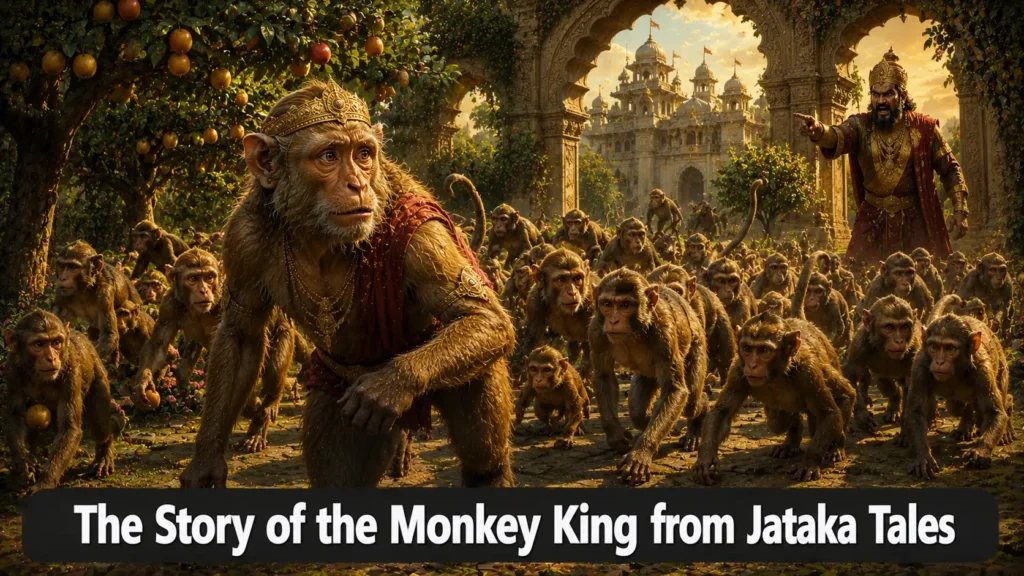
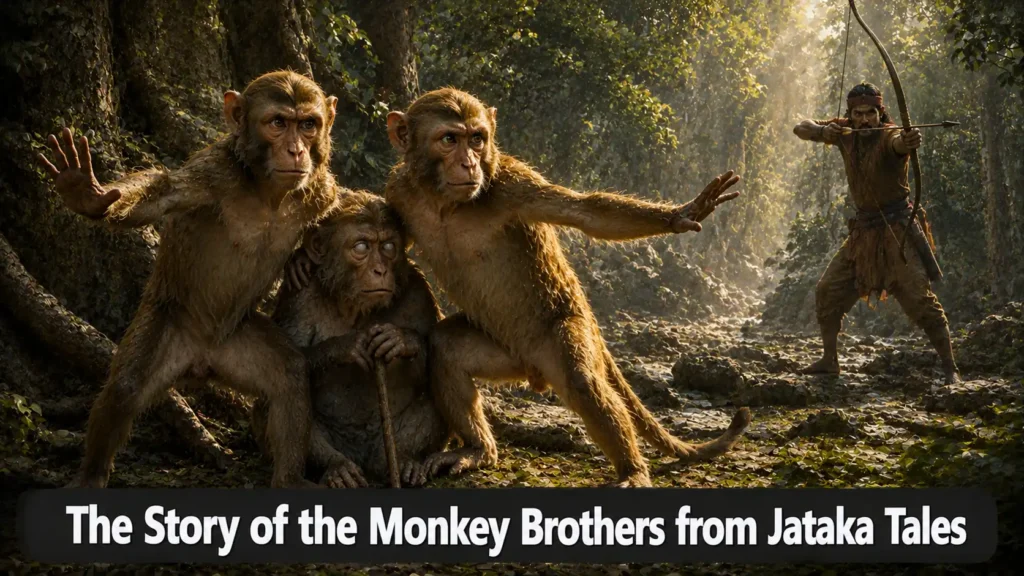
Once upon a time, in the lush forests of the Himalayas, the Bodhisatta was born as a monkey named Nandaka[reference:0]. His younger brother was called Chullanandaka[reference:1]. Together, they led a band of eighty-four thousand monkeys[reference:2]. They were wise, compassionate, and deeply devoted to their family. The two brothers had no father, and their mother was blind and elderly[reference:3].
Nandaka and Chullanandaka ruled their troop with wisdom and kindness. They protected their followers from danger, ensured everyone had enough to eat, and maintained peace within the community. But their greatest love was reserved for their blind mother. They cared for her with unwavering devotion, ensuring she was always fed, comfortable, and safe[reference:4].
The Story of the Monkey Brothers from Jataka Tales begins with these two noble beings who embodied the highest ideals of filial piety.
The Mother’s Suffering
One day, while enjoying the forest fruits, the brothers and their troop ventured far away from their abode[reference:5]. They were gone for many days, but they did not forget their blind mother. They kept sending food to her through their friends, trusting that the fruits would reach her[reference:6].
But the messengers were careless. They seldom delivered the fruits to the old mother[reference:7]. Perhaps they ate them themselves, or perhaps they simply forgot. Whatever the reason, the mother monkey received almost nothing. Tormented with hunger, she virtually starved and became emaciated and sickly[reference:8].
When Nandaka and Chullanandaka finally returned, they were shocked to see their mother in such a pitiful state[reference:9]. Her body was thin and frail, her once-soft fur now dull and matted. She could barely move from weakness. The brothers’ hearts broke at the sight.
When they learnt that the fruits they had sent had seldom reached her, they made a decision[reference:10]. They left all their companions and retired to a banyan tree with their mother[reference:11]. They would no longer trust others to care for her. They would devote themselves entirely to her welfare.
The Wicked Hunter
In that same forest, a wicked brahmin was wandering. He was a dropout from the famous Taxila school, a once-promising student who had deserted his teacher, the most reputed Parasariya, to take up the profession of hunting and killing[reference:12][reference:13]. His teacher had warned him to curb his wickedness, but he had ignored the advice[reference:14].
He had chosen the path of violence, believing there was no other way to keep his wife and child fed[reference:15]. His heart had grown hard, and his conscience had grown silent. He entered the forest with his bow and arrow, seeking prey[reference:16].
This was the moment when The Story of the Monkey Brothers from Jataka Tales would take its tragic turn—the moment when wickedness would meet devotion.
Seeing the hunter approaching, the two brothers quickly hid behind the leaves[reference:17]. But the mother monkey, blind and weak, was exposed. The hunter saw her and lifted his bow, preparing to shoot[reference:18].
The First Sacrifice
Nandaka, the elder brother, could not bear to watch his mother die. Without hesitation, he jumped before the hunter[reference:19]. “Spare the life of my mother,” he pleaded. “Kill me instead. Take my life, but let her live[reference:20].”
The hunter, seeing the monkey’s courage, agreed. He raised his bow and shot Nandaka[reference:21]. The noble brother fell, his life given for his mother’s sake. The Story of the Monkey Brothers from Jataka Tales reveals the depth of Nandaka’s love—he did not hesitate to die for the one who had given him life.
But the hunter did not keep his promise[reference:22]. He broke his word and aimed his bow at the mother monkey once again[reference:23].
This was the moment of supreme betrayal in The Story of the Monkey Brothers from Jataka Tales—a promise broken, a life taken in vain.
The Second Sacrifice
Chullanandaka, the younger brother, saw the hunter’s treachery. He had just watched his elder brother die to save their mother, and now the hunter was preparing to kill her anyway. His heart filled with grief and determination[reference:24].
He jumped before the hunter[reference:25]. “Please,” he begged, “spare the life of my mother. I offer my life in her place. Take me instead[reference:26][reference:27].”
Once again, the hunter agreed. He raised his bow and shot the younger brother[reference:28]. Chullanandaka fell beside his elder brother, both sons now dead, both sacrifices offered in vain.
But the hunter did not keep his promise for a second time[reference:29]. He took out a third arrow and shot the blind old monkey[reference:30]. The mother, who had already lost both her sons, fell dead as well. The hunter had shown no mercy, no honour, no humanity.
Thus, the hunter killed all three monkeys—the devoted sons and their blind mother[reference:31].
This was the tragedy of The Story of the Monkey Brothers from Jataka Tales—the senseless destruction of a family by a heartless hunter.
The Hunter’s Fate
The hunter picked up all three dead bodies and happily carried them home[reference:32]. He was proud of his “valour.” All through his journey, he mused about how he would please his family by having killed three monkeys in one day[reference:33].
But as he approached his home, he heard terrible news. His house had been struck by a thunderbolt, and all his family members had perished there[reference:34][reference:35]. His wife, his children—everyone he loved—was dead.
The loss of his family made him delirious and lunatic[reference:36]. In his frenzy, he threw out his garments and ran towards his house with outstretched arms, hoping to find his children and wife alive[reference:37]. But when he reached the debris, the burnt bamboos of the house crumbled and fell on his head[reference:38].
It is said that, as witnessed by the people, he was lost in the smoke, and a fire sprang from hell with the yawning of the earth and swallowed him[reference:39][reference:40]. The hunter who had shown no mercy to the innocent monkeys was consumed by the fires of hell[reference:41].
The Story of the Monkey Brothers from Jataka Tales shows that no one can escape the consequences of their actions—that karma is inescapable.
The Final Lesson
The eye-witnesses who saw the hunter’s final moments also heard the dying man recalling the lessons of his good old Taxila guru. In his final moments, as the flames consumed him, he uttered these words[reference:42]:
"Now I remember the lessons of my teacher,
And now I understand what he meant
When he taught me to be careful
And do nothing to repent."
The Story of the Monkey Brothers from Jataka Tales teaches that wisdom often comes too late. The hunter had been warned by his teacher to curb his wickedness[reference:43]. He had chosen to ignore the advice. And when he finally understood the truth, it was too late.
Thus, The Story of the Monkey Brothers from Jataka Tales concludes with a powerful lesson: our actions have consequences, and we must be careful in everything we do[reference:44].
Moral of the Story: The Power of Filial Devotion and the Inescapable Law of Karma
The Story of the Monkey Brothers from Jataka Tales is a profound teaching on the power of filial devotion and the inescapable law of karma. It illustrates two fundamental truths of the Buddhist path: the supreme importance of gratitude toward one’s parents and the certainty that our actions will bear fruit.
The brothers’ sacrifice is the highest expression of filial piety. In Buddhist tradition, caring for one’s parents is considered one of the greatest virtues. The Buddha himself taught that there is no one more worthy of our gratitude than our parents. Nandaka and Chullanandaka embodied this teaching completely—they did not hesitate to give their lives for their blind mother. Their love was unconditional, their devotion absolute.
The hunter’s story is a warning about the dangers of broken promises and the corruption of greed. He made two promises to spare the mother’s life, and he broke both of them. His greed for trophies and his desire to please his family led him to commit three murders. But his actions created consequences that he could not escape. The loss of his own family and his eventual destruction in hell show that karma is not a punishment imposed from outside—it is the natural consequence of our actions.
This Jataka also teaches the importance of heeding wise counsel. The hunter had been warned by his teacher Parasariya to curb his wickedness[reference:45]. But he ignored the advice, believing that killing was the only way to provide for his family. When he finally understood the truth, it was too late. The story reminds us that we must listen to those who have wisdom and experience, especially when they warn us about the path we are taking.
The hunter’s final words—”Now I remember the lessons of my teacher, and now I understand what he meant when he taught me to be careful and do nothing to repent”—are a poignant reminder that wisdom often comes too late. We cannot undo the past. We can only learn from our mistakes and try to do better in the future.
In our own lives, this Jataka invites us to examine our relationships with our parents. Do we show them the gratitude and devotion they deserve? Do we care for them in their old age? The brothers’ sacrifice challenges us to consider how far we would go for those who gave us life.
It also invites us to examine our actions. Do we keep our promises? Do we act with integrity, even when no one is watching? The hunter’s broken promises led to his destruction. The story teaches that our words and actions matter—they create the karma that shapes our future.
By exploring The Story of the Monkey Brothers from Jataka Tales, we gain timeless wisdom about the power of filial devotion and the inescapable law of karma. It guides us toward a life of gratitude, integrity, and mindful action.
In our world of broken promises and forgotten gratitude, this Jataka tale invites us to examine our relationships with our parents and our integrity in keeping our word. By exploring The Story of the Monkey Brothers from Jataka Tales, we gain timeless wisdom about the power of filial devotion and the certainty of karmic consequence.
Read the previous story: The Story of the Crows from Jataka Tales – The Foolish Crows Who Tried to Empty the Sea

Get the ThePoemStory App — Read Poems Anywhere