The Story of Somadatta from Jataka Tales: The Ascetic Who Learned to Let Go
A timeless tale of attachment and the wisdom of letting go from the Buddha Jataka Tales, exploring the depths of Jataka Stories Buddhism, the profound lessons of the Buddha Life Story, and the transformative power of ancient Buddhist Stories.
Introduction: The Grieving Ascetic
The Story of Somadatta from Jataka Tales is a touching tale of attachment, grief, and the liberating power of wisdom. It recounts the story of an ascetic who renounced the world only to become attached to a baby elephant. This Jataka illustrates how attachment leads to suffering and how wisdom can free us from grief.
This tale is unique in its portrayal of how even renunciants can fall prey to attachment. It shows that attachment is not limited to worldly possessions—it can bind us to anything we love. As we journey through this story, we discover that true renunciation means letting go of all attachments.
The Story of Somadatta from Jataka Tales
The Story of Somadatta from Jataka Tales
The Wealthy Brahmin’s Renunciation
Once upon a time, in the great city of Varanasi, there lived a wealthy Brahmin. He had everything—wealth, status, and comfort. Yet despite his riches, he felt a deep longing for something more meaningful. Worldly possessions cannot satisfy the deepest yearnings of the heart.
One day, the Brahmin made a life-changing decision. He renounced the life of a householder and all his worldly possessions. He chose to lead the life of an ascetic, seeking spiritual liberation through meditation and simplicity. He left behind everything he owned and retired to the forests of the Himalayas.
In the serene wilderness of the Himalayas, the ascetic lived a simple life. He built a humble hermitage and devoted himself to meditation and contemplation. The path of renunciation is not easy—it requires letting go of all attachments.
The Baby Elephant
One day, while wandering through the forest, the ascetic came across a heartbreaking sight. A baby elephant was left alone in the forest, abandoned and helpless. He could not bear to see the innocent creature suffering. He brought the baby elephant to his hermitage and took care of him.
The ascetic looked after the baby elephant with tender care. He fed him fruits and food, built a shelter for him, and kept him warm during the cold nights. He had renounced the world, but his heart was still open to those in need.
Soon, the ascetic developed a deep attachment to the baby elephant. He called him Somadatta out of affection. He had renounced everything, yet he had found something new to hold on to. He loved the elephant as if it were his own child.
This was the beginning of the lesson that this story would teach—that attachment can arise anywhere, even in the heart of a renunciant.
Attachment and Care
Days turned into weeks, and weeks into months. The ascetic’s bond with Somadatta grew stronger with each passing day. Attachment deepens through daily care and interaction. The ascetic fed the elephant, bathed him, and protected him from dangers.
He spoke to the elephant as if it could understand him. He shared his thoughts and feelings with the gentle creature. The ascetic had left behind his family, his wealth, and his home. Yet he had created a new attachment to fill the void.
Attachment is a habit of the mind. We will always find something to cling to until we learn to let go. The ascetic believed that his love for the elephant was pure and innocent. But even love, when it becomes clinging, is a bond that can cause suffering.
The Elephant’s Death
One day, when the ascetic was away from the hermitage, a tragedy occurred. The baby elephant, Somadatta, ate too much and died. The loss was sudden and unexpected. The elephant was healthy one moment and gone the next.
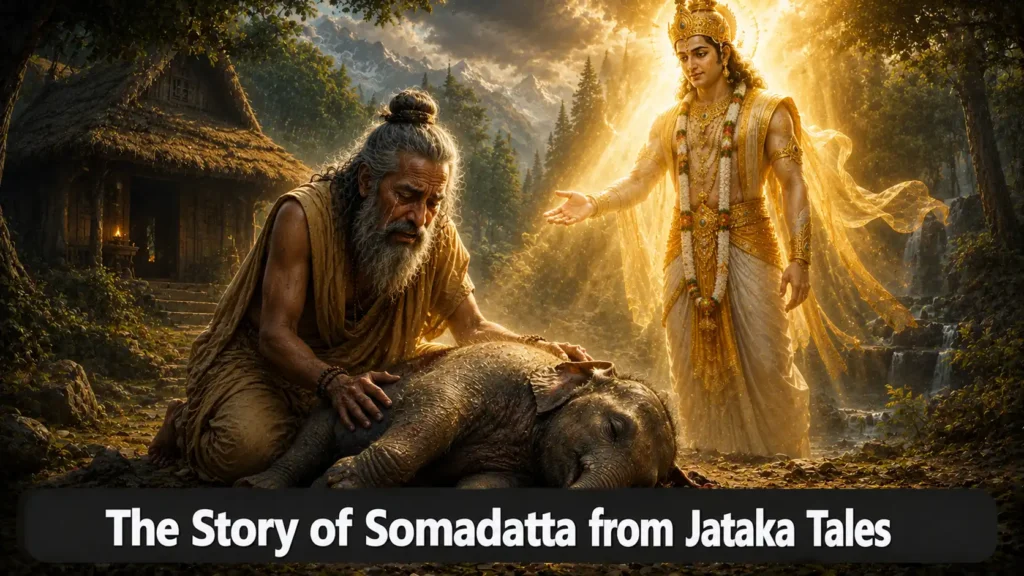
When the ascetic returned to his hermitage, he found Somadatta lying motionless on the ground. The elephant’s body was cold, his eyes closed forever. The ascetic could not accept what had happened. The elephant had been the center of his world, and now he was gone.
The ascetic was overwhelmed with sorrow. He sat beside the elephant’s body, weeping uncontrollably. He had loved the elephant like a child, and now that child was dead.
Overwhelmed by Sorrow
The ascetic’s grief consumed him completely. He stopped all his activities. He no longer meditated. He no longer gathered food. He no longer cared for himself. His entire world had revolved around the elephant, and without Somadatta, he felt empty and lost.
He spent his days weeping and lamenting. The pain was unbearable. The ascetic had tried to renounce the world, but he had created a new attachment to fill the void. And when that attachment was broken, his suffering was immense.
The ascetic’s grief was not just for the elephant—it was for the illusion of security he had built around it. We cannot hold onto anything forever. Everything we love will eventually change or disappear.
**This was the tragedy at the heart of The Story of Somadatta from Jataka Tales**—a renunciant who had not truly renounced. He had given up his possessions, but he had not given up his attachment.
Sakka’s Compassion
At that time, the Bodhisatta was born as Sakka, the king of the devas. He was pious and deeply concerned with the welfare of all beings. From his celestial throne in the heavens, he noticed the sorrow of the ascetic.
Sakka looked down upon the earth and saw the ascetic weeping over the dead elephant. He did not turn away from the ascetic’s pain. He thought of how he could help him overcome his grief.
He understood the nature of the ascetic’s suffering—it was caused by attachment. He knew that the ascetic’s grief would only end when he understood the source of his suffering. He decided to descend to earth and teach the ascetic a lesson in letting go.
The Teaching
Sakka descended from the heavens in a blaze of light. He appeared before the grieving ascetic and spoke with great compassion.
“Why do you grieve so deeply, O ascetic?” Sakka asked gently. “Do you not see that your grief is due to attachment? All grief is due to attachment. You have become attached to this elephant, and now that attachment has brought you suffering.”
He continued, “You renounced your family and your home to seek liberation. Yet you have formed a new attachment. Attachment is the cause of all suffering. You must learn to let go.”
Sakka asked him, “What merit would you partake by leading the life of an ascetic if you are still bound by attachment? True renunciation is not about giving up things—it is about giving up attachment.”
The Awakening
Sakka’s words struck the ascetic like a bolt of lightning. His eyes were opened to the truth he had been avoiding. He realized that his grief was not caused by the elephant’s death—it was caused by his own attachment to the elephant.
He had believed that his love for the elephant was innocent. But any love that clings is a source of suffering. The ascetic saw clearly that his attachment had created his pain.
“I have been a fool,” the ascetic admitted. “I renounced the world but I still clung to attachment. I thought I was free, but I was still bound.”
The acknowledgment of his infatuation helped him overcome his grief. When we see our attachments clearly, we can release them.
The ascetic bowed to Sakka and thanked him for his teaching. He resumed his meditation with renewed commitment. He no longer wept for the elephant. He had learned to let go.
Thus, **The Story of Somadatta from Jataka Tales** concludes with a powerful lesson: attachment is the root of suffering, and wisdom is the path to freedom. It reminds us that true renunciation means letting go of all attachments, even the ones that seem innocent.
Moral of the Story: The Wisdom of Letting Go
The Story of Somadatta from Jataka Tales is a profound teaching on the nature of attachment and the wisdom of letting go. It illustrates the Buddhist truth that attachment is the root of all suffering. The ascetic’s grief was not caused by the elephant’s death—it was caused by his own clinging to the elephant.
In Buddhist philosophy, the Second Noble Truth teaches that suffering arises from craving and attachment. This Jataka shows this truth in action. The ascetic had renounced his worldly possessions, but he had not renounced attachment itself. His love for the elephant became a new form of clinging, and when the elephant died, his suffering was overwhelming.
Sakka’s teaching reveals that even renunciants can fall prey to attachment. The path of renunciation is not about giving up things—it is about giving up attachment. We can renounce our possessions, our homes, and our families, but if we still cling to something, we have not truly renounced.
The ascetic’s awakening is a lesson in self-awareness. We must examine our own hearts to identify our attachments. Only by seeing our attachments clearly can we begin to release them. The ascetic’s grief was transformed when he recognized his infatuation for what it was.
This Jataka also teaches the importance of wise teachers. Sakka descended from heaven to help the ascetic. We all need guidance on the spiritual path. Sometimes we are too close to our suffering to see the truth. Wise teachers can help us see clearly.
The ascetic’s story is also a reminder that attachment can take many forms. Attachment is not limited to material things. We can become attached to people, to animals, to ideas, to identities, and even to our spiritual practices. The goal is not to eliminate love—the goal is to love without clinging.
In our own lives, this Jataka invites us to examine our attachments. What do we cling to? What would we grieve over if it were taken away? True freedom comes from letting go of all attachments, not just the obvious ones.
By exploring The Story of Somadatta from Jataka Tales, we gain timeless wisdom about the nature of attachment and the path to liberation. It guides us toward a life of non-clinging, wisdom, and inner freedom.
In our world of attachment and grief, this Jataka tale invites us to examine our own clinging. By exploring The Story of Somadatta from Jataka Tales, we gain timeless wisdom about the nature of attachment and the liberating power of letting go.
Read the previous story: The Story of the Lion and the Jackal from Jataka Tales – The Foolish Jackal Who Learned Too Late

Get the ThePoemStory App — Read Poems Anywhere