The Wolf’s Children: Romulus and Remus and the Brother’s Blood That Founded Rome
In The Wolf’s Children: Romulus and Remus, two abandoned babies are fed by a wild animal, raised by a shepherd, and grow up to found the most powerful city in the ancient world. Then one of them kills the other. This is a story of mythological stories, heroes and mortals, fate and prophecy, and the Roman identity and legacy that began with a fratricide.
The Wolf’s Children: Romulus and Remus
Introduction: The Twins on the River
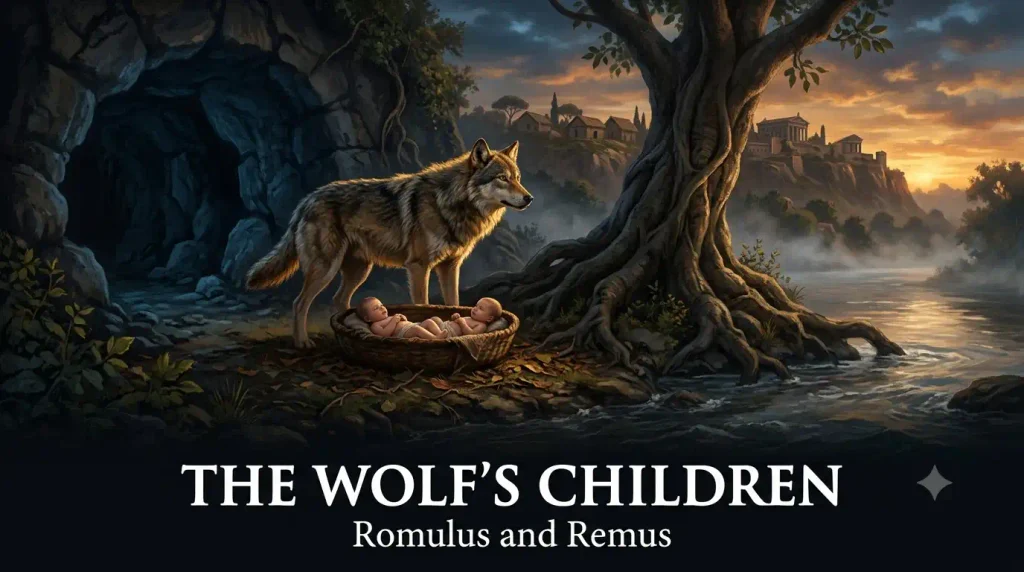
The story begins with a river in flood. The Tiber has overflowed its banks, and the servant of a king carries a basket containing two newborn babies down to the water. He is supposed to drown them. Instead, he leaves the basket in a shallow pool, thinking the river will do the work for him. The water recedes. The basket lodges against the roots of a wild fig tree at the foot of the Palatine Hill.
What happens next is the most famous image in Roman mythology. A she-wolf comes down from the cave of the Lupercal, licks the babies clean, and offers them her teats. They survive. A shepherd named Faustulus finds them and takes them home to his wife, Acca Larentia, who raises them as her own. The twins are called Romulus and Remus.
The Wolf’s Children: Romulus and Remus is the Roman foundation myth, and it is different from the story of Aeneas. Aeneas came from Troy. He carried a foreign legacy into Italy. Romulus and Remus are local. They are born in Latium, nursed by an Italian wolf, and raised by Italian shepherds. The story is not about a hero arriving from somewhere else. It is about a city growing out of its own soil, and out of its own violence.
The story is Roman, not Greek, although it shares motifs with Greek myths of exposed children. The Romans told it about themselves, and they placed it at the exact centre of their city. The cave of the Lupercal was on the Palatine. The fig tree was in the Forum. The hut of Romulus was preserved for centuries. When a Roman told this story, they were pointing at the ground beneath their feet.
Romulus and Remus: The She-Wolf and the Cave
Rhea Silvia and the Vestal Vow
The twins are the sons of a Vestal virgin. Their mother is Rhea Silvia, the daughter of Numitor, the rightful king of Alba Longa. Her uncle Amulius has seized the throne, killed Numitor’s son, and forced Rhea Silvia to become a priestess of Vesta so that she will never bear children who could challenge him. The plan is ruthless and logical. A Vestal virgin is bound to chastity. If she breaks her vow, she dies. If she keeps it, the line of Numitor ends.
But Mars, the god of war, visits her. Livy says she was violated by the god, and she bears twins. Whether the reader believes the divine paternity or not, the consequence is the same: Amulius has a problem. He orders Rhea Silvia imprisoned and the infants thrown into the Tiber. The river is in flood, and the soldiers who carry out the order do not want to wade into the current. They leave the basket at the edge of the water and walk away.
This is the Roman version of the exposure motif. In Greek myth, exposed children are often saved by shepherds or gods. In Rome, the children are saved by a wolf. The difference matters. The wolf is not a gentle animal. It is the predator that threatens the flock. The Romans chose to make the wolf the nurse of their founder, and that choice says something about how they saw themselves: a people who were not raised by civilisation, but by the wild.
The Lupercal and the Fig Tree
The cave of the Lupercal was sacred to Faunus Lupercus, a god of shepherds and wild places. It was located at the north-west corner of the Palatine Hill, overlooking the Velabrum, the low ground that would later become the Forum Boarium. In 2007, Italian archaeologists announced that they had found a richly decorated grotto beneath the ruins of Augustus’s palace on the Palatine, and they identified it as the Lupercal. Whether the identification is correct or not, the discovery shows how seriously the Romans took the geography of the myth.
The fig tree was called the ficus Ruminalis, and it stood in the Forum near the Lupercal. The Romans believed that the tree had grown from the basket of the twins, or that it had sheltered them when the water receded. The tree was a living monument to the moment the city began. When the tree died, a new one was planted. The Romans did not treat the story as a metaphor. They treated it as a site.
The she-wolf herself became the emblem of Rome. The Capitoline Wolf, the bronze statue of the wolf suckling the twins, is one of the most recognisable symbols of the city. The dating of the statue is debated, and the twins were probably added in the fifteenth century, but the image is ancient. The Romans put the wolf on their coins and their monuments. The Wolf’s Children: Romulus and Remus is not only a story. It is a logo, and it has been a logo for more than two thousand years.
Remus’s Death: Brother Against Brother
The twins grow up, discover their parentage, and overthrow Amulius. They restore Numitor to the throne of Alba Longa. Then they decide to build a city of their own on the site where they were found. This is where the story turns. The brothers cannot agree on where the city should be, or who should rule it. They consult the augury of birds.
Remus sees six vultures first. Romulus sees twelve vultures afterwards. Each claims the sign in his favour. Remus argues that priority of time is what matters. Romulus argues that number is what matters. The shepherds who are watching decide for Romulus. He begins to build on the Palatine, and he marks the boundary with a furrow and a wall. The wall is the sacred line of the pomerium, the boundary of the city.
Remus leaps over the wall. In Livy’s account, he does it in derision, and Romulus kills him, saying, “So shall every one die who dares to leap over these walls.” In Plutarch’s account, Remus ridicules the work and obstructs it, and then he leaps over it. Some say he fell by the hand of Romulus. Others say he fell by the hand of Celer, one of Romulus’s companions. In Dionysius of Halicarnassus, the quarrel between the brothers degenerates into a skirmish between their followers, and Remus is killed in the fighting.
Remus’s Death: Brother Against Brother is not a single story. It is a cluster of stories, and the Romans knew it. The different versions do different things. The version in which Romulus kills Remus directly makes the founder a fratricide. The version in which Celer kills him shifts the guilt away from Romulus. The version in which the brothers’ followers fight turns the founding into a civil war. The Romans did not resolve the contradiction. They preserved it, because the contradiction was the point.
Horace, writing in the first century BC, saw the fratricide as the original curse of Rome. In Epode 7, he asks why the Roman people are destroying themselves in civil war, and he answers that the blood of Remus has been a curse on his descendants since the day it flowed. The poet does not treat the killing as a distant myth. He treats it as the explanation for the violence of his own time. Rome was founded by a brother-killing, and Rome keeps repeating it.
The Asylum on the Capitoline
Romulus has a city, but he does not have enough people. So he opens an asylum. Livy says he opened a place of refuge on the Capitoline Hill and invited the lawless and discontented from all the surrounding country to come and live there. Plutarch says the same. The asylum was a sacred space, and the Romans believed that it had been founded on the instruction of the god Apollo. Anyone who came was accepted. Slaves were not returned to their masters. Debtors were not handed over to their creditors. Murderers were not given up to the magistrate.
The asylum is the second great Roman institution in the story, after the wall. It is a place where the normal rules of society are suspended. It is also the origin of the Roman people. The Asylum on the Capitoline means that Rome was, from the beginning, a city of immigrants, fugitives, and people who had nowhere else to go. The Romans did not see this as a shameful origin. They saw it as the source of their strength. A city that welcomes the rejected can grow faster than a city that does not.
The asylum creates a problem, however. The people who come are mostly men. They have no wives. Romulus asks the neighbouring cities to give their daughters in marriage, and they refuse. So he invites them to a festival and seizes the women, an episode known as the rape of the Sabine women. The story is disturbing, and the Romans told it without flinching. The founding of the city required violence against women as well as violence against a brother. The Wolf’s Children: Romulus and Remus is not a gentle origin story. It is a story about a city that was built by force, and that knew it.
The Founding of Rome: April 21, 753 BCE
The Romans dated the founding of their city to 21 April 753 BC. The date was calculated by the scholar Varro, and it became the standard in the late Republic and the Empire. The day was the Parilia, a festival of the goddess Pales, who protected shepherds and their flocks. It was a rural festival, concerned with the health of sheep and the fertility of the fields, and it was the perfect day for a city founded by a shepherd.
The Parilia was celebrated every year on 21 April. It was the birthday of Rome, the dies natalis urbis Romae. The Romans did not celebrate the founding as a single event in a distant past. They celebrated it as an annual renewal. The city was founded again every year, and the myth was re-enacted in the calendar.
The Founding of Rome: April 21, 753 BCE is a date that modern historians treat with caution. The archaeological evidence from the Palatine shows that people were living on the hill in the eighth century BC, and that the settlement began to look like a city around that time. The traditional date is not a record of a single foundation. It is a retrospective construction, a way of giving the city a birthday. But the Romans believed it, and the belief shaped their sense of themselves. Rome was not an accident. It was founded on a specific day, by a specific man, with a specific purpose.
What The Wolf’s Children Means
The story of Romulus and Remus is often told as a founding myth, but it is also a warning. The city begins with a brother killing a brother. The first blood spilled inside the walls is the blood of the founder’s twin. The Romans did not hide this. They put it at the centre of their history, and their poets returned to it whenever Rome was torn apart by civil war.
There is also a quieter meaning in the she-wolf. The wolf is a predator, but she is also a mother. She feeds the babies instead of eating them. The Romans chose an animal that is both a threat and a protector, and they made it the symbol of their city. The Wolf’s Children: Romulus and Remus is a story about a people who were raised by the wild and who never fully left it. They built walls, but the wolf was always at the door.
And there is the asylum. The city of Rome was open to anyone who came, and that openness was the source of its growth. But the asylum also created the need for the Sabine women, and the seizure of the women created the first war. The story does not separate hospitality from violence. It shows them as two sides of the same foundation. A city that welcomes strangers must also defend itself against them, and the defence can become a crime.
“So shall every one die who dares to leap over these walls.”
— Romulus, in Livy, Ab Urbe Condita 1.7
The wolf fed them. The shepherd raised them. The wall divided them. Rome began with a line drawn in the earth, and the first person to cross it was the founder's brother.
So the question the myth leaves us with is not whether Romulus was a hero. It is whether a city can be founded without a crime. Rome was built by a man who killed his brother, populated by fugitives, and defended by the seizure of women. The Romans called this virtus, and they built an empire on it. But they never stopped telling the story of Remus, and they never stopped asking what it meant. Was The Wolf’s Children: Romulus and Remus a story of destiny, or was it a story about the violence that destiny requires?
Sources and Further Reading
Primary texts online. Livy, Ab Urbe Condita 1.3–7 (Loeb Classical Library), for the birth, exposure, she-wolf, Faustulus, augury, death of Remus, and asylum. Plutarch, Life of Romulus (Loeb Classical Library), 3–8, for the variants of Remus’s death and the asylum. Dionysius of Halicarnassus, Roman Antiquities 1.76–87, for the civil-conflict version of Remus’s death.
Further reading. The Oxford Classical Dictionary entry on Romulus and Remus (Rose and Scheid) summarises the sources and the variants. T. J. Cornell, “Aeneas and the Twins: The Development of the Roman Foundation Legend,” Cambridge Classical Journal (1975), explains how the Aeneas and Romulus legends were combined. T. P. Wiseman, Remus: A Roman Myth (1995), is the fullest study of the Remus variants and their political meaning. Horace, Epode 7, is the poet’s curse on the fratricide. The Capitoline Wolf in the Capitoline Museums is the most famous visual representation of the myth.
Read the previous story: Aeneas: The Last Hope of Troy and the Man Who Carried Rome Out of the Fire

Get the ThePoemStory App — Read Poems Anywhere