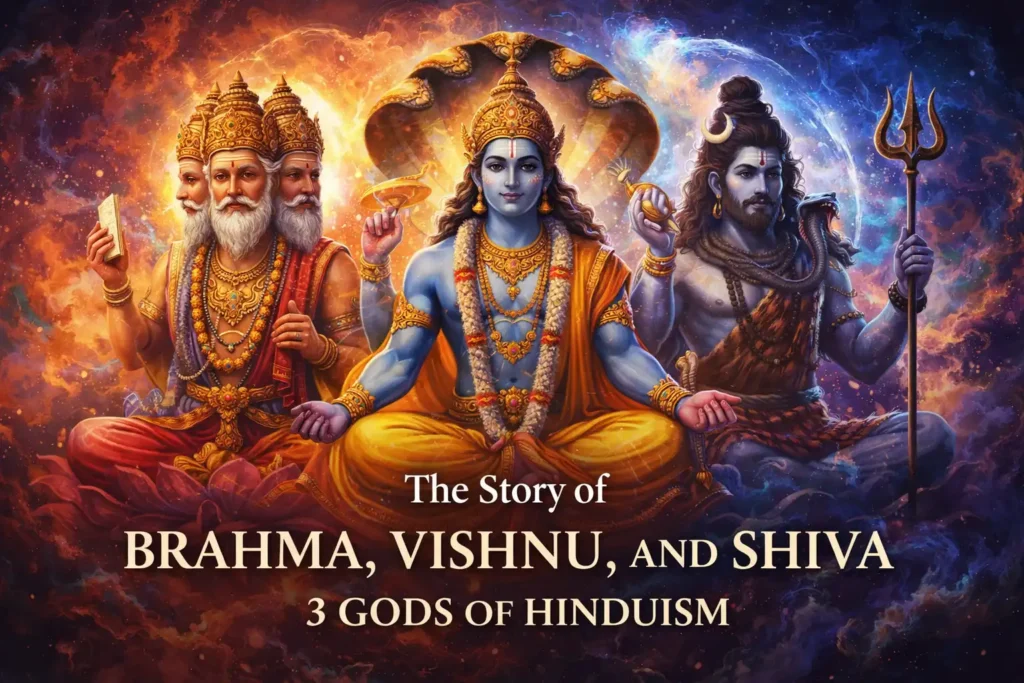
3 Gods of Hinduism, Brahma, Vishnu, and Shiva. In Hindu philosophy, this understanding takes a beautifully simple form: three forces that shape everything we experience. Creation, preservation, and destruction. These are represented by three deities — Brahma, Vishnu, and Shiva.
Human beings have always searched for patterns that make sense of life. Not just in terms of survival or logic, but in terms of meaning. We want to understand why things begin, why they continue, and why they must eventually come to an end. Across cultures, different philosophies have tried to answer this in different ways. In Hindu thought, one of the most elegant expressions of this idea is the story of the Trimurti — Brahma, Vishnu, and Shiva.
At a surface level, this appears to be a structured myth. Three gods, three responsibilities — one creates the universe, one sustains it, and one destroys it. It is simple, almost too simple. But that simplicity is deceptive. Because this story was never meant to remain confined within religion. It was not created merely to be worshipped. It was created to be understood.
Over time, however, something shifted. The story remained intact, but the intention behind it began to fade. The focus moved toward glorification — rituals, identities, and devotion — while the deeper meaning slowly became secondary. The question changed from “What does this represent?” to “How do we honor this?” And in that shift, we unintentionally created distance between ourselves and the very truth the story was trying to show.
This blog is not about rejecting belief. It is about returning to meaning. It is about reading this story not just as mythology, but as a reflection of a universal pattern — one that exists in nature, in systems, and in every human life.
Read More blog on ThePoemStory or Explore: Stories section.
3 Gods of Hinduism | The Story of Brahma, Vishnu, and Shiva
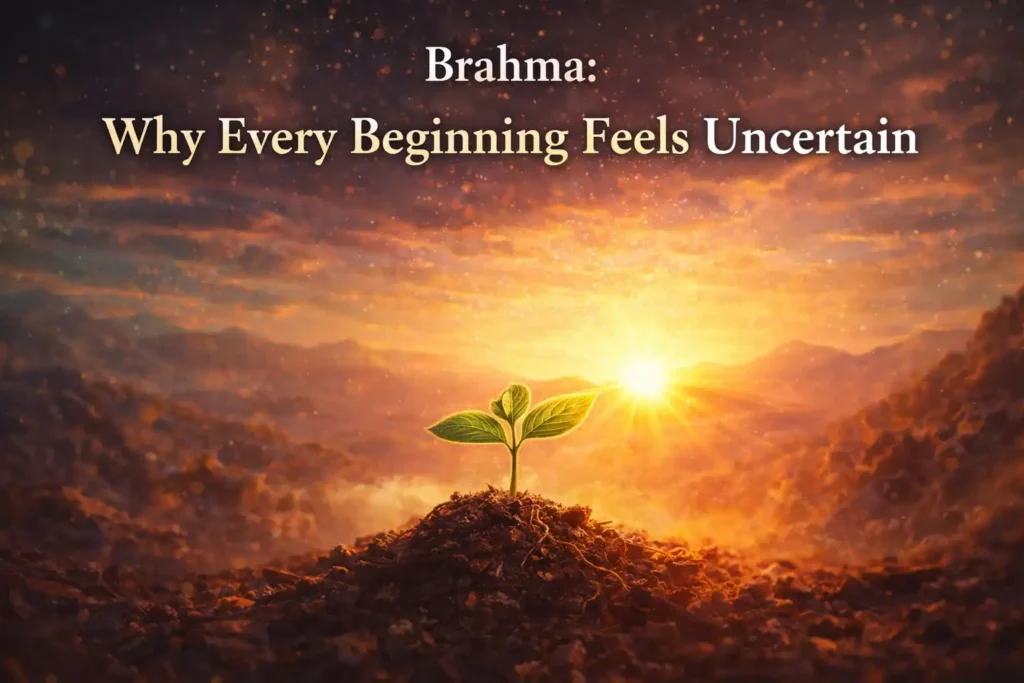
Brahma the creator: Why Every Beginning Feels Uncertain
In Hindu cosmology, Brahma is known as the creator — the one from whom the universe emerges. He is often depicted with four heads, symbolizing knowledge and awareness in all directions, seated on a lotus that rises from the cosmic waters. It is an image that represents origin, emergence, and possibility.
But if we look beyond the imagery, we find something far more familiar. Creation is not a distant, one-time event. It is something that happens constantly, often in ways that go unnoticed.
Every day, we create. We create thoughts, decisions, relationships, identities, and directions. A simple decision can alter the course of a life. A new idea can reshape how someone sees the world. These are not grand cosmic events, but they follow the same principle. Something that did not exist begins to exist.
What makes creation difficult is not the act itself, but the uncertainty that comes with it. Every beginning carries a question that does not have an immediate answer. Will this work? Will it last? Will it matter? And because we do not have answers, we hesitate.
We prefer clarity before action. We want assurance before commitment. We wait for the right moment, the right confidence, the right conditions. But creation does not operate on certainty. It exists in ambiguity. It requires movement even when the outcome is unclear.
Nature does not hesitate in this way. A seed does not question whether it will grow. It responds to its environment and begins. It adapts as it moves forward. It does not wait for perfect conditions because those conditions rarely exist.
In contrast, human beings often delay beginnings because we are trying to eliminate risk. But the truth is simple: most meaningful beginnings happen before you feel ready. Confidence is not what allows you to start. It is often what develops after you have already begun.
The story of Brahma, then, is not just about the creation of the universe. It is about the nature of beginnings themselves. It is about the willingness to step into something new without having complete control over the outcome.
Interestingly, Brahma is one of the least worshipped deities. There are very few temples dedicated to him. This detail is often seen as a cultural curiosity, but it can also be understood symbolically. Creation is essential, but it is only the first step. It is not where most of life unfolds.
But a beginning, no matter how powerful, is only a starting point. What truly shapes anything — whether a life, a relationship, or an idea — is what happens after it begins.
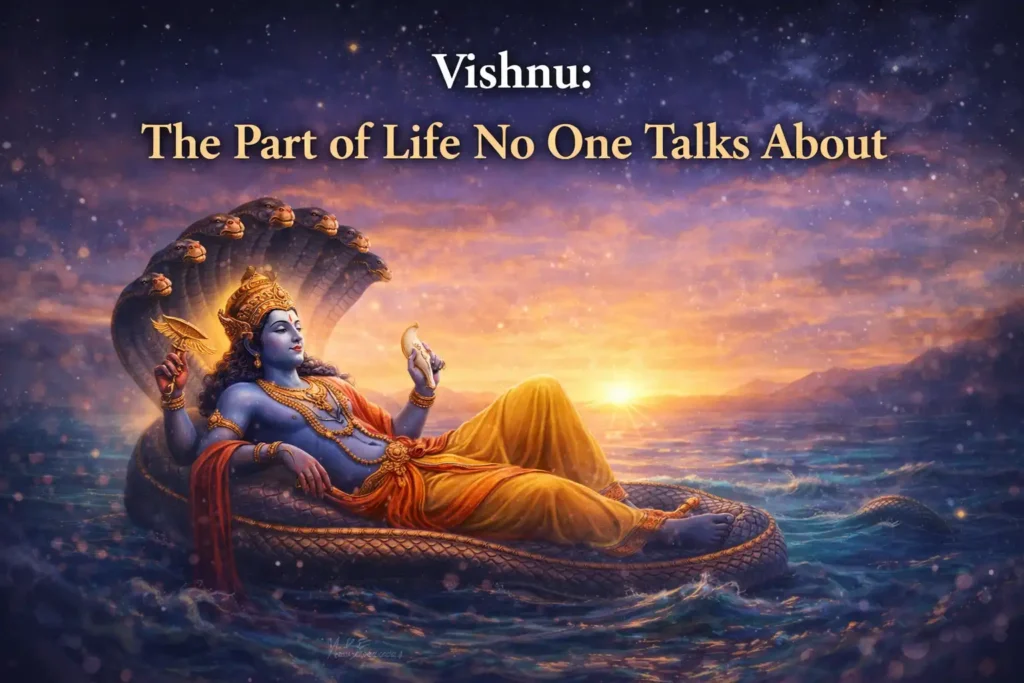
Vishnu the preserver: The Part of Life No One Talks About
If creation is about beginning, preservation is about continuing. This is where Vishnu enters the story. Vishnu is described as the preserver — the one who maintains balance in the universe. When disorder arises, he takes different forms to restore stability. His role is not to create or destroy, but to sustain.
This phase is far less celebrated, but far more demanding. Because in human life, this is where most of our time is spent. Not in beginnings, which are brief, and not in endings, which are often decisive, but in the long, continuous phase of maintaining.
Preservation is waking up every day and continuing what you started, even when the initial excitement has faded. It is maintaining relationships beyond the early stage of connection. It is staying committed to responsibilities when motivation is inconsistent. It is holding on to values when it would be easier to compromise.
There is nothing glamorous about this phase. It does not offer the thrill of something new or the clarity of something ending. It is repetitive, sometimes exhausting, and often invisible to others. But without it, nothing lasts.
This is where many things begin to break down. Not because they were created poorly, but because they were not sustained consistently. Ideas lose momentum. Relationships weaken. Systems collapse. Not due to a lack of potential, but due to a lack of maintenance.
Preservation requires a different kind of strength. It does not require boldness. It requires steadiness. It is not driven by inspiration, which comes and goes. It is driven by discipline, which is a choice.
Nature reflects this as well. Ecosystems do not remain balanced automatically. They require constant adjustment. Remove one element, and the entire system begins to shift. Stability is not a fixed state. It is something that is maintained through continuous interaction.
In mythology, Vishnu takes avatars whenever balance is threatened. In human life, this translates into moments where we must step in and correct our course. When things begin to drift, we need awareness and intervention. Left unattended, everything moves toward disorder.
The story of Vishnu is not just about preservation. It is about responsibility. It is about recognizing that what we value must be actively maintained.
What we sustain eventually confronts us with a difficult question — should this continue, or has it reached its natural end?
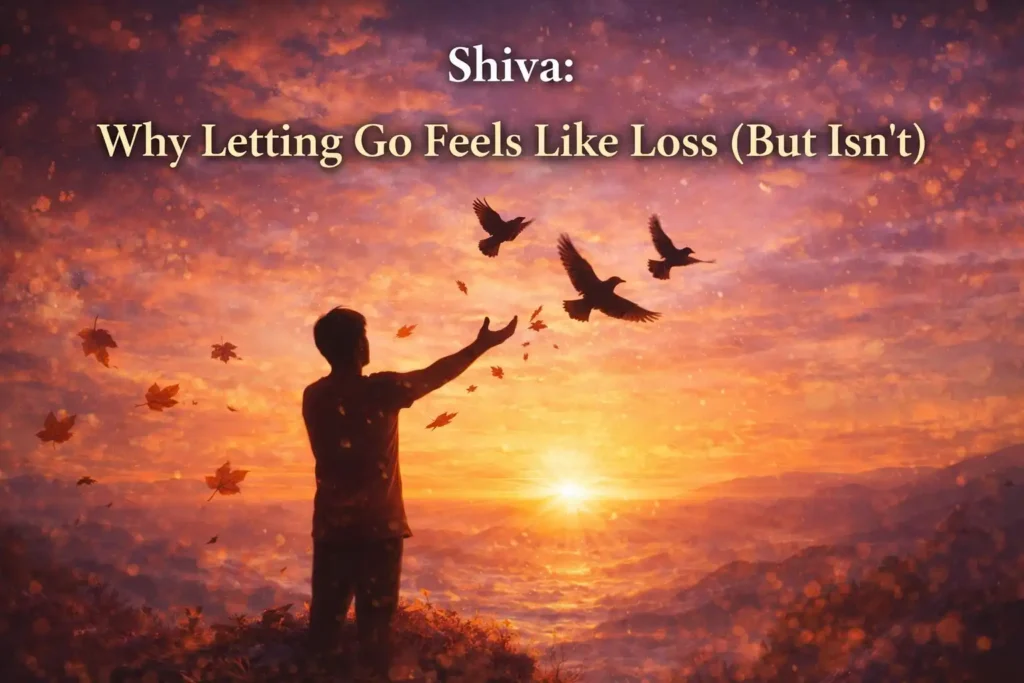
Shiva the destroyer: Why Letting Go Feels Like Loss (But Isn’t)
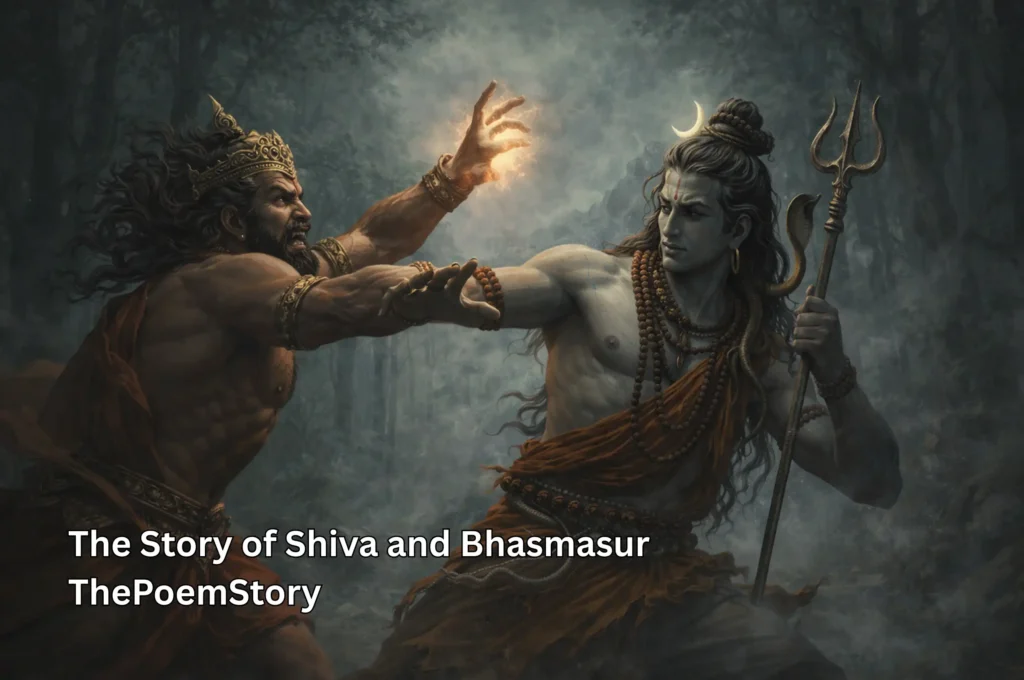
Then comes the most misunderstood part of the story — Shiva, the destroyer.
The word itself creates resistance. It suggests endings, loss, something we instinctively want to avoid. But in the philosophy of the Trimurti, destruction is not an act of negativity. It is an act of necessity.
Shiva is not just a destroyer. He is a transformer. His cosmic dance, the Tandava, represents the destruction of the old to make space for the new. It is not about chaos. It is about renewal.
Because without destruction, creation cannot happen again.
Nature demonstrates this clearly. Leaves fall so new ones can grow. Old cells die so that the body can function. Seasons change, not because something failed, but because change is part of the system.
Destruction, in this sense, is not an exception. It is a requirement.
In human life, this phase is where we struggle the most. We resist endings, even when they are necessary. We hold on to things not because they are still right, but because they are familiar. We confuse continuity with correctness.
We stay in situations longer than we should. We continue identities that no longer represent who we are. We repeat patterns that no longer serve us. Not because we do not see the problem, but because letting go is uncomfortable.
Letting go requires honesty. It requires us to acknowledge that something meaningful has reached its natural conclusion. It requires detachment — the ability to release something even when it still holds emotional value.
And this is difficult.
So we delay endings. We convince ourselves that things will improve. We avoid difficult decisions. We remain in spaces that no longer align with us.
But avoiding destruction does not preserve something. It distorts it.
When something has completed its role, holding onto it does not keep it alive. It prevents growth. It blocks the possibility of something new emerging.
Destruction, then, is not negative. It is clarity. It is the ability to recognize when something has served its purpose.
Without this phase, life becomes stagnant. There is no room for change. No space for new beginnings.
Shiva’s role is not to take away meaning. It is to make space for it to emerge again.
When you look at these three not as separate roles but as connected phases, a pattern begins to emerge — one that repeats itself everywhere.
The Hidden Cycle: What the Story Really Means
When we look at Brahma, Vishnu, and Shiva together, we do not see three separate functions. We see a continuous cycle.
Something begins. It is sustained for a while. And eventually, it ends or transforms. Then, the cycle begins again.
This pattern exists everywhere. In nature, in systems, in relationships, and within our own lives.
You are not the same person you were years ago. Something in you ended. Something new began. And something in between was maintained.
The difficulty is not the cycle itself. The difficulty lies in our resistance to parts of it.
We enjoy beginnings because they carry hope. We take pride in maintaining because it gives us stability. But we resist endings because they force us to confront change.
And yet, avoiding endings does not prevent them. It only delays them.
The longer we resist, the more difficult the transition becomes. What could have been a natural shift becomes a prolonged struggle.
Understanding this cycle does not remove discomfort. It does not make beginnings certain or endings easy. But it provides clarity. It allows us to see that what we are experiencing is not random. It is part of a larger pattern.
But somewhere along the way, this understanding began to fade, and the focus shifted from meaning to reverence.
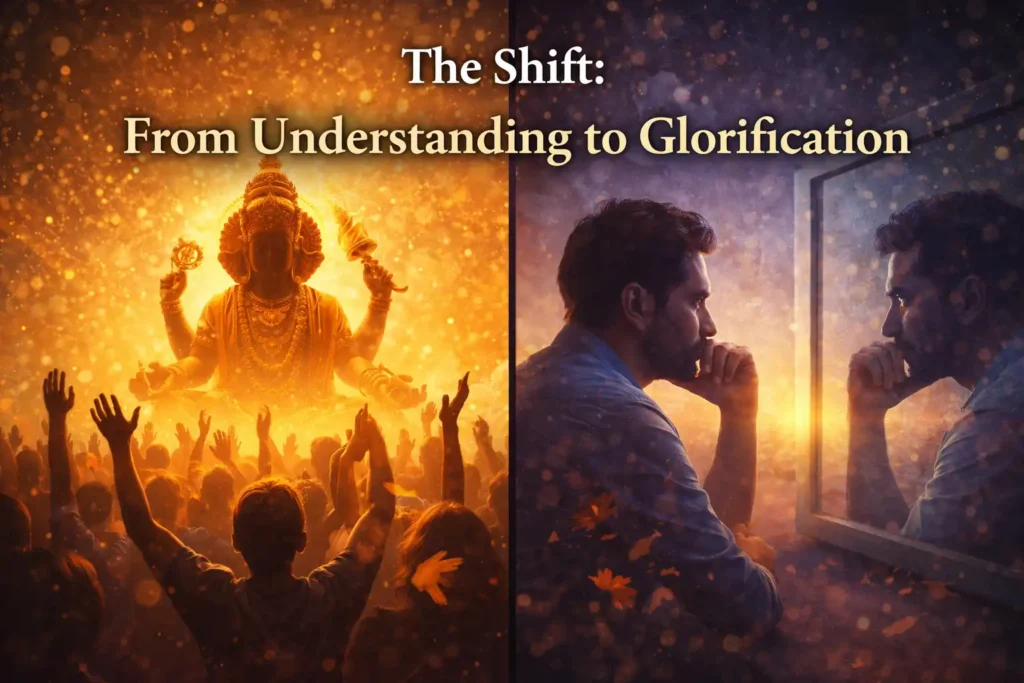
The Shift: From Understanding to Glorification
Over time, the way this story is understood has quietly changed. What was once a way to explain a natural pattern of existence gradually became something to admire, defend, and glorify. The symbols remained, but the meaning behind them became less central.
Instead of asking what creation, preservation, and destruction represent, the focus shifted toward the figures themselves. The conversation moved away from understanding toward identity. What began as a philosophical insight slowly turned into something that demanded belief rather than reflection.
This shift is not limited to religion. It is visible in how we think, work, and organize society.
Take the example of civil services, particularly the journey of an IAS officer. Every year, thousands of aspirants prepare for years to clear one of the toughest exams. The moment someone succeeds, that success is glorified — celebrated as the ultimate achievement. But very little attention is given to what follows.
Once inside the system, the real work begins. Managing districts, handling crises, balancing political pressure, administrative responsibility, and public expectations — this is the phase of preservation. It is less visible, less celebrated, and far more demanding. Many officers enter with idealism, but sustaining that idealism within a complex system requires consistency, judgment, and resilience.
And then comes the phase no one talks about openly — change and displacement. Transfers, policy shifts, systemic resistance, and sometimes the realization that certain efforts will not produce the intended outcomes. This is where the “destruction” phase appears — not as failure, but as a necessary adjustment. Roles change. Approaches evolve. Sometimes, what was started with conviction must be let go or redefined.
But public perception rarely follows this full cycle. It glorifies the success of clearing the exam, overlooks the discipline required to sustain impact, and resists acknowledging the complexity of change within the system.
A similar pattern exists in corporate life.
A startup founder builds something from scratch. The early phase is celebrated — the idea, the risk, the courage to begin. This is the creation phase, and it attracts attention.
But once the company grows, the real challenge begins. Managing teams, maintaining culture, ensuring consistent performance, handling financial pressure — this is preservation. It requires a different mindset altogether. It is less visible, more structured, and often less appreciated.
Then comes the phase that is often avoided in conversations — restructuring, pivoting, or even shutting down parts of the business. Markets change, strategies fail, priorities shift. Letting go of a product, a team, or even an entire direction becomes necessary. This is not destruction in a negative sense. It is adaptation.
Yet, the narrative rarely includes this phase honestly. Success stories highlight the beginning, occasionally acknowledge the growth, but often ignore the difficult decisions required to change direction.
The same pattern appears in individual lives.
We glorify success but ignore the process that sustains it. We admire stability but avoid the responsibility required to maintain it. We fear endings, even when they are necessary for growth.
In identity and group thinking, this becomes even more rigid. Once a symbol becomes tied to identity, it is no longer open to interpretation. It must be protected. Questioning it feels like a threat. As a result, understanding stops evolving.
And this is where the original insight of the Trimurti fades.
Creation begins to feel distant — something divine, not something we actively engage in.
Preservation becomes something expected — something that should happen, not something we are responsible for.
Destruction becomes something negative — something to resist, rather than something to understand.
The more we glorify the symbols, the more we disconnect from their meaning.
What was once a framework to understand life becomes something we admire from a distance.
And in doing so, we overlook the most important part — that these forces are not external. They are active within us, shaping our decisions, our patterns, and our lives every day.
Final Reflection: From Worship to Awareness
The story of Brahma, Vishnu, and Shiva can be seen in many ways — as mythology, as belief, or as philosophy.
But its deepest value lies in what it reveals.
Life is constantly creating, preserving, and transforming.
You are not separate from this process. You are part of it.
You create through your choices.
You preserve through your discipline.
You transform through your ability to let go.
The more we focus only on glorification, the easier it becomes to miss this connection. The more we focus on understanding, the clearer it becomes.
Because this story is not asking for admiration.
It is asking for awareness.
Awareness of what you are beginning.
Awareness of what you are maintaining.
And awareness of what you need to release.
And once you see that clearly, the story is no longer just about three gods.
It becomes a reflection of your own life.
Read More blog on ThePoemStory or Explore: Stories section.

Get the ThePoemStory App — Read Poems Anywhere