Explore the science behind Makar Sankranti and why it represents a seasonal transition.
This is not just a festival of sweets and kites—it is a festival of timing, balance, and natural intelligence. From the idea of Tilāñjali and the tradition of til-gud, to the arrival of curd and poha, the emphasis on rice-based harvest foods, and the cosmic shift of Uttarayan, Makar Sankranti reveals something powerful:
✨ It is tradition designed like a system.
Most blogs will tell you the same story:
“Makar Sankranti is the day the Sun enters Capricorn. We eat til-gud. We fly kites.”
And yes—everything in that sentence is correct.
But it is also incomplete.
Because if we stop there, we reduce Makar Sankranti to a list of activities, not a living idea. We treat it like a holiday, not like a mechanism. We remember the celebration, but forget the intelligence behind it.
When you look closely, Makar Sankranti is not just a festival.
It is a seasonal system.
It is a carefully timed cultural reminder that the year has reached a turning point. The cold may still be present, but the direction of nature begins to change. The Sun’s path shifts. The light begins to stretch. The body starts preparing for a different climate. Farming cycles enter a new rhythm. Diet starts transforming without anyone calling it “diet science.”
This is what makes Makar Sankranti extraordinary.
It doesn’t merely celebrate belief—
it quietly trains people to move with nature.
It teaches you:
- how to recognize seasonal change, not just feel it
- how to shift food habits gently instead of suddenly
- how to respect the idea that the body needs different fuel in different weather
- how to connect the sky with the soil—astronomy with agriculture
- and how to align life with a rhythm bigger than personal routine
This is where India becomes deeply fascinating.
Because many of our traditions were not only about devotion. They were also about survival, health, farming, timing, and balance—packaged in the most memorable form possible: festivals.
What we call “religion” often carried something deeper inside it:
✅ Science embedded in tradition
✅ Astronomy preserved as culture
✅ Seasonal health coded into rituals
✅ Agriculture turned into celebration
And that is why Makar Sankranti feels so universal across India, even when the names, foods, and customs change from state to state.
Because at its core, it is not random joy.
It is seasonal intelligence—celebrated.
You next must read: Indus Valley Civilization: A civilization without religion
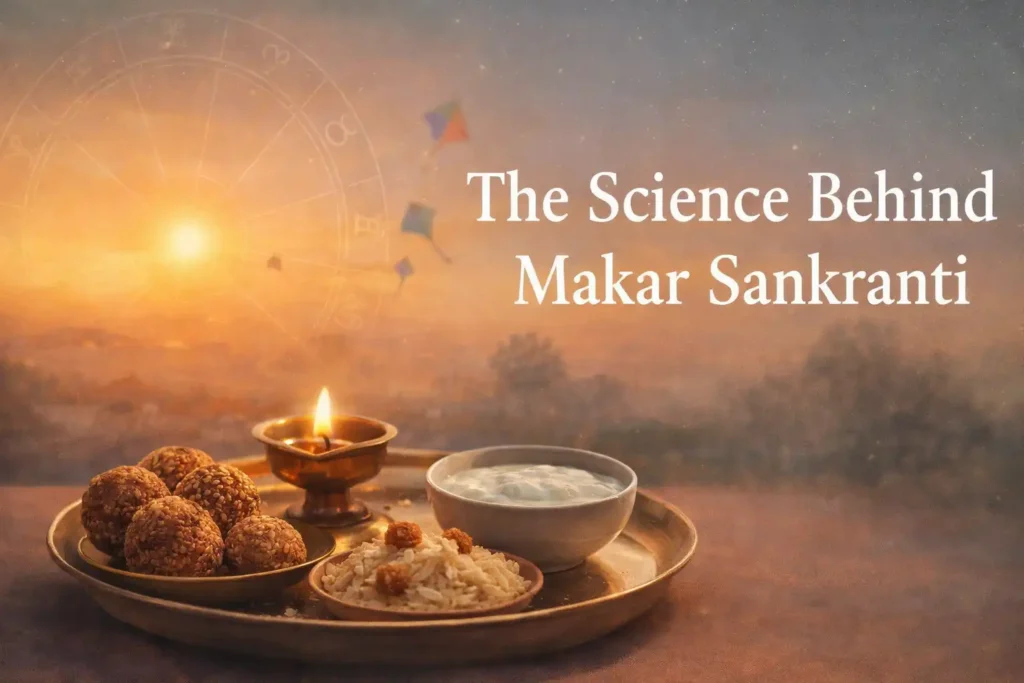
The Science Behind Makar Sankranti
The Real Meaning of “Sankranti”: A Shift, Not Just a Date
The word Sankranti itself points to movement.
The word Sankranti itself points to movement. It doesn’t simply mean a celebration or a ritual day—it literally refers to a shift.
In traditional Indian timekeeping, Sankranti marks the moment the Sun transitions from one zodiac sign (rashi) to another. This is not a symbolic idea alone. It is an astronomical event that can be observed and calculated.
That is why Sankranti is different from many festival dates that change due to lunar cycles. Sankranti is tied to the Sun’s position, and the Sun is the most consistent seasonal clock we have.
This is what makes Sankranti so meaningful.
It isn’t just a reason to gather and celebrate. It is a cosmic marker—a reminder that nature has crossed into a new phase, even if the visible changes take time to arrive.
Among all Sankrantis, Makar Sankranti became the most widely known because its timing aligns with something people experience in real life: the slow beginning of a seasonal turn.
On this day, the Sun is said to enter Makara (Capricorn). But beyond astrology, this transition is strongly associated with Uttarayan, the Sun’s northward journey.
Uttarayan is traditionally linked with the idea that daylight begins to increase gradually and the long dominance of winter begins to weaken. Even when the air remains cold and mornings stay foggy, the larger movement of the season begins shifting underneath.
And that is the most important point.
Makar Sankranti is not a festival that claims “winter ends today.”
It is a festival that signals: winter has reached its turning point.
From here, the change is gradual, not instant. The cold will not disappear in a day, but the direction has already changed.
And in nature, direction matters more than speed—because the biggest transformations always begin quietly.
The Festival That Follows the Sun (Not the Moon)
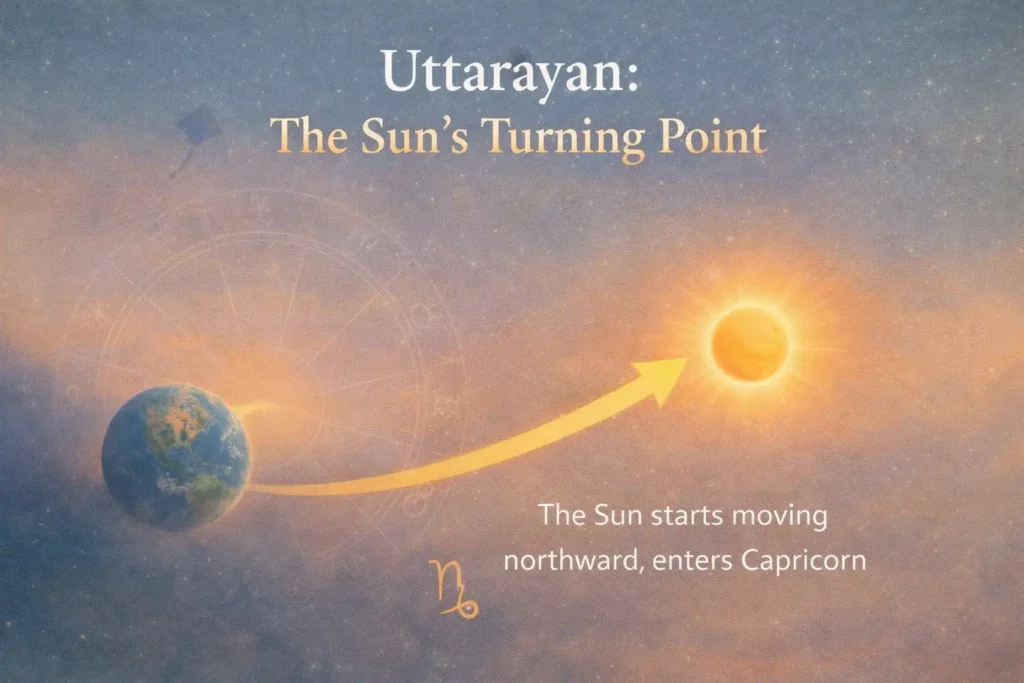
Most Indian festivals are based on the lunar calendar, which is why their dates keep shifting every year. One year they arrive early, the next year they move further into the month. The celebrations remain the same, but the calendar date changes because the Moon’s cycle is shorter than the solar year.
Makar Sankranti is different.
This festival is based on the Sun, not the Moon. And that one difference makes it incredibly special, because solar events are directly linked to seasons. That is why Makar Sankranti stays anchored around January 14 or January 15 almost every year, with only minor variation.
This consistency is not accidental.
It tells us that Makar Sankranti is not only an emotional celebration built on stories and rituals. It is also a time-marker, a cultural way of tracking the year through the movement of the Sun.
In other words, it is a festival that comes from observation.
Someone, centuries ago, noticed patterns: how the Sun’s position changes, how seasons respond, how the length of daylight shifts, and how nature slowly moves from one phase into another. That knowledge was not written only in scientific language—it was preserved in a form that people could remember, repeat, and celebrate.
That is the genius of it.
The festival of Makara Sankranti is tied to astronomy,
not in classrooms and textbooks—
but in everyday life.
What Most People Miss About Makar Sankranti
Most articles explain Makar Sankranti as a festival of til-gud and kites, and then stop there. But that framing misses the most important point: Sankranti is a transition marker, not just a celebration. It doesn’t announce that winter has ended—it signals that the direction has changed. That is why the food choices matter so much. Til isn’t only about warming the body; it may also represent winter’s final chapter. Curd and poha are not random combinations either—they look like a gentle preparation for the heat that slowly follows. When you view the festival through this lens, Makar Sankranti stops being a tradition you follow blindly. It becomes a seasonal system you can actually understand.
Your Body Doesn’t Stay the Same Across Seasons — So Why Should Your Diet?
The human body doesn’t behave the same way in every season. Winter and summer demand completely different adjustments—inside the body as much as outside. The metabolism shifts, digestion changes, appetite changes, and even the way we experience fatigue and heat changes with the weather.
That’s why seasonal living was always a part of Indian tradition. Not as a modern “diet trend,” but as a survival-level habit passed through generations.
This is the part most traditional posts miss.
They talk about til-gud as if the story ends there—like Makar Sankranti is simply a sweet festival meant to warm you up in winter. And yes, sesame and jaggery are warming in nature, so the explanation sounds complete at first.
But what if it isn’t?
What if til-gud is not the beginning of a winter habit… but the closing chapter of it?
What if Makar Sankranti is not a random day when we eat sesame, but a day when we finish it intentionally, because the season is about to turn?
This is a more realistic way to read the festival.
Because Sankranti is not just about celebrating the Sun’s transition in the sky. It is also about preparing the body for the transition on Earth. A festival that quietly helps you move from cold to warmth without shocking your system.
That’s where the intelligence becomes visible.
Makar Sankranti doesn’t just give you a ritual to follow.
It gives you a seasonal signal:
Winter diet ends here. The next phase begins now.
Til & Gud: Not Just Winter Food… But Winter’s Final Chapter
Sesame (til) is hot by nature. It generates warmth in the body, feels slightly oily, and carries a “heating” quality that works beautifully in peak winter. That’s why til is trusted across Indian households during cold months—because it supports energy, digestion, and inner warmth when the weather is harsh.
But seasonal food wisdom is not only about what we eat. It is also about when we stop eating it.
As the climate begins shifting from intense cold toward warmer days, continuing heavy heating foods can disturb balance. Winter foods that were once helpful can start becoming excessive. The body no longer needs constant internal heat generation. It starts preparing for a different season—one where cooling and lightness become equally important.
That is why I see Makar Sankranti differently.
For me, this festival is not a random day where we begin eating til-gud. It is the day we complete it. The last intentional winter serving. A final warmth before the dietary rhythm changes.
✅ Makar Sankranti is the last day we consume til with purpose.
A final seasonal closure.
Because this festival is not just about celebration—it is about transition. The Sun shifts, the season begins to turn, and the plate quietly follows that change.
And then… we move forward.
Tilāñjali: The Word That Reveals the Hidden Meaning
Now here comes the part that changes the way we look at til on Makar Sankranti.
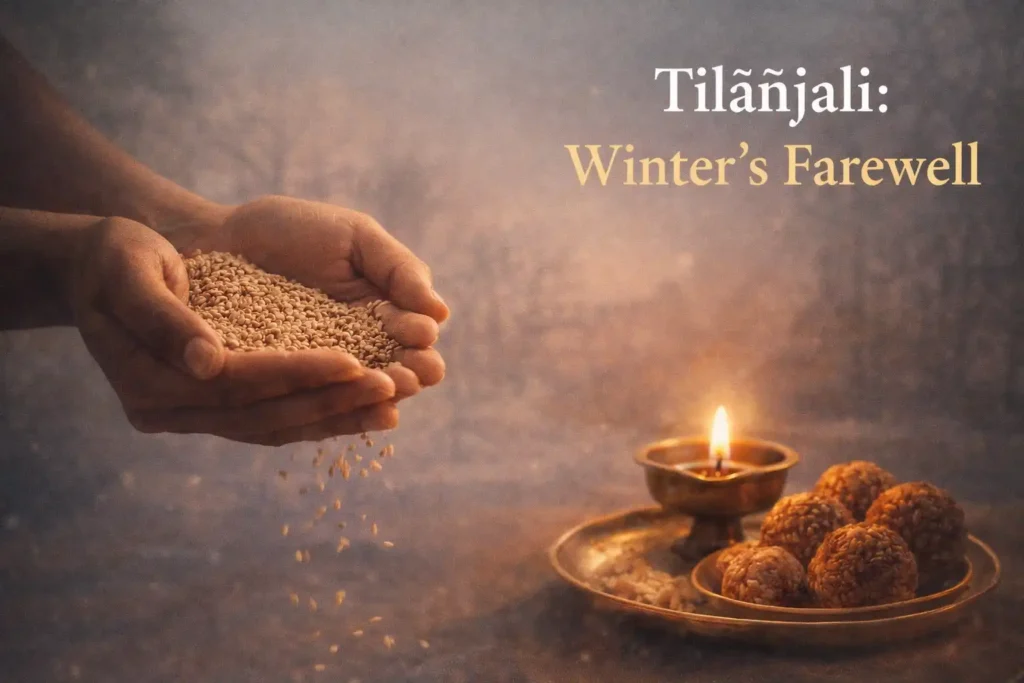
There is a powerful word in Sanskrit and Hindi: Tilāñjali (तिलांजलि). Traditionally, it refers to an offering made with til (sesame) along with water—an act associated with closure, remembrance, and finality. But what makes this word truly striking is how it also lives in everyday language.
Because Tilāñjali isn’t used only as a ritual term. Over time, it has also become a cultural expression for something far deeper: to abandon completely, to renounce forever, to leave something behind fully and finally.
Read that again.
This means Til + Anjali is not just a literal offering held in the palms. It carries the emotional weight of a final goodbye. A point of no return. A conscious ending.
And once you understand that, til on Sankranti stops being “just a sweet.”
It becomes symbolic.
Because if Makar Sankranti is a seasonal turning point, then til becomes more than a winter ingredient. It becomes a message of seasonal closure—almost like the body is being told, this chapter is ending now.
So when we eat til-gud on this day, it can be read in a completely different way: not as the beginning of a tradition, but as the completion of winter’s diet cycle—a final warmth, a final ritualised closure.
In that sense, Makar Sankranti feels like a Tilāñjali to winter itself. A farewell to the cold-season food pattern. A full stop before the next season begins.
And that is not poetry.
That is a cultural truth hidden inside language—proof that sometimes tradition doesn’t just preserve rituals… it preserves meaning.
From Hot to Cool: Why Curd and Poha Enter the Plate
Now comes the next transition step—the one that completes this entire seasonal logic.
If til represents the final warmth of winter, then what signals the beginning of the coming heat?
Curd.
Curd is widely understood as cooling in nature. It is soothing, balancing, and more suitable for warmer days. In fact, most people naturally associate curd with summer—when the body needs calmness, hydration, and a lighter internal temperature.
And yet, in many regions—especially in Bihar and parts of North and Eastern India—Makar Sankranti is celebrated with something very specific:
🥣 Dahi–Chura (curd + rice flakes/poha)
That combination is not accidental. It is almost too perfect to be a coincidence.
Because curd does not belong to winter comfort food logic. It belongs to seasonal transition logic.
It signals that the body is now preparing to shift gears. Winter has been heavy and heating. The diet has supported warmth for weeks, sometimes months. But now, nature begins to turn. The air will start changing slowly. The body will need to adapt gently.
This is exactly what curd and rice flakes do.
Poha (or chura) is light, easy to digest, and grain-based—linked to harvest and seasonal grain availability. Curd cools, stabilises, and prepares the system for rising heat. Together, they form a meal that feels like a bridge between two seasons.
It’s as if the festival is quietly telling you:
“You’ve warmed the body enough.
Now start training it to cool itself.”
And that is the real structure of Sankranti on the plate:
🔥 winter foods close
❄️ summer foods begin
🌾 the body adapts gradually, not suddenly
This is real science—not modern science written in lab language, but lived seasonal science, preserved in culture and repeated every year without needing a manual.
Makar Sankranti: The Festival of New Rice (Across India)
In many parts of India, Makar Sankranti is not only about astrology or the Sun’s transit. It also carries the emotion of a fresh harvest—especially the arrival of new grain, with rice playing a central role in many regions.
And once again, the clearest proof is not in speeches or rituals.
It is on the plate.
Across India, Sankranti is celebrated through food that reflects the season—light, grain-based, warming when needed, and symbolic of abundance. The names may change, but the agricultural heartbeat stays the same.
1) Rice flakes / Poha (Chura)
Rice flakes are one of the simplest harvest foods—light, easy to digest, and widely loved. In many homes, Sankranti meals include poha or chura, often paired with curd or jaggery, which makes it both seasonal and deeply rooted in harvest culture.
2) Khichdi: Rice as the Festival Meal
In parts of North India, especially Uttar Pradesh and Bihar, Sankranti is even known in many places as Khichdi, where khichdi becomes the signature dish of the day. Made with rice and lentils, it represents nourishment, simplicity, and the strength of fresh grain at the turning point of the season.
3) Pitha / Pittha made from rice flour
In several eastern regions, Sankranti season is closely associated with rice flour preparations like pitha. These traditional sweets are not just festive recipes—they are a cultural way of celebrating the new harvest by turning rice into something special and celebratory.
4) Lohri in Punjab: The Bonfire of Harvest Joy
In Punjab, the same seasonal transition and harvest emotion appears as Lohri—celebrated with warmth, community gathering, and a bonfire. While the expression is different, the message is familiar: the hardest part of winter is passing, and the harvest season brings hope, energy, and togetherness.
5) Uttarayan in Gujarat: When the Sky Becomes a Festival
In Gujarat, Makar Sankranti becomes Uttarayan, where kite flying fills the sky. It’s not just recreation—it reflects the joy of seasonal shift, sunlight, and renewed energy. The celebration moves upward, almost as if people are responding directly to the Sun’s changing journey.
So across India, one truth repeats in different forms:
🌾 The Sun shifts… and harvest arrives.
This is not random culture.
This is agriculture meeting astronomy—the sky marking a transition, and society celebrating what the land is beginning to offer.
The Festival is a Formula: Astronomy + Agriculture + Health
If you strip away the noise and simply observe the structure, Makar Sankranti starts looking less like a one-day celebration and more like a carefully designed seasonal system. It operates like a formula—where nature provides the signals and society responds in an organised way.
That is why this festival appears in so many forms across India. The food changes, the name changes, even the rituals change—but the underlying logic stays consistent. It is built on a few fundamental pillars that remain timeless.
🌞 Astronomy: The Sky Becomes the Calendar
Makar Sankranti is anchored to the Sun’s movement, not the Moon. The Sun becomes the date-marker, telling people that a transition has begun. This is why the festival remains stable around mid-January and aligns so well with seasonal rhythms. It is nature itself acting like a clock.
🌾 Agriculture: Harvest Turns into Celebration
The same date also reflects a shift on the land. In many regions, fresh grain and harvest-linked foods begin to appear—especially rice in different forms. What looks like cultural tradition is actually agricultural timing. The festival becomes a way of honouring what the soil has produced and what the season is bringing in.
🥗 Health: Seasonal Diet Switch is Built into Tradition
This is where the intelligence becomes personal. The festival quietly guides the body through transition—closing winter habits and introducing lighter, cooling, or harvest-based foods. Til, gud, curd, poha, rice flour sweets—these are not random festive items. They are seasonal instructions written in edible form.
And finally, there is the social layer. Charity, sharing, gatherings, and giving are not separate from the festival—they complete it. Winter creates empathy, and Sankranti turns that empathy into action. A community stays healthy when it does not celebrate alone.
This is exactly why such festivals survived for centuries.
Not because people were blindly following rituals.
But because the rituals worked.
They made life more organised, more seasonal, and more balanced—without requiring modern language, medical labels, or scientific explanations.
In that sense, Makar Sankranti is not just culture.
It is a system that still functions.
The Genius of Indian Tradition: Science That People Would Actually Follow
This is the real brilliance of what we call “science embedded in religion.” It was never just about belief. It was also about building habits that kept people aligned with nature, season after season, generation after generation.
Because here is a simple truth: people can forget advice.
They forget health rules.
They ignore warnings.
They postpone change.
Even today, a doctor can tell you to improve your diet or lifestyle, and most of us will agree—but still delay it. We’ll say “from Monday,” “from next month,” “after this busy week,” or “when life becomes calmer.”
But festivals don’t work like optional advice.
Festivals arrive with authority. They arrive with community participation. They arrive with emotion, repetition, and memory. And that makes them powerful.
So when a festival says, “Today we eat this,” it doesn’t feel like discipline. It feels like celebration.
And the moment something becomes celebration, it turns into habit.
That is how seasonal knowledge was preserved in India—not through long lectures or complicated instructions, but through rituals that people could follow effortlessly.
Not through books.
Through lived routines.
Not through scientific vocabulary.
Through food and timing.
Not through fear of consequences.
Through the joy of doing it together.
That is why these traditions survived. They were not only meaningful. They were practical. They made life easier to manage in a world where nature controlled everything.
In the end, Makar Sankranti becomes proof of a larger truth:
When knowledge is wrapped in culture, people don’t just learn it—
they live it.
Final Thought: Makar Sankranti is a Festival That Trains You
We often treat festivals like breaks from life—days meant for food, fun, and a temporary pause from routine. But the deeper truth is that festivals were never designed only for entertainment. They were designed as training systems for life, built around the biggest force that shaped human living: nature.
Makar Sankranti is a perfect example of that design.
It doesn’t just arrive as a celebration. It arrives as a signal. The Sun shifts its position, the season begins to turn, harvest energy enters homes, and the body quietly starts adapting. Nothing dramatic happens overnight, but everything starts moving in a new direction. And the festival gives people a framework to understand that change—and participate in it.
That is what makes this festival intelligent.
Makar Sankranti teaches you that seasons change, so you must change with them. It teaches you that warmth is good, but only for the right time and the right phase. It teaches you that balance matters more than extremes, because nature itself never jumps suddenly—it transitions. It teaches you that food is not just taste or tradition; it is timing. And most importantly, it proves that tradition is not always blind—it is often tested through lived experience.
When you start seeing Sankranti this way, you stop treating it as just another festive day on the calendar.
You stop saying “Happy Makar Sankranti” like it’s only a greeting.
You start feeling something deeper—something personal and universal at the same time:
🌞 Happy transition.
Happy seasonal wisdom.
Happy alignment with nature.
Because this festival doesn’t just celebrate the Sun.
It teaches you how to live under it.
Makar Sankranti is not just a festival — it’s seasonal intelligence, preserved in belief, and served on a plate.
If you’re curious about how this blend of belief and practical living developed over time, you may also enjoy reading When Did Religion Enter Indian Society — And Why?, because it adds historical context to why festivals became such powerful carriers of culture and seasonal wisdom.

Get the ThePoemStory App — Read Poems Anywhere