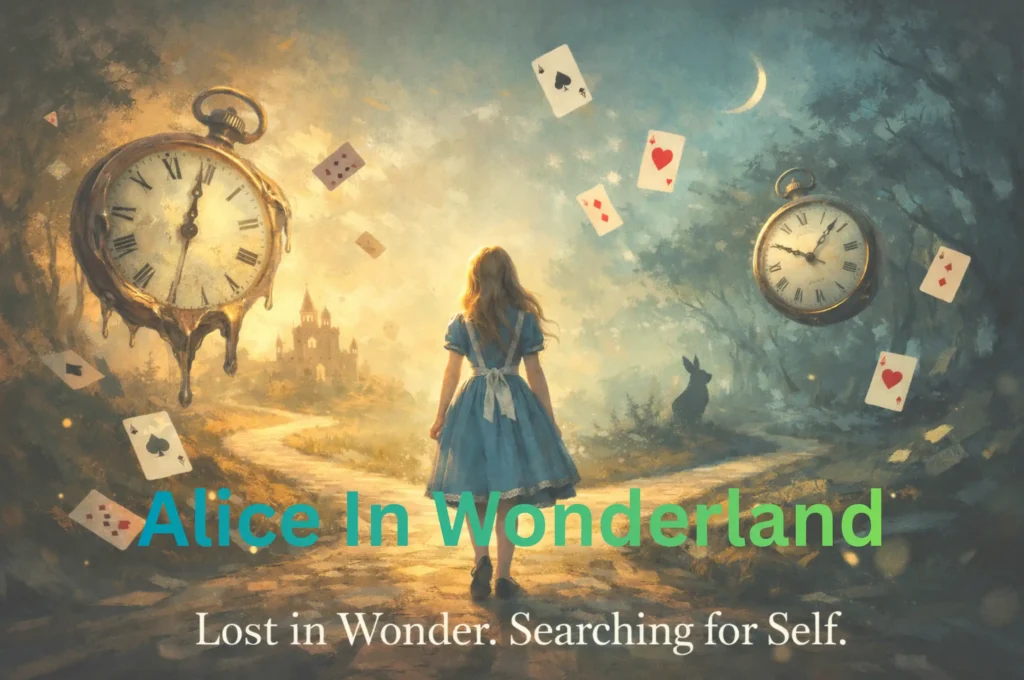
Alice in Wonderland is often remembered as a whimsical children’s tale filled with talking animals, tea parties, and nonsense rhymes. Yet reducing it to a fantasy for children misses its true power. More than a century and a half after its publication, Alice in Wonderland continues to resonate because it captures something fundamental about the human condition—especially in the modern age.
In a world shaped by rapid technological change, information overload, shifting identities, and questionable authority, Wonderland feels less like a fantasy and more like a mirror. This is not accidental. Lewis Carroll’s story survives because it does not belong to a single era. It speaks to how humans experience confusion, power, language, and selfhood—then and now.
This article explores Alice in Wonderland as a psychological, philosophical, and cultural text, revealing why it remains so relevant in the age of algorithms, social media, and constant uncertainty.
Read More Stories
Also Read:
- The Boy Who Cried Wolf: A Timeless Lesson on Truth, Trust, and Credibility
- The Tortoise and the Hare: A Timeless Lesson on Consistency and Character
A Review of Alice’s Adventures in Wonderland
A Story Born in Order—and Obsessed With Disorder
To understand why Alice in Wonderland feels so modern, it helps to remember the world it emerged from. Victorian England valued structure, hierarchy, rigid morality, and strict social rules. Children were expected to obey. Adults were expected to conform. Language, etiquette, and authority were treated as fixed and unquestionable.
Wonderland is the opposite of that world.
From the moment Alice falls down the rabbit hole, she enters a place where order collapses:
- Rules exist, but they change without explanation
- Authority speaks loudly but thinks poorly
- Logic is present, yet constantly contradicts itself
This inversion was radical. Carroll did not merely write nonsense—he weaponized it. By exaggerating absurdity, he exposed how fragile “sense” really is when it is built on unquestioned rules.
Modern readers recognize this immediately. Our world, too, is full of systems that claim logic yet behave irrationally. Policies change overnight. Algorithms decide visibility. Institutions speak with confidence while contradicting themselves. Wonderland feels familiar because we live in our own version of it.
Falling Down the Rabbit Hole: A Metaphor for Modern Entry Points
The rabbit hole is one of the most enduring metaphors in modern culture—and for good reason. Alice does not enter Wonderland through a door she chooses. She falls.
This loss of control is crucial.
Alice’s descent mirrors how people today often enter complexity:
- A child enters adulthood
- A user enters the internet
- A citizen enters bureaucracy
- A mind enters anxiety
There is no manual. No clear orientation. Only acceleration.
Once inside, Alice struggles to find stable ground—physically and mentally. She shrinks. She grows. She forgets what she knows. This constant instability reflects modern psychological experiences: identity shifts, imposter syndrome, and the feeling of being too much or not enough depending on context.
The rabbit hole is not escapism. It is initiation.
A World That Feels Uncomfortably Familiar
Wonderland operates on rules that are never explained, only enforced. Characters expect Alice to understand customs she has never been taught. When she questions them, she is told that she is the problem.
This is one of the most psychologically accurate aspects of the book.
Modern life often works the same way:
- Social norms shift rapidly
- Professional expectations remain unspoken
- Cultural rules are enforced without clarity
People are judged not for breaking rules, but for failing to intuit them.
Alice’s confusion is not stupidity—it is the natural response of a rational mind placed in an irrational system. Her experience validates the reader’s own confusion in complex environments.
Curiosity as an Act of Survival
Alice’s defining trait is curiosity. She asks questions when silence would be safer. She challenges statements that make no sense. She insists on understanding—even when doing so isolates her.
In Wonderland, curiosity is dangerous. It attracts hostility. It disrupts routines. Yet without it, Alice would be completely lost.
This framing feels especially relevant today.
In an age of:
- Clickbait headlines
- Performative certainty
- Simplified narratives
curiosity becomes an act of resistance.
Carroll presents curiosity not as rebellion for its own sake, but as intellectual self-preservation. Alice’s questions are how she stays anchored to herself. Each question is a refusal to surrender her mind.
“Who Am I?” — Identity as a Moving Target
Few literary works explore identity as persistently as Alice in Wonderland. Alice’s body changes constantly. Her memory falters. Other characters question who she is. At times, even she is unsure.
“Who in the world am I? Ah, that’s the great puzzle.”
This is not a passing line—it is the emotional core of the book.
Identity in Wonderland is unstable. It depends on:
- Size
- Context
- Authority
- Perception
This anticipates modern identity struggles remarkably well. Today, identity is shaped by:
- Online personas
- Professional roles
- Social validation
- Algorithmic feedback
Like Alice, people often feel fragmented—one self at work, another online, another in private. The pressure to be consistent in inconsistent environments creates deep anxiety.
Carroll does not resolve this tension. Alice does not “find herself” in a neat conclusion. Instead, she learns to tolerate uncertainty—to exist without fixed definitions. This lesson feels especially valuable today.
The Queen of Hearts: Power Without Wisdom
The Queen of Hearts is one of literature’s most recognizable symbols of meaningless authority. She shouts orders. She threatens punishment. She never listens.
Her famous line—“Off with their heads!”—reveals a system where power is loud, impulsive, and disconnected from reason.
This is satire, but it is also observation.
Carroll understood that authority often functions theatrically. The Queen’s power depends on repetition, fear, and spectacle—not intelligence or fairness. When challenged calmly, her authority collapses.
Modern readers cannot miss the parallel:
- Loud leadership
- Reactionary decisions
- Punishment-first thinking
The Queen of Hearts remains relevant because she embodies a timeless truth: power without understanding is fragile, but dangerous.
The Trial Scene: Justice as Performance
The trial near the end of the story is one of Carroll’s sharpest critiques. Evidence is irrelevant. Verdicts are decided before arguments. Logic is reversed.
This scene is funny—but unsettling.
It exposes how systems of justice can become rituals rather than searches for truth. Rules exist to maintain appearances, not fairness.
For modern readers accustomed to:
- Performative outrage
- Prejudged narratives
- Symbolic accountability
the trial scene feels disturbingly familiar.
Alice’s eventual refusal to accept the trial’s logic marks a turning point. She grows—literally and psychologically—and recognizes the system’s emptiness. Her growth is not just physical; it is moral clarity.
Language as a Tool—and a Weapon
Carroll was deeply interested in language, logic, and mathematics. In Wonderland, language does not simply communicate—it confuses, dominates, and misleads.
Characters twist meanings. Definitions change mid-sentence. Words are treated as flexible weapons rather than shared tools.
This aspect of the book feels strikingly modern.
Today, language is often used to:
- Obscure responsibility
- Reframe failure
- Manufacture consent
Buzzwords replace clarity. Confidence replaces accuracy. Carroll anticipated this dynamic long before modern media.
By forcing readers to confront linguistic absurdity, Alice in Wonderland trains them to question language itself—a skill increasingly vital in the digital age.
Time, Anxiety, and the Mad Hatter
The Mad Hatter’s relationship with time is one of the most psychologically rich elements of the book. Time is not flowing—it is stuck. The tea party never ends.
This frozen moment reflects a particular anxiety: being trapped in repetition without progress.
Modern life often produces similar feelings:
- Endless notifications
- Perpetual urgency
- No clear completion
The Hatter’s madness is not random. It is the result of a broken relationship with time—something many people experience today.
Wonderland understands that mental distress often comes not from chaos, but from meaningless repetition.
Childhood, Adulthood, and the Loss of Wonder
Although often categorized as children’s literature, Alice in Wonderland is deeply ambivalent about adulthood. Adults in Wonderland are irrational, authoritarian, and insecure. Children, represented by Alice, possess clarity and moral instinct.
Carroll does not idealize childhood innocence. Instead, he critiques adulthood’s obsession with control and certainty.
In this sense, Wonderland asks an uncomfortable question:
What if maturity is not about knowing more—but about questioning less?
This question resonates with modern audiences navigating institutions that discourage doubt and reward compliance.
Why Alice in Wonderland Still Captivates Modern Readers
From a storytelling perspective, Alice in Wonderland endures because it speaks to universal human experiences that never age:
- It is timeless, not tied to trends or eras
- It explores emotional and psychological depth without preaching
- Its characters are culturally familiar, yet endlessly reinterpretable
- Its world offers rich visual symbolism that invites imagination
- Its ideas encourage reflection, sharing, and personal interpretation
Stories that survive do so because readers recognize themselves within them.
Alice in Wonderland does not demand belief—it invites recognition.
Readers don’t just read about Wonderland.
They recognize their own confusion, curiosity, and growth inside it.
Alice’s Growth: Not Mastery, but Recognition
Importantly, Alice does not conquer Wonderland. She does not fix it. She outgrows it.
Her final growth is not domination—it is awareness. She recognizes nonsense as nonsense. She understands that not all systems deserve obedience.
This is a powerful conclusion.
In a world that often demands participation in broken systems, Alice models an alternative: internal sovereignty. The ability to think clearly even when surrounded by chaos.
Final Reflection: Why This Story Still Matters
Alice in Wonderland endures because it tells the truth gently. It acknowledges confusion without shaming it. It questions authority without glorifying rebellion. It treats curiosity as courage.
Its message feels increasingly urgent:
- Confusion is not failure
- Questioning is not disobedience
- Identity is not fixed
- Power is not wisdom
In a modern world that often feels like Wonderland, Alice remains a guide—not because she has answers, but because she keeps asking the right questions.
And that, more than anything, is how we stay human.
Frequently Asked Questions About Alice in Wonderland
What is the deeper meaning of Alice in Wonderland?
The deeper meaning of Alice’s Adventures in Wonderland lies in its exploration of identity, logic, power, and personal growth. Beneath its playful surface, the story examines how individuals navigate confusion, question authority, and search for meaning in a world where rules often feel arbitrary. It reflects the psychological experience of growing up and learning to think independently.
Is Alice in Wonderland meant for adults or children?
While originally written for children, Alice in Wonderland is equally—if not more—relevant for adults. Children enjoy its imagination and characters, but adults recognize its satire of society, authority, and language. The book operates on multiple levels, making it a classic example of literature that grows with the reader.
Why does Alice keep changing her size in Wonderland?
Alice’s physical changes symbolize identity instability. Growing and shrinking represent how people feel too small in some situations and too large in others. These shifts mirror real-life experiences of self-doubt, social pressure, and changing roles—especially during periods of transition.
What does the Queen of Hearts represent?
The Queen of Hearts represents power without wisdom. She rules through fear, emotional reactions, and empty authority rather than reason or justice. Her character is a satirical critique of leaders and systems that demand obedience without understanding or fairness.
Why is Alice in Wonderland considered a philosophical story?
The story raises philosophical questions about:
What defines identity
How language shapes reality
Whether rules are inherently meaningful
How authority gains legitimacy
Through absurd situations, Lewis Carroll invites readers to question assumptions they normally accept without thought.
What is the significance of nonsense in Alice in Wonderland?
The “nonsense” in Alice in Wonderland is intentional. Carroll uses absurd dialogue and illogical situations to show how language and logic can be manipulated. This highlights how meaning is often constructed, distorted, or misunderstood—making the story surprisingly relevant in the modern information age.
Why does Alice in Wonderland still feel relevant today?
The story remains relevant because it reflects modern experiences:
Confusion in complex systems
Identity struggles
Questionable authority
Information overload
Readers see their own lives mirrored in Wonderland, which is why the book continues to resonate across generations.
What lesson does Alice in Wonderland ultimately teach?
The core lesson of Alice in Wonderland is that questioning is essential. Curiosity, self-reflection, and critical thinking help individuals navigate irrational environments. The story encourages readers to trust their reasoning—even when the world around them doesn’t make sense.
Is Alice in Wonderland about escaping reality?
No. Rather than escaping reality, Alice in Wonderland teaches readers how to cope with reality—especially when it feels illogical or overwhelming. Wonderland exaggerates real-world confusion to make it easier to recognize and understand.
Read Alice’s Adventures in Wonderland by Lewis Carroll
The original text of Alice’s Adventures in Wonderland is in the public domain and can be read for free.
🔗 Free Public Domain Version (Project Gutenberg)
Project Gutenberg offers the complete, unabridged text in multiple formats:
👉 Read for free on Project Gutenberg
https://www.gutenberg.org/ebooks/11
Available formats:
- Online reading (HTML)
- EPUB (for Kindle & eReaders)
- Plain text
- PDF (via external mirrors)
This is ideal for readers who want to explore the original language exactly as Lewis Carroll wrote it.
🛒 Buy Alice in Wonderland (Recommended Editions)
If readers prefer a physical book, illustrated edition, or collector’s copy, here are some excellent Amazon options you can use with affiliate links.
(Replace links below with your Amazon Affiliate URLs)
📘 1. Alice’s Adventures in Wonderland — Illustrated Classic Edition
Best for first-time readers and collectors
- Original text with classic illustrations
- High-quality print
- Ideal for gifting
👉 Buy on Amazon:
📗 2. Alice’s Adventures in Wonderland & Through the Looking-Glass (Complete Collection)
Best value edition
- Includes both books in one volume
- Scholarly notes in many editions
- Excellent for deeper reading
👉 Buy on Amazon:
📕 3. Alice in Wonderland — Annotated Edition
Best for literary and philosophical readers
- Detailed explanations of wordplay and symbolism
- Historical and linguistic context
- Popular among students and researchers
👉 Buy on Amazon:
📙 4. Children’s Illustrated Edition (Modern Artwork)
Best for younger readers
- Simplified formatting
- Engaging illustrations
- Parent-friendly introduction to the story
👉 Buy on Amazon:
Read More Stories
Also Read:
- The Boy Who Cried Wolf: A Timeless Lesson on Truth, Trust, and Credibility
- The Tortoise and the Hare: A Timeless Lesson on Consistency and Character
Continue Reading Stories
Some stories don’t end with the final line—they stay, echoing in thought and memory. If this tale moved you, there are many more waiting to be discovered, each carrying its own meaning, emotion, and quiet truth.
Get the ThePoemStory App — Read Poems Anywhere