Ramdhari Singh Dinkar (23 September 1908 – 24 April 1974) is remembered as one of the most powerful voices of modern Hindi literature. Widely celebrated as “Rashtrakavi” (National Poet), Dinkar’s poetry didn’t merely reflect the spirit of India’s freedom struggle—it fed it. At a time when the nation needed words that could awaken courage, dignity, and resistance, Dinkar’s verses rose like a flame—bold, uncompromising, and unforgettable. Even after independence, his writing continued to shape India’s cultural and social consciousness, because his poetry was never limited to politics alone. It moved deeper—into the questions of identity, justice, morality, and the human condition, making his voice relevant across generations.
What made Dinkar exceptional was the rare balance he carried: patriotism without blindness, revolution without chaos, and tradition without rigidity. His writing combined fierce nationalism with reformist thought, philosophical depth, and an unmatched command over Veer Ras—the heroic sentiment that doesn’t simply glorify battle, but celebrates inner strength, sacrifice, and fearless truth. Dinkar’s “heroism” was not only the heroism of swords, but the heroism of conscience—standing tall against injustice, hypocrisy, weakness, and moral surrender.
Whether it was the thunder of nationalism, the pain of social inequality, or the eternal dilemmas of duty and destiny, Dinkar gave Hindi poetry a voice that felt rebellious yet deeply rooted, modern yet anchored in India’s civilizational memory. He could write with the aggression of a revolutionary and the clarity of a philosopher—sometimes like a roar, sometimes like a whisper that still shakes the mind. His poems became more than literature; they became a public force—recited in gatherings, remembered in difficult times, and quoted whenever India speaks of courage.
In this sense, Dinkar wasn’t just a poet you read.
He was a poet you feel—in your chest, in your spine, in your silence.
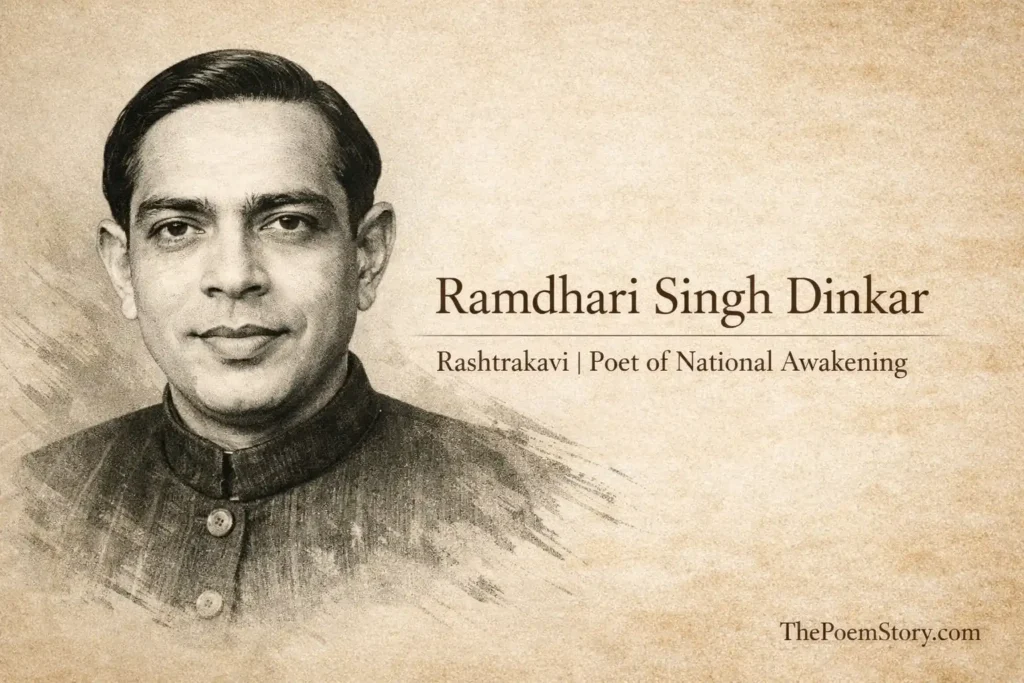
Biography of Ramdhari Singh Dinkar
Early Life and Family Background
Ramdhari Singh Dinkar was born on 23 September 1908 in Simaria village, located in the Bengal Presidency during British rule—an area that is now part of Begusarai district, Bihar. He came from a modest agrarian household. His father, Babu Ravi Singh, was a farmer, while his mother, Manroop Devi, played a quiet but foundational role in shaping his values, discipline, and emotional strength.
Dinkar’s childhood unfolded in the soil and simplicity of rural Bihar—where life was shaped by hard work, limited resources, and the unspoken struggle of ordinary people. In such surroundings, he saw poverty not as an idea but as a daily reality, and he learned early how dignity survives even in hardship. This environment became the first classroom of his life, where he understood the meaning of endurance, self-respect, and silent sacrifice.
These early experiences left deep marks on him. The rural world around him—fields, laborers, village traditions, and the weight of social inequality—slowly developed into the emotional core of his writing. His poetry later carried the same pulse: the voice of the common Indian, the anger against injustice, and the pride of a nation that refused to remain weak. What began as a village childhood eventually evolved into a national consciousness, where personal struggle transformed into collective vision.
In many ways, Dinkar’s greatness lies in this connection: he never wrote as someone detached from society. He wrote as someone who had lived close to its wounds—and therefore understood both its pain and its power.
Education and Literary Influences
Dinkar’s formal education played a decisive role in shaping him not only as a poet, but as a thinker. He pursued higher studies at Patna College, affiliated with the University of Patna, where he developed a deep interest in subjects such as history, philosophy, and political science. These were not merely academic choices—they became the intellectual backbone of his literary voice. History gave him a sense of civilizational journey and national identity, philosophy gave him depth and reflection, and political science connected him to the realities of governance, power, justice, and social structure.
This is why Dinkar’s poetry never remained limited to beauty or emotion alone—it always carried ideas. Even when he wrote with fire and rebellion, there was thought behind the thunder. His writings often read like the voice of a poet who understands the past, observes the present, and dares to shape the future.
Alongside academic learning, Dinkar’s literary growth was strengthened by his broad exposure to languages and traditions. He studied and engaged deeply with Hindi and Sanskrit, absorbing the richness of India’s classical vocabulary, mythology, and poetic discipline. At the same time, he was not confined within one cultural boundary. He explored Indian and world literatures, which gave his writing a wider horizon and a modern sensibility.
Among the major influences on him, Rabindranath Tagore stands out as a literary force whose emotional depth, spiritual tone, and artistic freedom left a lasting impression. Dinkar also encountered global poetic traditions through English literature, allowing him to understand the rhythm, structure, and temperament of world poetry. This blend of Indian classical grounding and global literary exposure helped shape the unique character of his style—rooted, powerful, and intellectually expansive.
By the time he completed his education, Dinkar was no longer simply a student of books—he had become a student of life, society, and the human mind. And it was this combination—academic depth and poetic fire—that prepared him to emerge as one of the strongest voices of modern Hindi literature.
Dinkar: A Poet of the Freedom Movement
Dinkar’s rise as a poet unfolded during one of the most turbulent and transformational periods in Indian history—the era when the country was no longer willing to tolerate silence, fear, or submission. The national mood was changing rapidly. The struggle for freedom had entered a stage where people didn’t just need political leadership—they needed emotional strength, moral clarity, and a voice that could ignite courage. In that moment, Dinkar’s poetry arrived not as entertainment, but as a force.
His verses became a kind of cultural weapon—fierce, fearless, and awakening. They didn’t ask the people to merely hope; they urged them to stand. They didn’t comfort weakness; they challenged it. Dinkar gained recognition as a “poet of rebellion” because his words were not written for quiet reading alone. They belonged to the public space—recited in gatherings, quoted in conversations, and carried like slogans in the minds of those who believed India must rise.
What made his nationalist poetry different was its intensity. It wasn’t empty patriotism or surface-level pride. It was rooted in a deep belief that a nation can only become free when its people become fearless within themselves. That is why his writing constantly emphasized not just freedom from foreign rule, but freedom from inner slavery—fear, hopelessness, and the habit of accepting injustice.
At the heart of his nationalist poems were themes that felt personal and collective at the same time:
- Sacrifice and courage — the willingness to lose comfort for a higher cause
- National pride and unity — the vision of a nation rising as one spirit
- Resistance against oppression — refusing to accept injustice as fate
- Dignity of the common Indian — honoring the strength of ordinary lives
In Dinkar’s voice, the common Indian was never powerless. The farmer, the laborer, the young rebel, the forgotten citizen—everyone became a symbol of strength waiting to awaken. His poetry gave people something more valuable than information: it gave them belief.
This is why Dinkar became a permanent presence in Kavi Sammelans and public gatherings. People didn’t just listen to him—they responded to him. His poems created an atmosphere, a vibration, a surge of confidence. And that connection with the masses became his greatest identity: he was not a poet living above society, he was a poet speaking from within it.
Even today, when his lines are recited, they still carry the same energy—an echo of an era when words were not decoration, but fire.
Literary Career and Major Works
Dinkar’s literary career was not confined to one mood or one mission. While he became nationally known for poetry filled with courage and patriotic fire, his true strength lay in his range. Over time, his writing expanded beyond nationalism into philosophy, social reform, cultural criticism, and psychological depth. He could write like a revolutionary when the nation needed strength—and like a philosopher when the mind needed meaning.
His works reflect a steady evolution: from youthful energy and awakening, to mature reflection, and finally to timeless spiritual and emotional complexity. This is why Dinkar is not remembered as a poet of one era alone, but as a voice that continues to speak to different kinds of readers, in different stages of life.
1) Renuka (1935) — The Beginning of a Powerful Voice
One of Dinkar’s earliest major poetry collections, Renuka (1935) marked the beginning of his serious literary identity. In this work, the young poet’s voice carries both emotional sensitivity and an emerging national consciousness. Renuka introduced readers to a poet who could feel deeply and speak boldly—someone whose words were rooted in the soil of India, but who had the vision to rise beyond it.
This collection helped establish him as a rising force in Hindi literature—an author whose voice carried freshness, sincerity, and power.
Dance—yes, dance, O Divine Dancer!
Moon-crested One! Three-eyed Lord! Bearer of Ganga!
End and Beginning of all creation! Ascetic Eternal! Shankar!
Dance—yes, dance, O Divine Dancer!Primal play—unseen, beginningless sound,
~ From Renuka (translated to english)
Immortal dance—its motion, its rhythm everlasting.
With every limb you break and build the world again,
Roaring, thundering—shake the universe, O Lord of all!
Dance—yes, dance, O Divine Dancer!
2) Kurukshetra (1946) — The Moral Philosophy of Conflict
Published in the post-war period, Kurukshetra (1946) is one of Dinkar’s most intellectually intense works. It explores the moral conflict behind war—not merely the battlefield conflict, but the conflict of conscience.
Using the symbolic universe of the Mahabharata, Dinkar reflects upon difficult questions:
- When does duty become cruelty?
- Can violence ever be justified?
- What happens when righteousness itself becomes complicated?
- Is silence also a form of injustice?
Rather than glorifying war, Kurukshetra examines the tension between justice and destruction, between responsibility and guilt—a theme that felt deeply relevant to a world recovering from global violence and an India approaching a historic transformation.
3) Rashmirathi (1952) — The Epic of Karna and the Pain of Greatness
Dinkar’s most celebrated work, Rashmirathi (1952), is an epic poem based on Karna, one of the most tragic and heroic characters of the Mahabharata. But Rashmirathi is not simply mythology—it is a deeply human story wrapped in an epic form.
Dinkar chose Karna because Karna represents a rare kind of hero: strong yet wounded, proud yet rejected, loyal yet doomed. Through this character, Dinkar explores the moral complexities of life and society.
The poem becomes a powerful psychological and philosophical exploration of:
- Identity and rejection — the pain of being judged by birth rather than ability
- Loyalty and pride — the struggle between gratitude and truth
- Fate vs choice — the question of how much control we really have
- Injustice and dignity — the courage to remain noble even when life is unfair
What makes Rashmirathi immortal is that it speaks not only of Karna, but of every person who has ever felt unseen, underestimated, or trapped by circumstances. Karna’s tragedy feels modern, personal, and timeless—and that is why the poem continues to resonate across generations. It is widely regarded as one of the greatest epics of Hindi literature, and a masterpiece of Dinkar’s poetic brilliance.
Wherever the sacred fire burns in this world—
hail to it, and bow to that pure flame.
And in every human heart where radiance lives,
we salute that light, that strength, that might.Even if a flower blooms unnoticed on a quiet branch,
it is still worthy of reverence.
The wise do not search for the “origin” of virtue—
they honor power, and the root of strength.The truly wise is one who knows no high or low,
who sees no difference between great and small.
The most worship-worthy is the one who lives with compassion and righteousness,
the noblest soul among all.A Kshatriya is one who carries the fire of fearlessness within,
~ From Rashmirathi (Translated to English)
and the greatest Brahmin is one who holds
austerity, discipline, and sacrifice.
4) Parashuram Ki Pratiksha — The Fire of Social Reform
In Parashuram Ki Pratiksha, Dinkar’s voice takes on a sharp reformist tone. Here, the poet isn’t only inspiring nationalism—he is confronting society itself. The work expresses anger against injustice and frustration with hypocrisy, while also reflecting a longing for change and transformation.
Through symbolism and powerful imagery, Dinkar highlights the need to awaken society from moral sleep, and to create a future built on dignity, fairness, and courage. It stands as a reminder that for Dinkar, true strength was not only about defeating an oppressor—it was also about defeating the injustices within our own society.
5) Hunkar — The Voice of Roar
If there is one word that captures Dinkar’s warrior spirit, it is Hunkar (in Hindi) —the roar of awakening. In this work, his tone becomes commanding and fearless. The poetry reads like a rallying cry—not for violence, but for inner power, self-respect, and national confidence.
Hunkar is symbolic of Dinkar’s belief that a nation cannot rise unless its people rise internally. His verses urge individuals to stand upright against fear, submission, and self-doubt. This is Dinkar at his most fiery—challenging weakness, demanding courage, and reminding readers that silence is often the first defeat.
6) Urvashi (1961) — A Different Dinkar: Love, Desire, and Inner Conflict
While Dinkar is widely known for Veer Ras, Urvashi (1961) reveals another side of him—lyrical, philosophical, and emotionally complex. Inspired by classical mythology, this work explores love, desire, and human attachment with rare poetic elegance.
Instead of war and rebellion, Urvashi deals with:
- the beauty and intensity of love
- the conflict between desire and discipline
- the fleeting nature of worldly attraction
- the eternal tension between body and spirit
It proves that Dinkar was not limited to heroic poetry alone—he could also write with tenderness and depth. Urvashi stands as one of his most refined works, showing his mastery over emotion, imagination, and philosophical reflection.
Awards and Honors
Ramdhari Singh Dinkar’s contribution to Hindi literature was not only celebrated by readers, but also formally recognized at the highest national level. His poetry and critical writing brought Hindi to the center of India’s literary pride, and his works earned some of the most respected honors in the country.
✅ Padma Bhushan (1959)
In recognition of his outstanding contribution to literature and public life, Dinkar was awarded the Padma Bhushan in 1959. This honor established him as not just a literary figure, but also a national cultural voice whose influence reached far beyond poetry circles.
✅ Sahitya Akademi Award (1957) for Sanskriti ke Char Adhyaya
Dinkar received the Sahitya Akademi Award in 1957 for his acclaimed work Sanskriti ke Char Adhyaya.
This recognition was especially significant because the book represents Dinkar’s intellectual depth—an exploration of Indian culture, its evolution, and its moral foundations. The Sahitya Akademi Award validated Dinkar’s role not only as a poet of fire and patriotism, but also as a thinker who could interpret civilization with clarity and vision.
Important Correction:
The award year is often mistakenly written as 1959, but according to the official Sahitya Akademi records, Sanskriti ke Char Adhyaya received the award in 1957. This correction is essential to keep the biography factually accurate.
✅ Jnanpith Award (1972) for Urvashi
In 1972, Dinkar was honored with the Jnanpith Award, India’s highest literary recognition, for his masterpiece Urvashi.
This award was a landmark moment in his career, because Urvashi revealed a different dimension of Dinkar’s genius—lyrical beauty, philosophical depth, and a refined exploration of love, desire, and human attachment. Winning the Jnanpith confirmed that Dinkar’s greatness was not limited to heroic poetry alone—he was a complete literary force.
Dinkar’s Ideas: Nationalism, Social Reform, and Human Values
Ramdhari Singh Dinkar was a patriot—but never a blind nationalist. That is what makes him timeless. His nationalism was not built on hatred or loud slogans; it was built on self-respect, cultural confidence, and moral responsibility. For Dinkar, love for the nation did not mean ignoring its flaws—it meant having the courage to confront them.
His real greatness lies in the balance he maintained throughout his writing:
- National pride without hatred — a love that unites, not divides
- Strength without cruelty — power guided by righteousness
- Tradition with the courage to reform — respect for roots, without fear of change
- Culture rooted in critical thinking — belief with awareness, not superstition
Dinkar’s poetry and essays consistently addressed the deeper problems within society, not just the struggle outside it. He wrote about:
- caste discrimination and social oppression
- inequality and injustice that weakened India from within
- the need for cultural unity beyond divisions
- and the responsibility of power, reminding leaders and citizens alike that strength without ethics becomes danger
In many ways, his writing feels like an ongoing dialogue—between India’s spiritual heritage and its future moral duty. It is as if Dinkar constantly asks: “What is the purpose of freedom, if society remains unfree from fear, injustice, and inequality?”
Famous Works and Themes Readers Still Love
Listing every poem and work of Dinkar is impossible, but readers remember him most for the emotions his poetry awakens—emotions that do not fade with time.
His writings consistently evoke:
- bravery and awakening — the fire to rise
- dignity and resistance — the refusal to bow down
- pain, sacrifice, and duty — the cost of truth and responsibility
- moral and philosophical struggle — the battle within the human soul
Works like Rashmirathi, Hunkar, and Kurukshetra remain among the most widely read and referenced in his legacy. They represent Dinkar at his strongest: fearless, thoughtful, and unforgettable.
Death and Legacy
Ramdhari Singh Dinkar passed away on 24 April 1974 in Madras (now Chennai). But death did not silence him—because poets like Dinkar do not survive through memory alone. They survive through relevance.
Even today, his poetry lives in India’s cultural bloodstream. His lines are recited in gatherings, quoted in speeches, heard in classrooms, and remembered whenever India speaks about courage, justice, dignity, or the meaning of nationhood.
Dinkar’s legacy is not only literary—it is emotional and moral. His words have become a kind of strength passed from one generation to the next.
He remains the symbol of modern Hindi literature’s most powerful identity:
a poet who could awaken a nation—
and still speak softly to the human soul.
Conclusion
Ramdhari Singh Dinkar was not just a poet—he was an era. From a modest village life in Bihar to national recognition, from the fire of the freedom struggle to shaping India’s cultural confidence after independence, his journey proves that literature can be both art and action, both beauty and force.
His poetry still matters because it speaks to eternal questions that every society must face:
What is courage? What is justice? What is duty?
And most importantly—
how does a nation become strong without losing its soul?
Dinkar did not merely write poems.
He wrote awakening.

Get the ThePoemStory App — Read Poems Anywhere