Some stories endure not because they are dramatic, but because they are painfully honest. The Boy Who Cried Wolf is one such fable—a short narrative that carries a profound warning about the fragile nature of trust. Told for generations, it continues to resonate because its lesson remains deeply relevant in a world where words are spoken quickly, shared widely, and often without consequence.
At its heart, this story is not about a boy or a wolf. It is about credibility—and what happens when it is lost.
For younger readers, the story introduces a simple truth: honesty matters, even when dishonesty seems harmless or amusing. It shows how small lies, repeated casually, can quietly erode trust long before anyone notices the damage. What begins as a joke slowly becomes a habit, and habits shape how others perceive us.
Read More in Moral Stories
Also Read:
The Boy Who Cried Wolf
The Story of The Boy Who Cried Wolf
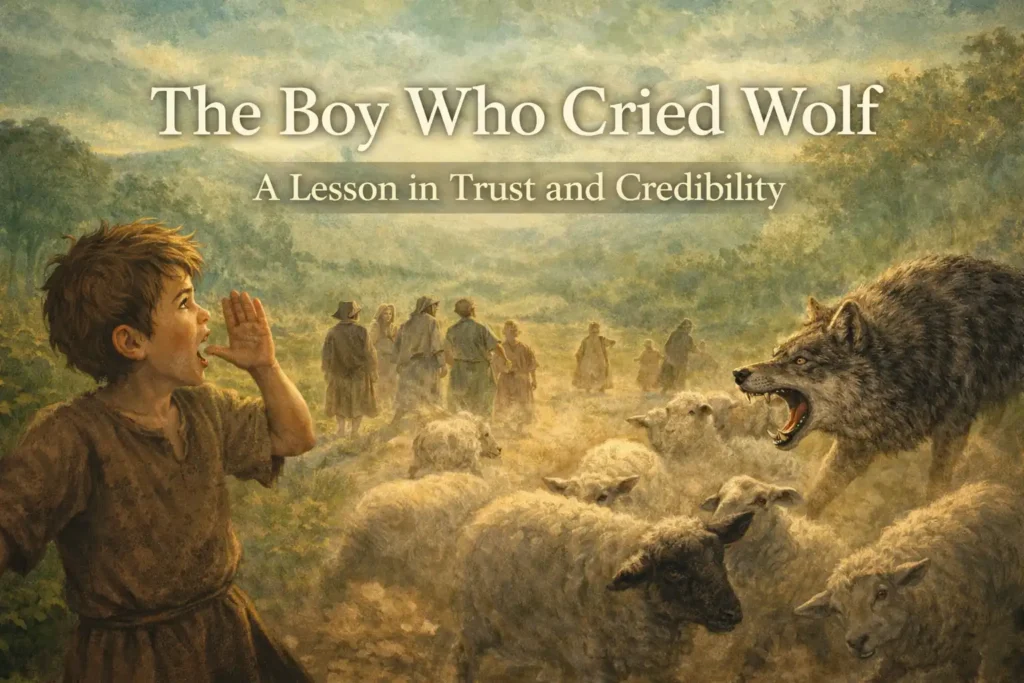
In a quiet village at the edge of rolling hills, a young shepherd boy was entrusted with an important responsibility. Each day, he watched over the village’s flock of sheep, guiding them across open fields and keeping guard against danger. His role required attentiveness and honesty—if a wolf appeared, his call for help would bring the villagers running.
They trusted him completely. His voice, they believed, would signal real danger.
But long hours alone in the fields soon turned into boredom. With nothing but silence for company, the boy grew restless. Seeking amusement, he suddenly cried out, “Wolf! Wolf!” His voice echoed across the hills.
Alarm spread quickly through the village. Men and women dropped their work and rushed toward the fields, hearts pounding—only to find the boy laughing, delighted by the fear he had caused. There was no wolf. Just a joke, he said.
The villagers returned home, annoyed but relieved.
Days passed. And then, the boy did it again.
Once more, the villagers ran to help, driven by habit and lingering trust. Once more, they found nothing. This time, their relief turned into frustration. Their faith in the boy did not vanish entirely, but it cracked. Doubt took its place.
Then, one afternoon, danger truly arrived.
A wolf emerged from the hills, its presence unmistakable. Panic seized the boy as he watched the animal move toward the flock. He screamed for help with all his strength, calling the villagers just as he had before.
But no one came.
Remembering his earlier lies, the villagers dismissed the cries as another trick. His voice, once trusted, now carried no urgency. Alone and helpless, the boy watched as the wolf attacked the sheep, scattering the flock.
By the time the villagers finally reached the fields, the damage was done. The sheep were gone. And something else had vanished as well—something far harder to replace.
The boy’s credibility.
The Moral of the Story The Boy Who Cried Wolf
The moral of The Boy Who Cried Wolf is clear and unforgiving:
Lies destroy trust, even when the truth matters most.
The tragedy of the story is not the wolf’s attack—it is the moment when honesty finally appears and no one believes it. Trust, once broken, does not return on demand. It must be rebuilt slowly, if at all.
The boy’s failure was not a single lie, but a pattern of dishonesty. Each false alarm weakened the bond between him and the villagers, until his words lost all value. When truth finally mattered, it arrived too late to be effective.
Why This Story Still Matters Today
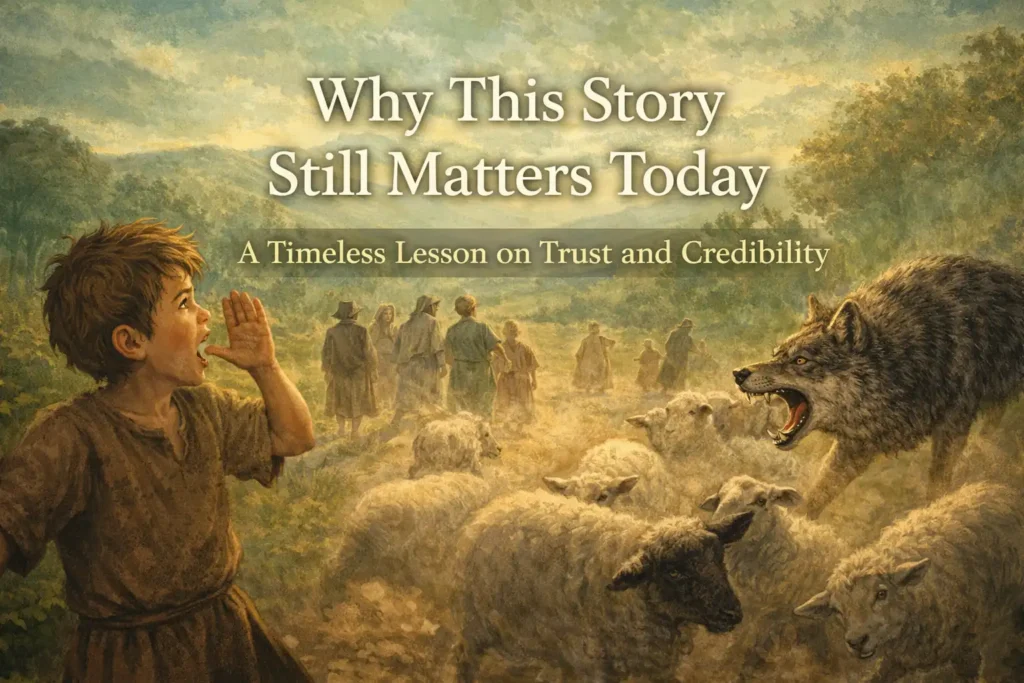
In modern life, communication is constant and immediate. Opinions are shared in seconds, warnings are broadcast instantly, and statements travel far beyond their original context. Yet this speed often comes at a cost—many words are spoken without verification, reflection, or accountability. In such an environment, credibility has become one of the most valuable, and most fragile, assets a person can possess.
The Boy Who Cried Wolf remains relevant because it captures this reality with striking clarity. It reminds us that trust is not granted automatically; it is earned slowly, through repeated honesty. Every truthful action strengthens credibility, while every careless or dishonest moment weakens it.
The story teaches that trust is cumulative. It builds quietly over time, shaped by consistency rather than intention. At the same time, credibility is far easier to lose than to regain. Once doubt takes root, even genuine warnings may be ignored.
Perhaps most importantly, the story shows that words carry weight only when they are reliable. A voice that exaggerates or misleads loses its power to protect, persuade, or guide. When truth finally matters most, it depends entirely on the trust built beforehand.
Whether in personal relationships, professional environments, leadership roles, or public discourse, the lesson remains unchanged: people listen to those who have proven they can be trusted. This is why the story continues to matter—not as a tale of fear, but as a lasting reminder that credibility is earned long before it is needed.
Honesty, Reputation, and Long-Term Consequences
The boy did not intend to cause lasting harm. His lies were playful, not malicious. Yet the outcome was severe. This is what makes the story so powerful—it shows that intent does not erase consequence.
Reputation is shaped not by a single moment, but by repeated behavior. Once doubt enters, every future statement is questioned. Even truth struggles to survive in the shadow of past dishonesty.
The story warns us that credibility is not built in moments of crisis—it is built long before crisis arrives.
A Story for Every Age
While often told early in life, The Boy Who Cried Wolf becomes more relevant with age. As responsibilities grow, so do the consequences of dishonesty. The story encourages restraint, integrity, and respect for the trust others place in us.
It reminds us that honesty is not merely a moral ideal—it is a practical necessity.
Final Reflection
The Boy Who Cried Wolf is not a story about punishment. It is a story about loss—the loss of trust, belief, and connection. Once credibility is gone, even truth struggles to be heard.
In a world where voices are loud and attention is fleeting, this fable offers a quiet but enduring warning:
Speak truthfully.
Act responsibly.
Because when the moment comes that truly matters, your words must still carry weight.
For adults, the story carries a deeper weight. It reflects everyday realities—workplace credibility, public discourse, leadership, relationships, and even digital life. In professional and personal spaces alike, trust is often built over years and undone in moments. Once doubt replaces belief, every word that follows is questioned, even when it is finally sincere.
The story also speaks to a universal human tendency: the desire for attention. The boy’s lies are not born from cruelty, but from boredom and the need to be heard. This makes the fable timeless. Across all ages, people are tempted to exaggerate, misrepresent, or speak carelessly—often without realizing that credibility is quietly being spent.
What makes The Boy Who Cried Wolf endure is its refusal to soften the truth. It reminds us that honesty is not only a moral choice, but a responsibility to those who listen. When trust is broken, even truth may arrive too late to make a difference.
In this way, the story speaks equally to children learning right from wrong, and to adults navigating a world where trust has become increasingly fragile. It asks a simple yet uncomfortable question—one that matters at every stage of life:
When the moment truly matters, will your words still be believed?
Also Read:
Continue Reading Stories
Some stories don’t end with the final line—they stay, echoing in thought and memory. If this tale moved you, there are many more waiting to be discovered, each carrying its own meaning, emotion, and quiet truth.

Get the ThePoemStory App — Read Poems Anywhere