Robert Frost stands as one of the colossal figures of 20th-century American poetry. Known for his accessible yet profoundly layered verses, Frost often employed the rural landscapes of New England as a canvas for exploring the deepest crevices of the human psyche. While his later works, such as “The Road Not Taken” and “Stopping by Woods on a Snowy Evening,” cemented his place in the public consciousness, it is in his early collections that we find the raw, unpolished seeds of his genius.
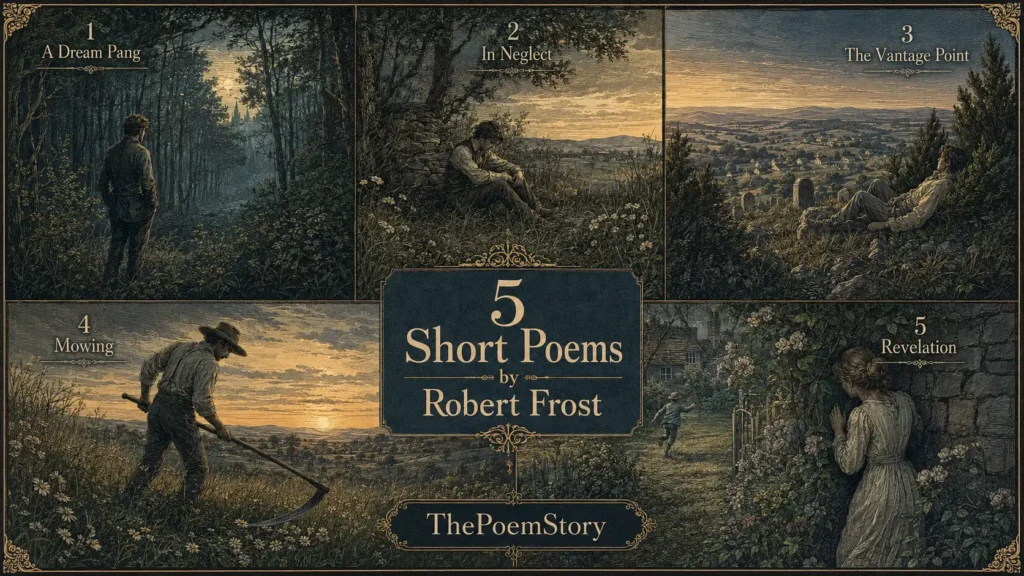
This 5 short poems by Robert Frost analysis brings together five brief but remarkably powerful poems from his debut collection, A Boy’s Will (1913). These poems—”A Dream Pang,” “In Neglect,” “The Vantage Point,” “Mowing,” and “Revelation”—each capture a distinct facet of Frost’s poetic vision: the tension between solitude and connection, the relationship between labor and truth, the longing for understanding, and the quiet revelations that come from paying attention to the world.
Though brief, these poems are remarkably rich in meaning. “A Dream Pang” explores the painful distance between two souls who long to connect but cannot. “In Neglect” reflects on the strange freedom of being forgotten. “The Vantage Point” finds the speaker caught between the worlds of nature and mankind. “Mowing” celebrates the truth of honest labor. And “Revelation” examines the human need to be truly seen and understood.
In this comprehensive guide, we will dissect each of these five short poems with careful attention to their structure, language, and thematic resonance. We will provide detailed summaries and analyses, exploring the profound themes, the masterful literary devices, and the enduring meaning of each poem. Together, they reveal the depth and range of Frost’s early genius.
Read and explore ThePoemStory and go through Collected Poems of Robert Frost.
for more poems explore Poetry Section
Table of Contents
1. A Dream Pang – Analysis and Summary
“A Dream Pang” is a brief but intensely emotional poem that captures the pain of missed connection. The speaker dreams of a time when he withdrew into the forest, his song swallowed by the leaves. A beloved figure comes to the forest edge, looks in, and longs to enter but does not. The speaker, hidden behind low boughs, watches but does not call out. The “sweet pang” of that restraint still lingers.
I had withdrawn in forest, and my song
Was swallowed up in leaves that blew alway;
And to the forest edge you came one day
(This was my dream) and looked and pondered long,
But did not enter, though the wish was strong:
You shook your pensive head as who should say,
‘I dare not—too far in his footsteps stray—
He must seek me would he undo the wrong.’
Not far, but near, I stood and saw it all
Behind low boughs the trees let down outside;
And the sweet pang it cost me not to call
And tell you that I saw does still abide.
But ’tis not true that thus I dwelt aloof,
For the wood wakes, and you are here for proof.
Summary
The speaker describes a dream in which he has withdrawn into a forest, his song lost among the leaves. The beloved comes to the forest edge, looks in, and ponders whether to enter. Though the wish is strong, she shakes her head and decides not to enter, believing that the speaker must seek her to “undo the wrong.” The speaker stands nearby, hidden behind low branches, watching everything. The “sweet pang” of not calling out to her still remains. The poem ends with a turn: the speaker insists it is not true that he dwells aloof, for the wood wakes, and the beloved is there as proof.
Themes
- Missed Connection: The central theme of the poem is the pain of missed connection. Both the speaker and the beloved long to be together, but neither makes the move. The speaker watches but does not call. The beloved looks but does not enter. The distance between them is not physical but emotional—a failure of courage.
- The Sweetness of Pain: The speaker describes the pang of restraint as “sweet.” This paradox captures the strange pleasure of longing, the way that unfulfilled desire can be both painful and beautiful.
- The Dream as Reality: The poem is framed as a dream, but the speaker insists at the end that it is not true that he dwells aloof—”the wood wakes, and you are here for proof.” The dream is a metaphor for a real emotional state.
- Pride and Hesitation: The beloved’s refusal to enter is based on a sense of pride or propriety: “He must seek me would he undo the wrong.” This theme explores how pride can prevent connection.
Literary Devices
- Imagery: “forest,” “leaves that blew alway,” “forest edge,” “low boughs,” “wood wakes.”
- Personification: The song is “swallowed up” by the leaves—a vivid image of silence and loss.
- Paradox: “sweet pang” captures the bittersweet nature of longing.
- Oxymoron: The dream is both a dream and a reality—the speaker insists it is true.
Meaning
“A Dream Pang” is a meditation on the pain of missed connection. The speaker and the beloved are close—”Not far, but near”—yet they cannot bridge the distance. The poem captures the strange sweetness of longing, the way that unfulfilled desire can linger and shape us. The final lines insist that the wood wakes, that the beloved is there, that the dream is true. The poem is a plea for connection, a recognition that love requires courage, and a lament for the moments when we fail to reach out.
2. In Neglect – Analysis and Summary
“In Neglect” is a short, reflective poem that explores the strange experience of being forgotten. The speaker reflects on how others have left them to “the way we took,” as if they were mistaken in their judgment. Now, sitting in a “wayside nook,” the speaker tries to feel forsaken—but the attempt itself suggests a kind of freedom.
They leave us so to the way we took,
As two in whom they were proved mistaken,
That we sit sometimes in the wayside nook,
With mischievous, vagrant, seraphic look,
And try if we cannot feel forsaken.
Summary
The speaker observes how others have left them to the path they chose, as if they were proved mistaken. Now, sitting in a wayside nook, they wear a look that is “mischievous, vagrant, seraphic”—playful, wandering, angelic. They try to feel forsaken, to experience the pain of being forgotten. But the attempt itself suggests that they are not truly forsaken; they are merely experimenting with the feeling.
Themes
- Neglect as Freedom: The poem suggests that being forgotten can be a kind of liberation. The speaker is not burdened by the expectations of others; they are free to sit in the wayside nook, wearing a playful expression.
- The Irony of Forsakenness: The speaker tries to feel forsaken, but the attempt is ironic. They are not truly forsaken; they are simply exploring the feeling. The poem plays with the idea that we sometimes perform emotions we do not truly feel.
- The Vagrant Spirit: The word “vagrant” suggests a wandering, restless spirit. The speaker is not settled; they are in motion, both physically and emotionally.
Literary Devices
- Alliteration: “wayside nook,” “mischievous, vagrant, seraphic.”
- Imagery: “wayside nook” suggests a quiet, hidden place.
- Tone: The tone is playful and ironic. The speaker is not truly despairing; they are amused by the attempt to feel forsaken.
Meaning
“In Neglect” is a wry meditation on the experience of being forgotten. The speaker tries to feel forsaken, but the attempt is playful rather than painful. The poem suggests that neglect is not always a tragedy; it can be a kind of freedom. The “mischievous, vagrant, seraphic look” suggests a spirit that is not broken by neglect but liberated by it. The poem invites us to reconsider our relationship with being overlooked—perhaps it is not a punishment but a release.
3. The Vantage Point – Analysis and Summary
“The Vantage Point” explores the speaker’s movement between the worlds of nature and mankind. The speaker seeks out a slope where he can observe the homes and graves of men from a distance. But when he tires of this perspective, he turns to the natural world—the sun-burned hillside, the bluet, the earth, the ant.
If tired of trees I seek again mankind,
Well I know where to hie me—in the dawn,
To a slope where the cattle keep the lawn.
There amid lolling juniper reclined,
Myself unseen, I see in white defined
Far off the homes of men, and farther still,
The graves of men on an opposing hill,
Living or dead, whichever are to mind.
And if by noon I have too much of these,
I have but to turn on my arm, and lo,
The sun-burned hillside sets my face aglow,
My breathing shakes the bluet like a breeze,
I smell the earth, I smell the bruisèd plant,
I look into the crater of the ant.
Summary
The speaker describes a vantage point—a slope where cattle keep the lawn, with juniper trees. From this hidden position, he observes the homes of men and, farther still, the graves on an opposing hill. He can see both the living and the dead. But when he has “too much of these,” he turns his arm and focuses on the natural world: the sun-burned hillside, the bluet flower, the smell of the earth, and the crater of the ant.
Themes
- The Duality of Human Experience: The speaker moves between the world of mankind and the world of nature. Both are necessary, and both can become overwhelming. The poem suggests that we need both perspectives—the social and the natural.
- The Distance of Observation: The speaker observes the homes and graves from a distance. This distance allows for reflection but also for detachment. The poem explores the value of stepping back and seeing from a vantage point.
- The Micro and Macro: The poem moves from the distant graves of men to the tiny crater of an ant. This shift suggests that all scales—from the cosmic to the microscopic—are worthy of attention.
- Solitude as Refuge: The speaker seeks solitude on the slope, away from mankind. But solitude is not isolation; it is a space for reflection and connection with nature.
Literary Devices
- Imagery: “cattle keep the lawn,” “lolling juniper,” “homes of men in white defined,” “graves of men on an opposing hill,” “sun-burned hillside,” “bluet,” “crater of the ant.”
- Contrast: The poem contrasts the distant world of mankind with the immediate world of nature. The homes and graves are far; the bluet and the ant are near.
- Sensory Detail: “My breathing shakes the bluet like a breeze, / I smell the earth, I smell the bruisèd plant.” The poem engages all the senses.
Meaning
“The Vantage Point” is a meditation on perspective. The speaker finds a place where he can observe both the living and the dead, both mankind and nature. The poem suggests that we need multiple perspectives to understand the world—the distance of observation and the intimacy of immediate experience. The speaker can turn from the graves of men to the crater of an ant, finding meaning in both scales. The poem celebrates the richness of the natural world and the value of solitude.
4. Mowing – Analysis and Summary
“Mowing” is one of Frost’s most celebrated early poems. It captures a moment of labor in a field, where the speaker’s scythe whispers to the ground. The poem reflects on the nature of work, truth, and the satisfaction of honest labor. The scythe whispers, and the speaker wonders what it says—perhaps about the heat of the sun, or the lack of sound. But the scythe does not dream of idle hours or easy gold. It is satisfied with the “sweetest dream that labor knows.”
There was never a sound beside the wood but one,
And that was my long scythe whispering to the ground.
What was it it whispered? I knew not well myself;
Perhaps it was something about the heat of the sun,
Something, perhaps, about the lack of sound—
And that was why it whispered and did not speak.
It was no dream of the gift of idle hours,
Or easy gold at the hand of fay or elf:
Anything more than the truth would have seemed too weak
To the earnest love that laid the swale in rows,
Not without feeble-pointed spikes of flowers
(Pale orchises), and scared a bright green snake.
The fact is the sweetest dream that labor knows.
My long scythe whispered and left the hay to make.
Summary
The speaker describes a quiet moment in a field, where the only sound is the scythe whispering to the ground. The speaker does not know what the scythe whispers—perhaps about the heat of the sun, or the lack of sound. But it is not a dream of idle hours or easy gold. Anything more than the truth would be too weak for the earnest love that laid the swale in rows. The scythe leaves the hay to make, and the speaker reflects that “the fact is the sweetest dream that labor knows.”
Themes
- Labor and Truth: The central theme of the poem is the relationship between labor and truth. The scythe whispers the truth—the fact of the work itself. The speaker suggests that the truth of labor is more satisfying than any fantasy.
- The Value of Honest Work: The poem celebrates the value of honest work. The scythe does not dream of easy gold or idle hours; it is content with the work itself. The “earnest love” that laid the swale in rows is a love of the work itself.
- Nature and Labor: The poem blends nature and labor. The scythe cuts the hay, but it also leaves the hay to make. The pale orchises and the bright green snake are part of the same world as the labor. Nature and work are inseparable.
- The Sweetness of Reality: The final line—”The fact is the sweetest dream that labor knows”—suggests that reality is more satisfying than fantasy. The truth of the work, the fact of the hay, is sweeter than any dream.
Literary Devices
- Personification: The scythe “whispers” to the ground. It is given a voice, a personality.
- Imagery: “long scythe whispering to the ground,” “heat of the sun,” “lack of sound,” “feeble-pointed spikes of flowers,” “pale orchises,” “bright green snake.”
- Metaphor: The scythe’s whisper is a metaphor for the truth of labor.
- Aphorism: “The fact is the sweetest dream that labor knows” is a memorable, quotable line—a kind of wisdom.
Meaning
“Mowing” is a celebration of honest labor and the truth it reveals. The scythe whispers the truth of the work, and the speaker listens. The poem rejects fantasies of easy wealth and idle hours, embracing instead the “earnest love” of labor. The fact of the work—the hay, the swale, the rows—is the sweetest dream. The poem is a meditation on the dignity of work and the satisfaction of doing something real.
5. Revelation – Analysis and Summary
“Revelation” is a brief but profound meditation on the human need to be truly known and understood. The speaker reflects on how we hide behind light words and playful language, but our hearts are agitated until someone finds us out. The poem suggests that we all need to be seen—from children playing hide-and-seek to God himself.
We make ourselves a place apart
Behind light words that tease and flout,
But oh, the agitated heart
Till someone find us really out.
‘Tis pity if the case require
(Or so we say) that in the end
We speak the literal to inspire
The understanding of a friend.
But so with all, from babes that play
At hide-and-seek to God afar,
So all who hide too well away
Must speak and tell us where they are.
Summary
The speaker reflects on how humans hide behind light words that tease and flout. But the heart is agitated until someone truly finds us out. It is a pity if we must speak the literal to inspire understanding in a friend. The poem concludes that this is true for everyone—from children playing hide-and-seek to God Himself. All who hide too well away must eventually speak and tell us where they are.
Themes
- The Need to Be Known: The central theme of the poem is the human need to be truly known and understood. We hide behind words, but our hearts are agitated until someone sees us clearly.
- The Limits of Language: Light words and teasing language can conceal as much as they reveal. Sometimes we must speak the literal truth to be understood.
- The Universal Human Condition: The poem extends this need to all beings—from children to God. Everyone, even the divine, needs to be found.
- Vulnerability and Trust: To be truly known requires vulnerability and trust. We must reveal ourselves to others, and they must be willing to find us.
Literary Devices
- Imagery: “place apart,” “light words that tease and flout,” “agitated heart,” “hide-and-seek.”
- Alliteration: “light words,” “tease and flout,” “hide-and-seek.”
- Aphorism: “So all who hide too well away / Must speak and tell us where they are.”
- Paradox: To be found, we must speak. To be understood, we must reveal. The poem explores the paradox of hiding and being found.
Meaning
“Revelation” is a meditation on the human need for connection and understanding. We hide behind words, but our hearts long to be found. The poem extends this need to all of existence—from children to God. The final lines suggest that even the divine must speak and reveal itself. The poem is a call to vulnerability, to honesty, to the courage of being truly seen. It invites us to speak, to reveal, and to allow ourselves to be found.
Conclusion – The Genius of Frost’s Short Poems
These five short poems from A Boy’s Will reveal the extraordinary range and depth of Robert Frost’s early genius. Though brief, each poem is a complete world—a meditation on a single idea or feeling, rendered with precision and grace.
Through our 5 short poems by Robert Frost analysis, we have explored the themes, literary devices, and deeper meanings of “A Dream Pang,” “In Neglect,” “The Vantage Point,” “Mowing,” and “Revelation.” Each poem offers a unique perspective on the human condition:
- “A Dream Pang” explores the painful sweetness of missed connection and the courage required for love.
- “In Neglect” reflects on the strange freedom of being forgotten and the irony of trying to feel forsaken.
- “The Vantage Point” celebrates the value of perspective—the ability to see both the world of mankind and the world of nature.
- “Mowing” honors the dignity of honest labor and the truth that reveals itself through work.
- “Revelation” examines the human need to be truly known and the courage required to reveal ourselves.
Together, these poems showcase Frost’s ability to find the universal in the particular—to take a moment of labor, a dream, a vantage point, or a feeling of neglect and transform it into something timeless. They remind us that poetry does not need to be long to be profound. Sometimes, the shortest poems carry the deepest wisdom.
If you have ever felt the pang of missed connection, the freedom of being forgotten, the need for perspective, the satisfaction of honest work, or the longing to be truly known, then these poems speak to you. They are gifts from a poet who understood the human heart with extraordinary clarity and compassion.
Enjoyed this deep dive into Frost’s poetry? If you want to explore more of his work, consider adding a complete collection to your library. There is no better companion for a quiet evening than the timeless verses of Robert Frost.
Did these analyses illuminate new perspectives on Frost’s short poems for you? Drop a comment below and let me know your thoughts. If you found this valuable, please share it with a fellow poetry enthusiast!
Read and explore ThePoemStory and go through Collected Poems of Robert Frost.
for more poems explore Poetry Section
Get the ThePoemStory App — Read Poems Anywhere