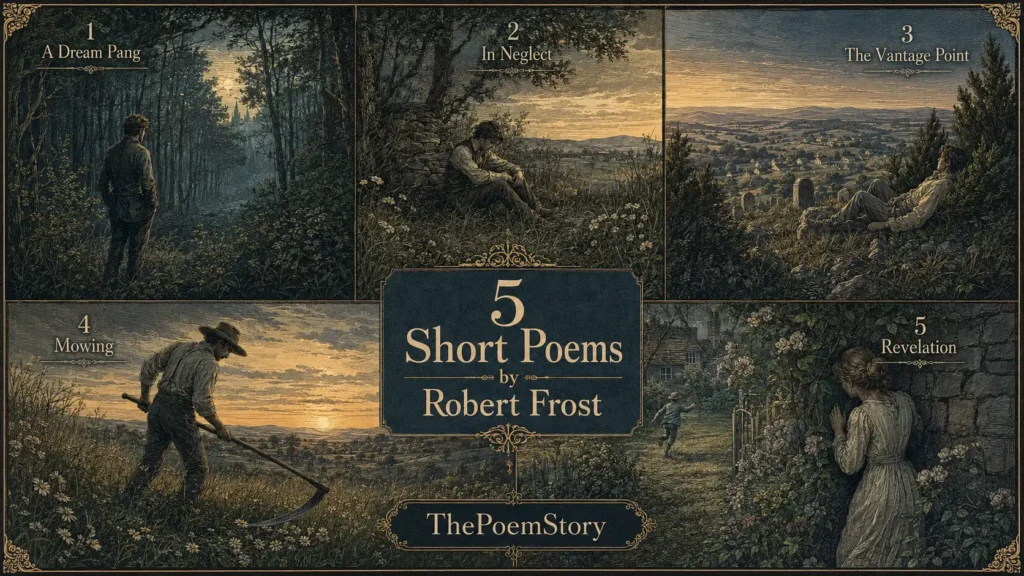
Robert Frost stands as one of the colossal figures of 20th-century American poetry. Known for his accessible yet profoundly layered verses, Frost often employed the rural landscapes of New England as a canvas for exploring the deepest crevices of the human psyche. While his later works, such as “The Road Not Taken” and “Stopping by Woods on a Snowy Evening,” cemented his place in the public consciousness, it is in his early collections that we find the raw, unpolished seeds of his genius.
This Waiting by Robert Frost analysis examines one of the most introspective and hauntingly beautiful poems from his debut collection, A Boy’s Will (1913). “Waiting (Afield at Dusk)” is a lyric meditation on solitude, memory, and the strange state of being suspended between day and night, between presence and absence. The poem captures a speaker alone in a stubble field at dusk, surrounded by the sounds and sights of the fading day, lost in dreams of a distant beloved.
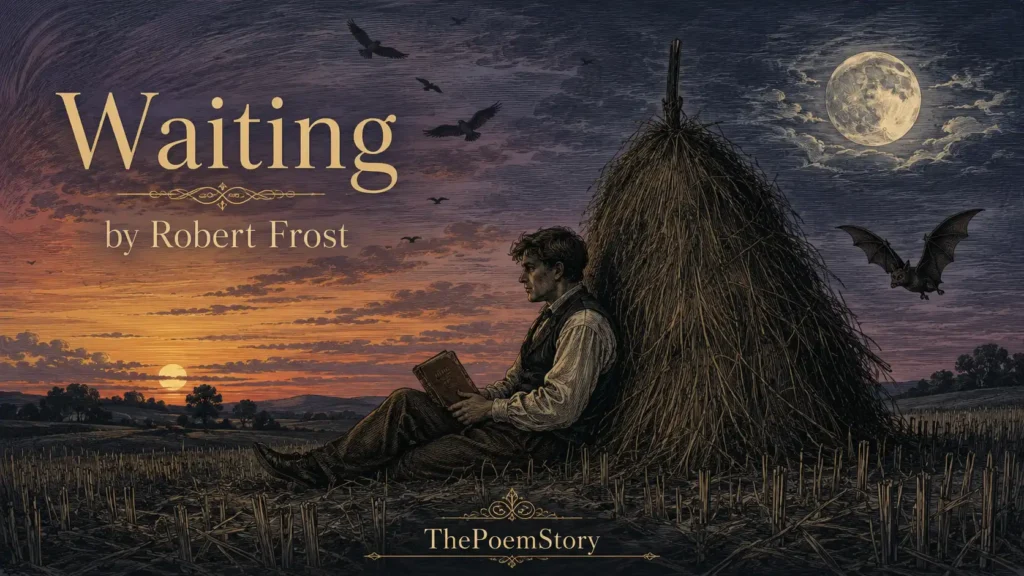
The poem presents a speaker who enters a field after the laborers have left. He sits beside a haycock, observing the night-hawks, the bat, the swallow, and the rasping insect at his back. He holds a book of “old-golden song” but does not read it—he simply holds it, letting it “freshen in this air of withering sweetness.” The poem culminates in a memory of “one absent most,” for whom the lines are written. “Waiting” is a meditation on the nature of waiting itself—the suspended state of being between presence and absence, between the fading light and the rising moon.
In this comprehensive guide, we will dissect “Waiting” with careful attention to its structure, language, and emotional resonance. We will provide a detailed Waiting poem summary, explore the profound themes in Waiting by Robert Frost, examine its masterful literary devices in Waiting, and ultimately reflect on the Waiting meaning and what it reveals about the human experience of solitude, memory, and longing.
Read and explore ThePoemStory and go through Collected Poems of Robert Frost.
for more poems explore Poetry Section
Table of Contents
The Poem – Waiting (Afield at Dusk) by Robert Frost
What things for dream there are when spectre-like,
~ Waiting (Afield at Dusk) by Robert Frost – Analysis and Summary
Moving among tall haycocks lightly piled,
I enter alone upon the stubble field,
From which the laborers’ voices late have died,
And in the antiphony of afterglow
And rising full moon, sit me down
Upon the full moon’s side of the first haycock
And lose myself amid so many alike.
I dream upon the opposing lights of the hour,
Preventing shadow until the moon prevail;
I dream upon the night-hawks peopling heaven,
Each circling each with vague unearthly cry,
Or plunging headlong with fierce twang afar;
And on the bat’s mute antics, who would seem
Dimly to have made out my secret place,
Only to lose it when he pirouettes,
And seek it endlessly with purblind haste;
On the last swallow’s sweep; and on the rasp
In the abyss of odor and rustle at my back,
That, silenced by my advent, finds once more,
After an interval, his instrument,
And tries once—twice—and thrice if I be there;
And on the worn book of old-golden song
I brought not here to read, it seems, but hold
And freshen in this air of withering sweetness;
But on the memory of one absent most,
For whom these lines when they shall greet her eye.
Waiting Poem Summary
Before delving into the thematic and literary depths, it is essential to establish a clear Waiting poem summary to ensure every reader grasps the narrative and emotional arc of this introspective lyric. The poem is structured as a single, continuous stanza of twenty-seven lines, creating a sense of flowing, uninterrupted meditation that mirrors the speaker’s suspended state of consciousness.
Lines 1–8: The Setting and the State
The poem opens with the speaker entering a stubble field at dusk. He moves “spectre-like” among “tall haycocks lightly piled.” The word “spectre-like” suggests that the speaker is like a ghost—insubstantial, barely present, moving through a landscape that is itself fading into twilight. The laborers’ voices have “late have died”—the human presence has disappeared, leaving only the speaker alone.
The speaker sits down “in the antiphony of afterglow / And rising full moon.” The word “antiphony” suggests a call-and-response, a dialogue between the fading light of the afterglow and the rising light of the full moon. The speaker sits “Upon the full moon’s side of the first haycock”—a specific, deliberate choice. He positions himself in the light of the rising moon, as if waiting for its illumination to prevail. He then “lose myself amid so many alike.” He becomes lost among the haycocks, dissolving into the landscape, losing his individuality.
Lines 9–18: The Dreaming
The speaker “dreams” upon the “opposing lights of the hour”—the struggle between the afterglow and the moon. The shadow is “preventing” until the moon prevails. He dreams upon the night-hawks “peopling heaven,” circling with “vague unearthly cry” or plunging “headlong with fierce twang afar.” The night-hawks are mysterious, almost otherworldly creatures, their cries “vague” and “unearthly.”
He dreams upon the bat’s “mute antics.” The bat seems to have “made out my secret place” but then loses it when he “pirouettes.” The bat seeks the speaker “endlessly with purblind haste.” The bat is blind (“purblind”) but searches endlessly, a symbol of longing and futility.
Lines 19–24: The Sounds and the Book
The speaker dreams upon the “last swallow’s sweep” and the “rasp” of an insect at his back. The insect is “in the abyss of odor and rustle”—a sensory abyss of smell and sound. The insect was silenced by the speaker’s arrival but now “finds once more, / After an interval, his instrument.” It tries “once—twice—and thrice if I be there,” testing to see if the speaker is still present, if it is safe.
The speaker also dreams upon the “worn book of old-golden song” that he brought. He did not bring it to read but to hold—”and freshen in this air of withering sweetness.” The book is a physical object, a talisman, a connection to something past. The “withering sweetness” suggests the fading beauty of the evening, the fading season, perhaps the fading of love itself.
Lines 25–27: The Memory
The poem culminates in the final lines: “But on the memory of one absent most, / For whom these lines when they shall greet her eye.” The speaker is waiting for someone—a specific, absent person. The poem itself is addressed to her. The lines are written for her, waiting for her to read them. The entire meditation has been a form of waiting, a suspended state of longing for the one who is absent.
This completes our Waiting poem summary, revealing a poem about solitude, memory, and the suspended state of waiting for someone who is not there.
Major Themes in Waiting by Robert Frost
Now that we have a clear understanding of the narrative, let us examine the profound themes in Waiting by Robert Frost. This introspective poem contains layers of psychological and emotional insight.
1. Solitude and Isolation
The central theme of the poem is solitude. The speaker is entirely alone in the field. The laborers have left, their voices “late have died.” The speaker is “spectre-like,” a ghostly presence in a fading landscape. This solitude is both peaceful and haunting—a state of being suspended between presence and absence.
2. The Nature of Waiting
The poem explores the nature of waiting itself. The speaker is waiting for someone—”one absent most.” Waiting is a suspended state, a condition of being between. The speaker is between day and night, between the afterglow and the rising moon, between presence and absence. The poem captures the strange, dreamlike quality of waiting—the way time seems to stretch and dissolve.
3. Memory and Longing
The poem culminates in the memory of an absent person. The speaker’s meditation is ultimately a meditation on longing—the desire for someone who is not there. The book of “old-golden song” is a talisman of memory, a connection to the past. The poem itself is a gift, waiting for the absent one to read it.
4. The Natural World as Mirror
The natural world reflects the speaker’s inner state. The night-hawks circle with “vague unearthly cry.” The bat seeks “endlessly with purblind haste.” The insect tests “once—twice—and thrice if I be there.” The natural world is full of longing, searching, and uncertainty—mirroring the speaker’s own emotional state.
5. The Suspended Moment
The poem captures a suspended moment—the time between day and night, between labor and rest, between presence and absence. The speaker is “lose myself amid so many alike.” He dissolves into the landscape, losing his individuality. This suspended state is both beautiful and unsettling—a moment of pure potential, pure waiting.
6. The Power of the Book
The “worn book of old-golden song” is a powerful symbol. It represents art, memory, and the enduring power of poetry. The speaker does not read it; he holds it. It “freshens” in the “air of withering sweetness.” The book is a connection to something timeless in a moment of transience.
7. The Address to the Beloved
The poem is addressed to “one absent most.” The speaker writes for her, waiting for her to read the lines. This address transforms the poem from a solitary meditation into a communication, a bridge across distance. The poem is an act of love, a gift waiting to be received.
Literary Devices in Waiting
To fully appreciate the craftsmanship of this poem, we must examine the rich array of literary devices in Waiting. Frost employs these techniques with his characteristic subtlety and precision, creating a poem that is both introspective and emotionally resonant.
1. Imagery
Frost’s imagery in this poem is evocative and sensory:
- Visual: “spectre-like,” “tall haycocks lightly piled,” “stubble field,” “afterglow,” “rising full moon,” “night-hawks peopling heaven,” “bat’s mute antics,” “last swallow’s sweep,” “worn book of old-golden song.”
- Auditory: “voices late have died,” “vague unearthly cry,” “fierce twang,” “rasp,” “odor and rustle,” “tries once—twice—and thrice.”
- Olfactory: “abyss of odor and rustle,” “air of withering sweetness.”
The imagery consistently emphasizes the sensory richness of the evening—the sounds, the smells, the fading light.
2. Symbolism
Several symbols enrich the poem’s meaning:
- The Haycocks: Represent the harvest, the end of the day, and the quiet order of rural life.
- The Afterglow and Full Moon: Represent the opposing forces of fading and rising, past and future, presence and absence.
- The Night-Hawks: Represent mystery, the unknown, and the strange beauty of the natural world.
- The Bat: Represents blind searching, longing, and the futility of seeking what cannot be found.
- The Book: Represents art, memory, and the enduring power of poetry.
- The Absent One: Represents love, longing, and the desire for connection.
3. Personification
The poem uses subtle personification. The night-hawks “people heaven.” The bat “seems / Dimly to have made out my secret place.” The insect “finds once more, / After an interval, his instrument.” The natural world is given human qualities—intention, searching, curiosity.
4. Simile
The speaker moves “spectre-like”—like a ghost. This simile emphasizes the speaker’s insubstantiality, his ghost-like presence in a fading landscape. He is barely there, suspended between presence and absence.
5. Metaphor
The insect’s sound is described as a “rasp / In the abyss of odor and rustle.” The “abyss” is a metaphor for the overwhelming sensory experience of the evening—a deep, almost frightening richness of smell and sound.
6. Tone
The tone of the poem is introspective, melancholic, and tender. The speaker is alone but not despairing. He is waiting, dreaming, remembering. The tone reflects a state of quiet longing—a suspended emotional state.
7. Enjambment
Frost uses enjambment extensively. The lines flow into each other, creating a sense of uninterrupted meditation. The poem does not pause; it drifts, just as the speaker drifts in his dreams and memories.
8. Apostrophe
The poem is a form of apostrophe—an address to an absent person. The speaker writes “these lines” for “one absent most.” The poem is a communication across distance, a gift waiting to be received.
The Deeper Meaning of Waiting
Beyond its surface-level meditation, the Waiting meaning reveals a profound exploration of the human experience of longing, solitude, and the suspended state of being between presence and absence. This is where the poem transcends its historical context and speaks directly to the human condition.
The Waiting meaning centers on the recognition that waiting is a fundamental human experience. We wait for people, for events, for the future. Waiting is a state of suspension—a time between what was and what will be. The poem captures this suspension with extraordinary precision. The speaker is between day and night, between the afterglow and the rising moon, between the voices of the laborers and the silence of the evening.
The poem also explores the nature of longing. The speaker is waiting for someone who is absent. The poem itself is a gesture toward that person—a gift, a message, a bridge across distance. Longing is a form of presence in absence. The speaker holds the book, dreams upon the memory, and writes these lines. The act of waiting is itself an act of love.
The Waiting meaning also speaks to the relationship between solitude and connection. The speaker is alone, but he is not disconnected. He is connected to the natural world, to the book, to the memory of the absent one. Solitude is not isolation; it is a state of heightened awareness, a space where connection can be felt more intensely.
Ultimately, the Waiting meaning is that waiting is not empty. It is full of dreams, memories, and longing. It is a state of creative potential—a time when the mind is free to wander, to observe, to connect. The poem invites us to see waiting not as a passive state but as an active, rich experience.
Reflection on Human Life
“Waiting” offers a timeless mirror to the human condition, and its relevance only grows in our modern world of constant distraction and instant gratification.
The Art of Waiting
In our fast-paced world, waiting is often seen as a waste of time. We are constantly urged to be productive, to fill every moment with activity. The poem reminds us that waiting can be rich and meaningful. It is a time for dreaming, for observing, for connecting with ourselves and with the world. The poem invites us to embrace the art of waiting.
The Power of Solitude
The speaker is alone, but his solitude is not empty. It is full of observation, reflection, and longing. The poem reminds us that solitude can be a source of creativity and connection. In a world that values constant social engagement, the poem invites us to value solitude as a space of rich experience.
The Presence in Absence
The speaker is waiting for someone who is absent. But the absent one is present in his memory, in his dreams, in the lines he writes. The poem reminds us that absence does not mean disconnection. We can carry those we love with us, even when they are far away. The poem invites us to honor the presence in absence.
The Connection to Nature
The speaker is deeply connected to the natural world. He observes the night-hawks, the bat, the swallow, and the insect. He is attuned to the sounds and smells of the evening. The poem reminds us that nature can be a source of solace and connection. The poem invites us to pay attention to the natural world, to find comfort in its rhythms.
The Gift of Poetry
The poem itself is a gift. The speaker writes these lines for the absent one. Poetry is a way of bridging distance, of expressing longing, of connecting across time and space. The poem reminds us of the power of words to reach across distance and touch the heart of another.
The Suspended State
The speaker is in a suspended state—between day and night, between presence and absence. This is the state of waiting. The poem invites us to embrace this suspended state, to find meaning in the in-between, to recognize that life is full of transitions, and that these transitions are rich with potential.
Conclusion
“Waiting (Afield at Dusk)” is a quiet masterpiece of early Frost—a poem that rewards careful reading and deep reflection. It is a meditation on solitude, memory, and the suspended state of longing. Through its rich imagery, its introspective tone, and its tender address to the absent beloved, the poem invites us to embrace the art of waiting.
Through our Waiting by Robert Frost analysis, we have explored the poem’s structure, its Waiting poem summary, the profound themes in Waiting by Robert Frost, the masterful literary devices in Waiting, and the enduring Waiting meaning.
“Waiting” is a reminder that waiting is not empty. It is full of dreams, memories, and longing. It is a state of creative potential, a time when the mind is free to wander and connect. The poem invites us to see waiting not as a passive state but as an active, rich experience—a time of presence, attention, and love.
If you have ever waited for someone, held a book without reading it, or sat alone in a field at dusk, then you have stood where Frost stood. And like him, you have discovered that waiting is not a void but a space full of dreams.
Enjoyed this deep dive into Frost’s poetry? If you want to explore more of his work, consider adding a complete collection to your library. There is no better companion for a quiet evening than the timeless verses of Robert Frost.
Did this analysis illuminate a new perspective on “Waiting” for you? Drop a comment below and let me know your thoughts. If you found this valuable, please share it with a fellow poetry enthusiast!
Read and explore ThePoemStory and go through Collected Poems of Robert Frost.
for more poems explore Poetry Section
Get the ThePoemStory App — Read Poems Anywhere