Robert Frost stands as one of the colossal figures of 20th-century American poetry. Known for his accessible yet profoundly layered verses, Frost often employed the rural landscapes of New England as a canvas for exploring the deepest crevices of the human psyche. While his later works, such as “The Road Not Taken” and “Stopping by Woods on a Snowy Evening,” cemented his place in the public consciousness, it is in his early collections that we find the raw, unpolished seeds of his genius.
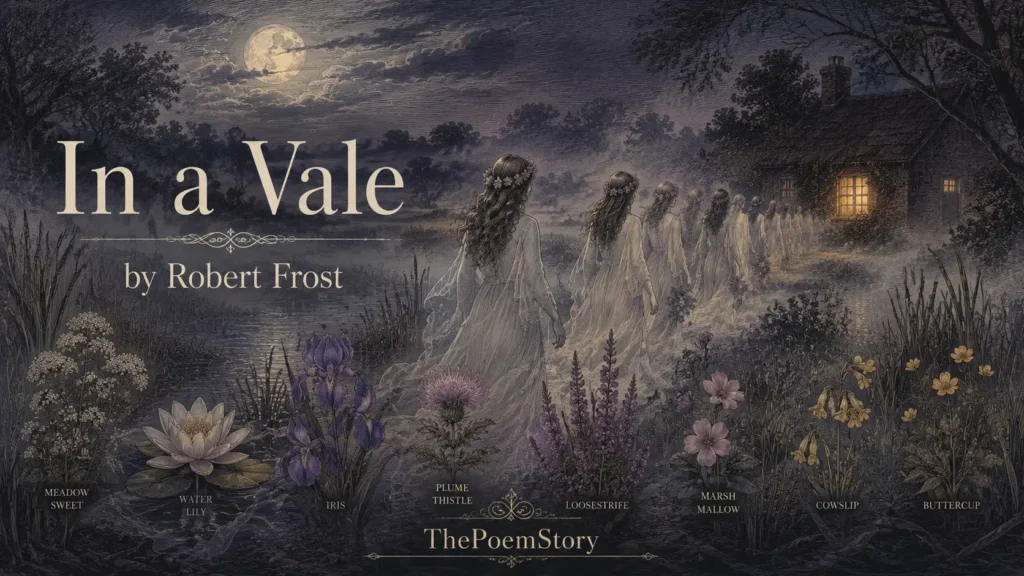
This In a Vale by Robert Frost analysis examines one of the most mysterious and enchanting poems from his debut collection, A Boy’s Will (1913). “In a Vale” is a dreamlike lyric that blends memory, myth, and natural imagery into a haunting meditation on beauty, longing, and the origins of art itself. The poem recalls a time when the speaker dwelt in a vale by a misty fen, visited each night by spectral maidens who came to speak with him.
The poem presents a speaker who recalls his youth in a misty valley. Each night, maidens with pale garments would come to him through the mist, bringing news and stories. They would stay until the stars faded, then return to the place “where bird and flower were one and the same.” The speaker concludes that this is why he knows the origins of beauty—why the flower has odor and the bird has song. The poem is a meditation on the relationship between memory, imagination, and the creative spirit.
In this comprehensive guide, we will dissect “In a Vale” with careful attention to its structure, language, and mystical resonance. We will provide a detailed In a Vale poem summary, explore the profound themes in In a Vale by Robert Frost, examine its masterful literary devices in In a Vale, and ultimately reflect on the In a Vale meaning and what it reveals about the human capacity for imagination, memory, and the creation of beauty.
Read and explore ThePoemStory and go through Collected Poems of Robert Frost.
for more poems explore Poetry Section
In a Vale by Robert Frost analysis
The Poem – In a Vale by Robert Frost
When I was young, we dwelt in a vale
~ In a Vale by Robert Frost – Analysis and Summary
By a misty fen that rang all night,
And thus it was the maidens pale
I knew so well, whose garments trail
Across the reeds to a window light.
The fen had every kind of bloom,
And for every kind there was a face,
And a voice that has sounded in my room
Across the sill from the outer gloom.
Each came singly unto her place,
But all came every night with the mist;
And often they brought so much to say
Of things of moment to which, they wist,
One so lonely was fain to list,
That the stars were almost faded away
Before the last went, heavy with dew,
Back to the place from which she came—
Where the bird was before it flew,
Where the flower was before it grew,
Where bird and flower were one and the same.
And thus it is I know so well
Why the flower has odor, the bird has song.
You have only to ask me, and I can tell.
No, not vainly there did I dwell,
Nor vainly listen all the night long.
In a Vale Poem Summary
Before delving into the thematic and literary depths, it is essential to establish a clear In a Vale poem summary to ensure every reader grasps the narrative and mystical arc of this enchanting lyric. The poem is structured in five stanzas of varying lengths, creating a sense of flowing, dreamlike meditation that mirrors the speaker’s recollections.
Stanza 1: The Vale and the Maidens
The poem opens with the speaker recalling his youth: “When I was young, we dwelt in a vale / By a misty fen that rang all night.” The vale is a valley, a secluded place. The fen is a marsh or swamp, misty and mysterious. It “rang all night”—filled with sounds, perhaps the calls of birds or insects, or perhaps something more mysterious.
The speaker recalls the “maidens pale” he knew so well. Their garments “trail / Across the reeds to a window light.” The maidens are spectral, ghostly figures who move through the reeds toward a lit window. The image is both beautiful and haunting—figures emerging from the mist, drawn to the light.
Stanza 2: The Fen and the Faces
The second stanza describes the fen: “The fen had every kind of bloom, / And for every kind there was a face.” The flowers of the fen are associated with faces—each flower has a corresponding maiden. Each has “a voice that has sounded in my room / Across the sill from the outer gloom.” The maidens speak to the speaker from outside his window, their voices crossing the threshold from the darkness into his room.
The maidens come “singly unto her place”—each has a specific place, a specific role. They are individual, distinct, yet part of a larger pattern.
Stanza 3: The Nightly Visits
The third stanza reveals that the maidens come “every night with the mist.” They bring “so much to say / Of things of moment to which, they wist, / One so lonely was fain to list.” The speaker is lonely, and the maidens know this. They bring him news, stories, and companionship. He is “fain to list”—eager to listen. The conversations last so long that “the stars were almost faded away” before the last maiden departs.
Stanza 4: The Return
The fourth stanza describes the maidens’ return. They go “Back to the place from which she came— / Where the bird was before it flew, / Where the flower was before it grew, / Where bird and flower were one and the same.” This is the most mysterious passage of the poem. The maidens return to a primordial place—a place before creation, where bird and flower were not yet separate but one.
Stanza 5: The Knowledge Gained
The final stanza reveals the meaning of these visits: “And thus it is I know so well / Why the flower has odor, the bird has song.” The speaker has learned the origins of beauty—why flowers smell and birds sing. He claims, “You have only to ask me, and I can tell.” He concludes that his time in the vale was not in vain: “No, not vainly there did I dwell, / Nor vainly listen all the night long.”
This completes our In a Vale poem summary, revealing a poem about memory, imagination, and the mystical origins of beauty and art.
Major Themes in In a Vale by Robert Frost
Now that we have a clear understanding of the narrative, let us examine the profound themes in In a Vale by Robert Frost. This mystical poem contains layers of philosophical and artistic insight.
1. Memory and Imagination
The central theme of the poem is the power of memory and imagination. The speaker recalls his youth in the vale, but the recollection is not purely factual—it is dreamlike, mystical, and imaginative. The maidens may be real or imagined, but their significance is real. The poem suggests that memory is not a passive recording but an active creative act.
2. The Origins of Beauty and Art
The poem explores the origins of beauty. The speaker claims to know “Why the flower has odor, the bird has song.” The maidens, who come from a place “where bird and flower were one and the same,” have revealed this knowledge. The poem suggests that art and beauty originate in a primordial unity, a place before separation and distinction.
3. The Relationship Between Nature and the Supernatural
The poem blurs the boundary between nature and the supernatural. The maidens are both natural (associated with flowers) and spectral (pale, ghostly, coming with the mist). The fen is a natural place, but it is also a place of mystery and magic. The poem suggests that nature is not merely material but also spiritual—it contains mysteries that can be revealed to those who listen.
4. Solitude and Companionship
The speaker is lonely. The maidens come to him because he is “one so lonely.” They bring companionship and conversation. The poem suggests that solitude can be a source of creativity—a space where the imagination can flourish and where mystical visitors can appear.
5. The Primordial Unity of Creation
The maidens return to a place “Where the bird was before it flew, / Where the flower was before it grew, / Where bird and flower were one and the same.” This is a vision of primordial unity—a state before creation, before separation, before the world became divided into distinct forms. The poem suggests that art seeks to recover this unity.
6. The Poet as Mystic
The speaker claims to have special knowledge—he knows why the flower has odor and the bird has song. This is the role of the poet as mystic, as one who has access to hidden truths. The poet’s knowledge comes not from study but from experience, from listening, from dwelling in a place of mystery.
7. The Value of Listening
The poem emphasizes the value of listening. The speaker did not speak; he listened. He was “fain to list.” The maidens brought their messages, and he received them. The poem suggests that wisdom comes not from speaking but from listening—from being open to the voices that come from the mist.
Literary Devices in In a Vale
To fully appreciate the craftsmanship of this poem, we must examine the rich array of literary devices in In a Vale. Frost employs these techniques with his characteristic subtlety and precision, creating a poem that is both mystical and emotionally resonant.
1. Imagery
Frost’s imagery in this poem is evocative and atmospheric:
- Visual: “misty fen,” “maidens pale,” “garments trail,” “window light,” “every kind of bloom,” “outer gloom,” “stars were almost faded,” “heavy with dew.”
- Auditory: “rang all night,” “voice that has sounded in my room.”
- Tactile: “heavy with dew.”
The imagery consistently emphasizes mist, light, and the boundary between the natural and the supernatural.
2. Symbolism
Several symbols enrich the poem’s meaning:
- The Vale: Represents a secluded, protected space—a place of memory and imagination.
- The Misty Fen: Represents mystery, the unknown, and the boundary between the natural and supernatural.
- The Maidens: Represent inspiration, beauty, and the voices of the imagination.
- The Window Light: Represents consciousness, the threshold between the self and the world.
- The Primordial Place: Represents the origin of creation, the unity before separation.
- The Flower and Bird: Represent beauty, art, and the expression of the creative spirit.
3. Personification
The fen is given human qualities: “the fen had every kind of bloom, / And for every kind there was a face.” The fen is not just a landscape; it is a place of faces and voices. The natural world is animated, alive with meaning.
4. Metaphor
The maidens are associated with flowers: “for every kind there was a face.” Each maiden is a flower, and each flower is a maiden. This metaphor suggests the inseparability of beauty and inspiration.
5. Tone
The tone of the poem is nostalgic, mystical, and quietly triumphant. The speaker recalls his youth with fondness and wonder. He claims knowledge and celebrates his experience. The tone reflects a sense of having received a gift—the gift of understanding.
6. Rhyme and Meter
The poem follows a varied rhyme scheme, with patterns of ABAB and AABB. The meter is predominantly iambic, with variations that reflect the dreamlike, flowing quality of the poem. The rhythm creates a sense of gentle, hypnotic movement.
7. Enjambment
Frost uses enjambment to create a sense of flow and continuity. The lines run into each other, mimicking the misty, dreamlike quality of the speaker’s memories. The poem does not pause; it drifts, just as the maidens drift through the mist.
8. Repetition
The repetition of “Where the bird was before it flew, / Where the flower was before it grew, / Where bird and flower were one and the same” creates a rhythmic, incantatory effect. The repetition emphasizes the idea of primordial unity.
The Deeper Meaning of In a Vale
Beyond its surface-level narrative, the In a Vale meaning reveals a profound meditation on the nature of memory, imagination, and the origins of art. This is where the poem transcends its historical context and speaks directly to the human condition.
The In a Vale meaning centers on the recognition that beauty and art originate in a place of mystery. The maidens come from a place “where bird and flower were one and the same.” This is a vision of primordial unity—a state before the world was divided into separate forms. The poem suggests that art is an attempt to recover this unity, to bring together what has been separated.
The poem also speaks to the power of memory and imagination. The speaker’s recollection of the maidens may be literal, metaphorical, or both. But their significance is real. Memory is not a passive recording; it is an active creative act. The poet shapes his memories into meaning, transforming experience into art.
The In a Vale meaning also addresses the relationship between solitude and creativity. The speaker is lonely, and the maidens come to him. Solitude is not empty; it is a space where inspiration can appear. The poet must be open to the voices that come from the mist.
Ultimately, the In a Vale meaning is that the poet is a mystic—one who has access to hidden truths. The speaker claims to know why flowers smell and birds sing. This knowledge comes not from study but from experience, from listening, from dwelling in a place of mystery. The poem invites us to be open to the mysteries of the world, to listen to the voices that come from the mist, and to recognize the origins of beauty.
Reflection on Human Life
“In a Vale” offers a timeless mirror to the human condition, and its relevance only grows in our modern world of distraction and disconnection from the natural world.
The Power of Memory
Our memories are not just records of the past; they are sources of meaning and inspiration. The speaker’s memory of the maidens shapes his understanding of the world. The poem invites us to honor our memories, to see them as gifts, and to recognize their creative power.
The Mystery of Beauty
Beauty is mysterious. The poem suggests that beauty originates in a place beyond our understanding—a place of primordial unity. We cannot fully explain why flowers smell or birds sing. We can only appreciate and celebrate. The poem invites us to approach beauty with wonder and gratitude.
The Value of Listening
The speaker listened to the maidens. He was “fain to list.” The poem reminds us of the value of listening—not just to words but to the voices of nature, of memory, of the imagination. In a world of constant noise, the poem invites us to be silent, to listen, to receive.
The Solitude of the Poet
The speaker is “one so lonely.” Solitude is often the condition of the poet—a space where inspiration can appear. The poem invites us to value solitude, to see it not as emptiness but as potential, as a space where the voices of the imagination can be heard.
The Unity of Creation
The poem’s vision of primordial unity—”where bird and flower were one and the same”—is a vision of wholeness. In a world of fragmentation and division, the poem reminds us of the unity that underlies all things. Art seeks to recover this unity, to bring together what has been separated.
The Gift of Knowledge
The speaker claims to know “Why the flower has odor, the bird has song.” This knowledge is a gift—a gift of experience, of attention, of dwelling in a place of mystery. The poem invites us to seek knowledge, to be open to the mysteries of the world, and to recognize the gift of understanding.
Conclusion
“In a Vale” is a mystical masterpiece of early Frost—a poem that rewards careful reading and deep reflection. It is a meditation on memory, imagination, and the origins of beauty. Through its dreamlike imagery, its haunting maidens, and its vision of primordial unity, the poem invites us to recognize the mystery of the world and the power of the creative spirit.
Through our In a Vale by Robert Frost analysis, we have explored the poem’s structure, its In a Vale poem summary, the profound themes in In a Vale by Robert Frost, the masterful literary devices in In a Vale, and the enduring In a Vale meaning.
“In a Vale” is a reminder that beauty is mysterious, that memory is creative, and that the poet is a mystic—one who listens to the voices that come from the mist. The poem invites us to be open to the mysteries of the world, to honor our memories, and to recognize the gift of understanding.
If you have ever felt the presence of something mysterious, heard a voice in the silence, or glimpsed a beauty beyond words, then you have stood where Frost stood—in a vale by a misty fen, waiting for the maidens to arrive.
Enjoyed this deep dive into Frost’s poetry? If you want to explore more of his work, consider adding a complete collection to your library. There is no better companion for a quiet evening than the timeless verses of Robert Frost.
Did this analysis illuminate a new perspective on “In a Vale” for you? Drop a comment below and let me know your thoughts. If you found this valuable, please share it with a fellow poetry enthusiast!
Read and explore ThePoemStory and go through Collected Poems of Robert Frost.
for more poems explore Poetry Section
Get the ThePoemStory App — Read Poems Anywhere