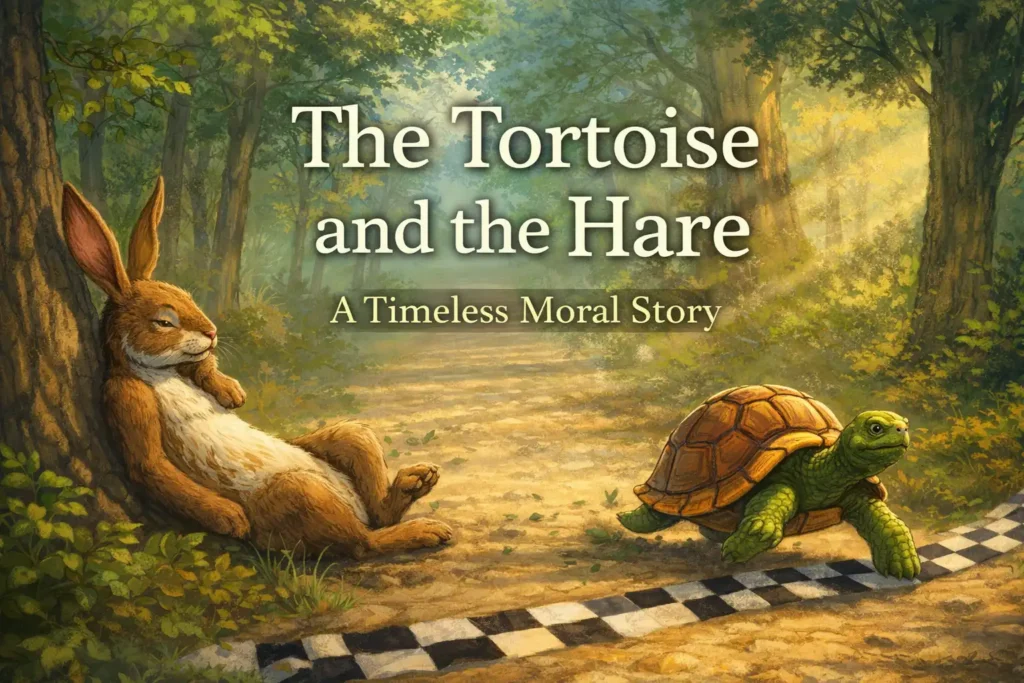
Some stories endure not because they are simple, but because they are truthful. The Tortoise and the Hare is one such fable—often told in a few lines, yet rich enough to reveal new meaning each time it is revisited. Its strength does not lie in complexity or spectacle, but in its honesty. The story mirrors patterns we repeatedly observe in real life, making it timeless rather than outdated.
Beneath its straightforward narrative lies a quiet but powerful reflection on human nature. It speaks to ambition and confidence, but also to the dangers of overestimating talent while underestimating effort. The hare’s speed symbolizes natural ability, privilege, and early success—qualities that can create the illusion of certainty. The tortoise, in contrast, represents perseverance, self-awareness, and resilience. He does not compete for admiration; he commits to progress.
Read Moral Stories:
The Ant and the Grasshopper
The Tortoise and the Hare
The Tortoise and the Hare Story
In a forest known for its lively creatures, a hare was admired for his unmatched speed. He could outrun anyone and never missed an opportunity to remind others of it. His confidence, however, often crossed the line into arrogance. Speed had become his identity, and he believed it guaranteed success in every situation.
One day, the hare noticed a tortoise moving slowly along a forest path. Amused, the hare mocked the tortoise’s pace, questioning how anyone could live—or succeed—by moving so slowly. The tortoise listened patiently and responded without anger or defensiveness. He did not deny his slowness. Instead, he offered a quiet challenge: a race.
The idea entertained the forest animals. A course was marked, and the race began.
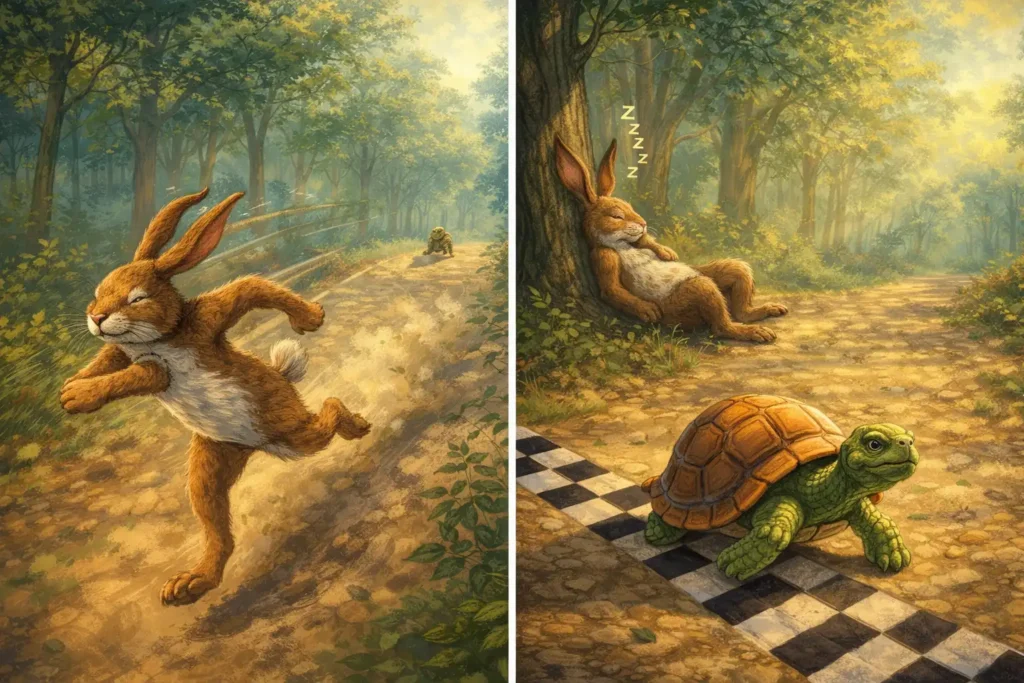
As expected, the hare surged ahead immediately, disappearing into the distance within moments. Certain of his victory, he saw no reason to hurry. Confident that the outcome was already decided, he stopped to rest beneath a tree. What began as a pause soon turned into sleep.
Meanwhile, the tortoise continued forward.
There was no urgency in his movement, no attempt to compete in speed. He simply kept going—step by step, without stopping, without distraction. He did not concern himself with the hare’s absence or progress. His focus remained on the path ahead.
As the day wore on, the hare awoke and realized, with sudden panic, how much time had passed. He raced toward the finish line with all his strength, but the moment had already slipped away.
The tortoise crossed the finish line first.
The forest fell silent, then erupted in applause—not for speed, but for resolve.
The Moral Beneath the Fable –
The moral of The Tortoise and the Hare is often summarized in a single line:
Slow and steady effort wins over arrogance and haste.
Yet the deeper lesson goes beyond pace.
The hare did not fail because he lacked ability. He failed because he underestimated the value of consistency and overestimated the security of talent. His confidence turned into complacency, and his advantage became his weakness.
The tortoise succeeded not by competing on the hare’s terms, but by remaining faithful to his own rhythm. He understood something the hare did not: progress is not always dramatic, but it is powerful when sustained.
Why “The Tortoise and the Hare Story” Still Matters
In modern life, speed is celebrated. Quick success, instant results, and visible talent are often rewarded with attention. But lasting achievement—whether in career, creativity, relationships, or personal growth—rarely follows a sIn modern life, speed is often mistaken for success. Quick wins, instant recognition, and visible talent tend to attract admiration and applause. Social media amplifies this illusion, making rapid progress appear not only desirable, but necessary. Yet lasting achievement—whether in career, creativity, relationships, or personal growth—rarely follows a straight, fast, or predictable path.
The Tortoise and the Hare endures because it challenges this obsession with immediacy. It reminds us that speed can impress, but it does not guarantee endurance. What truly sustains progress is not how quickly one begins, but how faithfully one continues.
The story quietly teaches that talent without discipline is fragile. Natural ability can offer an early advantage, but without focus and commitment, it fades under pressure. The hare’s failure is not a lack of skill, but a lack of respect for effort.
It also reveals that consistency outlasts intensity. Short bursts of motivation feel powerful, but they are unreliable. Steady effort, repeated over time, builds momentum that cannot be easily undone. The tortoise succeeds not through extraordinary action, but through ordinary persistence.
Another enduring lesson is that focus matters more than comparison. The tortoise does not measure himself against the hare. He does not rush to match someone else’s pace. Instead, he stays attentive to his own path—an approach that allows progress without distraction or self-doubt.
Finally, the story shows how progress compounds quietly over time. Small, consistent actions may appear insignificant in the moment, but they accumulate into meaningful outcomes. What seems slow at first often proves to be the most reliable way forward.
Many people abandon meaningful pursuits not because they lack ability, but because results do not arrive quickly enough to reassure them. The tortoise teaches us a powerful truth: persistence does not need recognition to be effective. Even when unnoticed, steady effort carries us further than bursts of enthusiasm ever can.
That is why this story continues to matter—not as a lesson about speed, but as a reminder of what truly lasts.
A Story for Every Stage of Life
What makes The Tortoise and the Hare remarkable is its relevance at every age. Early in life, it cautions against overconfidence. Later, it becomes a reminder not to underestimate steady effort—especially one’s own.
The story does not argue against ambition or excellence. Instead, it warns against arrogance and distraction. It invites reflection on how we define success and how we pursue it.
Final Reflection
The Tortoise and the Hare is not about winning a race. It is about understanding how progress truly happens.
What makes this story enduring is its emotional familiarity. Most of us have encountered moments where we moved quickly but lost focus, or where steady effort felt insignificant until it quietly carried us forward. The fable captures this universal tension between haste and patience, ego and discipline, comfort and commitment.
More than a tale about winning or losing, The Tortoise and the Hare invites introspection. It asks us to consider how we measure success, how we respond to advantage, and how often we mistake momentum for permanence. In a world that celebrates speed and visibility, the story reminds us that perseverance often works in silence—and that lasting progress rarely announces itself as it unfolds.
This is why the fable continues to resonate across generations. It does not change because human behavior does not change. Each reading offers a mirror, reflecting where we stand in our own journeys, and quietly asking whether we are relying on speed—or building endurance.
Those who move steadily, with patience and intention, often reach places that speed alone cannot sustain. And those who rely entirely on advantage may find it slipping away when focus is lost.
In a world obsessed with acceleration, this story quietly reminds us:
Consistency is not slow. It is enduring.
Continue Reading Stories
Some stories don’t end with the final line—they stay, echoing in thought and memory. If this tale moved you, there are many more waiting to be discovered, each carrying its own meaning, emotion, and quiet truth.

Get the ThePoemStory App — Read Poems Anywhere