Read the true story of Naik Darwan Singh Negi VC, one of the first two Indian soldiers to receive the Victoria Cross for gallantry at Festubert, France, in 1914.
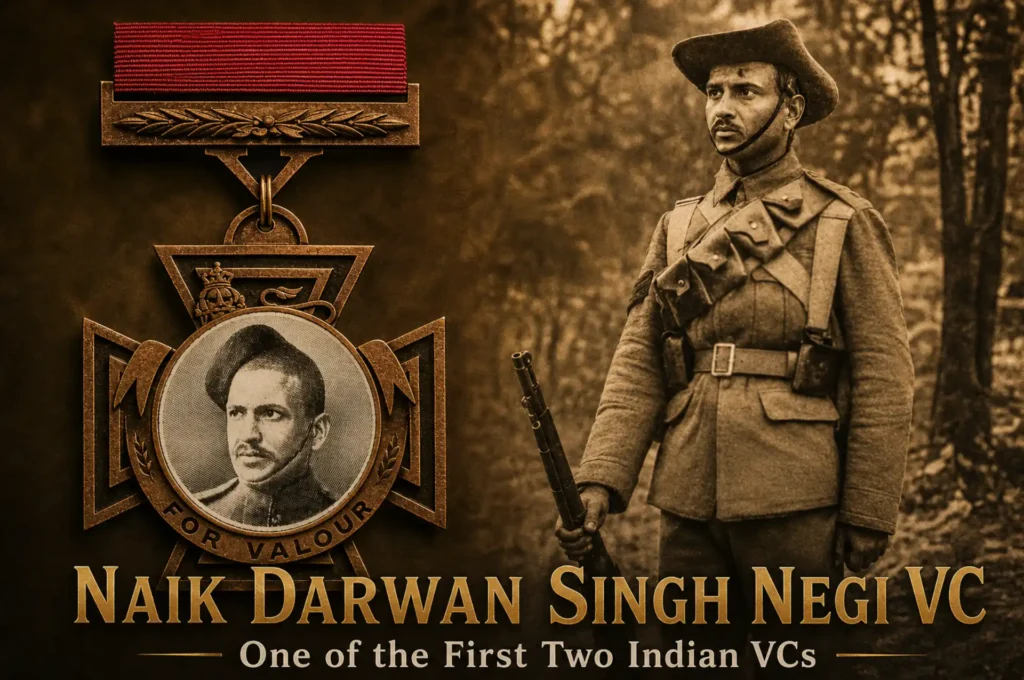
Naik Darwan Singh Negi VC
Introduction: The Night That Made History
It was the night of 23 November 1914. The fields of Festubert in northern France were a hell of mud, blood, and exploding shells. The Germans had captured British trenches, and the Indian Corps was ordered to retake them at any cost.
Among the soldiers advancing into the darkness was a 31‑year‑old Naik (Corporal) from the Garhwal Himalayas. His name was Darwan Singh Negi of the 1st Battalion, 39th Garhwal Rifles. He had already been wounded twice – once in the head and once in the arm. But he did not stop.
He was one of the first to push round each successive traverse, clearing the enemy from the trenches with rifle, bayonet, and grenade. By the time the battle was over, he was drenched in blood from head to foot.
For this act of extraordinary bravery, Darwan Singh Negi became one of the first two Indian soldiers to receive the Victoria Cross – Britain’s highest award for gallantry.
This is his true story.
Historical Context: The Western Front and the Indian Corps
The Indian Corps Arrives in France
When the First World War broke out in August 1914, the British Indian Army was among the first colonial forces to be deployed to Europe. The Indian Corps arrived in France in September 1914 and was thrown into the brutal fighting on the Western Front.
By November 1914, the war had already become a bloody stalemate. The German and Allied forces had dug themselves into a vast network of trenches stretching from the North Sea to the Swiss border. Neither side could break through.
The Garhwal Brigade, part of the 7th (Meerut) Division, had already seen action at the First Battle of Ypres. They had suffered heavy casualties, but they had proven their courage. Now, they were ordered to retake captured trenches near the village of Festubert.
The Battle of Festubert – November 1914
Festubert, just north of Givenchy and west of La Bassée, was a sector of the front line that saw fierce fighting in late November 1914. The Germans had launched a surprise attack and captured British trenches. The Indian Corps was tasked with a desperate counter‑attack.
The 1st Battalion of the 39th Garhwal Rifles was ordered to carry out a flank attack to retake the lost positions. It was a night assault – the most dangerous kind of attack, where visibility was almost zero and friendly fire was a constant threat.
The Garhwalis advanced in silence, their bayonets fixed. They knew that failure was not an option.
Who Was Darwan Singh Negi Before the War?
A Farmer’s Son from the Garhwal Hills
Darwan Singh Negi was born on 4 March 1883 in the village of Kafarteer (also recorded as Karbartir) in the Garhwal District of the North‑Western Provinces – present‑day Chamoli district, Uttarakhand, India.
His father, Kalam Singh Negi, was a landowner and cultivator. The family lived a simple life, farming the terraced hillsides of the Himalayan foothills. For a young man from Garhwal, joining the army was not just a career – it was a tradition and an honour.
Enlistment in the 39th Garhwal Rifles
In 1902, at the age of 19, Darwan Singh enlisted in the 39th Garhwal Rifles. He joined the 1st Battalion and rose through the ranks to become a Naik – the equivalent of a Corporal.
The 39th Garhwal Rifles had been raised in 1887 and was known for its fierce martial traditions. The Garhwali soldiers were recruited from the Himalayan region of Uttarakhand – hardy, disciplined, and utterly loyal.
By the time the war broke out in 1914, Darwan Singh was a seasoned soldier with over a decade of service. He was 31 years old, a husband, and a father. He had no idea that a single night in a muddy French trench would change his life forever.
The Victoria Cross Citation: What Darwan Singh Negi Did
The Official Citation
The Victoria Cross citation for Naik Darwan Singh Negi was published in the London Gazette on 7 December 1914. The citation read:
“For great gallantry on the night of the 23rd–24th November, near Festubert, France, when the regiment was engaged in retaking and clearing the enemy out of our trenches, and, although wounded in two places in the head, and also in the arm, being one of the first to push round each successive traverse, in the face of severe fire from bombs and rifles at the closest range.”
What the Citation Means – A Detailed Breakdown
To understand the full weight of those words, you must understand what a traverse was.
German trenches were not straight lines. They were built in a zig‑zag pattern – each corner was called a traverse. The purpose of the traverse was to stop shrapnel and bullets from flying down the entire length of the trench. But it also created deadly blind spots. Every time a soldier rounded a traverse, he had no idea what was waiting on the other side – a machine gun, a grenade, or a bayonet.
Phase 1 – The Night Assault: On the night of 23‑24 November 1914, the Germans attacked the Indian Corps positions at Festubert. The 1/39th Garhwal Rifles were ordered to retake the captured trenches via a flank attack.
Phase 2 – The Advance: The Garhwalis advanced under intense rifle fire and bomb explosions. Darwan Singh Negi was one of the first to push forward in the attack.
Phase 3 – The Wounds: He was wounded twice in the head and once in the arm. But he did not stop. He did not report his wounds.
Phase 4 – Clearing the Traverses: He was among the first to push round each successive traverse, facing severe fire from bombs and rifles at the closest range.
Phase 5 – The Victory: The Garhwalis succeeded in retaking the trenches. By the time it was over, Darwan Singh was drenched in blood from head to foot. He had cleared the enemy from the trenches, saving countless lives.
First in Every Dash
One contemporary account captured the essence of his bravery:
*”First in every dash on the traverses with the bayonet, three times wounded, Naik Darwan Sing Negi of the 1/39th Garhwal Rifles did not even report his wounds till his company fell in.”*
This single sentence tells us everything about the man: he was first in every attack, he was wounded three times, and he did not report his wounds until the battle was over.
Immediate Aftermath – Recognition and the Victoria Cross
One of the First Two Indian VCs
Darwan Singh Negi and Sepoy Khudadad Khan were the first two Indians to be awarded the Victoria Cross. While Khudadad Khan’s action took place on 31 October 1914, Negi’s citation was published in the same London Gazette on 7 December 1914.
Being presented the award by the King added to their self‑esteem and helped to ensure their loyalty and that of their fellows.
The King’s Visit – 5 December 1914
On 5 December 1914, King George V visited troops in France. In a special ceremony, Darwan Singh Negi was presented with his Victoria Cross by the King himself.
This was a moment of immense pride – not just for Negi, but for the entire Indian Corps. An Indian soldier, standing before the King‑Emperor, receiving the highest award for gallantry.
The King’s Question and Negi’s Wish
According to his son, Lieutenant Colonel Balbir Singh Negi (retd), when King George V presented the Victoria Cross, he asked Negi: “What can I do for you?”
Negi’s reply was simple and humble: “There aren’t any schools in my area. A middle school should be started at Karanprayag.”
Karanprayag was 25 miles from his native village Kafarteer. The King immediately granted his wish, and a school was opened by the British government at Karanprayag.
It was a request born of a deep desire to give his people – his children – the education he never had.
Later Life – Retirement, Social Work, and Legacy
A Humble Retirement
Negi took premature retirement from the army in 1924. He retired with the rank of Subedar – the equivalent of a Captain.
Despite his heroism, he was humbled by the war. He had seen too much destruction. He did not want his sons to join the Army.
Social Work and Service
After retirement, Negi dedicated himself to social work. He:
- Helped war widows and their families
- Opened a school in his village
- Requested authorities to extend road and rail links to Karanprayag
The road link was completed before Independence, but the railway line – the Rishikesh‑Karanprayag railway – was sanctioned only later.
His Family’s Military Tradition
Though Negi discouraged his sons from joining the Army, his youngest son, Balbir Singh Negi, was too charmed by the military. He joined the Garhwal Rifles (5th Battalion) and served for 34 years. He took part in the Indo‑Pak wars of 1965 and 1971, peacekeeping in Sri Lanka, and Operation Bajrang in Assam.
His grandson went on to command the 13th Battalion of the Garhwal Rifles at the Siachen glacier. The legacy of Darwan Singh Negi lives on in his family’s continued service.
Death and Burial
Darwan Singh Negi died on 24 June 1950 at the age of 67. He passed away in his native village of Kafarteer, Chamoli district, Uttarakhand. He was laid to rest in the land he had fought to protect.
Legacy: How India and the World Remember Darwan Singh Negi
The Darwan Singh Negi Museum, Lansdowne
The regimental museum of the Garhwal Rifles in Lansdowne, Uttarakhand, is named in his honour. The Darwan Singh Negi Museum documents the history of the Garhwal Rifles through artefacts, photos, and weapons.
It stands as a testament to the bravery of one of the regiment’s greatest heroes.
The Family’s Prized Possessions
The Negi family still treasures:
- A century‑old parchment paper telling Naik Darwan Singh Negi his duties
- A photograph of Field Marshal Claude Auchinleck adorning Negi with his Victoria Cross in 1948
- A chapter on Negi in a coffee table book
- A handful of medals and other memorabilia
The School at Karanprayag
The school that King George V granted – a middle school at Karanprayag – stands as a living legacy of Negi’s humility and vision. It was not a request for wealth or power. It was a request for education.
A Place in History
Darwan Singh Negi is remembered as one of the first Indian soldiers to receive the Victoria Cross. His name is inscribed alongside the other Indian VC recipients of World War I. He is a symbol of the courage, sacrifice, and loyalty of the Indian soldiers who fought on the Western Front.
Why This Story Still Matters
Darwan Singh Negi was not a general or a politician. He was a farmer’s son from the Garhwal Himalayas who, on one night in November 1914, showed extraordinary courage.
He was wounded three times – twice in the head and once in the arm. He did not stop. He did not report his wounds. He was first in every dash on the traverses, clearing the enemy with bayonet and grenade.
When the King asked him what he wanted, he did not ask for money or land. He asked for a school for his people.
His story is a reminder that true courage is not just about fighting – it is about sacrifice, humility, and the desire to build a better future for those who come after us.
Darwan Singh Negi’s name may not be in every history book, but his actions – and his legacy – deserve to be remembered.
Sources & Further Reading (Primary and Authoritative)
- The London Gazette – Victoria Cross citation, Supplement, 7 December 1914, p. 10425
- UK Government – WW1 Indian VC recipient Darwan Singh Negi
- Wikipedia – Darwan Singh Negi biography
- The Indian Express – Darwan Singh Negi: Defence of Festubert
- The Tribune – King granted him wish—a school
- Victoria Cross & George Cross Association – Naik Darwan Singh Negi VC
- The National Archives – VC winners and King’s visit
More Stories of Valor from ThePoemStory
- Read next: Rifleman Gabar Singh Negi VC – A 19‑Year‑Old Who Changed a Battle at Neuve Chapelle
- Read next: Sepoy Khudadad Khan VC – The First Indian to Win the Victoria Cross
- Read next: Sergeant Henry Johnson – Who Fought 20 Germans with a Knife
- Read next: Captain Charles Upham VC & Bar – The Only Combat Soldier to Win the Victoria Cross Twice

Get the ThePoemStory App — Read Poems Anywhere