The letter arrived on a Tuesday. No return address. Just a stamp, a postmark from a city he had sworn never to think about again, and his name – Arjun – written in handwriting he would have recognized anywhere.
It was from his father.
Arjun hadn’t spoken to his father in twelve years. Not since the night he walked out of their family home at eighteen, carrying nothing but a backpack and a rage so hot it had kept him warm through many cold nights.
The letter sat on his kitchen counter for three days unopened. His wife, Priya, saw it. She didn’t ask. She just placed a cup of chai beside it each morning and waited.
On the third night, Arjun opened it. Inside was a single sheet of paper. Eleven words:
“I am dying. I would like to see you. If you can forgive me.”
Arjun read the line eleven times. Then he folded the paper, put it back in the envelope, and placed it in a drawer.
That night, he didn’t sleep. He lay in bed, staring at the ceiling, and for the first time in over a decade, he let himself remember.
This is a story of breaking free – not from a person or a place, but from the prison of your own anger. The kind of freedom that comes only when you stop letting your past define your future.
Read More Inspirational Stories and Inspirational Poems on ThePoemStory
The Year He Forgave the Unforgivable – A Story of Breaking Free
The Ordinary World: A Childhood That Looked Normal
To anyone outside, Arjun’s childhood seemed ordinary. Middle-class family. A father who worked in a government office. A mother who taught at a local school. A younger sister. Weekday routines and weekend trips to the market.
But inside the walls of their small apartment, something was wrong.
Arjun’s father had a temper. Not the yelling kind – the silent kind. The kind that filled a room with dread before any words were spoken. The kind that made a child learn to read moods instead of books.
By the time Arjun was twelve, he had become an expert at noticing the signs. A certain tightening of the jaw. A certain way of putting down a cup. A certain silence that meant: Someone is about to get hurt.
The someone was usually Arjun.
Not physically, not at first. But his father had a gift for words – sharp, precise, devastating. “You are a disappointment.” “You will never amount to anything.” “Why can’t you be more like your cousin?”
Arjun learned to shrink. To make himself small. To apologize for existing. He thought every family was like this. He thought every father called his son a failure. He thought the constant knot in his stomach was just what it felt like to be alive.
The breaking point came when Arjun was seventeen. He had just received his board exam results – 92%. Good enough for a scholarship. Good enough to make any parent proud.
He showed his father the marksheet. His father glanced at it, then looked at him, and said: “Only 92? Your cousin got 96. You couldn’t even beat him?”
Arjun said nothing. He had learned not to speak.
But that night, something inside him cracked – not broke, but cracked just enough to let a single thought through: This will never change.
The Breaking Point: When the Dream Goes Silent
He left home the day he turned eighteen. Not in a dramatic confrontation. Just quietly, in the early morning, while his father was still asleep and his mother was making tea. He packed a bag, left a note that said “I’m sorry, I love you, I can’t stay,” and walked to the bus station.
He didn’t cry. He didn’t look back. He told himself he was letting go of dreams – not just the dream of a happy family, but the dream of ever being enough for a man who had decided he wasn’t.
He moved to a different city. He worked night shifts at a petrol pump while finishing school. He got a scholarship to a good college. He met Priya. He built a life. A successful life. A life that looked, from the outside, like everything he had ever wanted.
But the anger never left.
It lived in his chest like a second heartbeat. It showed up in small ways – the way he flinched when someone raised their voice, the way he worked himself to exhaustion to prove he was “enough,” the way he couldn’t accept a compliment without feeling like a fraud.
He told himself he had forgiven his father. He told himself he had moved on. But forgiveness, he would learn, is not the same as silence.
The Dark Middle: Loss, Confusion, and a Letter
The letter changed everything.
For three weeks after opening it, Arjun said nothing to anyone. He went to work. He came home. He ate dinner with Priya. He watched TV. But he was gone – somewhere deep inside, wrestling with a question he had spent twelve years avoiding: If he dies tomorrow, will I regret not going?
Priya finally confronted him. Not with anger, but with a question: “What are you afraid of?”
“I’m afraid of going and feeling nothing,” he said. “I’m afraid of going and feeling too much. I’m afraid that he will apologize and it won’t fix anything. I’m afraid that he won’t apologize at all.”
“That’s a lot of fears,” Priya said. “What if you just go and see what happens?”
Arjun bought a train ticket.
The journey was twelve hours. He didn’t sleep. He watched the landscape change from city to town to village to the familiar streets of his childhood. Every mile felt like peeling off a layer of skin.
His sister met him at the station. She was older now – thirty-one, with a child of her own. She hugged him and cried. “He’s very sick,” she said. “The doctors gave him three months. That was six weeks ago.”
Arjun nodded. He didn’t ask why she had never told him. He already knew the answer: because he had made it clear he didn’t want to know.
The Small Turning Point: Paying Attention Instead of Performing
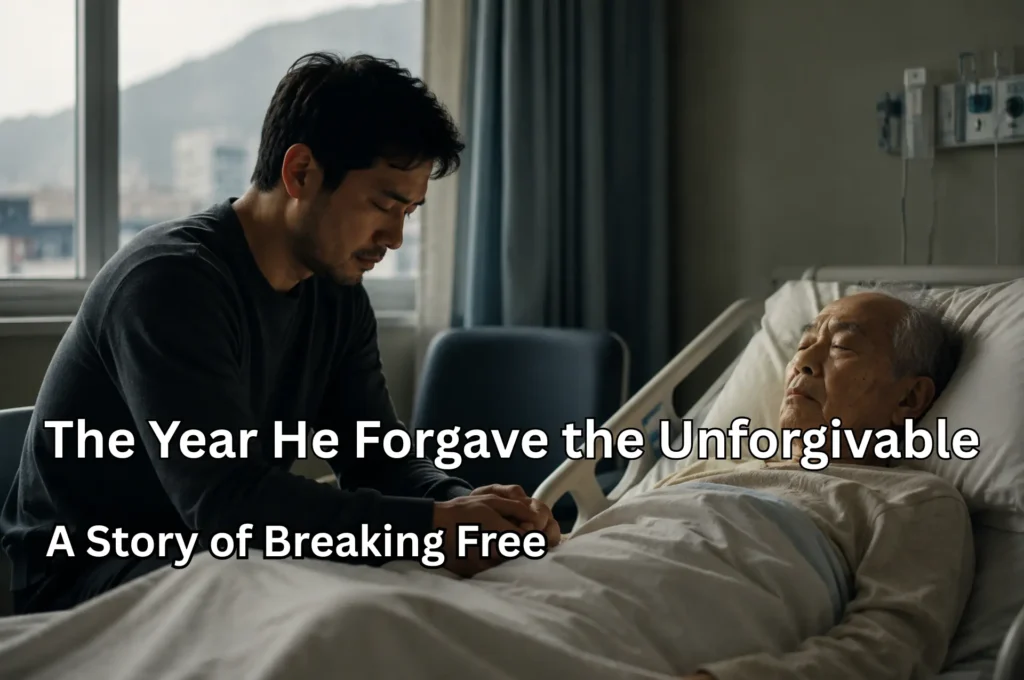
The hospital room was small and smelled of antiseptic. His father lay in the bed, pale, thin, a shadow of the man who had once filled every room with dread.
Arjun stood at the doorway for a long time. His father’s eyes were closed. He looked small. Breakable. Human.
Arjun sat in the chair beside the bed. He didn’t say anything. He just sat.
After a while, his father opened his eyes. He looked at Arjun. For a moment, neither spoke. Then his father whispered, “You came.”
“You asked me to,” Arjun said.
“I didn’t think you would.”
“I almost didn’t.”
His father closed his eyes again. A single tear rolled down his cheek. “I was a cruel man,” he said. “Not just to you. To everyone. I thought I was teaching you strength. I was teaching you fear.”
Arjun had imagined this conversation a thousand times. In his imagination, he was angry. He demanded apologies. He listed every hurt. He got the satisfaction of watching his father suffer.
But in the real room, with the real man, he felt only exhaustion. The anger was still there – but it was old, tired, like a fire that had burned too long without fuel.
“I’m not here to fight,” Arjun said. “I’m just here.”
The Climb: Finding Purpose After Failure
The next three weeks were the hardest of Arjun’s life.
He stayed in his childhood home – the same walls, the same floors, the same memories pressing in from every corner. He visited the hospital every day. He sat with his father. Sometimes they talked. Mostly they sat in silence.
His father did not apologize in grand speeches. He apologized in small moments. In a hand that reached out. In a question about Arjun’s work. In a whispered “I am proud of you” that came too late to undo anything but still meant something.
Arjun realized that finding purpose after failure didn’t mean fixing the past. It meant learning to carry it differently.
He started writing in a journal again – not about his father, but about himself. He wrote down questions he had never asked: What kind of father do I want to be? What kind of husband? What kind of man?
He realized that his anger at his father had become an excuse. An excuse to stay distant. An excuse to avoid vulnerability. An excuse to never risk being hurt again.
His father died on a Thursday morning. Arjun was holding his hand.
In the final moment, his father opened his eyes, looked at him, and said, “You were always enough. I was the one who couldn’t see.”
Then he was gone.
Arjun did not feel relief. He did not feel closure. He felt grief – not for the man who had died, but for the boy who had spent eighteen years being told he wasn’t enough, and for the father who had spent a lifetime not knowing how to love.
That night, Arjun sat on the roof of his childhood home and watched the stars. And for the first time in twelve years, he cried. Not angry tears. Not sad tears. Just tears.
The Resolution: Overcoming Identity Crisis and Living an Authentic Life
Arjun returned to his city a different man.
Not healed. Not “over it.” But different. He had stopped running. He had faced the thing he feared most – not his father’s anger, but his own. And in facing it, he had found something he didn’t expect: compassion.
Compassion for the boy he had been. Compassion for the father who had failed. And most surprisingly, compassion for the angry young man who had spent twelve years building a life around a wound.
He called his sister more often. He started seeing a therapist. He learned to say things he had never said: “I’m scared.” “I need help.” “I love you.”
He also learned that forgiveness is not a single act. It is a daily choice. Some days he woke up still angry. Some days he felt nothing. Some days he felt a quiet tenderness for the man who had given him life and then made that life so hard.
That’s what overcoming identity crisis actually looks like – not erasing the past, but integrating it. Becoming a person who can hold both the hurt and the love in the same hand.
Five years later, Arjun became a father himself. A daughter. He held her in his arms and made a promise: You will never have to earn my love. You will never be told you are not enough. You will never be afraid of my silence.
He knows he will fail sometimes. He is human. But he also knows that failure is not the end – it is the beginning of trying again.
And he is, for the first time, living an authentic life – not the life of a man running from his past, but the life of a man who has made peace with it.
How This Story Inspires
A story of breaking free doesn’t tell you that forgiveness is easy. It tells you that forgiveness is possible – but only when you stop expecting the other person to change and start changing yourself.
Arjun’s inspiration isn’t in the dramatic deathbed reconciliation. It’s in the quiet work of untangling twelve years of anger, one thread at a time. It’s in the courage to show up, even when showing up might hurt. It’s in the realization that the prison of resentment has a door – and you are the only one who can open it.
What makes this story inspirational:
- It shows that healing is not linear. Some days are hard. That’s okay.
- The turning point is small and realistic – a letter, a train ride, a hospital chair.
- Success is redefined as peace, not revenge or resolution.
Questions for readers:
- What “letter” are you still not opening in your own life?
- Who are you still angry at – and who is that anger really hurting?
- If you could forgive yourself for one thing today, what would it be?
Takeaway: You don’t need an apology to move forward. You don’t need the other person to change. You just need to decide that you are done carrying the weight. That’s not weakness. That’s a story of breaking free.
Read More Inspirational Stories and Inspirational Poems on ThePoemStory

Get the ThePoemStory App — Read Poems Anywhere