Read the true story of Rifleman Kulbir Thapa VC, the first Gurkha soldier to receive the Victoria Cross for rescuing wounded comrades under enemy fire at Fauquissart in 1915.
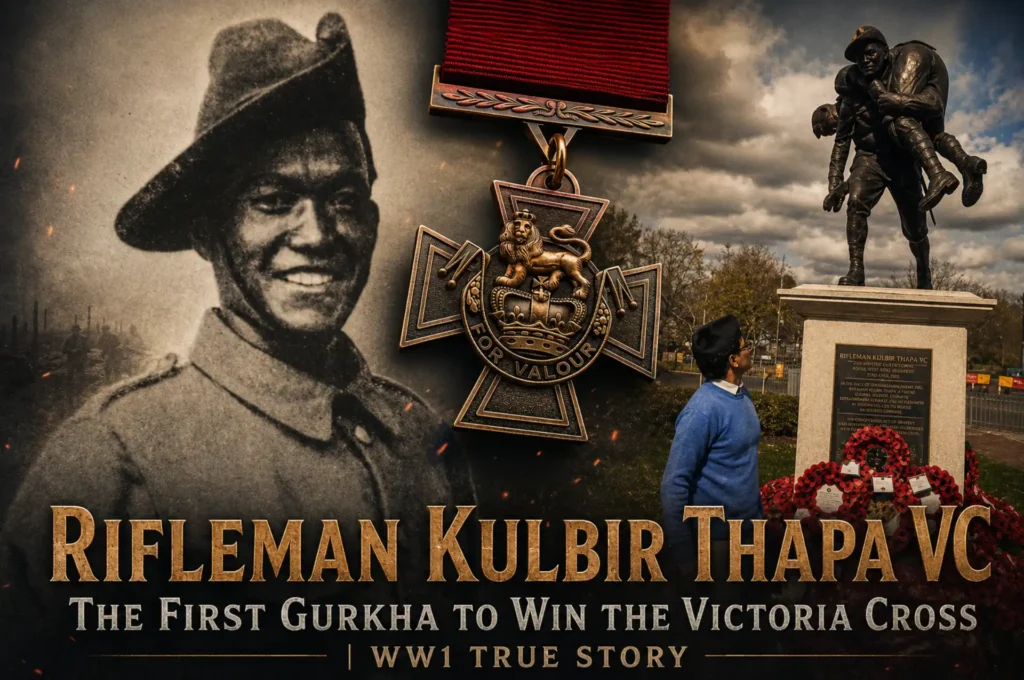
Rifleman Kulbir Thapa VC
Introduction: The Braveheart Who Refused to Leave a Comrade Behind
It was 25 September 1915. The fields of Fauquissart in northern France were a hell of gas, machine-gun fire, and exploding shells. The British had launched a diversionary attack to draw German resources away from the main Battle of Loos. The 2nd Battalion of the 3rd Gurkha Rifles was ordered to attack the German trenches.
Among the soldiers advancing into the chaos was a 26-year-old Rifleman from the hills of Nepal. His name was Kulbir Thapa of the 2nd Battalion, 3rd Queen Alexandra’s Own Gurkha Rifles. It was the first time he had ever been under fire. What happened next would make him a legend.
His company was cut down by German fire. Only Lieutenant Wood and four men reached the German front line – and all but Kulbir Thapa were killed. Wounded himself, he found a badly wounded soldier of the 2nd Leicestershire Regiment behind the first-line German trench. The British soldier urged him to save himself. He refused.
For the next 24 hours, Kulbir Thapa did the impossible. He stayed with the wounded man all day and night. He carried him through German wire under enemy fire. He returned to rescue two wounded Gurkhas. And then he went back one more time – in broad daylight – to bring the British soldier to safety.
For this extraordinary act of selfless bravery, Kulbir Thapa became the first Gurkha soldier to receive the Victoria Cross.
This is his true story.
Historical Context: The Gurkhas on the Western Front
The Indian Corps Arrives in France
When the First World War broke out in August 1914, the British Expeditionary Force found itself heavily outnumbered and in danger of being outmanoeuvred. The British high command took the decision to deploy Indian Army troops to France and Belgium – the only available standing force large enough to provide such reinforcements.
The Gurkhas had previously served outside the Indian Subcontinent, but only for short periods. The deployment to France was unprecedented. By September 1915, the Indian Corps had achieved its objectives of stabilising the British positions, but at a terrible cost. The Indian and Gurkha soldiers had fought bravely and with determination.
The Battle of Loos and the Diversionary Attack at Fauquissart
The Battle of Loos (25 September – 8 October 1915) was the largest British offensive of 1915. The British used gas for the first time – but the wind carried it back across their own lines with disastrous consequences.
To draw German resources away from the main attack, the Garhwal and Bareilly Brigades, together with the 12th Battalion Rifle Brigade, attacked the enemy line at Piètre, just north-west of Aubers on the Fauquissart road.
The 2nd Battalion of the 3rd Gurkha Rifles was part of this diversionary attack. It was a desperate mission – and the Gurkhas paid a heavy price.
Who Was Kulbir Thapa Before the War?
Early Life in the Hills of Nepal
Kulbir Thapa was born on 15 December 1888 (some sources say 1889) in the village of Nigalpani, Palpa District, Nepal. He was born into the Magar ethnic group – a community known for its martial traditions and service in the British Indian Army.
His father was Haria Gulte. The family lived a simple life in the hills of western Nepal, where farming and military service were the two main paths for young men.
Enlistment in the Gurkha Rifles
In 1907, at the age of 19, Kulbir Thapa enlisted in the Indian Army as part of Queen Alexandra’s Own Gurkha Rifles. He originally joined the 1st Battalion of the 3rd Gurkha Rifles, but was transferred to the 2nd Battalion for service in France after the outbreak of the First World War in 1914.
By September 1915, he was a 26-year-old Rifleman – experienced in training but never before under fire. That was about to change.
The Gurkha Reputation
The Gurkhas had already earned a fearsome reputation in the British Indian Army. They were known for their loyalty, discipline, and extraordinary courage. The phrase “Bravest of the Brave, Most Generous of the Generous” was first used to describe Gurkha soldiers during the First World War.
Kulbir Thapa would embody that reputation.
The Victoria Cross Citation: What Kulbir Thapa Did
The Official Citation
The Victoria Cross citation for Rifleman Kulbir Thapa was published in the London Gazette on 18 November 1915. It read:
*”For most conspicuous bravery during operations against the German trenches south of Mauquissart. When himself wounded, on the 25th September, 1915, he found a badly wounded soldier of the 2nd Leicestershire Regiment behind the first line German trench, and, though urged by the British soldier to save himself, he remained with him all day and night.
In the early morning of the 26th September, in misty weather, he brought him out through the German wire, and, leaving him in a place of comparative safety, returned and brought in two wounded Gurkhas one after the other. He then went back in broad daylight for the British soldier and brought him in also, carrying him most of the way, and being at most points under the enemy’s fire.”**
What the Citation Means – A Detailed Breakdown
Phase 1 – The Attack (25 September 1915): The 2nd Battalion of the 3rd Gurkha Rifles attacked the German trenches at Fauquissart. A prior German bombardment had hit a cache of British gas shells, forcing the Gurkhas to carry out their attacks in gas masks. Casualties were heavy.
Phase 2 – The Last Survivor: Most of No. 4 Double Company were cut down by German fire. Only Lieutenant Wood and four men reached the German front line – and all but Kulbir Thapa were killed. He was alone, wounded, and trapped behind enemy lines.
Phase 3 – The Discovery: Between the first and second German trenches, Kulbir found a badly wounded soldier of the 2nd Leicestershire Regiment. The British soldier urged him to save himself. He refused.
Phase 4 – The Vigil: Kulbir stayed with the wounded British soldier for the rest of the day and throughout the night. He could have saved himself – but he chose to stay.
Phase 5 – The First Rescue (26 September, early morning): In misty weather, Kulbir carried the British soldier out through the German wire. He left him in a place of comparative safety.
Phase 6 – The Second Rescue: He returned and brought in two wounded Gurkhas, one after the other.
Phase 7 – The Final Rescue: He went back – in broad daylight – for the British soldier and brought him in, carrying him most of the way and being at most points under the enemy’s fire.
The Remarkable Detail
What makes this story truly extraordinary is that Kulbir Thapa had never been under fire before this incident. He was a young soldier experiencing combat for the first time – and he showed courage that veterans would envy.
His actions were so remarkable that they attracted a good deal of attention from both sides. The sheer willpower of the Gurkha soldier brought British and German soldiers together in acknowledgment of his bravery.
Immediate Aftermath – Recognition and the Victoria Cross
The First Gurkha VC
Kulbir Thapa was the first Nepalese Gurkha recipient of the Victoria Cross. It was a moment of immense pride – not just for him, but for the entire Gurkha community.
Soldiers of the Indian Army had only been made eligible for the Victoria Cross four years previously, in 1911. Kulbir Thapa’s award was historic.
The Award Ceremony
Kulbir Thapa was personally awarded his Victoria Cross by King George V at Buckingham Palace. The Victoria Cross awarded to Kulbir Thapa was in the first group of awards for the Battle of Loos, which were gazetted on 18 November 1915.
Of the 18 VCs gazetted that day, no less than 17 were presented by the King at Buckingham Palace in nine presentations.
Recovery and Promotion
Kulbir recovered from his wound and was promoted to the rank of Havildar (equivalent of a Sergeant). He survived the war – a remarkable feat given the horrors he had endured.
Later Life – Quiet Retirement and Lasting Legacy
Return to Nepal
After the war, Kulbir Thapa returned to Nepal. He retired from the army with the rank of Havildar and lived quietly in his homeland.
Death and Final Rest
Kulbir Thapa died on 3 October 1956 at the age of 67. He was buried in Nepal – far from the French fields where he had shown such extraordinary courage.
A Life of Humility
Despite being the first Gurkha to receive the highest award for gallantry, Kulbir Thapa lived a life of quiet humility. He never sought fame or fortune – he simply did what he believed was right.
Legacy: How the World Remembers Kulbir Thapa
The Statue in Aldershot
On 24 September 2021, a life-size statue of Kulbir Thapa was unveiled in Princes Gardens, Aldershot. The statue depicts Kulbir carrying a wounded soldier from the Leicestershire Regiment – one of the acts for which he became the first Gurkha soldier to receive the Victoria Cross.
The statue stands as a symbol of the courage and compassion of the Gurkha soldiers who have served the British Crown for over 200 years.
Kulbir Thapa House, Morden
On 11 October 2019, Kulbir Thapa House was opened in Morden, London, by Her Majesty Queen Elizabeth II. The housing complex is named in his honour and stands as a permanent reminder of his bravery.
The Gurkha Memorial Museum, Nepal
A bronze memorial plaque engraved with Kulbir Thapa’s name is displayed at the Gurkha Memorial Museum in Nepal. It serves as a tribute to the first Gurkha to receive the Victoria Cross.
The Sand Portrait at Lyme Regis
On 11 November 2018 – the centenary of the Armistice – a large-scale portrait of Kulbir Thapa was drawn in the sand on Lyme Regis beach. The portrait was part of Danny Boyle’s Pages of the Sea project, which commemorated the men and women who left their home shores during the First World War.
Kulbir Thapa’s face was chosen to represent the range of individuals, regions, and international communities that were part of the First World War.
The Royal Leicestershire Regiment
Kulbir Thapa is still remembered by the Royal Leicestershire Regiment at their regimental museum. His act of selfless bravery – rescuing a wounded soldier of the 2nd Leicestershire Regiment – forged a bond between the Gurkhas and the Leicester soldiers that endures to this day.
In Popular Culture
- “1915: Legend of the Gurkhas” (2023) – A film depicting Kulbir Thapa’s story.
- Numerous documentaries and articles celebrate his extraordinary courage.
Why This Story Still Matters
Kulbir Thapa was not a general or a politician. He was a young soldier from the hills of Nepal who, on his first day under fire, showed courage beyond measure.
He was wounded. He was alone. He was surrounded by enemy soldiers. He could have saved himself – but he chose to stay with a wounded comrade from a different regiment, a different country, a different background.
He stayed with him all day and all night. He carried him through German wire under enemy fire. He returned three times to rescue others. He did all of this in broad daylight, knowing that every step could be his last.
His courage was not reckless. It was deliberate. It was born of compassion – the simple belief that no comrade should be left behind.
His story is a reminder that courage comes in many forms. Sometimes it means charging a machine gun. Sometimes it means staying with a wounded man when every instinct tells you to run. And sometimes it means going back – not once, not twice, but three times – to save others.
Kulbir Thapa’s name may not be in every history book, but his actions – and his legacy – deserve to be remembered.
More than 90,000 Gurkhas enlisted during the First World War, fighting across Asia, the Middle East, and Europe, where more than 6,000 died in action. Kulbir Thapa was the first of them to receive the Victoria Cross – and his story embodies the spirit of the Gurkha soldier: Bravest of the Brave, Most Generous of the Generous.
Sources & Further Reading (Primary and Authoritative)
- The London Gazette – Victoria Cross citation, 18 November 1915
- UK Government – WW1 Nepalese VC recipient Kulbir Thapa
- Wikipedia – Kulbir Thapa biography
- The Gurkha Museum, Winchester – The First Gurkha Victoria Cross
- VC & GC Association – Kulbir Thapa VC profile
- Imperial War Museum – Kulbir Thapa memorial
- Imperial War Museum (Lives of the First World War) – First Gurkha VC story
- Commonwealth War Graves Commission – Kulbir Thapa entry
More Stories of Valor from ThePoemStory
- Read next: Naik Darwan Singh Negi VC – One of the First Two Indian VCs
- Read next: Rifleman Gabar Singh Negi VC – A 19‑Year‑Old Who Changed a Battle at Neuve Chapelle
- Read next: Sepoy Khudadad Khan VC – The First Indian to Win the Victoria Cross
- Read next: Sergeant Henry Johnson – Who Fought 20 Germans with a Knife

Get the ThePoemStory App — Read Poems Anywhere