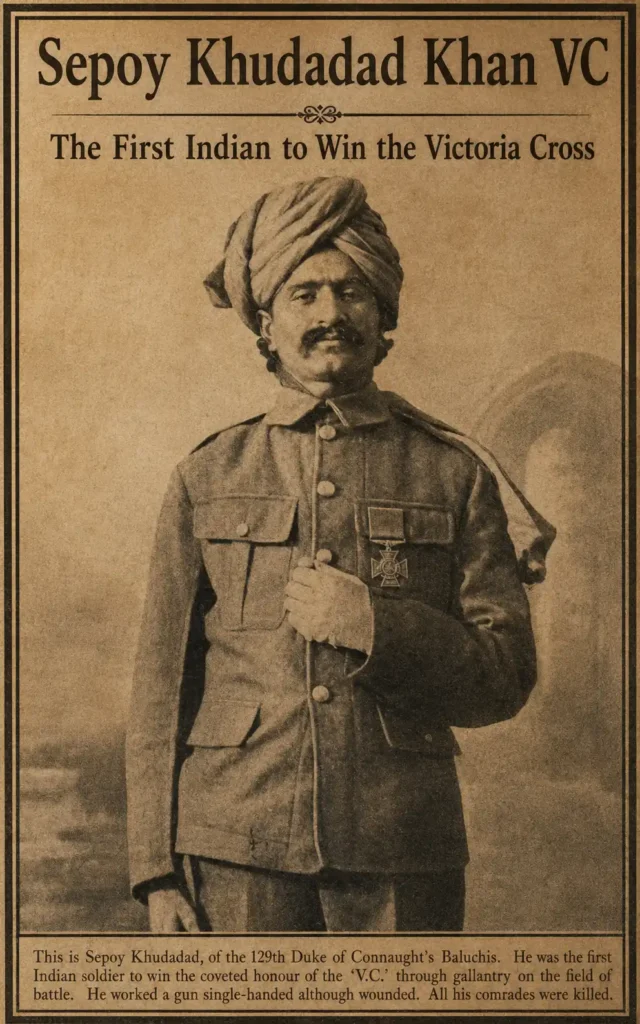
Read the true story of Sepoy Khudadad Khan VC, the first Indian soldier to receive the Victoria Cross for holding a machine gun alone against German forces at Hollebeke in 1914.
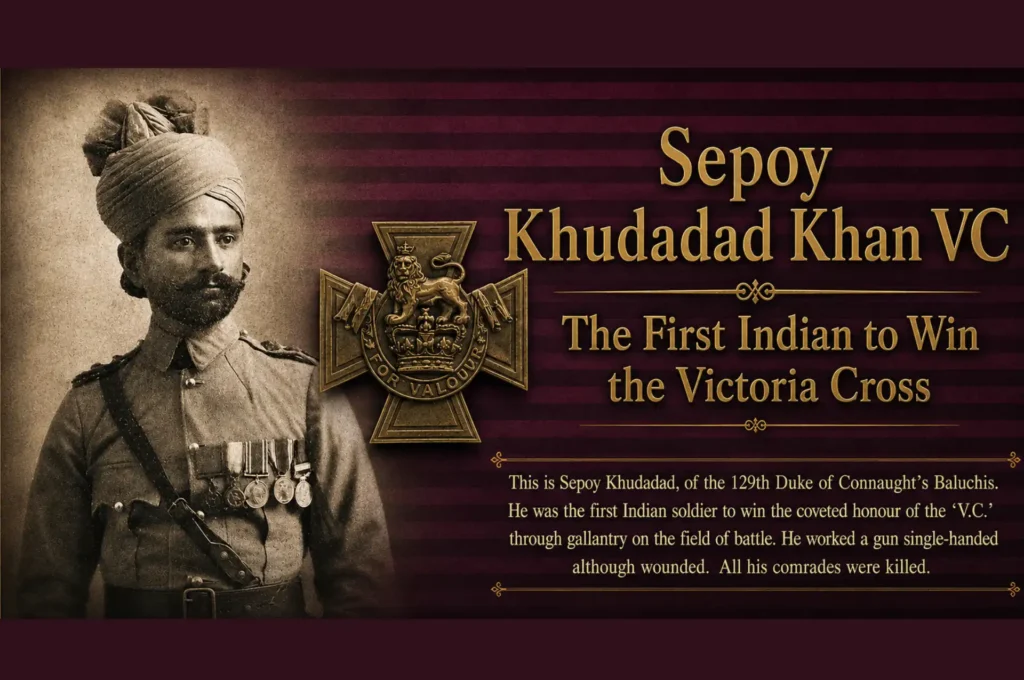
Sepoy Khudadad Khan VC
Introduction: One Man, One Gun, Against an Army
It was 31 October 1914. The fields of Hollebeke, Belgium, were churned into a swamp of mud, blood, and shell craters. The German army was advancing in overwhelming numbers – outnumbering the Allied defenders by an estimated five to one. The British and Indian forces were desperately trying to hold the line, knowing that if the Germans broke through, the vital Channel ports would fall.
Somewhere in that hellish landscape, a 26‑year‑old machine‑gunner from the Punjab stood his ground. His name was Sepoy Khudadad Khan of the 129th Duke of Connaught’s Own Baluchis. All around him, his comrades were falling – one by one, shot, bayoneted, or blown apart by shells. His British officer was wounded. The other machine gun was destroyed. He was alone, wounded himself, and facing an entire German assault.
He did not run. He did not surrender. He remained working his gun until all the other five men of the gun detachment had been killed.
This is the true story of the first Indian soldier to receive the Victoria Cross – a story of extraordinary courage, sacrifice, and survival against impossible odds.
Historical Context: The First Battle of Ypres and the Race to the Sea
Why the Channel Ports Mattered
By October 1914, the First World War had entered a critical phase. The German army’s initial advance through Belgium and France had been halted at the Marne, but they were not defeated. Both sides now raced northward in what became known as the “Race to the Sea” – a desperate attempt to outflank each other and seize control of the French and Belgian Channel ports.
The ports of Boulogne, Calais, and Dunkirk were vital lifelines for the British Expeditionary Force (BEF). If the Germans captured them, British supply lines would be severed, and the entire Allied war effort on the Western Front would collapse.
The First Battle of Ypres (19 October – 22 November 1914) was the climax of this race. The ancient Belgian city of Ypres stood as a barrier between the German army and the coast. If Ypres fell, the ports would be next.
The Indian Corps Arrives in France
The British Indian Army had arrived in France in September 1914 – the first Indian troops to fight on European soil. The 7th (Ferozepore) Brigade, which included the 129th Duke of Connaught’s Own Baluchis, was among the first Indian units to reach the Western Front.
These soldiers came from the villages of Punjab, the North‑West Frontier, and the Himalayan foothills. Many had never seen snow before, let alone the mud‑filled trenches of Flanders. They were hardy, disciplined, and fiercely loyal – but nothing could have prepared them for the industrial slaughter of the Western Front.
The 129th Baluchis – A Regiment of Pathans
The 129th Duke of Connaught’s Own Baluchis was a regiment of the British Indian Army recruited primarily from the Pathan tribes of the North‑West Frontier (now Khyber Pakhtunkhwa, Pakistan) and the Punjab. Half the men in the regiment were Pathans. They were known for their toughness, marksmanship, and unwavering courage in close combat.
Khudadad Khan was one of them. He enlisted in October 1906 at the age of 18 and trained on the frontier, where skirmishes with tribal forces were a regular part of life. By 1914, he was a seasoned soldier – and a trained machine‑gunner.
Who Was Khudadad Khan Before the War?
Early Life in the Punjab
Khudadad Khan was born on 20 October 1888 (some sources say 26 October) in the village of Dab, in the Chakwal District of the Punjab Province, British India – now in present‑day Pakistan.
His family were Punjabi Muslim Rajputs of the Mangan Bhatti clan. They were a family of farmers and soldiers, with a tradition of military service stretching back generations. His ancestors came originally from the North‑West Frontier, bordering Afghanistan.
Khudadad grew up in a simple rural household. He learned to handle a rifle, ride a horse, and survive in the harsh terrain of the Punjab. When he was old enough, he did what many young men of his region did – he enlisted in the British Indian Army.
Enlistment and Early Service
In October 1906, at the age of 18, Khudadad Khan enlisted as a Sepoy (the equivalent of a private) in the 129th Duke of Connaught’s Own Baluchis. The regiment was stationed on the North‑West Frontier, where it was engaged in policing the tribal areas and defending British India’s borders.
He trained as a machine‑gunner, operating the heavy Vickers‑Maxim .303 machine gun – a weapon so heavy it required six men to carry it and its ammunition. The Maxim was the deadliest weapon on the battlefield, capable of firing 600 rounds per minute. But it was also a magnet for enemy fire. Machine‑gunners were prime targets, and their life expectancy in combat was brutally short.
Deployment to the Western Front
When war broke out in August 1914, Khudadad Khan’s regiment was initially sent to the Suez Canal Zone in Egypt. But the crisis on the Western Front was so desperate that the Indian Corps was urgently redirected to France. By September 1914, the 129th Baluchis had arrived in France.
They were thrown into the front lines almost immediately. The fighting was unlike anything they had ever experienced – artillery barrages, machine‑gun fire, and waves of German infantry attacking in massed formations. The Baluchis held their ground, but the cost was terrible.
The Victoria Cross Citation: What Khudadad Khan Did
The Official Citation
On 7 December 1914, the London Gazette published the official Victoria Cross citation for Sepoy Khudadad Khan. It read:
*”On 31st October, 1914, at Hollebeke, Belgium, the British Officer in charge of the detachment having been wounded, and the other gun put out of action by a shell, Sepoy Khudadad, though himself wounded, remained working his gun until all the other five men of the gun detachment had been killed.”***
Those 38 words contain an epic story of courage, sacrifice, and survival.
The Setup – Hollebeke, 31 October 1914
By 31 October, the situation at Hollebeke was desperate. The German army had captured the town the previous day. The British 2nd Cavalry Division had been repulsed, and the Germans were pushing forward with overwhelming force.
The 129th Baluchis were tasked with holding the line. They were positioned in water‑logged trenches – shallow, muddy ditches that offered little protection from the German artillery. They had insufficient hand grenades, gaps in the line due to a shortage of soldiers, and no barbed wire to slow the German advance.
The Baluchis had two Maxim machine guns to defend their position. These were their only hope of stopping the German infantry.
The Action – Step by Step
Phase 1 – The German Attack: Early on 31 October, the Germans launched a massive assault. Artillery shells rained down on the Baluchi positions. One of the two Maxim machine guns was destroyed by a direct hit. The British officer in charge of the machine‑gun detachment was wounded.
Phase 2 – Khudadad Takes Over: With his officer down and one gun destroyed, Khudadad Khan took command of the remaining Maxim gun. He was already wounded – shrapnel had torn into his upper body. But he ignored his injuries and continued to work his gun.
Phase 3 – The Gun Crew Falls: One by one, the six men of his gun detachment were killed. Havildar Ghulam Mahomed, Sepoy Lal Sher, Sepoy Said Ahmed, Sepoy Kassib, and Sepoy Afsar Khan – all fell to German fire. Khudadad was the last man standing.
Phase 4 – The Final Stand: Alone, wounded, and surrounded, Khudadad remained working his gun. He fired until his ammunition ran out. When the Germans finally overran his position, he feigned death – lying still among the bodies of his comrades.
Phase 5 – The Escape: Before the Germans could capture his machine gun, Khudadad put it out of action so it would not fall into enemy hands. Then, when the Germans had moved on, he crawled back to rejoin his company during the night.
What His Sacrifice Achieved
The actions of Khudadad Khan and the 129th Baluchis had held up the German advance long enough for other Indian and British troops to arrive and halt the attack. The Channel ports remained in Allied hands.
Khudadad had saved his machine gun from capture, saved his own life by feigning death, and returned to his regiment to continue fighting. He was the only survivor of his gun detachment.
Immediate Aftermath – Wounds, Survival, and Recognition
Hospitalisation and Recovery
Khudadad Khan was evacuated from the front lines and admitted to the Indian Hospital at the Brighton Pavilion in England. The Pavilion had been converted into a military hospital for Indian soldiers wounded on the Western Front. Later, he was moved to the Indian Hospital in New Milton.
He had suffered serious wounds to his upper body, but he survived – unlike his five comrades.
The Victoria Cross Ceremony
On 26 January 1915, King George V visited the Indian Hospital in New Milton. The King personally decorated Khudadad Khan with the Victoria Cross. The ceremony received wide media attention, and the Daily Mirror published a full‑length portrait of Khan.
Khudadad was the first Indian and the first Muslim to receive the Victoria Cross. He was also one of the first two Indians to be awarded the VC – the other was Naik Darwan Sing Negi of the 1st Battalion, 39th Garhwal Rifles, who received his VC in December 1914 for actions at Festubert.
The London Gazette Announcement
The award was formally announced in the London Gazette on 7 December 1914. The citation remains one of the shortest and most powerful VC citations ever published.
The announcement made Khudadad Khan a celebrity in Britain and India. He was hailed as a hero, a symbol of the Indian Army’s contribution to the war effort, and a testament to the bravery of Muslim soldiers serving the Empire.
Later Life – Continued Service and Quiet Retirement
Further Service in France and Africa
Khudadad Khan did not rest on his laurels. He continued to serve in the British Indian Army for several more years. He took part in numerous battles in France in 1915 before being transferred to the East Africa Brigade at Mombasa, Kenya, where he served from 1916 to 1918.
He returned to India in 1918 and was promoted to the rank of Subedar (a senior Indian officer rank, equivalent to a captain). He remained in the army until his retirement.
Return to Britain – The 1956 Parade
To mark the centenary of the Victoria Cross, Khudadad Khan took part in a parade with another VC winner, Ali Khan, held by Queen Elizabeth II in Hyde Park, London, in June 1956. This was the only time he is believed to have revisited Britain after the war.
He generally kept a low profile and lived quietly in Pakistan.
The Mystery of His Survival
In 1963, the Military Adviser at the Office of the High Commissioner for Pakistan wrote to the Victoria Cross and George Cross Association to confirm that Khudadad Khan was still alive:
“Sub. KHUDADAD KHAN, V. C. is surviving.”
The Chairman of the Association wrote back:
*”We had always been under the impression that he was no longer alive.”
For decades, even the VC Association had lost track of him. But Khudadad Khan had survived – not just the war, but the passage of time itself.
Death and Burial
Khudadad Khan died on 8 March 1971 at the age of 82 years. He was buried in Rukhan Tehsil Village, Pakistan (some sources say Chak No. 25, Mandi Bahauddin).
At the time of his death, he was the last surviving British Indian World War I veteran who had served on the Western Front. He had outlived all his comrades – the five men of his gun detachment who died beside him, and countless others who had fought alongside him.
His Victoria Cross medal is now on display at his ancestral house in Village Dab (Chakwal), Pakistan. A separate set of his medals was acquired by the Lord Ashcroft VC Collection and is on display at the Imperial War Museum in London.
Legacy: How Pakistan, India, and Britain Remember Khudadad Khan
The First Indian and First Muslim VC
Khudadad Khan holds a unique place in history. He was not only the first Indian to receive the Victoria Cross but also the first Muslim. His courage transcended borders, religions, and nationalities. He is a symbol of the shared sacrifice of soldiers from across the British Empire.
Statues and Memorials
- Pakistan Army Museum, Rawalpindi – A statue of Khudadad Khan stands at the main entrance.
- National Memorial Arboretum, Staffordshire, UK – A commemorative paving stone was laid in his honour on 9 March 2015 as part of the Government’s First World War Centenary commemorations. He is among 145 overseas‑born VC recipients honoured with paving stones.
- British Library, London – A special ceremony was held at the British Library on 31 October 2014 to mark the 100th anniversary of his VC action.
- Islamabad, Pakistan – A commemorative plaque was unveiled in November 2014 honouring Khudadad Khan, Jemadar Mir Dast, and Naik Shahamad Khan – all VC recipients from the Indian Army.
A Symbol of Shared History
Khudadad Khan’s story is a reminder of the global nature of the First World War. Soldiers from every corner of the British Empire – from the villages of Punjab to the mountains of Nepal, from the plains of Africa to the islands of the Caribbean – fought and died for a cause far from their homes.
His courage also challenges the narrative that the war was exclusively a “European” affair. Indian soldiers made up a significant portion of the Allied forces on the Western Front, and they fought with extraordinary bravery. Of the 11 Victoria Crosses awarded to Indian soldiers during WW1, Khudadad Khan’s was the first.
Annual Commemorations
Every year, on 31 October, the anniversary of his VC action, ceremonies are held in Pakistan, the UK, and India to remember Khudadad Khan’s bravery. His name is included in Remembrance Day services, and his story is taught in schools across Pakistan and India.
The VC in His Ancestral Home
His Victoria Cross remains on display at his ancestral house in Dab, Chakwal, Pakistan. The house has become a place of pilgrimage for those who wish to pay their respects to one of the greatest heroes of the Indian subcontinent.
Why This Story Still Matters
Khudadad Khan was not a general, a prime minister, or a celebrity. He was a farmer’s son from a small village in the Punjab who, on one day in October 1914, refused to run, refused to surrender, and refused to stop fighting – even when all his comrades lay dead around him.
He was wounded. He was outnumbered. He was alone. But he kept firing.
His courage was not reckless. It was deliberate. He knew that every round he fired bought precious seconds for the Allied forces to regroup. He knew that holding that line might mean the difference between saving the Channel ports and losing the war. He did it anyway – and he survived.
His story is a reminder that ordinary people can do extraordinary things under the worst conditions. It is a story of sacrifice, duty, and quiet bravery. It is also a story of survival – of a man who crawled back from the dead, rejoined his regiment, and lived to see his heroism recognised by a king.
Khudadad Khan’s name may not be in every history book, but his actions changed the course of the First Battle of Ypres. And through the statues, memorials, and stories we tell today – he will not be forgotten.
Sources & Further Reading (Primary and Authoritative)
- The London Gazette – Victoria Cross citation, Issue 28999, 7 December 1914
- National Army Museum – Subadar Khudadad Khan VC (1888-1971), 10th Baluch Regiment
- Lord Ashcroft VC Collection – Khudadad Khan VC
- Victoria Cross and George Cross Association – Khudadad Khan profile
- IWM Lives of the First World War – Khudadad’s actions on 31 October 1914
- UK Government – Paving stone laid for Pakistani-born First World War hero
- Wikipedia – Khudadad Khan
- South Asian Heritage Trust – The First Indian Victoria Cross Recipient: Khudadad Khan VC
- Britain at War (Lord Ashcroft) – Hero of the Month, December 2019
- National Archives – VC winners and King’s visit
More Stories of Valor from ThePoemStory
- Read next: Rifleman Gabar Singh Negi VC – A 19‑Year‑Old Who Changed a Battle at Neuve Chapelle
- Read next: Sergeant Henry Johnson – Who Fought 20 Germans with a Knife
- Read next: Noor Inayat Khan – The Sufi Princess Who Defied the Gestapo (coming soon)

Get the ThePoemStory App — Read Poems Anywhere