The dressing room mirror showed a woman in a beautiful costume, perfect makeup, and wide, terrified eyes.
Maya had just finished the final night of The Merry Wives of Windsor at a small regional theater in Ohio. The audience clapped. A few stood. Her mother sent roses. Everything looked like success.
But Maya knew something they didn’t. She hadn’t felt a single genuine emotion on that stage for over a year. She was thirty-two years old, trained at Juilliard, praised by a New York Times critic once (briefly, in parentheses), and completely hollow. Acting had been her identity since she was nine years old. Now she had lines every night, and she wanted to walk out in the middle of them.
This is a story of quiet courage — not about someone who pushed through and found glory, but about what happens when the thing you love stops loving you back in the language you expected.
Read More Inspirational Stories and Inspirational Poems on ThePoemStory
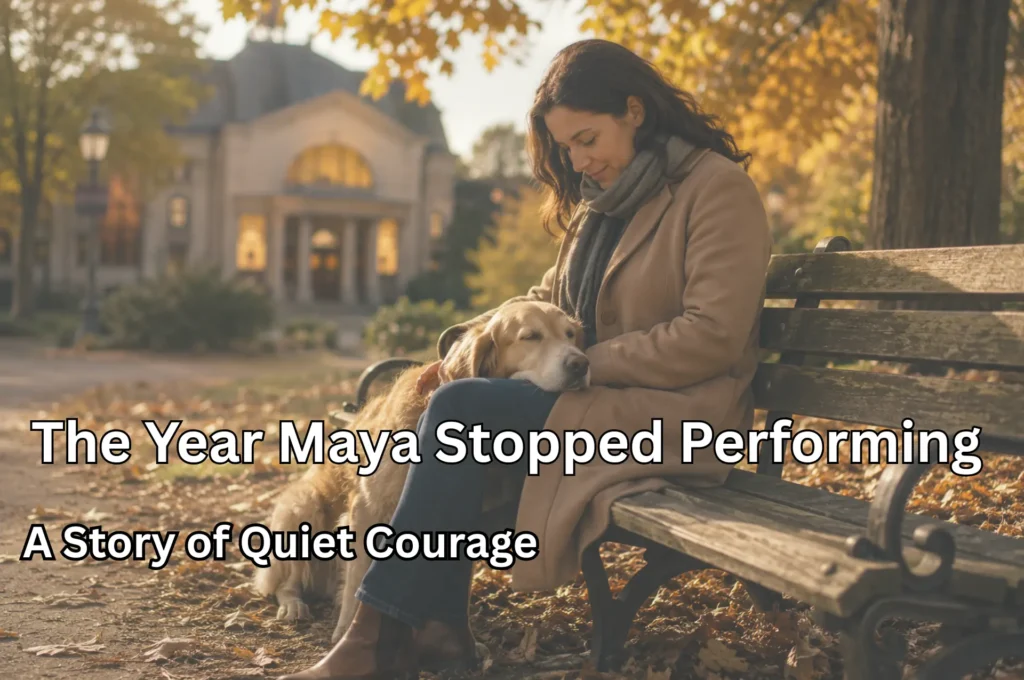
The Year Maya Stopped Performing: A Story of Quiet Courage
The Ordinary World: A Life Built on Applause
Maya had done everything right.
That was the problem. She had done everything right the way a machine does things right. Perfectly, precisely, without asking why.
At Juilliard, she was the student who never missed a warm-up. Her teachers called her “a formidable technician.” Nobody called her surprising. She graduated with honors and spent the next ten years in the middle. Not unemployed — she worked constantly. Regional Shakespeare, off-off-Broadway, a national tour of a musical she couldn’t stand. Enough to pay rent. Not enough to feel real.
The problem wasn’t the rejections. Actors get told “no” five hundred times for every “yes.” The problem was that the “yeses” stopped meaning anything.
By year eight, she got a lead role in a new play and felt… nothing. Just logistics. She started dreading curtain call. Not because she was tired. Because she had to smile at people who believed she was feeling something, and she felt like a fraud.
The Breaking Point: When the Dream Goes Silent
Then came the audition that cracked her open.
It was for a small independent film — a mother grieving a stillbirth. Maya prepared for three weeks. She gave what she thought was the best audition of her life.
They cast a model with thirty-seven Instagram followers who had never acted before.
Maya sat in her car in the parking lot for an hour. She didn’t cry. She didn’t scream. She just sat there, hands on the steering wheel, staring at a crack in the windshield. And she thought: I don’t know why I’m doing this anymore.
That night, she went home and deleted her actor website. Not dramatically. Just quietly. Click. Click. Gone.
She started telling people she did “administrative support” instead of acting. Her mother called every Sunday. “Any auditions?” “No.” “Did you call your agent?” “He dropped me.” Silence. Then: “You’re too talented to waste.” Maya said nothing.
The low point came on a Tuesday in November. She was lying on her living room floor — not doing yoga, not stretching, just lying there — with the heat off because she forgot to pay the bill. Her phone buzzed. A former classmate posted photos from the opening night of her Broadway debut. Maya zoomed in on the woman’s face. She looked happy. Genuinely happy.
And Maya realized: she didn’t want that anymore. That was the terrifying part. It wasn’t jealousy. It wasn’t even sadness. She looked at her classmate’s Broadway smile and felt absolutely nothing. The dream had gone quiet inside her. Not defeated — just gone.
That was letting go of dreams – not a dramatic surrender, but a quiet, terrifying release.
The Dark Middle: Loss, Confusion, and a Living Room Floor
She got up off the floor because she had to walk a dog. A golden retriever named Biscuit who belonged to a retired librarian named Helen. Maya showed up at Helen’s apartment, leashed Biscuit, and walked the same route they always walked: two blocks to the park, one loop around the pond, back.
But that night, a man was sitting on a bench feeding ducks. He had a kind, tired face and a stack of papers next to him. Maya sat down on the next bench over because Biscuit wanted to stare at the ducks. The man glanced at her and said, “Do you write?”
“No,” Maya said.
“You look like you’re thinking very hard,” he said. “People who think hard usually write or pray. And you don’t look like you’re praying.”
She almost laughed. “I used to act.”
“What stopped you?”
She expected to give a polite, shallow answer. Instead, what came out was: “I stopped believing that pretending to feel things was the same as feeling them.”
The man nodded slowly. He tapped his stack of papers. “I’m a high school English teacher. I’ve watched teenagers perform understanding of The Great Gatsby for eighteen years. The ones who actually understand it are always the ones who stop trying to impress me. The performers get B-pluses. The real ones get messy essays that take me an hour to grade.”
He stood up, gathered his papers, and said: “Maybe you stopped performing just in time to start actually living.”
Then he walked away. Maya never saw him again.
She sat on that bench for another twenty minutes, Biscuit’s head in her lap, and let herself cry for the first time in years. Not because she was sad. Because something had been released. The pressure to be an actor — to prove she was special, to justify every hour of training, to make her mother proud — had been squeezing her chest for so long that she’d forgotten what it felt like to breathe without it.
The Small Turning Point: Paying Attention Instead of Performing
She didn’t have a sudden revelation about a new career. She just went to bed, woke up, walked Biscuit again, and started noticing things. The way light fell on Helen’s bookshelves. The rhythm of the lawyer’s typing through the thin office walls. The sound of her own voice when she said “good morning” to a stranger.
She started keeping a notebook. Not a journal — she’d tried those and they always felt like homework. Just a cheap spiral where she wrote down things she saw. Dried leaves stuck to a wet sidewalk like confession notes. The bus driver who hums off-key but only at red lights. My own hands look like my father’s when I hold a coffee cup.
She didn’t show anyone. She didn’t think of it as writing. She thought of it as paying attention.
Six months later, Helen — the retired librarian — asked Maya if she’d be interested in leading a small weekly workshop at the library. “Just reading stories to kids,” Helen said. “You don’t have to act. Just read.”
Maya almost said no. The word “perform” still made her stomach tighten. But Helen had a gentle way of asking that felt like an offer, not a demand.
The Climb: Finding Purpose After Failure
She showed up. Seven kids, ages four to nine, sitting on a stained carpet. Maya opened a picture book about a shy octopus. She read slowly. She didn’t do voices. She didn’t exaggerate. She just… read.
A little girl in a purple coat leaned forward and whispered, “The octopus is me.”
Maya looked at the girl. The girl wasn’t performing. She wasn’t trying to be cute. She was telling the truth.
And Maya thought: This is what I wanted all along. Not applause. Not reviews. Just someone believing that a story was really for them.
Maya looked at the girl and understood something she’d been missing for years: finding purpose after failure didn’t mean winning bigger. It meant showing up smaller and truer.
She kept doing the workshop. Then she started one for adults — people who wanted to read aloud but were terrified. A man who’d had a stroke and was relearning language. A teenager who stuttered. A grandmother who wanted to read to her grandson without crying every time.
Maya never called herself a teacher. She called herself a “reading companion.” The title was awkward, homemade, and completely hers.
Two years later, the library asked her to design a program for the whole county. She got paid. Not much — but money wasn’t the point anymore. The point was that she woke up in the morning and wanted to do the thing in front of her.
The Resolution: Overcoming Identity Crisis and Living an Authentic Life
She still walks Biscuit sometimes, even though Helen passed away last spring. The golden retriever lives with Maya now. They take the same route to the same park. The man with the duck-feeding habit never reappeared.
But Maya kept one thing from that bench conversation. She stopped performing. And in the silence after the performance ended, she found a version of herself she actually recognized.
She never became famous. But she did something harder: she stopped asking the world to validate her existence. That’s what overcoming identity crisis actually looks like — not a triumphant return, but a peaceful departure from the person you never really were.
Maya’s journey didn’t end with a TED Talk or a book deal. She has a small apartment, a golden retriever, a library program, and a spiral notebook full of sentences no one else will ever read.
And she is, for the first time, living an authentic life.
How This Story Inspires
A story of quiet courage doesn’t tell you to “never give up on your dreams.” Some dreams need to be released — not because you failed, but because you outgrew them. Maya’s inspiration isn’t in her perseverance as an actor. It’s in her courage to stop performing, listen to her own emptiness, and build something true from the quiet.
What makes this story inspirational:
- It honors the pain of losing an identity, not just the triumph of finding a new one.
- The turning point is small and realistic — a stranger’s comment, a library workshop.
- Success is redefined as aliveness, not achievement.
Questions for your readers:
- What “performance” are you still doing that exhausts you?
- If you stopped trying to impress anyone tomorrow, what would you actually want to spend your time doing?
- Where in your life have you confused pretending with feeling?
Takeaway: You don’t have to burn down your old dream. You can just walk away from it quietly and see what grows in the space it leaves behind. That’s not failure. That’s a story of quiet courage.
Read More Inspirational Stories and Inspirational Poems on ThePoemStory

Get the ThePoemStory App — Read Poems Anywhere