Robert Frost stands as one of the colossal figures of 20th-century American poetry. Known for his accessible yet profoundly layered verses, Frost often employed the rural landscapes of New England as a canvas for exploring the deepest crevices of the human psyche. While his later works, such as “The Road Not Taken” and “Stopping by Woods on a Snowy Evening,” cemented his place in the public consciousness, it is in his early collections that we find the raw, unpolished seeds of his genius.
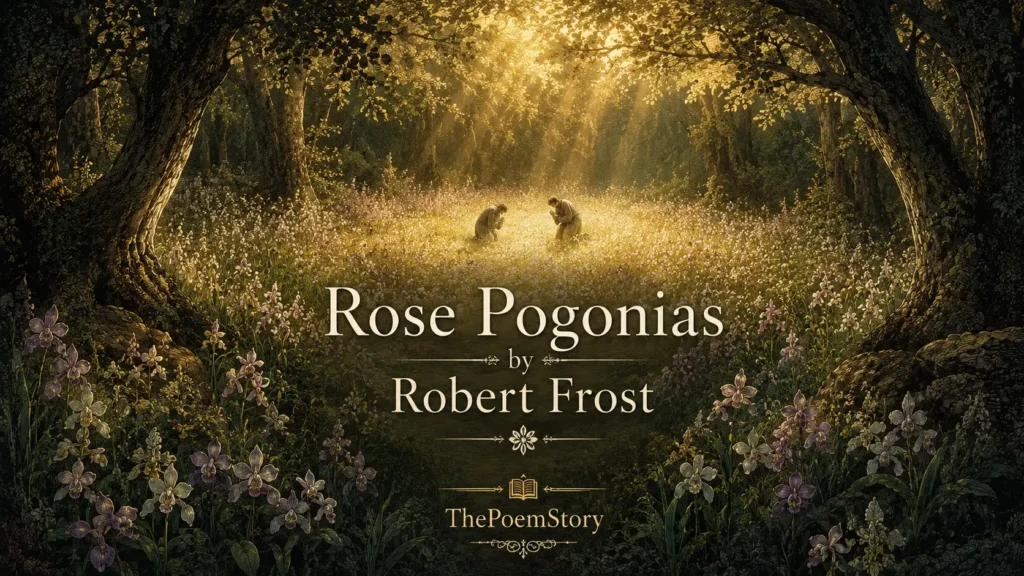
This Rose Pogonias by Robert Frost analysis examines one of the most exquisitely beautiful and spiritually resonant poems from his debut collection, A Boy’s Will (1913). “Rose Pogonias” is a lyric meditation on a hidden meadow filled with orchises (wild orchids)—a place of such intense beauty that it becomes a “temple of the heat.” The poem captures a moment of reverence, a simple prayer offered to preserve this sacred space from the “general mowing” of the world.
The poem presents a speaker who, along with a companion, discovers a saturated, sun-filled meadow where countless orchises bloom. The experience is almost religious—they bow “in the burning, / As the sun’s right worship is.” Before leaving, they offer a prayer: that this place might be forgotten by the mowers, or at least granted enough time to let the flowers fade naturally. The poem is a meditation on beauty, preservation, and the desire to protect what is fragile and sacred from the relentless march of utility.
In this comprehensive guide, we will dissect “Rose Pogonias” with careful attention to its structure, language, and spiritual resonance. We will provide a detailed Rose Pogonias poem summary, explore the profound themes in Rose Pogonias by Robert Frost, examine its masterful literary devices in Rose Pogonias, and ultimately reflect on the Rose Pogonias meaning and what it reveals about the human longing for sanctuary and the protection of beauty in a world that often overlooks it.
Read and explore ThePoemStory and go through Collected Poems of Robert Frost.
for more poems explore Poetry Section
Table of Contents
The Poem – Rose Pogonias by Robert Frost
A saturated meadow,
~ Rose Pogonias by Robert Frost – Analysis and Summary
Sun-shaped and jewel-small,
A circle scarcely wider
Than the trees around were tall;
Where winds were quite excluded,
And the air was stifling sweet
With the breath of many flowers,—
A temple of the heat.
There we bowed us in the burning,
As the sun’s right worship is,
To pick where none could miss them
A thousand orchises;
For though the grass was scattered,
Yet every second spear
Seemed tipped with wings of color,
That tinged the atmosphere.
We raised a simple prayer
Before we left the spot,
That in the general mowing
That place might be forgot;
Or if not all so favoured,
Obtain such grace of hours,
That none should mow the grass there
While so confused with flowers.
Rose Pogonias Poem Summary
Before delving into the thematic and literary depths, it is essential to establish a clear Rose Pogonias poem summary to ensure every reader grasps the narrative and spiritual arc of this beautiful lyric. The poem is structured in three stanzas, each building upon the other to create a complete meditation on beauty, reverence, and the desire for preservation.
Stanza 1: The Sacred Meadow
The poem opens with a description of a “saturated meadow”—a place so full of moisture and life that it seems almost to glow. The meadow is “Sun-shaped and jewel-small,” suggesting a circular clearing that has been shaped by the sun itself, a precious gem of a place. It is “a circle scarcely wider / Than the trees around were tall.” The meadow is a natural amphitheater, enclosed by trees, protected from the outside world.
The winds are “quite excluded”—this is a place of stillness and calm. The air is “stifling sweet” with the breath of many flowers. The intensity of the sweetness is almost overwhelming. This place is “a temple of the heat.” The meadow is not just a natural space; it is a sacred space, a temple where the sun is worshipped. The heat is not oppressive; it is sacred.
Stanza 2: The Harvest of Flowers
In the second stanza, the speaker and his companion enter this sacred space: “There we bowed us in the burning, / As the sun’s right worship is.” Their action—bowing in the heat—is described as worship. They are not simply picking flowers; they are participating in a ritual. They pick “where none could miss them / A thousand orchises.” The orchises (wild orchids) are so plentiful that they could not miss them—every step reveals more.
The grass is scattered, but “every second spear / Seemed tipped with wings of color.” The grass is transformed into something almost magical—each blade seems to have a “wing of color” that “tinged the atmosphere.” The beauty is so intense that it colors the very air. The orchises are not just flowers; they are like jewels, like wings, like fragments of light.
Stanza 3: The Prayer for Preservation
The third stanza shifts from description to prayer: “We raised a simple prayer / Before we left the spot.” The speaker and his companion offer a prayer before they leave. The prayer is simple but profound: “That in the general mowing / That place might be forgot.” They pray that the meadow will be overlooked by the mowers, that it will be spared from the “general mowing” that clears the fields.
If the meadow cannot be completely forgotten, they pray that it might “obtain such grace of hours, / That none should mow the grass there / While so confused with flowers.” The prayer is for time—enough time for the flowers to complete their cycle, to fade naturally, to finish their season. The word “confused” suggests a beautiful chaos, a profusion of life that is too rich, too complex, too sacred to be cut down.
This completes our Rose Pogonias poem summary, revealing a poem about the sacredness of natural beauty and the human desire to protect what is fragile and precious.
Major Themes in Rose Pogonias by Robert Frost
Now that we have a clear understanding of the narrative, let us examine the profound themes in Rose Pogonias by Robert Frost. This seemingly simple poem contains layers of spiritual and philosophical insight.
1. The Sacredness of Nature
The central theme of the poem is the sacredness of nature. The meadow is described as a “temple of the heat.” The speaker and his companion bow “as the sun’s right worship is.” The experience of picking flowers is described as a religious ritual. Nature is not just beautiful; it is holy. The poem invites us to approach the natural world with reverence.
2. The Desire for Preservation
The poem expresses a deep desire to protect the meadow from destruction. The speaker prays that the place might be forgotten by the mowers, or at least granted enough time to let the flowers fade naturally. This is a plea for preservation, for the protection of beauty from the forces of utility and progress. The poem speaks to the human longing to protect what is fragile and sacred.
3. The Conflict Between Beauty and Utility
The “general mowing” represents the forces of utility—the clearing of land for agriculture, the cutting of grass for hay, the imposition of human order on the natural world. The meadow represents beauty, chaos, and the sacred. The poem explores the conflict between these two forces. The speaker hopes that beauty will be spared, even for a little while.
4. The Transience of Beauty
The flowers are beautiful, but they are also fragile. They will fade, they will wither, they will be cut. The poem acknowledges the transience of beauty. The speaker does not pray that the flowers will last forever; he prays that they will be given “such grace of hours”—enough time to complete their natural cycle.
5. The Power of Observation
The speaker sees the meadow with intense attention. He notices that the meadow is “Sun-shaped and jewel-small.” He notices that “every second spear / Seemed tipped with wings of color.” This attention is a form of love. The poem suggests that seeing something truly, paying attention to its beauty, is a way of honoring it.
6. Reverence and Humility
The speaker and his companion bow “in the burning.” They offer a “simple prayer.” Their actions are characterized by reverence and humility. They do not claim ownership of the meadow; they acknowledge its sacredness. They ask, rather than demand, that it be preserved. The poem models a humble approach to the natural world.
7. The Grace of Hours
The poem asks for “grace of hours”—a gift of time. This is a beautiful and unusual request. The speaker does not ask for wealth, power, or fame. He asks for time—enough time to let the flowers finish their season. The theme suggests that time itself is a kind of grace, a gift that we should treasure.
Literary Devices in Rose Pogonias
To fully appreciate the craftsmanship of this poem, we must examine the rich array of literary devices in Rose Pogonias. Frost employs these techniques with his characteristic subtlety and precision, creating a poem that is both exquisitely beautiful and spiritually profound.
1. Imagery
Frost’s imagery in this poem is vivid and luminous:
- Visual: “saturated meadow,” “Sun-shaped and jewel-small,” “circle,” “trees around were tall,” “a thousand orchises,” “every second spear,” “wings of color,” “tinged the atmosphere.”
- Olfactory: “stifling sweet,” “breath of many flowers.”
- Thermal: “saturated,” “burning,” “heat,” “temple of the heat.”
The imagery consistently emphasizes light, warmth, and intense beauty. The meadow glows, the air is sweet, and the flowers are like jewels.
2. Metaphor
The poem contains a powerful metaphor: the meadow is a “temple of the heat.” This metaphor transforms the natural space into a sacred space, suggesting that the experience of nature is a religious experience. The metaphor elevates the meadow from a simple field to a place of worship.
3. Simile
The poem contains a striking simile: the meadow is “Sun-shaped and jewel-small.” The meadow is compared to a sun (round, radiant) and a jewel (precious, small, valuable). This simile emphasizes the meadow’s perfection and preciousness.
4. Symbolism
Several symbols enrich the poem’s meaning:
- The Meadow: Represents natural beauty, the sacred, and the fragile places that need protection.
- The Orchises: Represent individual moments of beauty, rare and precious gifts of nature.
- The Sun: Represents the divine, the source of life, and the object of worship.
- The Mowing: Represents human utility, the forces that destroy beauty in the name of progress.
- The Prayer: Represents the human desire to protect and preserve what is sacred.
- Grace of Hours: Represents the gift of time, the opportunity for things to complete their natural cycle.
5. Tone
The tone of the poem is reverent, humble, and quietly joyful. The speaker approaches the meadow with awe and gratitude. The tone reflects a deep appreciation for the beauty of the natural world and a humble acknowledgment of its sacredness.
6. Rhyme and Meter
The poem follows a varied rhyme scheme, with a pattern of alternating rhymes (ABCB) that gives it a gentle, flowing quality. The meter is predominantly iambic, with variations that reflect the speaker’s contemplative mood. The rhythm creates a sense of calm and meditation, fitting the poem’s spiritual themes.
7. Enjambment
Frost uses enjambment to create a sense of flow and continuity. The lines run into each other, mimicking the dense, saturated quality of the meadow. The poem does not pause; it flows, just as the meadow is full of life and beauty.
8. Allusion
The title “Rose Pogonias” alludes to a specific genus of orchids (Pogonia). This botanical precision grounds the poem in the natural world. The orchises are not generic flowers; they are specific, identifiable species. This attention to detail reflects Frost’s love of the natural world and his belief in the importance of seeing clearly.
The Deeper Meaning of Rose Pogonias
Beyond its surface-level description, the Rose Pogonias meaning reveals a profound meditation on the sacredness of nature, the desire for preservation, and the human longing for sanctuary. This is where the poem transcends its historical context and speaks directly to the human condition.
The Rose Pogonias meaning centers on the recognition that there are places in the world that are sacred, that deserve protection, that should not be sacrificed to the forces of utility. The meadow is a “temple of the heat”—a place of worship. The speaker’s prayer is a plea for the preservation of this sacred space.
The poem also speaks to the human desire for sanctuary. In a world of constant change, of mowing and development, we long for places that remain untouched, that retain their beauty and their wildness. The meadow represents the possibility of sanctuary—a place where we can bow in worship, where we can experience the sacred.
The Rose Pogonias meaning also addresses the transience of beauty. The flowers will fade. The meadow will eventually be mowed. The prayer is not for eternal preservation but for “grace of hours”—enough time to let the flowers complete their cycle. This is a wisdom about the nature of beauty: it is fleeting, and we must appreciate it while it lasts.
Ultimately, the Rose Pogonias meaning is that beauty is sacred and deserves protection. The poem is a call to pay attention, to see the beauty of the natural world, and to protect it from the forces that would destroy it. It is a prayer for grace, for time, for the preservation of what is precious.
Reflection on Human Life
“Rose Pogonias” offers a timeless mirror to the human condition, and its relevance only grows in our modern world of environmental destruction, urbanization, and the loss of wild places.
The Sacredness of Nature
The poem invites us to see nature as sacred. The meadow is not just a field; it is a temple. This is a powerful reframing of our relationship with the natural world. In a culture that often treats nature as a resource to be exploited, the poem invites us to approach it with reverence.
The Need for Preservation
The poem is a plea for preservation. The speaker prays that the meadow will be spared from the “general mowing.” This is a call to protect wild places, to resist the forces of development and utility. In a world of accelerating environmental destruction, the poem’s message is more urgent than ever.
The Power of Prayer
The speaker offers a “simple prayer.” This is a reminder that we can ask for what we need, that we can speak our desires to the universe. The prayer is not for wealth or power but for the preservation of beauty. The poem suggests that prayer is a powerful act, a way of aligning our will with the sacred.
The Grace of Time
The poem asks for “grace of hours.” Time is a gift. We do not always appreciate the time we have, the moments of beauty that are available to us. The poem invites us to treasure time, to see it as a grace, to use it wisely.
The Beauty of Wildness
The meadow is wild, uncontrolled, “confused with flowers.” This wildness is its beauty. The poem celebrates the chaos of nature, the profusion of life that cannot be contained. In a world that values order and control, the poem reminds us of the beauty of wildness.
The Importance of Witness
The speaker sees the meadow. He pays attention. He notices that “every second spear / Seemed tipped with wings of color.” This attention is a form of love. The poem suggests that witnessing beauty is a sacred act. To see something truly is to honor it.
Conclusion
“Rose Pogonias” is an exquisite masterpiece of early Frost—a poem that rewards careful reading and deep reflection. It is a meditation on the sacredness of nature, the desire for preservation, and the human longing for sanctuary. Through its luminous imagery, its reverent tone, and its simple prayer, the poem invites us to see the natural world with new eyes.
Through our Rose Pogonias by Robert Frost analysis, we have explored the poem’s structure, its Rose Pogonias poem summary, the profound themes in Rose Pogonias by Robert Frost, the masterful literary devices in Rose Pogonias, and the enduring Rose Pogonias meaning.
“Rose Pogonias” is a call to pay attention, to see the beauty of the natural world, and to protect what is fragile and sacred. It is a reminder that there are places that deserve to be spared from the “general mowing,” places that should be allowed to complete their season, places that are temples of the heat.
If you have ever found a hidden meadow, a secret garden, a place of such intense beauty that it felt sacred, then you have stood where Frost stood. And like him, you have offered a prayer—for grace, for time, for the preservation of beauty.
Enjoyed this deep dive into Frost’s poetry? If you want to explore more of his work, consider adding a complete collection to your library. There is no better companion for a summer day than the timeless verses of Robert Frost.
Did this analysis illuminate a new perspective on “Rose Pogonias” for you? Drop a comment below and let me know your thoughts. If you found this valuable, please share it with a fellow poetry enthusiast!
Read and explore ThePoemStory and go through Collected Poems of Robert Frost.
for more poems explore Poetry Section

Get the ThePoemStory App — Read Poems Anywhere