Robert Frost stands as one of the colossal figures of 20th-century American poetry. Known for his accessible yet profoundly layered verses, Frost often employed the rural landscapes of New England as a canvas for exploring the deepest crevices of the human psyche. While his later works, such as “The Road Not Taken” and “Stopping by Woods on a Snowy Evening,” cemented his place in the public consciousness, it is in his early collections that we find the raw, unpolished seeds of his genius.
This Flower-Gathering by Robert Frost analysis examines one of the most tender and emotionally resonant poems from his debut collection, A Boy’s Will (1913). “Flower-Gathering” is a delicate lyric that explores the complexities of parting, memory, and the quiet anxiety of whether absence has changed a relationship. The poem captures a moment of separation and return, framed by the simple gesture of gathering flowers.
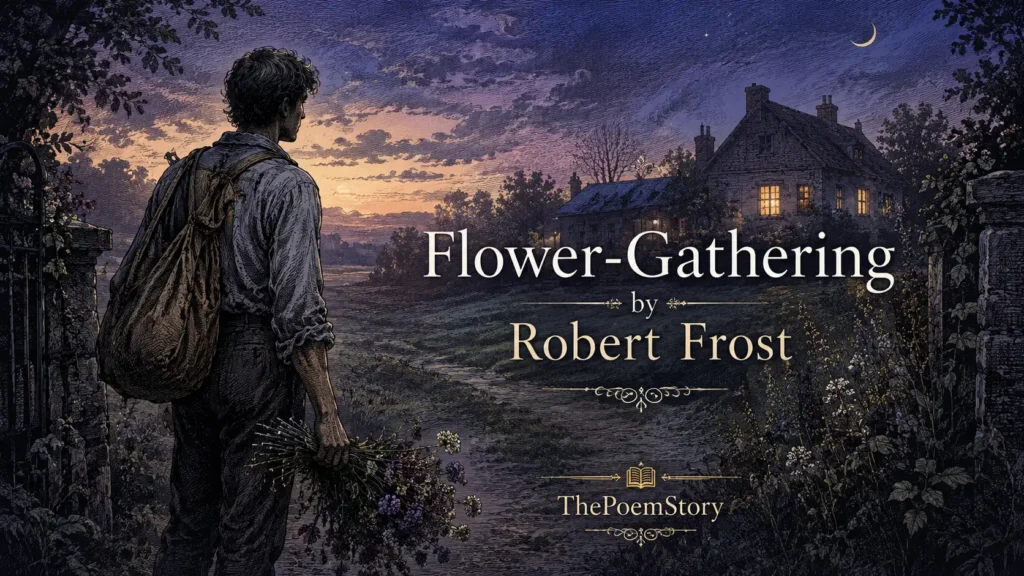
The poem presents a speaker who has left his beloved in the morning, walked through the fields gathering flowers, and returns in the evening—”gaunt and dusty grey with roaming.” He questions whether his beloved recognizes him, whether she is silent because she does not know him or because she knows him too well. The flowers he has gathered become a symbol of his journey, his absence, and his love. The poem is a meditation on the nature of love, the meaning of gifts, and the strange distance that even a single day of absence can create.
In this comprehensive guide, we will dissect “Flower-Gathering” with careful attention to its structure, language, and emotional resonance. We will provide a detailed Flower-Gathering poem summary, explore the profound themes in Flower-Gathering by Robert Frost, examine its masterful&strong>literary devices in Flower-Gathering, and ultimately reflect on the Flower-Gathering meaning and what it reveals about the human experience of love, absence, and the gifts we offer to those we cherish.
Read and explore ThePoemStory and go through Collected Poems of Robert Frost.
for more poems explore Poetry Section
Flower-Gathering by Robert Frost Analysis
The Poem – Flower-Gathering by Robert Frost
I left you in the morning,
~ Flower-Gathering by Robert Frost – Analysis and Summary
And in the morning glow,
You walked a way beside me
To make me sad to go.
Do you know me in the gloaming,
Gaunt and dusty grey with roaming?
Are you dumb because you know me not,
Or dumb because you know?
All for me? And not a question
For the faded flowers gay
That could take me from beside you
For the ages of a day?
They are yours, and be the measure
Of their worth for you to treasure,
The measure of the little while
That I’ve been long away.
Flower-Gathering Poem Summary
Before delving into the thematic and literary depths, it is essential to establish a clear Flower-Gathering poem summary to ensure every reader grasps the narrative and emotional arc of this tender lyric. The poem is structured in four stanzas of varying lengths, creating a sense of intimacy and emotional vulnerability that mirrors the speaker’s anxious questioning.
Stanza 1: The Parting
The poem opens with the speaker recalling the morning departure: “I left you in the morning, / And in the morning glow.” The “morning glow” suggests warmth, light, and the promise of a new day. The beloved “walked a way beside me / To make me sad to go.” The beloved accompanies the speaker for a short distance, not to make the parting easier but to make it harder—”To make me sad to go.” This is a paradox: the beloved’s presence makes the departure more painful, not less. The gesture is both loving and bittersweet.
Stanza 2: The Return and the Question
The second stanza shifts to the present: the speaker has returned in the “gloaming”—the evening twilight. He is “gaunt and dusty grey with roaming.” The journey has been long and tiring. He has changed—he is tired, dusty, perhaps aged by the experience.
The speaker asks two parallel questions: “Do you know me in the gloaming?” and “Are you dumb because you know me not, / Or dumb because you know?” The beloved is silent. The speaker does not know whether the silence means that the beloved does not recognize him or that she knows him too well—so well that words are unnecessary. The uncertainty is painful. The speaker is anxious about the distance that even a single day of absence has created.
Stanza 3: The Flowers
The third stanza introduces the flowers: “All for me? And not a question / For the faded flowers gay.” The speaker has gathered flowers during his journey. They are “faded” now—they have wilted during the long day. They are “gay” (bright, cheerful) but faded. The beloved does not ask about the flowers. She does not seem to care about them.
The speaker reflects that the flowers “could take me from beside you / For the ages of a day.” The flowers drew him away, made him wander, caused him to be absent. Yet the beloved does not ask about them. She is silent. The speaker wonders if the flowers matter at all.
Stanza 4: The Gift and Its Measure
The final stanza delivers the poem’s quiet, tender conclusion: “They are yours, and be the measure / Of their worth for you to treasure, / The measure of the little while / That I’ve been long away.” The flowers belong to the beloved. Their worth is not in their beauty but in what they measure: the time the speaker has been away. The flowers are a gift, but their true value is as a symbol of absence and love. The “little while” has felt “long” to the speaker. The flowers are a tangible reminder of that longing.
This completes our Flower-Gathering poem summary, revealing a poem about love, absence, and the gifts that measure the distance between two hearts.
Major Themes in Flower-Gathering by Robert Frost
Now that we have a clear understanding of the narrative, let us examine the profound themes in Flower-Gathering by Robert Frost. This seemingly simple poem contains layers of psychological and emotional insight.
1. The Anxiety of Absence
The central theme of the poem is the anxiety that absence creates in a relationship. The speaker has been away for only a day, but he worries that his beloved may not recognize him, that she may be silent because she does not know him or because she knows him too well. Absence creates uncertainty. The poem captures the fear that distance—even brief distance—can change a relationship.
2. The Meaning of Gifts
The speaker brings flowers as a gift. But the flowers are faded, and the beloved does not ask about them. The speaker reflects that their true value is not in their beauty but in what they measure: the time of absence. The poem suggests that gifts are not valuable for their material worth but for their symbolic meaning—the love, the thought, the absence they represent.
3. The Silence of the Beloved
The beloved is silent. The speaker does not know whether the silence means recognition or distance. This theme explores the ambiguity of silence in relationships. Sometimes silence is a sign of intimacy—a wordless understanding. Sometimes it is a sign of estrangement—a failure to connect. The poem captures the uncertainty of reading the other’s silence.
4. The Paradox of Parting
The beloved walks with the speaker “To make me sad to go.” This is a paradox: the beloved’s presence makes the parting more painful. The theme explores the strange dynamics of love, where the intensity of connection makes separation more difficult. The beloved’s gesture is loving but also painful.
5. The Nature of Time
The poem explores the subjective experience of time. The speaker describes the “little while” of his absence as having been “long.” Time is measured not by clocks but by emotion. A short absence can feel endless when we are separated from those we love.
6. The Symbolism of Flowers
The flowers are a powerful symbol. They are “faded” and “gay”—wilted but still bright. They represent the beauty of the journey, the effort of love, and the passage of time. They are given as a gift, but their true value is as a measure of absence. The flowers symbolize both love and loss.
7. The Vulnerability of Love
The speaker is vulnerable. He asks anxious questions. He worries about being recognized. He reflects on the meaning of his gift. Love makes us vulnerable—to rejection, to misunderstanding, to distance. The poem captures this vulnerability with tenderness and honesty.
Literary Devices in Flower-Gathering
To fully appreciate the craftsmanship of this poem, we must examine the rich array of literary devices in Flower-Gathering. Frost employs these techniques with his characteristic subtlety and precision, creating a poem that is both tender and psychologically complex.
1. Imagery
Frost’s imagery in this poem is delicate and evocative:
- Visual: “morning glow,” “gloaming,” “gaunt and dusty grey,” “faded flowers gay.”
- Tactile: “dusty,” “roaming.”
- Kinetic: “walked a way,” “roaming.”
The imagery consistently emphasizes the passage of time—from morning to gloaming, from fresh flowers to faded ones.
2. Symbolism
Several symbols enrich the poem’s meaning:
- The Flowers: Represent love, effort, and the measure of absence.
- The Morning Glow: Represents hope, new beginnings, and the warmth of love.
- The Gloaming: Represents twilight, uncertainty, and the end of a journey.
- The Dust: Represents the weariness of travel and the passage of time.
- Silence: Represents the ambiguity of love—either intimacy or estrangement.
3. Rhetorical Questions
The poem is built on rhetorical questions: “Do you know me in the gloaming?” and “Are you dumb because you know me not, / Or dumb because you know?” and “All for me? And not a question / For the faded flowers gay?” These questions express the speaker’s anxiety and vulnerability. They are not asked to be answered but to express emotion.
4. Paradox
The poem contains a paradox in the first stanza: the beloved walks with the speaker “To make me sad to go.” The beloved’s presence makes the parting harder. This paradox captures the bittersweet nature of love.
5. Tone
The tone of the poem is tender, vulnerable, and slightly anxious. The speaker is not confident; he is questioning. The tone reflects the uncertainty that absence creates in love.
6. Rhyme and Meter
The poem follows a varied rhyme scheme: ABAB in the first stanza, AABB in the second, and a more irregular pattern in the final stanzas. The meter is predominantly iambic, with variations that reflect the speaker’s emotional state. The irregular rhythm creates a sense of vulnerability and hesitation.
7. Enjambment
Frost uses enjambment to create a sense of flow and continuity. The lines run into each other, reflecting the speaker’s anxious, questioning state of mind. The poem does not pause; it pushes forward, just as the speaker pushes forward in his questioning.
8. Understatement
The final stanza uses understatement: “the measure of the little while / That I’ve been long away.” The “little while” has felt “long.” This understatement captures the paradoxical experience of time in love—a short absence can feel endless.
The Deeper Meaning of Flower-Gathering
Beyond its surface-level narrative, the Flower-Gathering meaning reveals a profound meditation on the nature of love, absence, and the gifts we offer to those we cherish. This is where the poem transcends its historical context and speaks directly to the human condition.
The Flower-Gathering meaning centers on the recognition that absence creates uncertainty in love. The speaker has been away for only a day, but he worries that he has changed, that his beloved may not recognize him, that the silence between them may be a sign of estrangement. This anxiety is universal: we all fear that distance—even brief distance—can change a relationship.
The poem also explores the meaning of gifts. The flowers are faded, and the beloved does not ask about them. The speaker reflects that their true value is not in their beauty but in what they measure: the time of absence. Gifts are not valuable for their material worth but for their symbolic meaning. The flowers represent love, effort, and the longing that absence creates.
The Flower-Gathering meaning also speaks to the ambiguity of silence in relationships. The beloved is silent. Is her silence a sign of intimacy or estrangement? The speaker does not know. This uncertainty captures the difficulty of reading the other’s heart. Love requires trust, and trust requires vulnerability.
Ultimately, the Flower-Gathering meaning is that love is fragile. It can be wounded by absence, by silence, by uncertainty. But love is also resilient. The speaker brings flowers. He asks questions. He offers his gift. The poem is a testament to the endurance of love, even in the face of uncertainty.
Reflection on Human Life
“Flower-Gathering” offers a timeless mirror to the human condition, and its relevance only grows in our modern world of long-distance relationships, busy lives, and the constant threat of disconnection.
The Fear of Absence
We all fear that absence will change our relationships. We worry that our partners, friends, or family members will not recognize us when we return, that the silence between us will be a sign of estrangement. The poem captures this fear with honesty and tenderness. It invites us to acknowledge our vulnerability and to trust in the resilience of love.
The Meaning of Gifts
In a consumer culture, gifts are often valued for their material worth. The poem reminds us that gifts are valuable for their symbolic meaning—the love, the thought, the absence they represent. A simple, faded flower can carry more meaning than an expensive present. The poem invites us to value the intention behind the gift, not its price tag.
The Ambiguity of Silence
Silence is ambiguous. It can be a sign of intimacy or estrangement. The poem captures this ambiguity with honesty. Sometimes the people we love are silent because they understand us so well that words are unnecessary. Sometimes they are silent because they have drifted away. The poem invites us to sit with this ambiguity, to ask questions, and to seek understanding.
The Paradox of Love
Love is full of paradoxes. The beloved walks with the speaker “To make me sad to go.” Love makes parting harder, not easier. The poem captures this paradox with tenderness. Love is bittersweet. It brings joy and pain in equal measure. The poem invites us to accept this paradox and to love anyway.
The Endurance of Love
Despite the anxiety, the uncertainty, and the silence, the speaker returns. He brings flowers. He asks questions. He offers his gift. Love endures. The poem is a testament to the resilience of love—its ability to survive absence, uncertainty, and silence. The poem invites us to believe in the endurance of love, even when it feels fragile.
The Gift of Presence
The speaker’s presence is the greatest gift. He has returned. He is “gaunt and dusty grey with roaming,” but he is there. The poem reminds us that presence is the most precious gift we can offer. The flowers are a symbol, but the real gift is the return, the willingness to come back, the commitment to love.
Conclusion
“Flower-Gathering” is a tender and emotionally resonant poem—a quiet masterpiece of early Frost that explores the complexities of love, absence, and the meaning of gifts. Through its delicate imagery, its anxious questioning, and its quiet conclusion, the poem invites us to reflect on our own relationships and the ways we measure love.
Through our Flower-Gathering by Robert Frost analysis, we have explored the poem’s structure, its Flower-Gathering poem summary, the profound themes in Flower-Gathering by Robert Frost, the masterful literary devices in Flower-Gathering, and the enduring Flower-Gathering meaning.
“Flower-Gathering” is a reminder that love is fragile but resilient. Absence creates uncertainty, but presence heals. Gifts are valuable not for their material worth but for their symbolic meaning. Silence is ambiguous, but questions can bridge the gap. The poem invites us to love with vulnerability, to give with intention, and to trust in the endurance of love.
If you have ever returned from a journey and wondered if you were still recognized, if you have ever given a gift and wondered if it mattered, if you have ever sat in silence with someone you love and wondered what it meant—then you have walked with Frost. And like him, you have discovered that love is measured not by the absence but by the return.
Enjoyed this deep dive into Frost’s poetry? If you want to explore more of his work, consider adding a complete collection to your library. There is no better companion for a quiet evening than the timeless verses of Robert Frost.
Did this analysis illuminate a new perspective on “Flower-Gathering” for you? Drop a comment below and let me know your thoughts. If you found this valuable, please share it with a fellow poetry enthusiast!
Read and explore ThePoemStory and go through Collected Poems of Robert Frost.
for more poems explore Poetry Section

Get the ThePoemStory App — Read Poems Anywhere