Rifleman Gabar Singh Negi was posthumously awarded the Victoria Cross for leading a bayonet charge that forced the surrender of a German trench. Read his true 2000‑word story of WW1 valor with primary sources.
Read more Stories in our Stories Section.
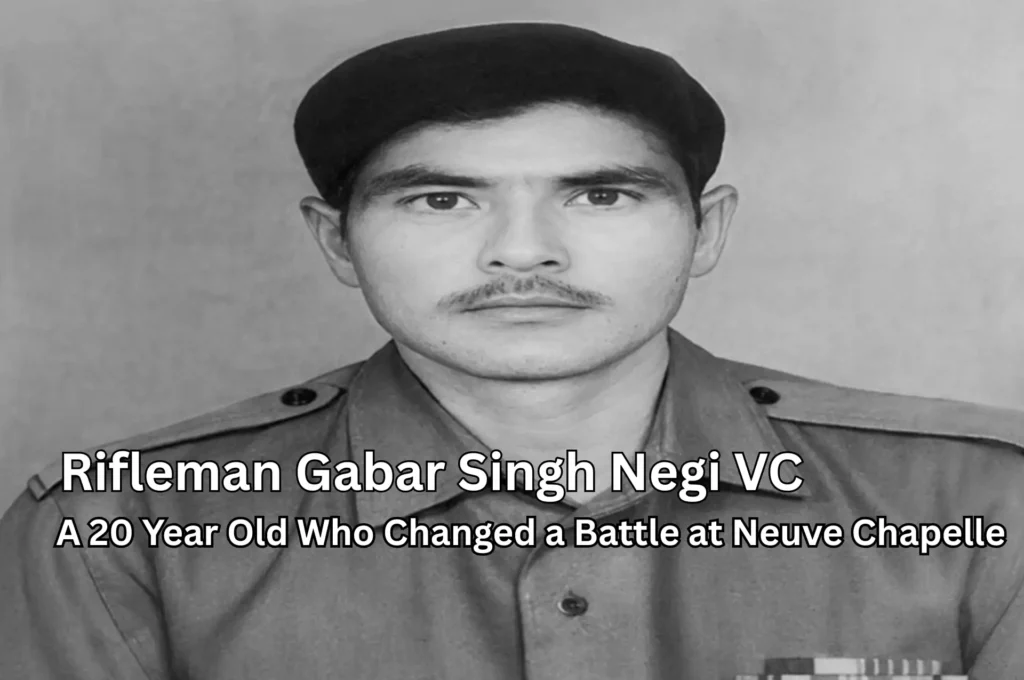
Rifleman Gabar Singh Negi VC
Introduction: A 20‑Year‑Old Who Changed a Battle
It was 6:45 AM on March 10, 1915. The thunder of 340 British artillery guns had just fallen silent after 35 minutes of relentless bombardment. In the muddy fields of northern France, near the village of Neuve Chapelle, thousands of soldiers rose from their trenches and charged into no‑man’s‑land.
Among them was a 19‑year‑old from the Himalayan foothills of Uttarakhand. He carried a rifle, a bayonet, and a handful of grenades. His name was Rifleman Gabar Singh Negi of the 2nd Battalion, 39th Garhwal Rifles.
What he did in the next 90 minutes would force an entire German trench to surrender. He would become one of only 11 Indian soldiers to receive the Victoria Cross during World War I. And he would die doing it – at just 19 years of age.
This is his true story, told through the official London Gazette citation, Commonwealth War Graves Commission records, and the living memory of his village in the Garhwal Himalayas.
The Battle of Neuve Chapelle: Why It Mattered
Why Neuve Chapelle Mattered
By March 1915, the First World War on the Western Front had become a stalemate of mud, barbed wire, and machine guns. The German army had dug deep defensive lines across northern France, and neither side could break through. The British high command needed a victory – and they needed it quickly.
The village of Neuve Chapelle, located near Lille in northern France, was chosen as the target. If the British and Indian forces could capture it, they would threaten the German supply lines and potentially force a larger retreat. The plan was ambitious: a surprise attack after a massive artillery barrage, followed by an infantry assault that would shatter the German front line.
For the first time, the Indian Corps would fight as a single national unit. Indian soldiers made up half of the attacking force. This was their chance to prove themselves on the European stage.
The Indian Corps on the Western Front
The Indian Corps had arrived in France in October 1914. By March 1915, they had already endured the brutal winter of the First Battle of Ypres. Soldiers from the subcontinent – many of whom had never seen snow before – were fighting in the mud‑filled trenches of Flanders and Pas‑de‑Calais.
The 39th Garhwal Rifles was part of the Garhwal Brigade, which formed the 7th (Meerut) Division. The regiment was composed primarily of Garhwali soldiers from the Himalayan region of Uttarakhand – hardy, disciplined men known for their loyalty and ferocity in close‑quarter combat.
By the time of Neuve Chapelle, the Garhwal Rifles had already earned a reputation for bravery. But nothing could have prepared them for the hell that awaited on March 10, 1915.
Who Was Gabar Singh Negi Before the War?
Early Life in the Garhwal Himalayas
Gabar Singh Negi was born on 21 April 1895 in the village of Manjaur (also recorded as Manjyur or Chambra), near Chamba in the Tehri Garhwal State – now the Tehri Garhwal district of Uttarakhand, India.
His village lay in the foothills of the Himalayas, a rugged landscape of steep mountains, dense forests, and isolated communities. The people of Garhwal had a long martial tradition, supplying soldiers to the British Indian Army for generations. For a young man like Gabar Singh, joining the army was not just a career – it was an honour and a duty.
His father was Badri Sing Negi, a farmer. The family lived a simple life, tending to their fields and livestock. At just 18 years old, Gabar Singh married Saturi Devi in 1913. The marriage was brief – the war would take him away from his young bride forever.
Enlistment in the 39th Garhwal Rifles
In October 1913, at the age of 18, Gabar Singh enlisted in the British Indian Army. He joined the 2nd Battalion of the 39th Garhwal Rifles, a regiment that recruited primarily from the Garhwali people of Uttarakhand.
His regimental number was 1685. He was designated a Rifleman – the equivalent of a private in the British Army.
The 39th Garhwal Rifles trained at Lansdowne, a hill station in Uttarakhand that served as the regimental centre. The training was rigorous: long marches, rifle drills, bayonet practice, and discipline that forged young men into soldiers. Gabar Singh excelled. He was quiet, hardworking, and utterly loyal to his regiment.
When war broke out in August 1914, the 39th Garhwal Rifles was among the first Indian units selected for overseas service. They were assigned to Indian Expeditionary Force A and sent to the Western Front in France.
The Road to Neuve Chapelle
From India to France
The journey from India to France was long and arduous. The Garhwal Rifles sailed from Bombay (now Mumbai) in September 1914, arriving in Marseilles in October. From the sunny ports of southern France, they were transported north to the frozen battlefields of Flanders and Picardy.
By October 1914, the 7th (Meerut) Division – which included the Garhwal Brigade – was in action at the First Battle of Ypres. The fighting was brutal. The German army was pushing hard, and the British and Indian forces were struggling to hold the line. The Garhwalis suffered heavy casualties in their first taste of European warfare.
After Ypres, the division was moved to the Pas‑de‑Calais sector, where it remained until the end of 1914. The men endured the worst winter in decades – rain, mud, frostbite, and constant sniper fire. They learned to dig trenches, lay barbed wire, and survive in the most hostile conditions imaginable.
Preparing for the Offensive
By early 1915, the British high command was planning a major offensive. The objective: the village of Neuve Chapelle. The plan called for a massive artillery bombardment followed by a swift infantry assault. The Indian Corps would play a central role.
The 2nd Battalion of the 39th Garhwal Rifles was assigned to attack the German lines to the southwest of Neuve Chapelle. Their objective was a heavily fortified trench system, defended by machine guns, barbed wire, and hundreds of German soldiers.
The artillery barrage began at 5:30 AM on March 10. For 35 minutes, 340 British guns pounded the German positions. The noise was deafening. The ground shook. Then, at 6:45 AM, the guns fell silent. The infantry rose from their trenches and charged.
The Victoria Cross Citation: What Gabar Singh Negi Did
The Official Citation
On 27 April 1915, the London Gazette published the official Victoria Cross citation for Rifleman Gabar Singh Negi. It read:
“For most conspicuous bravery on 10th March, 1915, at Neuve Chapelle. During our attack on the German position he was one of a bayonet party with bombs who entered their main trench, and was the first man to go round each traverse, driving back the enemy until they were eventually forced to surrender. He was killed during this engagement.”
To understand the full weight of those words, you must understand what a bayonet party was – and what it meant to clear a traverse.
What Was a Bayonet Party?
In trench warfare, a bayonet party was a small assault team armed with rifles, bayonets, and hand grenades (called “bombs” at the time). Their job was the most dangerous in any attack: enter the enemy trench and clear it section by section, using grenades and cold steel.
German trenches were not straight lines. They were built in a zig‑zag pattern – each corner was called a traverse. The purpose of the traverse was to stop shrapnel and bullets from flying down the entire length of the trench. But it also created deadly blind spots. Every time a soldier rounded a traverse, he had no idea what was waiting on the other side – a machine gun, a grenade, or a bayonet.
The Action – Step by Step
According to the CWGC account, the artillery barrage preceding the infantry assault had not been fully effective. The German trenches were still strongly defended. The bombing parties were organised to take the trench, one of which included Gabar Singh Negi.
Here is what happened next:
Phase 1 – The Advance: As the Garhwal Rifles charged across no‑man’s‑land, German machine guns opened fire. Men fell on all sides. But the Garhwalis kept moving, their discipline and training carrying them forward through the hail of bullets.
Phase 2 – Entering the Trench: The bayonet party reached the German main trench. Grenades were thrown, rifles fired, and the soldiers leapt into the chaos. The party commander was killed almost immediately. Leadership fell to the next man – Rifleman Gabar Singh Negi.
Phase 3 – Clearing the Traverses: Negi took control of the situation. He was the first man to go round each traverse. This meant that at every corner, he exposed himself to point‑blank fire. He threw grenades, fired his rifle, and used his bayonet to drive the enemy back.
Phase 4 – The Surrender: Traverse by traverse, Negi pushed forward. The Germans, stunned by his ferocity and the relentless assault of the Garhwalis, began to fall back. Eventually, they were forced to surrender. The trench was taken.
Phase 5 – The Sacrifice: During this engagement, Negi was killed. He was just 19 years old.
Immediate Aftermath – What His Sacrifice Achieved
The Battle of Neuve Chapelle
The Battle of Neuve Chapelle lasted from 10 to 13 March 1915. Despite the initial success, the British advance stalled due to delays in sending reinforcements and orders. General Sir Douglas Haig called off the offensive after three days and ordered troops to consolidate the small amount of ground they had gained.
The cost was immense. More than 7,000 British and 4,500 Indian troops became casualties. The Indian Corps had suffered heavily – but they had proven their worth. Indian soldiers had made up half of the attacking force and had succeeded in capturing important sections of the German line.
Negi’s Role in the Victory
Negi’s actions had been critical to the success of his battalion’s attack. By clearing the traverses and forcing the surrender of the German trench, he had opened a gap in the enemy line. This allowed the Garhwal Rifles and other units to push forward.
His bravery did not go unnoticed. The men who fought alongside him spoke of his courage. His officers recommended him for the highest award. And on 27 April 1915, the London Gazette published his Victoria Cross citation.
Recognition and the Victoria Cross
The Victoria Cross – Britain’s Highest Award
The Victoria Cross (VC) is the highest and most prestigious award for gallantry in the face of the enemy that can be awarded to British and Commonwealth forces. It is awarded only for “most conspicuous bravery, or some daring or pre‑eminent act of valour or self‑sacrifice, or extreme devotion to duty in the presence of the enemy.”
During the First World War, only 11 Indian soldiers received the Victoria Cross. Gabar Singh Negi was one of them.
Posthumous Award
Because Negi was killed in action, his VC was awarded posthumously. The medal was sent to his family in Chambra village.
His citation, published in the London Gazette on 27 April 1915, remains a testament to his bravery.
Legacy: How India and the World Remember Gabar Singh Negi
The Neuve Chapelle Memorial
Because Gabar Singh Negi has no known grave, he is commemorated on the Neuve Chapelle Memorial in France. The memorial honours over 4,700 Indian soldiers and labourers who lost their lives on the Western Front and whose last resting place is not known.
Every year, on Remembrance Day, wreaths are laid at the memorial in honour of the Indian soldiers who fought and died for a country far from their homes.
The Gabar Singh Negi Fair in Chamba
In his home village of Chamba (Tehri Garhwal), Gabar Singh Negi is remembered every year with a three‑day fair held on his birth anniversary. The tradition began in 1925, organised by his descendants.
In 1971, the Garhwal Regiment adopted the fair and built a memorial in his honour. The plaque at the memorial describes his valour. The fair features stalls, cultural programmes, and a military parade. Schoolchildren re‑enact the bayonet charge, keeping his story alive for new generations.
Regimental Tradition
The Garhwal Rifles – now part of the Indian Army – still honour Gabar Singh Negi as one of their greatest heroes. Every new recruit is told his story. The regiment’s battle cry remains “Garhwal Ki Jai!” (Victory to Garhwal).
In Popular Culture
In recent years, Negi’s story has gained wider recognition. The Indian government has included his name in official commemorations of India’s role in World War I. His portrait hangs in the Victoria Cross Corner at the Indian Military Academy in Dehradun.
Why This Story Matters
Gabar Singh Negi was not a general, a prime minister, or a celebrity. He was a 20‑year‑old farmer’s son who, for 90 minutes, refused to stop moving forward – even when it meant certain death.
His courage was not reckless. It was deliberate. He knew that each traverse he cleared saved the lives of the men behind him. He knew that surrender of that trench would shift the battle. He did it anyway.
This is what your series “Valor and Courage from World War 1 and 2” will capture: ordinary people doing extraordinary things under the worst conditions.
Sources & Further Reading (Primary and Authoritative)
- The London Gazette – Official VC citation, Issue 29170, 21 May 1915.
[Link to The Gazette archive] - Commonwealth War Graves Commission – Gabar Singh Negi entry, Neuve Chapelle Memorial.
[CWGC link] - British National Archives – War diary of 39th Garhwal Rifles, WO 95/3942 (March 1915).
- “The Victoria Cross: The Indian Army” by Rana Chhina, Centre for Armed Forces Historical Research, United Service Institution of India.
- Neuve Chapelle: India’s First Great Battle (1932) – official history by Colonel J.W.B. Merewether.
Related Stories in This Series (Internal Links)
- Henry Johnson: The Harlem Hellfighter Who Fought Off a German Raiding Party with a Bolo Knife (coming next)
- Khudadad Khan: The First Indian VC (coming soon)
- Desmond Doss: Unarmed and Unafraid on Hacksaw Ridge (coming soon)

Get the ThePoemStory App — Read Poems Anywhere