The Thunderer’s Judgement: Lycaon, the Wolf, and the Flood That Followed
In The Thunderer’s Judgement, Jupiter leaves Olympus to discover how far humanity has fallen and encounters a king who dares to test him. This is a story of mythological stories, Roman gods, transformation and justice, and the terrible consequences of challenging divine authority.
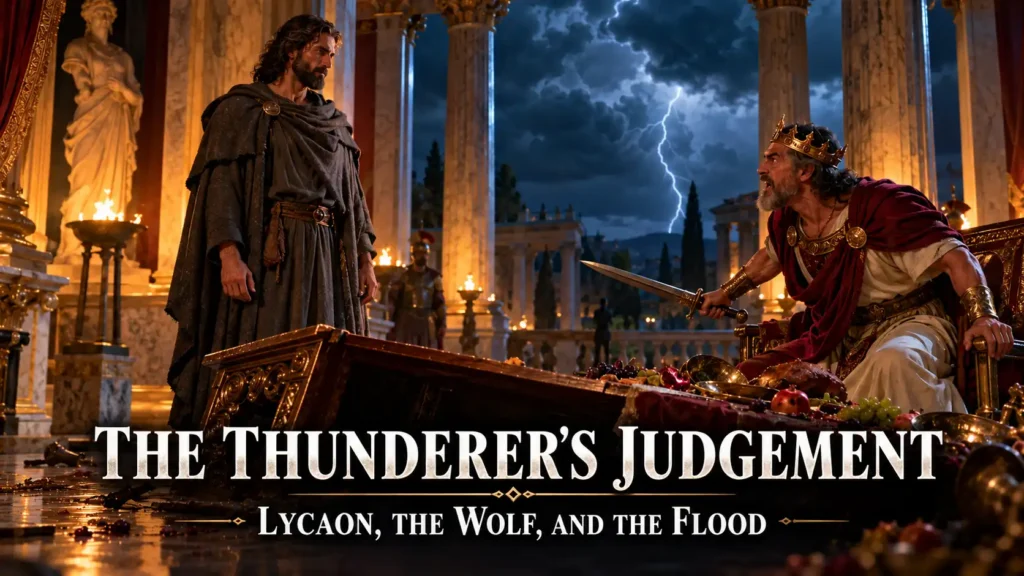
The Thunderer’s Judgement
Introduction: The God Who Came to Look
Jupiter, king of the gods, has heard troubling reports about humanity. Violence has spread, oaths have lost their meaning, and hospitality—the bond between host and guest—has become vulnerable to cruelty. Rather than rely entirely on what he has heard, Jupiter descends from Olympus to see for himself.
In Arcadia, he enters the hall of King Lycaon in human form. The king does not welcome his visitor with reverence. He doubts the stranger’s divinity and decides to test him through an act so brutal that it violates the very customs that hold society together.
The story of Lycaon comes from Greek mythology, where Zeus is king of the gods. In Ovid’s Roman retelling in the Metamorphoses, Zeus appears as Jupiter. This distinction matters: the story belongs to a wider Greek tradition, but Ovid gives it a distinctly Roman literary setting in which divine authority, violated hospitality, and the order of the world are closely connected.
What follows is more than a story about a king turned into a wolf. It is a story about power without restraint, judgment without mercy, and the uneasy boundary between justice and destruction.
Jupiter’s Thunderbolt and the Council of the Gods
A God in Human Form
Ovid places the story near the end of the Iron Age, an age marked by violence, greed, and the collapse of moral restraint. Jupiter has heard accounts of human wickedness, but he wants to witness it directly. Disguised as a mortal, he travels through Arcadia, where he eventually reaches the kingdom of Lycaon.
His disguise gives the encounter its tension. The stranger appears human, yet his presence carries the weight of something greater. Jupiter observes how people respond to him, and their reactions become evidence of the moral condition he has come to investigate.
Lycaon responds differently from those who recognise the divine visitor. Instead of showing reverence, he mocks the prayers offered by others and refuses to accept the possibility that the stranger is a god. His contempt soon becomes something more dangerous: a deliberate attempt to expose or destroy the visitor he believes he can outwit.
The Sign and the Mockery
Lycaon decides to test Jupiter through violence. In Ovid’s account, he attempts to kill his guest while the god is asleep. When that plan fails, Lycaon commits an even more shocking crime. He kills a Molossian hostage, has the body prepared as food, and serves it to his visitor to discover whether the supposed god can recognise what he is eating.
The meal is a calculated violation of hospitality. In the ancient Greek and Roman worlds, the relationship between host and guest carried powerful religious and social obligations. Lycaon turns his own hall into a place of murder and desecration, treating a guest’s trust as an opportunity for cruelty.
Jupiter recognises the crime. He rises in anger, overturns the table, and destroys the house with a thunderbolt. Lycaon escapes into the fields. The thunderbolt destroys his home, but the king’s punishment is not yet complete. His transformation follows as he flees, turning the man who mocked divine authority into a creature whose appearance reflects his violence.
Lycaon and the Flood: The Crime That Tested a God
The Table at Trapezus
The story survives in more than one form. Apollodorus associates the overturned table with Trapezus, a name connected with the Greek word for a table. In his account, Lycaon’s sons also take part in the crime, serving Zeus the flesh of a murdered child. Zeus overturns the table and strikes the guilty sons with thunderbolts, sparing the youngest, Nyctimus. Lycaon is transformed into a wolf.
Ovid’s version differs in important details, including the identity of the victim and the circumstances of the crime. The accounts should not be treated as identical narratives. Yet both present Lycaon as a ruler whose contempt for the gods and violation of hospitality provoke divine punishment.
The differences reveal how mythology changes across authors and generations. One tradition places greater emphasis on Lycaon’s household; another focuses on the encounter between a disguised Jupiter and a king who believes he can challenge the divine. Both make the table a symbol of the boundary between civilisation and brutality.
The First Change: Man into Wolf
Ovid describes Lycaon’s transformation with disturbing precision. His clothes become shaggy hair, his arms become legs, and his body takes on the shape of a wolf. He attempts to speak, but human words fail him. He can only howl. The king who tried to deceive a god loses the ability to address the world as a man.
The transformation is more than a physical punishment. It makes Lycaon’s cruelty visible. The wolf is Lycaon with the mask removed: the same violence, the same ferocity, but now expressed through a body that no longer pretends to belong to civilised society.
Ovid does not describe a moment of repentance. Lycaon runs into the fields, retaining traces of his former nature. The change does not erase what he has done; it gives that nature a new form. His punishment becomes a warning about what happens when power is separated from restraint and contempt replaces respect for others.
The Flood That Followed
Lycaon’s transformation is not the end of Ovid’s story. Jupiter returns to Olympus and calls the gods into council. He argues that humanity has become dangerously corrupt and considers destroying the world with fire. Fearing that the flames might reach the heavens themselves, he chooses water instead. With Neptune’s assistance, the rivers rise and the earth is overwhelmed by the flood.
This second judgment is far greater than the first. Lycaon has committed an individual crime, but Jupiter treats it as evidence of a wider human failure. The flood is a deliberate decision, discussed among the gods, rather than an immediate reaction to the king’s offence. Deucalion and Pyrrha survive, and humanity begins again through them.
The sequence changes the meaning of the myth. The wolf represents the judgment of one corrupt ruler; the flood represents the destruction of a world that Jupiter considers corrupt. The first punishment is personal. The second raises a much harder question: can the guilt of many justify the suffering of everyone?
The Roman Myth of Divine Justice
Why Jupiter Waited
In Roman religion, Jupiter was associated with oaths, public authority, and the order that sustained the community. His place on the Capitoline Hill reflected his importance in Roman civic and religious life. A story about Jupiter judging a king could therefore carry implications beyond the fate of one individual.
In Ovid’s account, Jupiter’s judgment follows observation and the revelation of Lycaon’s crime. The god does not strike the king at the first sign of doubt. He allows the encounter to unfold, and Lycaon reveals his intentions through his own actions.
The contrast is between power and self-restraint. Lycaon possesses a kingdom but violates the obligations that should govern his conduct. Jupiter possesses divine power and uses it to punish him. Yet the later flood complicates any simple claim that authority and justice are always the same. The myth invites readers to consider both the necessity of accountability and the danger of unchecked power.
The Thunderbolt as Verdict
The thunderbolt is Jupiter’s defining weapon, but in Lycaon’s story it also functions as a declaration of judgment. It destroys the king’s house after the crime has been exposed. Lycaon escapes, only to undergo a transformation that makes his conduct impossible to separate from his identity.
The episode can also be read politically. A ruler who believes himself beyond accountability threatens everyone under his authority. Lycaon’s hall becomes a miniature world in which power has abandoned its obligations. Jupiter’s intervention restores a form of order, although the flood that follows leaves open the question of how far such authority should extend.
Ovid’s Metamorphoses and the Meaning of the Wolf
What the Wolf Remembers
Ovid’s Metamorphoses is a poem filled with bodies changing shape. These transformations often carry meanings beyond the physical: they can express desire, punishment, escape, or the consequences of defying divine power. Lycaon’s transformation belongs to this tradition. His new body reflects the violence and contempt that have defined his actions.
The wolf retains the traces of the man he was. He is not presented as an innocent animal caught in a human conflict. Within Ovid’s narrative, the transformation makes Lycaon’s ferocity visible and turns his fate into a warning about the consequences of his choices.
The wolf also carries a wider association in Roman culture. Rome’s founding story links the animal to Romulus and Remus, who were nursed by a she-wolf. That tradition gives the wolf more than one possible meaning: it can be connected with danger and wildness, but also with the origins of Rome itself. Lycaon’s transformation draws on the darker possibilities of that animal image.
The God Who Is Also a State
Ovid wrote during the reign of Augustus, when questions of power, authority, and political order were central to Roman public life. Jupiter’s role in the story can be read against that background. He gathers the gods, considers the evidence of human wrongdoing, and decides what should happen to the world.
But the flood prevents the story from becoming a straightforward celebration of authority. It destroys the innocent along with the guilty. Even if Lycaon’s punishment appears proportionate to his crime, the destruction of humanity is far harder to defend. The myth leaves readers with an uncomfortable tension between the desire for justice and the terrible consequences of power exercised on a universal scale.
The Thunderer’s Judgement in Other Roman Stories
Lycaon is not the only figure whose encounter with Jupiter reveals the dangers of challenging a god. In the tradition preserved by Hyginus, Salmoneus attempts to imitate Jupiter. He drives a chariot over a bridge of brass to imitate thunder and throws burning torches to imitate lightning. Jupiter answers with a real thunderbolt. Virgil later places Salmoneus in Tartarus, where his punishment continues.
Semele’s story offers a different contrast. In Ovid’s Metamorphoses, Juno disguises herself and persuades Semele to ask Jupiter to appear in the full glory of his divinity. Bound by an oath sworn on the Styx, Jupiter cannot refuse. His appearance brings lightning and fire, and Semele dies from the overwhelming divine presence. Unlike Lycaon, she is not punished for a deliberate act of cruelty.
These stories give the thunderbolt different meanings. For Lycaon, it marks the exposure of a deliberate crime. For Salmoneus, it punishes the imitation of divine power. For Semele, it reveals the danger of encountering a god without the protection of disguise. Their differences make the Lycaon episode distinctive: his fate follows a series of choices that violate the obligations of hospitality and respect.
What the Thunderer’s Judgement Means
The story begins with a question about what people do when they believe no one is watching. Lycaon’s crime is not simply the murder of a hostage. It is the decision to turn a guest’s trust into an opportunity for violence because he believes himself beyond consequence. The wolf becomes the visible expression of that contempt.
Before the thunderbolt falls, Jupiter comes down to earth, observes humanity, and allows Lycaon to reveal his intentions. The king is not transformed because he merely doubts a stranger. He is transformed after choosing murder and desecrating the obligations of hospitality. His fate turns the idea of accountability into something physical and unforgettable.
The flood widens the story beyond one king. It asks whether the corruption of a society can justify the destruction of its people, including those who may not share the guilt of its worst members. That question prevents the myth from offering an easy verdict on Jupiter himself.
For a modern reader, the story need not be accepted as literal history to remain meaningful. It explores the relationship between power and restraint, the consequences of violating trust, and the danger of confusing authority with unquestionable justice.
"His clothes turn to shaggy hair, his arms to legs;
he becomes a wolf, and keeps the traces of his former shape."
— Ovid, Metamorphoses 1.238–239
The thunderbolt is loud, but the quiet detail is the one that lasts. Lycaon does not lose himself when he becomes a wolf. He becomes himself. The god who came to look saw a king who had already chosen his shape, and the judgment made it visible.
But the flood leaves a question that the wolf cannot answer. Was Jupiter’s judgment justice, or did the punishment of one man become the destruction of everyone else? Lycaon may have deserved his fate. Did humanity deserve the flood?
Sources and Further Reading
Ovid, Metamorphoses, Book 1, lines 163–312. The principal Roman literary account of Jupiter’s visit to Lycaon, the transformation into a wolf, and the decision to flood the world.
Apollodorus, Library, 3.8.1. A Greek mythological account that differs from Ovid’s version, particularly in its description of Lycaon’s sons and the meal served to Zeus.
Hyginus, Fabulae, 61. A source for the story of Salmoneus and his attempt to imitate Jupiter’s thunder and lightning.
Virgil, Aeneid, Book 6, lines 585–594. A reference for Salmoneus among the figures punished in the underworld.
Pausanias, Description of Greece, 8.2. A source for the Arcadian traditions associated with Lycaon and Zeus Lycaeus.
Read the previous story: The Thunderer’s Judgement: Lycaon, the Wolf, and the Flood That Followed
Read the next story: The Stolen Spring: Pluto, Proserpina, and the Pomegranate That Made Winter

Get the ThePoemStory App — Read Poems Anywhere