The wedding was six weeks away. The venue was booked. The dress was hanging in her mother’s guest room. Three hundred invitations had been mailed. Everyone had already RSVP’d “yes.”
Ananya was twenty-nine years old, a marketing manager at a tech startup, and engaged to a man who checked every box on her family’s list. He was an engineer. He was kind. He was stable. He was everything she had been taught to want.
And she was about to walk away from all of it.
Not because he did anything wrong. Not because she met someone else. But because one morning, while trying on her wedding dress for the final fitting, she looked at herself in the mirror and realized she was about to marry a life that didn’t belong to her.
The fear was enormous. Her parents would be devastated. Her friends would be confused. Her future in-laws would never forgive her. And she would be thirty years old, single, starting over, with no good explanation that anyone would understand.
But something inside her — something small and stubborn and absolutely certain — whispered: If you don’t do this now, you never will.
This is a story of uncommon courage — not about finding the right person, but about having the courage to leave the wrong situation even when everyone thinks it’s right.
Read More Inspirational Stories and Inspirational Poems on ThePoemStory
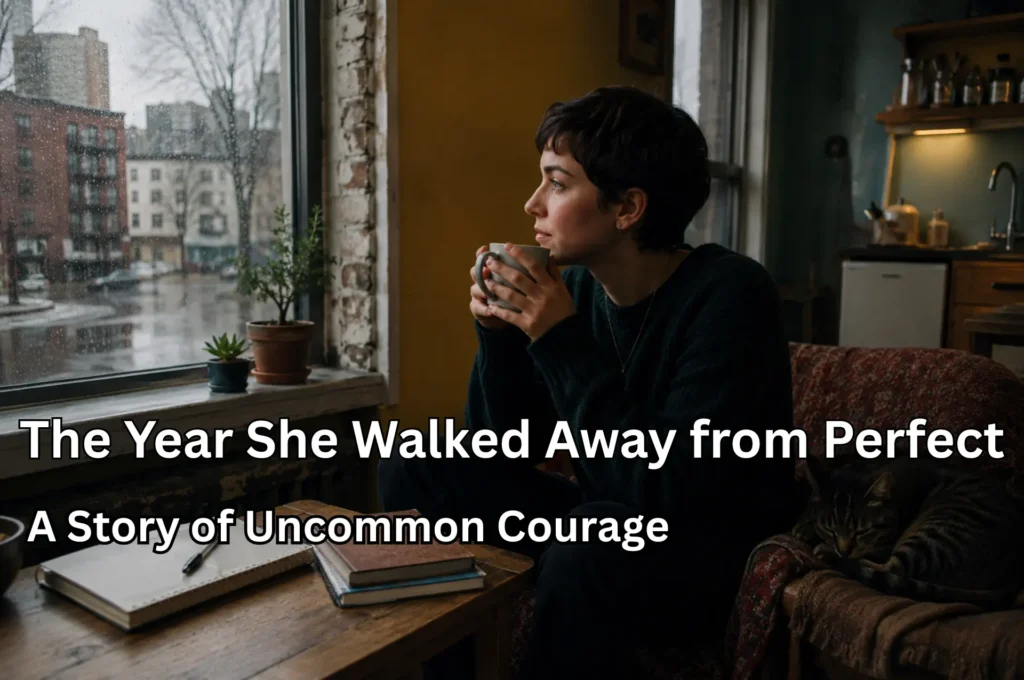
The Year She Walked Away from Perfect: A Story of Uncommon Courage
The Ordinary World: A Life Everyone Approved Of
Ananya had always been a good girl.
She got good grades. She went to a good college. She got a good job. She found a good man. She did everything in the right order, at the right time, with the right amount of enthusiasm.
Her fiancé, Rohan, was genuinely wonderful. He remembered her coffee order. He called her mother every week. He had never raised his voice. He wanted children, a house in the suburbs, and a golden retriever named Chai. He was, by any reasonable measure, a catch.
Everyone said so. Her aunties. Her colleagues. Her college friends who were still swiping on dating apps. “You’re so lucky,” they said. And Ananya nodded and smiled and agreed.
But late at night, when Rohan was asleep beside her, she would lie awake and feel something she couldn’t name. Not unhappiness. Not dissatisfaction. Just a quiet, persistent sense that she was wearing a costume that didn’t quite fit.
She told herself it was normal. Cold feet. Wedding stress. Everyone feels this way.
She told herself that for two years.
The Breaking Point: When the Dream Goes Silent
The moment of reckoning came on a rainy Sunday in September.
She was at her mother’s house, trying on the wedding dress for the final fitting. Her mother was there, crying happy tears. Her sister was taking photos. The tailor was pinning the hem.
And Ananya looked at herself in the full-length mirror — in the white dress, with the veil, with the perfect hair and makeup — and felt absolutely nothing.
Not joy. Not excitement. Not even nervousness.
Just a hollow, echoing silence where her feelings were supposed to be.
She smiled for the photos. She thanked the tailor. She hugged her mother. She drove home. And then she sat in her car in the parking garage for forty-five minutes, not moving, not crying, just staring at the crack in the dashboard.
That was letting go of dreams — not a dramatic surrender, but a quiet, terrifying realization that the dream you’ve been building might actually be a prison.
She didn’t call off the wedding that day. That would have been too brave. Instead, she started a private journal on her phone. She wrote one sentence every night: What did I feel today?
The answers were devastating. Most days: “Nothing.” Some days: “Anxious.” Almost never: “Happy.”
She started noticing things she had trained herself to ignore. The way her chest tightened when Rohan talked about their future. The way she felt relief when he traveled for work. The way she had stopped sharing her real thoughts with him — not because he was unkind, but because her real thoughts had started to scare her.
She realized she had been performing happiness for so long that she no longer knew what genuine happiness felt like.
The Dark Middle: Loss, Confusion, and a Silent Bedroom
For three months, Ananya lived in a fog.
She went through the motions of wedding planning. She tasted cake. She approved floral arrangements. She listened to her mother debate table settings. She smiled. She nodded. She felt like a ghost attending her own funeral.
Meanwhile, she was reading everything she could find about people who had called off weddings. The stories were terrifying and liberating in equal measure. Some women said it was the hardest thing they ever did. Some said it saved their lives. All of them said they knew — really knew — that staying would have been a slow kind of death.
Ananya started therapy. Not because she thought she was broken, but because she needed someone to say the words out loud to. Someone who wouldn’t be devastated.
Her therapist, a woman in her fifties with kind eyes and a direct manner, asked her one question that changed everything: “If you weren’t afraid of disappointing anyone, what would you do?”
Ananya answered without hesitating: “I would cancel the wedding. I would move into a tiny apartment by myself. I would take six months to figure out who I am without anyone telling me who I should be.”
“Then why aren’t you doing that?” the therapist asked.
“Because it would destroy my parents. Because I’m twenty-nine. Because I don’t have a good reason. Because he didn’t do anything wrong.”
The therapist nodded slowly. Then she said: “Not wanting to marry someone is the only reason you need.”
That week, Ananya started making a list. Not a pros-and-cons list — she had made a hundred of those. A list of things she had never admitted to anyone:
- She didn’t want children, and Rohan definitely did.
- She wanted to live abroad for a few years, and he never wanted to leave his city.
- She felt suffocated by their social circle, by the expectations, by the life everyone had already planned for her.
- She had never, not once, felt the kind of love she read about in books — the kind that made you feel more alive, not less.
She read the list to her therapist. Her therapist said: “That’s not a list of small problems. That’s a list of fundamental incompatibilities.”
That was when Ananya realized that finding purpose after failure didn’t mean fixing a broken relationship. It meant having the courage to admit that the relationship wasn’t broken — it just wasn’t hers.
The Small Turning Point: Paying Attention Instead of Performing
She decided to tell Rohan three weeks before the wedding.
She didn’t plan the moment. It just happened. They were eating dinner — takeout from their favorite Thai place — and he was talking about the honeymoon itinerary. He was so excited. So genuinely, openly excited.
And she started crying. Not quiet tears. The kind of crying that comes from somewhere deep and ancient and exhausted.
Rohan panicked. “What’s wrong? Did something happen? Are you okay?”
And Ananya said the words she had been rehearsing in her head for months: “I can’t marry you.”
The silence that followed was the longest silence of her life.
“What do you mean?” he asked.
“I mean I can’t. I’m sorry. I’m so sorry. You didn’t do anything wrong. But I can’t.”
He didn’t yell. He didn’t throw things. He just sat there, staring at his pad thai, processing.
“Is there someone else?” he asked.
“No. There’s no one. That’s the problem. There’s no one — not even me. I don’t know who I am anymore. And I can’t marry you to find out.”
That conversation lasted four hours. They talked about the children thing. The living abroad thing. The suffocation thing. And Rohan, to his credit, listened. He didn’t understand. But he listened.
At the end, he said: “I wish you had told me this a year ago.”
“I wish I had known it,” she said.
He moved out the next week. Ananya called her mother the day after.
That phone call was harder than breaking up with Rohan. Her mother screamed. Then she cried. Then she said things that would take years to forgive. “You’re throwing your life away.” “What will people say?” “After everything we’ve done for you.”
Ananya didn’t defend herself. She just said: “I love you. I’m sorry you’re hurting. But I can’t marry him.”
She hung up and sat on her empty apartment floor — Rohan had taken most of the furniture — and felt something she hadn’t felt in years: relief. Pure, clean, terrifying relief.
The Climb: Finding Purpose After Failure
The year that followed was the hardest year of Ananya’s life.
Her mother didn’t speak to her for six months. Her father sent her terse emails about “responsibility” and “family honor.” Her friends took sides. Some stayed. Many didn’t. Rohan married someone else eighteen months later — a woman who wanted children and suburbs and golden retrievers. Ananya was genuinely happy for him.
But she was also lost.
She moved into a small studio apartment in a neighborhood she had never considered before — one with street art and dive bars and a palpable sense of imperfection. She painted the walls a color her mother would hate. She adopted a cat she named Chaos.
She took a six-month leave from her marketing job. She had saved enough money. She needed space.
She traveled alone for the first time in her life — not to resorts or tourist destinations, but to places that scared her a little. A village in the mountains with no cell service. A coastal town where no one spoke her language. A meditation retreat where she wasn’t allowed to speak at all.
In the silence, she heard herself for the first time.
She realized she had been performing for so long — performing daughter, performing fiancée, performing success — that she had forgotten what her own voice sounded like. It was softer than she expected. Less certain. More curious.
She started writing. Not for an audience. Just for herself. Stories about the people she met. Poems about the mountains. Lists of things that made her feel alive: cold mornings, strong coffee, conversations with strangers, the smell of rain on hot pavement.
She read something that changed her: “The opposite of courage is not cowardice. It is conformity.”
That was it. That was the whole thing. She hadn’t been a coward. She had been a conformist. And breaking out of that — disappointing everyone, facing the shame, sitting alone in a studio apartment with a cat named Chaos — that was the bravest thing she had ever done.
Finding purpose after failure didn’t mean finding a new career or a new relationship. It meant finding herself — and liking what she found.
The Resolution: Overcoming Identity Crisis and Living an Authentic Life
Three years after she called off the wedding, Ananya’s mother finally visited her apartment.
She walked through the door, looked at the colorful walls, the cat, the mismatched furniture, the stack of notebooks on the coffee table. She didn’t say anything for a long time.
Then she said: “This is not the life I wanted for you.”
“I know,” Ananya said.
“But you look happy.”
Ananya smiled. “I am.”
Her mother sat down on the secondhand couch and stayed for three hours. They didn’t talk about the past. They talked about the present. About Ananya’s new job — she had left marketing and was now working at a small nonprofit. About her new friends. About her plans to move abroad for a year.
When her mother left, she hugged Ananya longer than usual. “I still don’t understand,” she said. “But I don’t want to lose you.”
That was enough.
Today, Ananya is thirty-three. She lives in a small apartment in Lisbon — not because she planned it, but because she bought a one-way ticket after saving for two years. She works remotely for a global nonprofit. She dates occasionally, but she’s in no rush. She has learned that being alone is not the same as being lonely.
She still writes in her journal every night. The entries are different now. Less searching. More grateful.
That’s what overcoming identity crisis actually looks like — not arriving at a final, perfect version of yourself, but learning to be at home in your own uncertainty.
She never got married. She never had children. She never bought a house in the suburbs or a golden retriever named Chai.
But she has something better: she has herself. Fully. Honestly. Without apology.
And she is, for the first time, living an authentic life.
How This Story Inspires
A story of uncommon courage doesn’t tell you to “follow your heart” as if it were simple. It tells you that sometimes the bravest thing you can do is disappoint everyone in order to save yourself.
Ananya’s inspiration isn’t in the dramatic cancellation of a wedding. It’s in the slow, quiet, terrifying work of rebuilding a life from scratch — without a script, without applause, without anyone’s approval.
What makes this story inspirational:
- It honors the real cost of choosing yourself: lost relationships, shame, uncertainty.
- The turning point is small and realistic — a moment in a dressing room, a question from a therapist.
- Success is redefined as authenticity, not achievement or partnership.
Questions for readers:
- What “wedding” are you still planning in your life — a job, a relationship, a path — that doesn’t actually fit?
- If you knew you wouldn’t be judged, what would you change starting tomorrow?
- Where have you confused other people’s happiness with your own?
Takeaway: You don’t need a dramatic reason to leave a situation that’s suffocating you. Not wanting it anymore is enough. That’s not failure. That’s a story of uncommon courage.
Read More Inspirational Stories and Inspirational Poems on ThePoemStory

Get the ThePoemStory App — Read Poems Anywhere