Robert Frost stands as one of the colossal figures of 20th-century American poetry. Known for his accessible yet profoundly layered verses, Frost often employed the rural landscapes of New England as a canvas for exploring the deepest crevices of the human psyche. While his later works, such as “The Road Not Taken” and “Stopping by Woods on a Snowy Evening,” cemented his place in the public consciousness, it is in his early collections that we find the raw, unpolished seeds of his genius.
This To the Thawing Wind by Robert Frost analysis examines one of the most exuberant and celebratory poems from his debut collection, A Boy’s Will (1913). “To the Thawing Wind” is an apostrophe—a direct address to the warm, life-giving wind of early spring that signals the end of winter. Unlike the dark, fearful poems of winter isolation, this poem is a joyous invocation, a call for renewal, transformation, and liberation.
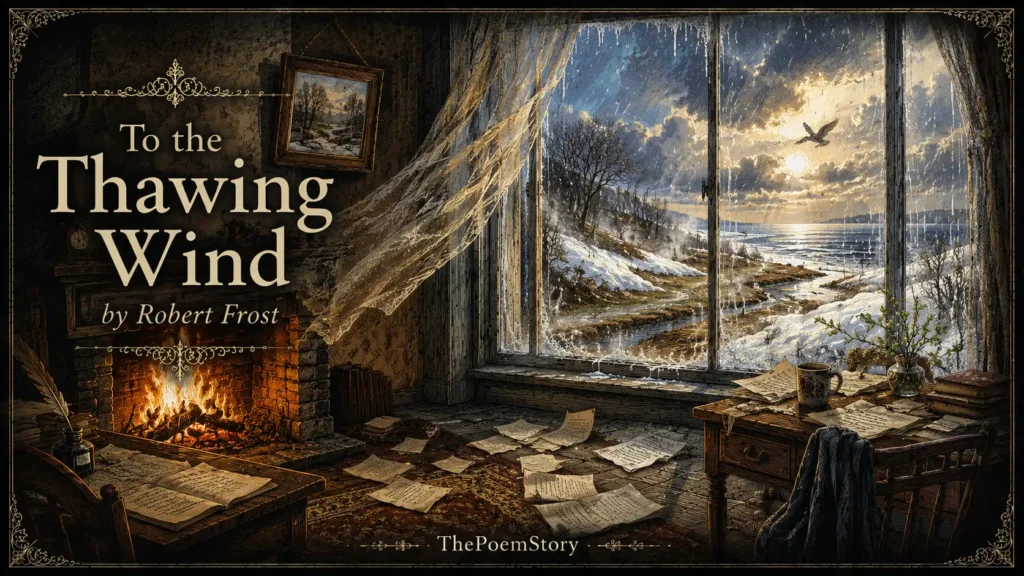
The poem is a prayer of sorts—not to a god, but to the “loud Southwester,” the warm wind that melts the snow, awakens the buried flower, and brings back the birds. The speaker invites the wind to enter his room, to disrupt his orderly space, to scatter his poems, and ultimately to “turn the poet out of door.” The poem is a celebration of the creative spirit and the need for renewal—both in nature and in the human soul.
In this comprehensive guide, we will dissect “To the Thawing Wind” with careful attention to its structure, language, and exuberant spirit. We will provide a detailed To the Thawing Wind poem summary, explore the profound themes in To the Thawing Wind by Robert Frost, examine its masterful literary devices in To the Thawing Wind, and ultimately reflect on the To the Thawing Wind meaning and what it reveals about the human need for renewal, transformation, and creative release.
Read and explore ThePoemStory and go through Collected Poems of Robert Frost.
for more poems explore Poetry Section
Table of Contents
The Poem – To the Thawing Wind by Robert Frost
Come with rain, O loud Southwester!
~ To the Thawing Wind by Robert Frost – Analysis and Summary
Bring the singer, bring the nester;
Give the buried flower a dream;
Make the settled snow-bank steam;
Find the brown beneath the white;
But whate’er you do to-night,
Bathe my window, make it flow,
Melt it as the ice will go;
Melt the glass and leave the sticks
Like a hermit’s crucifix;
Burst into my narrow stall;
Swing the picture on the wall;
Run the rattling pages o’er;
Scatter poems on the floor;
Turn the poet out of door.
To the Thawing Wind Poem Summary
Before delving into the thematic and literary depths, it is essential to establish a clear To the Thawing Wind poem summary to ensure every reader grasps the narrative and emotional arc of this exuberant lyric. The poem is structured as a single stanza of fifteen lines, creating a sense of breathless, unbroken excitement that mirrors the speaker’s passionate invocation.
Lines 1–5: The Invocation
The poem opens with a direct address: “Come with rain, O loud Southwester!” The Southwester is the warm wind that blows from the southwest, bringing rain and thaw. The speaker calls to it with urgency and joy. The word “loud” suggests that this wind is not subtle; it is powerful, boisterous, and impossible to ignore.
The speaker asks the wind to “bring the singer, bring the nester.” The singer is the bird that sings in spring—the returning songbird. The nester is the bird that builds its nest. The wind is asked to bring back life, to restore the cycle of renewal.
The speaker then asks the wind to “give the buried flower a dream.” The flower is buried beneath the snow, dormant, waiting. The dream is the promise of spring, the hope of rebirth. The wind is asked to “make the settled snow-bank steam,” to melt the snow and reveal what lies beneath. Finally, the speaker asks the wind to “find the brown beneath the white”—to reveal the earth, the soil, the foundation of life.
Lines 6–10: The Window and the Frost
The speaker turns from the external landscape to his own immediate environment: “But whate’er you do to-night, / Bathe my window, make it flow.” The speaker wants the wind to melt the frost on his window. The frost is a barrier between him and the outside world. He wants it to “flow” away, to dissolve, to disappear.
He asks the wind to “melt it as the ice will go”—to let the ice naturally vanish. Then comes a striking image: “Melt the glass and leave the sticks / Like a hermit’s crucifix.” The speaker wants the wind to melt the glass itself, leaving only the window frame, the “sticks” of the mullions. These sticks resemble a hermit’s crucifix—a cross made of simple wood. The image suggests a kind of spiritual stripping away, a removal of barriers between the self and the world.
Lines 11–15: The Room and the Poet
The speaker then invites the wind to enter his room: “Burst into my narrow stall.” The word “stall” suggests a small, confined space—like a stable or a cramped study. The speaker wants the wind to break in, to disrupt his confinement.
He asks the wind to “swing the picture on the wall,” to “run the rattling pages o’er,” and to “scatter poems on the floor.” The wind is asked to disrupt his orderly room, to shake things up, to create chaos. The poems are scattered—not destroyed, but released from their orderly arrangement.
Finally, the speaker asks the wind to “turn the poet out of door.” This is the ultimate request: to drive the poet out of his confined space, to force him into the world, to break him out of his isolation and into the vibrant, chaotic life of spring.
This completes our To the Thawing Wind poem summary, revealing a poem about the longing for renewal, transformation, and creative liberation.
Major Themes in To the Thawing Wind by Robert Frost
Now that we have a clear understanding of the narrative, let us examine the profound themes in To the Thawing Wind by Robert Frost. This short, exuberant poem contains layers of psychological and philosophical insight.
1. Renewal and Rebirth
The central theme of the poem is renewal. The thawing wind represents the arrival of spring, the end of winter, and the rebirth of life. The speaker asks the wind to bring birds, to awaken the buried flower, to melt the snow, and to reveal the earth. The poem is a celebration of the cyclical renewal of nature.
This theme also applies to the human spirit. The speaker is confined, isolated, and perhaps creatively blocked. The wind offers the promise of liberation, of new life, of creative release.
2. The Power of Nature
The poem emphasizes the power of nature to transform, to break through barriers, and to bring life. The wind is “loud,” “powerful,” and unstoppable. It can melt ice, shatter glass, scatter poems, and drive the poet out of his confinement. Nature is not a passive backdrop; it is an active, transformative force.
3. The Need for Creative Release
The speaker wants the wind to scatter his poems and turn him out of his room. This is a desire for creative release, for the disruption of orderly confinement, for the chaos that precedes new creation. The speaker is not asking for order; he is asking for liberation. The scattered poems are not destroyed; they are set free.
4. The Breaking of Barriers
The poem is full of barriers being broken: the frost on the window, the glass itself, the walls of the “narrow stall.” The speaker wants these barriers to be removed. This theme speaks to the human desire to break free from confinement—whether physical, psychological, or creative.
5. The Spiritual Dimension of Nature
The image of the “hermit’s crucifix” introduces a spiritual dimension. The window frame, stripped of its glass, resembles a cross. The speaker’s room is a “stall,” like a stable—the setting of Christ’s birth. The poem suggests that nature has a spiritual dimension, that the thawing wind is not just a weather event but a kind of divine visitation.
6. The Relationship Between the Poet and the World
The poem explores the relationship between the poet and the world. The poet is confined in his “narrow stall,” isolated from the outside world. He wants the wind to burst in, to disrupt his order, to scatter his poems, and to drive him out. The poem suggests that the poet cannot create in isolation; he must be connected to the world, to nature, to the chaotic vitality of life.
7. The Joy of Disruption
The poem is joyful. The speaker is not afraid of the wind; he welcomes it. He wants the wind to “scatter poems on the floor,” to “swing the picture,” to “burst into my narrow stall.” The poem celebrates disruption as a source of creativity and life.
Literary Devices in To the Thawing Wind
To fully appreciate the craftsmanship of this poem, we must examine the rich array of literary devices in To the Thawing Wind. Frost employs these techniques with his characteristic precision and exuberance, creating a poem that is both joyful and profoundly meaningful.
1. Apostrophe
The central device of the poem is apostrophe—a direct address to an absent or abstract entity. The speaker addresses the “loud Southwester” as if it were a person who can hear and respond. This technique gives the poem its urgent, prayer-like quality.
2. Personification
The wind is personified as a powerful, active force. It can “bring,” “give,” “make,” “find,” “bathe,” “melt,” “burst,” “swing,” “run,” “scatter,” and “turn.” The wind is not just a natural phenomenon; it is a living, purposeful agent.
3. Imagery
Frost’s imagery in this poem is vivid and dynamic:
- Visual: “settled snow-bank,” “brown beneath the white,” “bathe my window,” “hermit’s crucifix,” “narrow stall,” “picture on the wall,” “scatter poems.”
- Auditory: “loud Southwester,” “rattling pages.”
- Tactile: “flow,” “melt,” “burst.”
- Thermal: “rain,” “steam,” “melt,” “thawing.”
The imagery consistently emphasizes movement, transformation, and the melting of barriers.
4. Symbolism
Several symbols enrich the poem’s meaning:
- The Thawing Wind: Represents renewal, transformation, and the creative spirit.
- The Buried Flower: Represents dormant potential, waiting for the right conditions to bloom.
- The Snow-Bank: Represents coldness, death, and the barriers that separate us from life.
- The Window: Represents the barrier between the self and the world.
- The Hermit’s Crucifix: Represents spiritual devotion, simplicity, and the removal of material barriers.
- The Narrow Stall: Represents the confined space of the poet’s creative life—isolated, safe, but limiting.
- The Scattered Poems: Represent the release of creative work from order into the chaos of the world.
5. Tone
The tone of the poem is urgent, joyful, and celebratory. The speaker is not afraid of the wind; he welcomes it with open arms. The tone reflects Frost’s own love of the natural world and his belief in the power of renewal.
6. Rhythm and Meter
The poem follows a consistent AABB rhyme scheme throughout, giving it a musical, almost song-like quality. The meter is predominantly trochaic, with stressed syllables at the beginning of each line, creating a sense of urgency and forward movement. The rhythm mimics the insistent, energetic quality of the wind itself.
7. Imperative Mood
The entire poem is written in the imperative mood—a series of commands: “Come,” “bring,” “give,” “make,” “find,” “bathe,” “melt,” “burst,” “swing,” “run,” “scatter,” “turn.” These commands create a sense of urgency and power. The speaker is not asking politely; he is demanding, invoking the wind with all his might.
8. Alliteration
Frost uses alliteration to create musical effects: “singer,” “nester,” “settled snow-bank,” “bathe my window,” “hermit’s crucifix,” “narrow stall,” “rattling pages,” “poems on the floor.” These repeated sounds give the poem a rhythmic, incantatory quality.
The Deeper Meaning of To the Thawing Wind
Beyond its surface-level invocation, the To the Thawing Wind meaning reveals a profound meditation on the human need for renewal, transformation, and creative liberation. This is where the poem transcends its historical context and speaks directly to the human condition.
The To the Thawing Wind meaning centers on the recognition that human beings need renewal. We cannot stay in our “narrow stalls” forever. We need the thawing wind to burst in, to break our barriers, to scatter our comfortable order, and to drive us out into the world. The poem is a call to embrace change, to welcome disruption, and to allow ourselves to be transformed.
The poem also speaks to the creative process. The poet is confined in his room, surrounded by his orderly poems. He wants the wind to scatter them, to disrupt his order, to turn him out of doors. This is a powerful metaphor for the creative spirit: we cannot create in isolation. We must be connected to the world, to nature, to the chaotic vitality of life. The scattered poems are not destroyed; they are released. The poet is not harmed; he is liberated.
The To the Thawing Wind meaning also carries a spiritual dimension. The image of the “hermit’s crucifix” suggests a kind of spiritual stripping away. The speaker wants to be stripped of his barriers, his comforts, his isolation. He wants to be exposed to the world, to the elements, to the divine. This is a prayer for spiritual renewal—a desire to be cleansed, transformed, and reborn.
Ultimately, the To the Thawing Wind meaning is that renewal is necessary, inevitable, and joyful. The thawing wind will come. The snow will melt. The flowers will bloom. The poet will be turned out of doors. The poem invites us to embrace this renewal, to welcome the wind, and to allow ourselves to be transformed.
Reflection on Human Life
“To the Thawing Wind” offers a timeless mirror to the human condition, and its relevance only grows in our modern world of isolation, comfort, and the need for renewal.
The Need for Renewal
We all need renewal. We cannot stay in our “narrow stalls” forever. We need the thawing wind to burst in, to break our patterns, to disrupt our routines, and to drive us out into the world. The poem invites us to seek renewal—to welcome change, to embrace transformation, and to allow ourselves to be reborn.
The Danger of Isolation
The speaker is confined in his “narrow stall.” He is isolated from the world, cut off from nature, trapped in his own creative space. This isolation is a danger. The poet needs to be “turned out of door”—to be forced into the world, to be connected to life. In our modern world, we are often isolated—in our homes, our offices, our screens. The poem reminds us that we need to break out, to connect, to engage with the world.
The Power of Disruption
The speaker welcomes disruption. He wants the wind to scatter his poems, to swing the picture, to burst into his room. This is a powerful reminder that disruption can be creative. Sometimes, we need to break our patterns to grow. Sometimes, we need chaos to create order. The poem invites us to embrace disruption as a source of renewal.
The Creative Spirit
The poem is a celebration of the creative spirit. The poet wants his poems scattered, not destroyed. He wants to be turned out of his room, not silenced. The creative spirit needs freedom, movement, and connection. It cannot thrive in isolation. The poem invites us to release our creative work, to share it with the world, and to allow it to be transformed by life.
The Spirituality of Nature
The image of the “hermit’s crucifix” suggests that nature has a spiritual dimension. The wind is not just a weather event; it is a kind of divine visitation. The poem invites us to see the spiritual in the natural—to find renewal, transformation, and grace in the changing seasons.
The Joy of Letting Go
The poem is joyful. The speaker is not afraid of the wind; he welcomes it. He is not afraid of disruption; he embraces it. He is not afraid of being turned out of his room; he wants it. This is the joy of letting go—of releasing control, of embracing change, of trusting in the power of renewal. The poem invites us to let go, to trust, and to find joy in transformation.
Conclusion
“To the Thawing Wind” is a joyous and exuberant poem—a celebration of renewal, transformation, and creative liberation. Through its use of apostrophe, its vivid imagery, and its urgent rhythm, the poem invites us to welcome the wind, to embrace disruption, and to allow ourselves to be transformed.
Through our To the Thawing Wind by Robert Frost analysis, we have explored the poem’s structure, its To the Thawing Wind poem summary, the profound themes in To the Thawing Wind by Robert Frost, the masterful literary devices in To the Thawing Wind, and the enduring To the Thawing Wind meaning.
“To the Thawing Wind” is a reminder that renewal is possible, that transformation is necessary, and that the creative spirit needs freedom and connection. It invites us to open our windows, to welcome the wind, and to allow ourselves to be turned out of our comfortable rooms and into the vibrant, chaotic, beautiful world.
If you have ever felt the need for renewal, the urge to break free, or the desire to be transformed, then you have heard the call of the thawing wind. And like Frost, you are invited to answer it.
Enjoyed this deep dive into Frost’s poetry? If you want to explore more of his work, consider adding a complete collection to your library. There is no better companion for a spring day than the timeless verses of Robert Frost.
Did this analysis illuminate a new perspective on “To the Thawing Wind” for you? Drop a comment below and let me know your thoughts. If you found this valuable, please share it with a fellow poetry enthusiast!
Read and explore ThePoemStory and go through Collected Poems of Robert Frost.
for more poems explore Poetry Section

Get the ThePoemStory App — Read Poems Anywhere