Venus and Mars are the most famous lovers in Roman mythology, and the strangest. She is the goddess of love, beauty, and the life of the fields. He is the god of war, violence, and the discipline of the legion. Their divine affair is a story of mythological stories, Roman gods, love and desire, and the Roman identity and legacy that made two adulterers the parents of an empire.
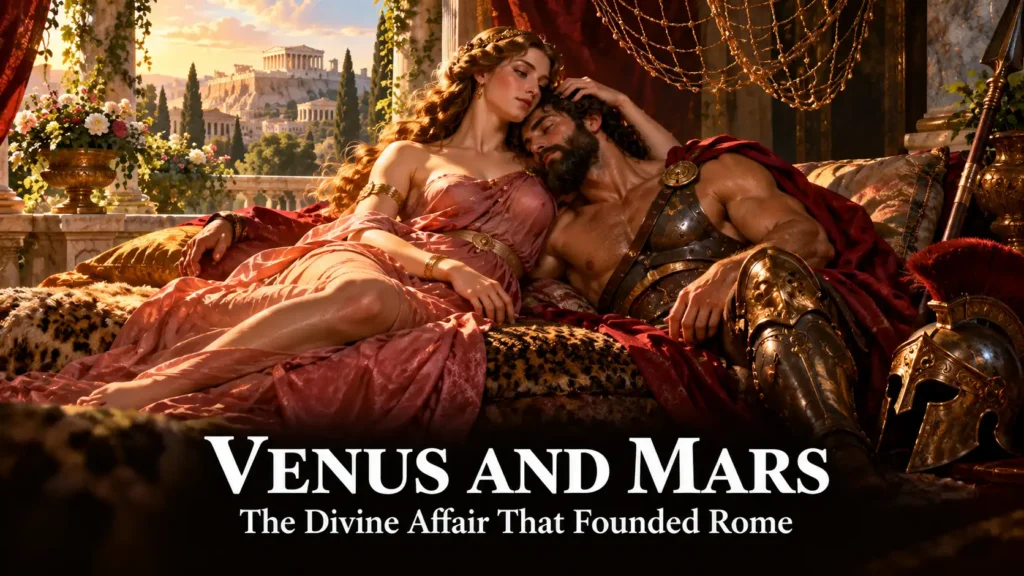
Venus and Mars: The Divine Affair
Introduction: The Lovers and the Trap
Most people meet Venus and Mars in the same story: the one where her husband builds an invisible net and catches them in bed. It is a brilliant story, and it belongs to Vulcan more than it belongs to them. The lovers are the exhibit. The craftsman is the protagonist.
But the affair is older than the net, and in Rome it meant something much larger than a scandal. Venus was the mother of Aeneas, the Trojan prince who carried the gods of Troy to Italy. Mars was the father of Romulus and Remus, the twins who founded the city. Rome traced its ancestry to both of them, and the story of their union became a way of explaining who the Romans were: a people born from love and from war at the same time.
The story comes from Greek mythology, where the lovers are Aphrodite and Ares. Homer tells it in the Odyssey, and Ovid retells it in Latin in the Metamorphoses. But the Romans did something the Greeks did not. They took a comic story about an adulterous affair and made it the genealogical foundation of their state. Venus and Mars is not only a myth about desire. It is a myth about where Rome came from.
The Divine Affair: Beauty and Violence in Bed
The Greek Original: Demodocus’s Song
The oldest surviving version of the story is in Homer’s Odyssey, Book 8. The blind singer Demodocus performs at the court of the Phaeacians, and he sings of how Ares and Aphrodite first lay together in the house of Hephaestus, secretly, and how Ares gave her many gifts and shamed the bed of the smith god. The Sun sees them and tells Hephaestus. Hephaestus goes to his forge, makes a net of chains that cannot be broken or loosened, and hangs it from the roof. When the lovers meet again, the net falls. They are trapped, naked, and the gods gather at the door and laugh.
Homer’s version is funny. It is also a story about craft defeating force. The god of war, the strongest of the Olympians, is caught by the god of the forge, the one with the lame legs. The laughter of the gods is the sound of a hierarchy being temporarily overturned. The affair is a scandal, but it is a scandal that makes the audience laugh at the god who usually makes everyone else afraid.
Ovid’s Roman Retelling
Ovid tells the story in Metamorphoses Book 4, and he keeps the comedy but changes the emphasis. In his version, the Sun is the witness, Vulcan is the betrayed husband, and the net is a masterpiece of invisible bronze work. Ovid describes the links as finer than a spider’s thread, arranged so that they will drop at the slightest touch. When Venus and Mars lie together, the net falls, and Vulcan throws open the ivory doors and lets in the gods.
The Roman poet does not let the lovers off the hook. The gods laugh, and Ovid says the story was repeated all over heaven for a long time. But he also notes that Mars and Venus continue their affair openly afterwards, because they no longer have anything to hide. The net does not end the divine affair. It only makes it public. That is the Roman twist: the scandal does not produce shame. It produces a kind of freedom.
Venus Genetrix and Mars Pater: The Ancestors of Rome
Venus and Aeneas
Venus is not only the goddess of love in Rome. She is Venus Genetrix, the mother of the Roman people through her son Aeneas. Virgil’s Aeneid begins with Aeneas carrying his father out of burning Troy, and Venus is the divine force that protects him, guides him, and pleads for him with Jupiter. The Julian family, the clan of Julius Caesar and Augustus, claimed descent from Aeneas and therefore from Venus. That claim was not a private family legend. It was a public fact of Roman religion and politics.
Caesar vowed a temple to Venus Genetrix before the battle of Pharsalus, and he built it in his new forum in Rome. The temple was dedicated in 46 BC, and it made the goddess of love the divine ancestor of the man who was about to become dictator for life. When the Romans looked at Venus, they were not only looking at a beautiful goddess. They were looking at the mother of their city and the protector of the family that ruled it.
Mars and Romulus
Mars is Mars Pater, the father of Romulus and Remus. The story is told by Livy and by Plutarch: Rhea Silvia, a Vestal virgin and the daughter of the deposed king Numitor, is visited by Mars and gives birth to twins. The twins are exposed, suckled by a wolf, and raised by a shepherd. Romulus goes on to found Rome and to give the city its first laws and its first army. Mars is not a distant ancestor in this story. He is the physical father of the founder, and the Romans called him pater because he was the father of the nation.
This is why the union of Venus and Mars mattered so much in Rome. Venus is the ancestor through Aeneas, the Trojan line that brought civilisation and the gods to Italy. Mars is the ancestor through Romulus, the native line that gave Rome its military character and its claim to the land. The two genealogies meet in the Roman people. Rome is not descended from one god. It is descended from two, and they are lovers.
Lucretius and the Peace of Venus
The Proem of De Rerum Natura
The most important Roman reading of Venus and Mars is not in a mythographer. It is in a philosophical poem. Lucretius opens his De Rerum Natura with a prayer to Venus as the creative force of the universe, the power that makes the sea teem and the fields bear fruit and every living thing come into being. He calls her Aeneadum genetrix, the mother of the descendants of Aeneas, and he asks her to help him write his poem about the nature of things.
Then he turns to Mars. Lucretius describes the god of war lying in Venus’s lap, overcome by the eternal wound of love, his eyes fixed on her, his breath hanging on her lips. The image is not a joke. It is a philosophical argument in mythological form. Mars is the force of destruction. Venus is the force of generation. When Mars lies in her arms, destruction is temporarily pacified by desire. Lucretius asks Venus to pour peace into the Romans, because in a time of civil war the poet cannot write with an untroubled mind.
Love as a Political Force
This is the most Roman thing about Venus and Mars. The affair is not only a private passion. It is a model of how the world works. Love and war are the two forces that make and unmake human life, and the myth puts them in bed together. Lucretius does not ask Mars to disappear. He asks Venus to hold him. The peace he wants is not the absence of war. It is the momentary softening of war by love, the pause in which something can grow.
Lucretius wrote during the late Republic, when Rome was tearing itself apart in civil wars. His prayer to Venus is a prayer for the city. The divine affair becomes a political image: the god of war resting in the arms of the goddess of life, and the poet begging her to keep him there long enough for the Roman people to survive. That is a long way from the comedy of Homer’s net, and it is the Roman contribution to the myth.
The Lovers in Roman Politics: Venus Genetrix and Mars Ultor
The Temple of Venus Genetrix
Caesar’s temple to Venus Genetrix stood in the Forum Iulium, the new forum he built next to the old Roman Forum. It was dedicated in 46 BC, and it housed a statue of the goddess by the Greek sculptor Arcesilaus. The temple was not only a religious building. It was a political statement. Caesar was claiming that his family descended from Venus through Aeneas, and that his power had divine backing. The lovers in Roman politics were not a scandal to be hidden. They were an ancestry to be displayed.
The Temple of Mars Ultor
Augustus built the temple of Mars Ultor, Mars the Avenger, in his new forum. He had vowed it before the battle of Philippi, where he and Antony defeated the assassins of Caesar, and he dedicated it in 2 BC. The temple was the religious centre of the Forum of Augustus, and it stood next to the temple of Venus Genetrix in the Forum of Caesar. The two temples were physically close, and the message was clear. Rome was protected by Venus and by Mars, by the mother of Aeneas and the father of Romulus, and Augustus was the heir of both.
This is the final Roman transformation of the affair. In Greece, Ares and Aphrodite are caught in a net and laughed at. In Rome, Venus and Mars become the divine parents of the state, and their temples face each other across the imperial forums. The divine affair is no longer a private scandal. It is the official genealogy of the Roman Empire.
“The savage works of battle, puissant Mars,
how often to thy bosom flings his strength,
o’ermastered by the eternal wound of love.”
— Lucretius, De Rerum Natura 1.32–34
The affair is a comedy in Homer and a philosophy in Lucretius. In Rome it becomes something else again: a family tree. Venus and Mars are caught in a net, and then they are carved on the pediments of temples. The scandal does not disappear. It is promoted.
So the question the myth leaves us with is not whether the affair was wrong. The gods themselves seem unsure. It is whether Rome ever stopped being the child of that affair. The city that called itself the descendant of Venus and Mars was also the city that conquered the world by force and justified it by love. Was Venus and Mars a story about peace, or was it a story about how war learns to call itself love?
Sources and Further Reading
Primary texts online. Homer, Odyssey Book 8 (Loeb Classical Library), lines 266–367, for the song of Demodocus. Ovid, Metamorphoses Book 4 (Loeb Classical Library), lines 167–189, for the net of Vulcan. Lucretius, De Rerum Natura Book 1 (Perseus Digital Library), lines 1–49, for the prayer to Venus and the tableau of Mars.
Further reading. Virgil, Aeneid 1.1–33 and 8.370–406, for Venus as the mother of Aeneas and the shield made by Vulcan. Livy, Ab Urbe Condita 1.3–4, and Plutarch, Life of Romulus 3–4, for Mars as the father of Romulus and Remus. Ovid, Fasti Book 4, for the month of April and the festivals of Venus. The Oxford Classical Dictionary entries on Venus and Mars summarise the Roman cults, the temples of Venus Genetrix and Mars Ultor, and the political use of the ancestry myth under Caesar and Augustus.
Read the previous story: The Forge of Vulcan: The God Who Was Thrown Away and Built the Gods Their Weapons

Get the ThePoemStory App — Read Poems Anywhere