The Twelve Labors of Hercules: The Hero Who Became a God by Finishing the Job
In The Twelve Labors of Hercules, a man is ordered to serve a king he despises, and the service turns him into the greatest hero of the ancient world. This is a story of mythological stories, heroes and mortals, transformation and justice, and the Roman identity and legacy that made a Greek hero into a Roman god.
The Twelve Labors of Hercules
Introduction: The Man Who Had to Serve
Hercules is the strongest man in the world, and the first thing the myths tell us about him is that he is not free. He is ordered to serve Eurystheus, the king of Mycenae, a man who is weaker, less brave, and less intelligent than he is. The service is not a choice. It is a sentence.
The Twelve Labors of Hercules are the tasks he performs during that service. He kills a lion with impenetrable skin. He cuts the heads off a monster that grows new ones. He cleans a stable that has never been cleaned. He brings back a dog from the land of the dead. He does all of it, and he does not stop. That is the story: not a hero who wins because he is strong, but a hero who wins because he does not quit.
The hero is Greek. His name is Heracles, and he is the son of Zeus and the mortal Alcmene. The Romans called him Hercules, and they made him their own. He had a cult in Rome before almost any other foreign god, an altar in the Forum Boarium, and a story about a monster in a cave that explained why the altar was there. The Twelve Labors of Hercules is a Greek story that became a Roman institution, and the two versions do not mean the same thing.
Why the Labors Happened: Hera, Madness, and the Oracle
The Madness of Heracles
The labors begin with a crime. In the most common version, Hera, the wife of Zeus, has hated Heracles since before he was born. She sends a madness upon him, and in that madness he kills his own wife and children. When he recovers, he understands what he has done, and he goes to the oracle at Delphi to ask how he can atone.
The oracle tells him to serve Eurystheus, the king of Mycenae, for twelve years, and to perform whatever tasks the king sets for him. Apollodorus gives the standard list of ten labors, which become twelve when Eurystheus refuses to count two of them. The number is not fixed in every source. The point is not the arithmetic. The point is that the labors are a penance. They are not a career. They are a sentence that Heracles accepts because he believes he has no other way to become clean.
This is the first thing that makes The Twelve Labors of Hercules different from a simple adventure story. The hero is not seeking glory. He is seeking forgiveness, and the only way to get it is to do what he is told by a man he could crush with one hand. The labors are a lesson in humility disguised as a series of monster fights.
The Greek and Roman Hero
In Greece, Heracles is a hero with a tragic flaw: his strength is also his destruction. He kills the people he loves, he suffers, and he dies in agony. In Rome, Hercules is a god of commerce, protection, and endurance. His cult at the Ara Maxima was one of the oldest in the city, and it was popular with merchants and traders because Hercules was a god who travelled and who could avert evil. The Romans did not ignore the Greek stories, but they put them to Roman uses.
The Roman Hercules is a model of virtus, the manly excellence that Romans admired. He endures. He does not complain. He finishes what he starts. When a Roman told the story of The Twelve Labors of Hercules, they were not only telling a story about a Greek hero. They were telling a story about the kind of person they wanted to be.
Hercules and the Nemean Lion: The First Labor
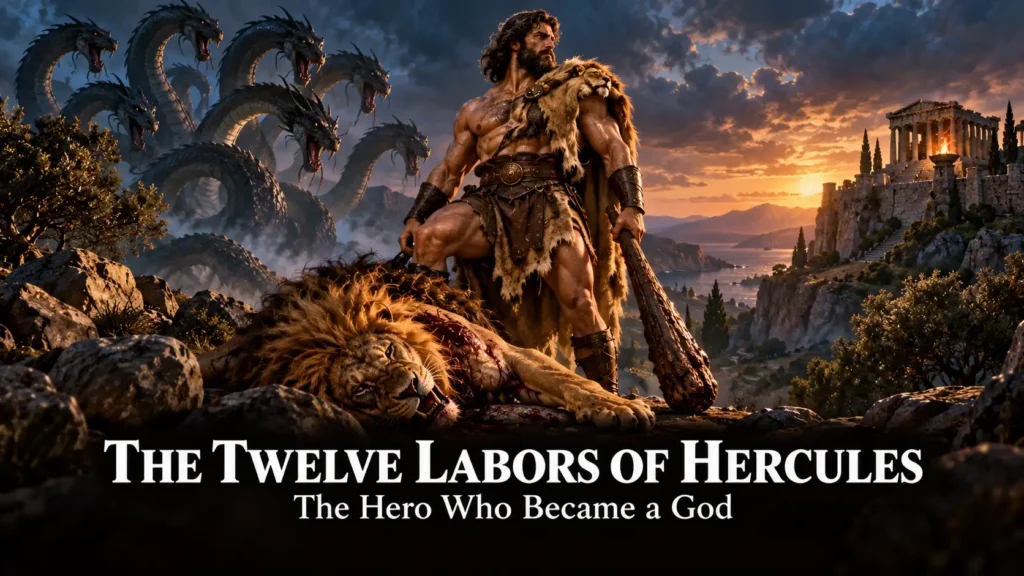
The first labor is the one that defines the hero’s image. The Nemean Lion is a monster with a hide that cannot be pierced by iron, bronze, or stone. Heracles tries to shoot it with arrows, and the arrows bounce off. He tries to cut it with a sword, and the sword breaks. So he does the only thing that is left. He wrestles it.
Apollodorus says that Heracles chased the lion into a cave with two openings, blocked one entrance, and went in through the other. He grabbed the lion around the neck and held it until it died. Then he skinned it with its own claws, because no knife could cut the hide. He wore the skin as armour for the rest of his life, and the lion’s head became his helmet. The club and the lion skin are his signature, and they come from this first labor.
Hercules and the Nemean Lion is not a story about a man who wins because he has better weapons. It is a story about a man who wins because he refuses to accept that he cannot. The lion cannot be cut, so Heracles does not cut it. He strangles it. The solution is not more technology. It is more of the hero himself. That is the pattern of the labors, and it is why the story has lasted.
The Labors: A Summary of the Twelve Tasks
Apollodorus gives the standard list. The first six labors take place in the Peloponnese, and the last six take Heracles across the known world. The order varies in different sources, but the tasks are the same.
1. The Nemean Lion. Strangled, skinned, worn as armour.
2. The Lernaean Hydra. A monster with many heads, one of them immortal. Every time Heracles cuts off a head, two grow back. He sears the necks with fire and buries the immortal head under a rock.
3. The Cerynitian Hind. A sacred deer with golden antlers and bronze hooves. Heracles chases it for a year and brings it back alive.
4. The Erymanthian Boar. A monstrous boar that Heracles drives into a snowdrift and carries back to Eurystheus, who is so frightened that he hides in a jar.
5. The Augean Stables. A stable that has never been cleaned. Heracles diverts two rivers through it and cleans it in a single day.
6. The Stymphalian Birds. Man-eating birds with bronze feathers. Heracles frightens them out of the trees with a bronze rattle and shoots them.
7. The Cretan Bull. The bull that Pasiphae loved. Heracles captures it and brings it to Eurystheus.
8. The Mares of Diomedes. Man-eating horses. Heracles feeds their owner to them and brings the mares back.
9. The Belt of Hippolyte. The belt of the queen of the Amazons. Heracles obtains it, and the expedition ends in a battle.
10. The Cattle of Geryon. A three-bodied giant in the far west. Heracles kills him and drives his cattle back across Europe.
11. The Apples of the Hesperides. Golden apples guarded by a dragon. Heracles holds up the sky for Atlas while Atlas fetches the apples, and then tricks Atlas into taking the sky back.
12. Cerberus. The dog of Hades. Heracles goes down to the underworld, asks Pluto for permission, and brings the dog up to the surface. Hercules and Cerberus is the last labor, and it is the one that proves he can go where no living man has gone and come back.
Hercules and Cerberus: The Descent to the Underworld
The twelfth labor is different from the others. The first eleven are tasks in the world of the living. The twelfth is a journey to the land of the dead, and it requires Heracles to do something no other hero has done: ask permission.
Apollodorus says that Heracles went to the underworld and asked Pluto for Cerberus. Pluto agreed, on the condition that Heracles could overpower the dog without using any weapons. Heracles wrestled Cerberus and brought him up to the surface. When he showed the dog to Eurystheus, the king was terrified, and Heracles took Cerberus back to the underworld.
Ovid, in the Metamorphoses, gives a different detail. He says that Heracles dragged Cerberus up by force, and that the dog struggled and turned his head away from the light. The Roman poet does not make the descent a polite negotiation. He makes it a violent act of strength. Hercules and Cerberus is the labor that shows the hero at his most extreme: he does not only defeat monsters in the world of the living. He goes into the world of the dead and takes one of its guardians.
The Ara Maxima and the Roman Hercules
Hercules was worshipped in Rome at the Ara Maxima, the Great Altar, in the Forum Boarium, the cattle market beside the Tiber. The Oxford Classical Dictionary calls it perhaps the earliest foreign cult received in Rome. The altar stood within the pomerium, the sacred boundary of the city, and it was associated with merchants, trade, and the protection of the commercial district.
The cult had rules that were unusual. Women and dogs were excluded from the sacrifices at the Ara Maxima. The meat had to be eaten or burnt on the same day, which made the sanctuary a place of public feasting. The Romans paid Hercules a tithe of their profits, and they invoked him as Hercules Invictus, the unconquered. He was not a distant god in Rome. He was a god of the marketplace, the road, and the deal.
This is the Roman transformation of The Twelve Labors of Hercules. In Greece, the labors are a penance. In Rome, they are the proof of a god’s usefulness. The hero who endured twelve impossible tasks became the god who could protect a merchant’s cargo, guard a boundary, and avert evil. The Ara Maxima and the Roman Hercules are not a footnote to the Greek myth. They are the reason the myth mattered in Rome.
Hercules and Cacus: The Roman Monster in the Cave
The Romans told a story about Hercules that was not one of the twelve labors. It happened in Italy, on the site of Rome itself, before the city was founded. Hercules was driving the cattle of Geryon through Italy when a monster named Cacus stole some of them. Cacus lived in a cave under the Aventine Hill, and he dragged the cattle into the cave by their tails so that no tracks would lead to him.
Hercules heard the lowing of the cattle inside the cave. He went to the cave and killed Cacus. Livy tells the story in Book 1 of his history, and Virgil tells it in Book 8 of the Aeneid. In Virgil’s version, Cacus is a fire-breathing son of Vulcan, and Hercules throttles him until he dies. After the monster is dead, Hercules establishes the Ara Maxima on the spot.
Hercules and Cacus is the Roman foundation myth of the Ara Maxima. It explains why the altar is there, and it places Hercules in Rome before Romulus. The Greek hero who performed the labors becomes the Italian hero who cleared the site of the future city of a monster. That is the Roman claim: Hercules belongs to us, and he was here first.
The Stoic Hero: Hercules as a Model of Endurance
The Romans did not only worship Hercules. They used him as a philosophical example. The Stoics saw Hercules as a model of endurance, self-control, and service. He does not perform the labors for pleasure or profit. He performs them because he has accepted a duty, and he does not abandon it. Seneca, the Roman Stoic, wrote a tragedy about Hercules in which the hero’s suffering is presented as a test of character.
This Stoic reading is not a modern invention. It is a Roman interpretation of a Greek hero. The labors are not only monster fights. They are exercises in virtus, the Roman virtue that combines courage, discipline, and endurance. The Twelve Labors of Hercules became a story about what a person can bear, and the Romans admired it because they believed that endurance was the highest form of strength.
The hero dies in the end. Ovid tells the story in Metamorphoses Book 9: Deianira, his wife, sends him a robe soaked in the blood of the centaur Nessus, and the blood is poisoned. Hercules burns on a funeral pyre, and Jupiter makes him a god. The labors do not save him from suffering. They make him worthy of divinity. That is the Roman lesson: the reward is not the absence of pain. It is the transformation that pain makes possible.
“I slew the Hydra that gained by its own loss,
and the fire devours my lungs, and feeds on all my members.
But Eurystheus keeps his health: who is there to think that gods exist?”
— Ovid, Metamorphoses 9.192–198
The labors are not a list of monsters. They are a list of things that could not be done, done by a man who had no choice but to do them. Hercules does not win because he is stronger than the world. He wins because he refuses to let the world win.
So the question the myth leaves us with is not whether Hercules was a hero. He was. It is whether a hero can ever be free. He serves a king he does not respect, performs labors he did not choose, and dies in pain caused by the woman he loves. The gods make him divine, but they do not make him happy. Was The Twelve Labors of Hercules a story of triumph, or was it a story about a man who was strong enough to carry the world and never strong enough to put it down?
Sources and Further Reading
Primary texts online. Apollodorus, Library 2.5.1–12 (Loeb Classical Library), for the full list of labors. Ovid, Metamorphoses Book 9 (Loeb Classical Library), lines 182–198 for the labors and 134–272 for the death of Hercules. Virgil, Aeneid Book 8 (Loeb Classical Library), lines 185–272, for Hercules and Cacus. Livy, Ab Urbe Condita 1.7 (Loeb Classical Library), for the Roman version of the Cacus story.
Further reading. The Oxford Classical Dictionary entry on Hercules (Rose and Scheid) summarises the Roman cult at the Ara Maxima, the exclusion of women and dogs, and the tithe paid by merchants. Seneca, Hercules Furens, is the Stoic tragedy. Diodorus Siculus, Library of History 4.11–39, gives a fuller narrative of the labors. Hyginus, Fabulae 30–36, preserves the Latin summary of the labors and the death of Hercules.
Read the previous story: Venus and Mars: The Divine Affair That Became the Founding Myth of Rome

Get the ThePoemStory App — Read Poems Anywhere