Robert Frost stands as one of the colossal figures of 20th-century American poetry. Known for his accessible yet profoundly layered verses, Frost often employed the rural landscapes of New England as a canvas for exploring the deepest crevices of the human psyche. While his later works, such as “The Road Not Taken” and “Stopping by Woods on a Snowy Evening,” cemented his place in the public consciousness, it is in his early collections that we find the raw, unpolished seeds of his genius.
This A Late Walk by Robert Frost analysis examines one of the most quietly beautiful poems from his debut collection, A Boy’s Will (1913). “A Late Walk” is a short, meditative lyric that captures a simple autumn evening walk through a mowing field and garden. Yet beneath its surface simplicity lies a profound meditation on loss, memory, and the delicate beauty of endings.
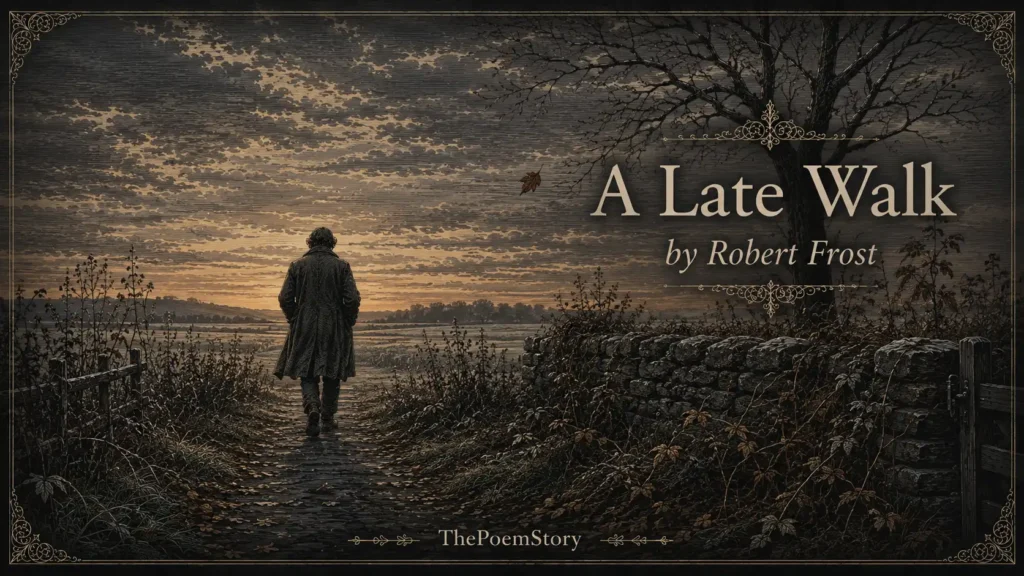
The poem follows the speaker as he walks through the aftermath of the harvest, through withered weeds and bare trees, and finally picks a single faded aster flower to carry back to an unnamed “you.” The walk is late in the season, late in the day, and perhaps late in life. The poem is a quiet elegy—a gentle mourning for what has passed, tempered by the small, tender gesture of offering a fading flower to a loved one.
In this comprehensive guide, we will dissect “A Late Walk” with careful attention to its structure, language, and emotional resonance. We will provide a detailed A Late Walk poem summary, explore the profound themes in A Late Walk by Robert Frost, examine its masterful literary devices in A Late Walk, and ultimately reflect on the A Late Walk meaning and what it reveals about the human capacity to find beauty in endings.
Read and explore ThePoemStory and go through Collected Poems of Robert Frost.
for more poems explore Poetry Section
Table of Contents
The Poem – A Late Walk by Robert Frost
When I go up through the mowing field,
~ A Late Walk by Robert Frost – Analysis and Summary
The headless aftermath,
Smooth-laid like thatch with the heavy dew,
Half closes the garden path.
And when I come to the garden ground,
The whir of sober birds
Up from the tangle of withered weeds
Is sadder than any words.
A tree beside the wall stands bare,
But a leaf that lingered brown,
Disturbed, I doubt not, by my thought,
Comes softly rattling down.
I end not far from my going forth
By picking the faded blue
Of the last remaining aster flower
To carry again to you.
A Late Walk Poem Summary
Before delving into the thematic and literary depths, it is essential to establish a clear A Late Walk poem summary to ensure every reader grasps the narrative and emotional arc of this delicate lyric. The poem is structured in four stanzas of four lines each (quatrains), creating a compact, almost haiku-like meditation on an autumn evening walk.
Stanza 1: The Walk Begins
The poem opens with the speaker walking “up through the mowing field.” The word “up” suggests an ascent, perhaps a hill or slope. This is not a casual stroll; it is a deliberate movement upward, suggesting a journey toward something higher, perhaps toward understanding or acceptance.
He describes “the headless aftermath.” “Aftermath” refers to the grass that grows after the first cutting of hay—what remains after the harvest. “Headless” suggests that the tops have been cut off, leaving only the stubble. This is a field that has been used, harvested, and now lies dormant. The image is one of absence and completion.
The aftermath is “smooth-laid like thatch with the heavy dew.” The dew is heavy, suggesting the moisture of evening or late autumn. The field is so flat and uniform that it resembles a thatched roof, a covering over something that is no longer there. The garden path is “half closed” by the field, suggesting that the boundary between cultivated garden and wild aftermath is blurring. Nature is reclaiming the path.
Stanza 2: The Garden and the Birds
The speaker arrives at the garden ground. Here, he hears the “whir of sober birds.” The word “whir” suggests the sound of wings taking flight—quick, sudden, and mechanical. The birds are “sober,” meaning serious, solemn, perhaps even sad. They rise “up from the tangle of withered weeds.”
This is a scene of decline: withered weeds, birds that are not singing but merely flying away. The speaker tells us that the sound of these birds is “sadder than any words.” This is a striking statement. Words, which are the tools of communication and expression, are inadequate to convey the sadness of this scene. The sound of the birds—their flight, their departure—expresses a sorrow that language cannot capture.
Stanza 3: The Bare Tree and the Falling Leaf
The speaker notices a tree beside the wall that stands “bare.” It has lost all its leaves. But one leaf has “lingered brown.” This leaf is a holdout, a survivor, a latecomer. It has not fallen with the others. The speaker’s thought disturbs it—”Disturbed, I doubt not, by my thought.” The speaker’s mere presence, his contemplation, is enough to dislodge the leaf.
The leaf “comes softly rattling down.” The word “softly” suggests a gentle, unhurried descent. It is not a violent fall; it is a quiet, almost graceful release. The leaf falls not because of wind or rain but because of the speaker’s thought. This is a beautiful and strange image—the idea that human thought can have a physical effect on the world.
Stanza 4: The Aster and the Gift
The final stanza brings the poem to its quiet, tender conclusion. The speaker ends his walk “not far from my going forth”—he has not traveled far, either physically or metaphorically. He picks “the faded blue / Of the last remaining aster flower.” The aster is a late-blooming flower, often associated with autumn. Its blue color is “faded,” suggesting that it is past its prime, nearing the end of its life.
He picks this last, fading flower to “carry again to you.” The word “again” is crucial. This is not the first time he has done this. He has picked flowers for this person before. The gesture is a ritual—a repeated act of love and connection. The speaker returns from his walk not with nothing, but with a small gift: a single fading flower. It is a modest offering, a gesture of tenderness in the face of decay.
This completes our A Late Walk poem summary, revealing a poem about the beauty of endings, the sadness of loss, and the small gestures that connect us to those we love.
Major Themes in A Late Walk by Robert Frost
Now that we have a clear understanding of the narrative, let us examine the profound themes in A Late Walk by Robert Frost. This seemingly simple poem contains layers of philosophical and emotional insight.
1. The Beauty of Endings
The most prominent theme of “A Late Walk” is the beauty of endings. The poem celebrates not beginnings or peaks but the final moments of things: the aftermath of the harvest, the withered weeds, the bare tree, the last lingering leaf, the faded aster. Frost finds aesthetic value in decay, decline, and conclusion.
This theme challenges our cultural obsession with growth, progress, and youth. Frost suggests that there is a quiet dignity in endings—a beauty that only reveals itself to those who pay attention. The fading blue of the aster is not less beautiful than the vibrant bloom of summer; it is beautiful in a different way.
2. The Inadequacy of Language
The speaker tells us that the sound of the birds is “sadder than any words.” This is a remarkable admission from a poet—someone whose profession is words. Frost suggests that language is inadequate to capture certain experiences. There are emotions so deep, so complex, that they exceed the capacity of words.
This theme reflects Frost’s philosophical skepticism about the power of language. Words can describe, but they cannot fully convey. The “whir of sober birds” communicates a sorrow that prose and poetry can only approximate.
3. The Power of Thought
The speaker’s thought disturbs the lingering leaf, causing it to fall. This is a powerful image of the connection between mind and world. The speaker’s contemplation has a physical effect. This theme suggests that consciousness is not separate from nature but participates in it.
There is also a hint of guilt in this image. The speaker’s thought causes the leaf to fall. He is responsible, in some small way, for hastening the leaf’s demise. This raises questions about the relationship between observation and interference.
4. Small Gestures of Love
The poem ends with a tender gesture: picking a faded flower to carry to an unnamed “you.” This small act is a ritual of love and connection. The flower is not a grand bouquet; it is a single, fading aster. Its modesty is part of its significance.
The word “again” tells us that this is a repeated act. The speaker regularly brings flowers to this person. This theme celebrates the power of small, consistent gestures in sustaining love and connection. It is not grand declarations that matter most but the quiet, repeated acts of attention and care.
5. Solitude and Connection
The walk is a solitary act. The speaker is alone in the field and garden. But he is not entirely alone—he carries the thought of the “you” to whom he will give the flower. The walk is a movement away and a return, a departure that culminates in a gift.
This theme explores the relationship between solitude and connection. We need time alone to observe, reflect, and gather. But the meaning of that solitude is enriched by the connection it serves. The walk is not an escape from relationship but a preparation for it.
6. The Cycle of Seasons
“A Late Walk” is deeply engaged with the cycle of seasons. The mowing field, the aftermath, the withered weeds, the bare tree, and the last aster all speak of autumn—the season of decay and preparation for winter. But autumn is also the season of harvest, of gathering, of conclusion.
Frost invites us to see autumn not as a tragedy but as a natural part of the cycle. The fading flower is not a symbol of death but of completion. The year is ending, and there is a kind of peace in that ending.
Literary Devices in A Late Walk
To fully appreciate the craftsmanship of this poem, we must examine the rich array of literary devices in A Late Walk. Frost employs these techniques with his characteristic subtlety and precision, creating a poem that is both simple and profoundly complex.
1. Imagery
Frost’s imagery in this poem is precise and evocative:
- Visual: “headless aftermath,” “smooth-laid like thatch,” “heavy dew,” “tangle of withered weeds,” “bare tree,” “leaf that lingered brown,” “faded blue aster.”
- Auditory: “whir of sober birds,” “softly rattling down.”
- Tactile: “heavy dew,” “smooth-laid.”
The imagery consistently emphasizes decay, silence, and muted colors. There are no bright colors, no loud sounds. The world of the poem is soft, quiet, and fading.
2. Simile
The poem contains a striking simile in the first stanza: the aftermath is “smooth-laid like thatch with the heavy dew.” The comparison of a mown field to a thatched roof is unexpected and precise. It suggests that the field has become a kind of covering, a roof over the earth.
3. Personification
The poem contains subtle personification. The garden path is “half closed” by the field, as if the path is a living thing that can be partially shut. The leaf “lingers,” suggesting a conscious decision to remain. The birds are “sober,” a human quality attributed to animals.
4. Symbolism
Several symbols enrich the poem’s meaning:
- The Late Walk: Represents the journey of life, particularly its later stages.
- The Aftermath: Represents what remains after the harvest of life—the residue of experience.
- The Bare Tree: Represents loss, aging, and the stripping away of life’s luxuries.
- The Lingering Leaf: Represents stubborn life, the refusal to let go.
- The Faded Aster: Represents last beauty, the final offering of a life cycle.
5. Tone
The tone of the poem is gentle, melancholic, and tender. There is no anger, no bitterness, no despair. The speaker accepts the decay around him with a quiet, almost grateful sadness. The tone reflects Frost’s characteristic restraint—the emotions are real, but they are expressed with understated dignity.
6. Rhyme and Meter
The poem follows a consistent ABAB rhyme scheme in each quatrain. The meter is predominantly iambic, with variations that reflect the speaker’s contemplative mood. The regular rhythm creates a sense of calm and stability, even as the poem explores loss and decay.
7. Alliteration
Frost uses alliteration to create musical effects: “smooth-laid,” “garden ground,” “whir,” “withered weeds,” “sober birds,” “sadder,” “stands,” “softly rattling.” These repeated sounds give the poem a gentle, rhythmic quality that mirrors the speaker’s slow walk.
8. Paradox
There is a subtle paradox in the poem. The speaker walks “up” but ends “not far from my going forth.” The upward movement is not a journey to a distant place; it is a circular journey that returns to where it began. This paradox suggests that the real journey is inward, not outward.
The Deeper Meaning of A Late Walk
Beyond its surface-level narrative, the A Late Walk meaning reveals a profound meditation on the nature of endings and the importance of small gestures of love. This is where the poem transcends its historical context and speaks directly to the human condition.
The A Late Walk meaning centers on the recognition that life is a series of endings. The walk is “late”—late in the season, late in the day, and perhaps late in life. The fields have been harvested, the weeds are withered, the tree is bare, and the last flower is fading. Everything is coming to an end.
But the poem does not despair. The speaker picks the faded aster and carries it to his beloved. This small gesture transforms the walk from a meditation on loss into an act of love. The beauty of the ending is not lost; it is gathered and offered.
The A Late Walk meaning also speaks to the power of attention. The speaker notices the aftermath, the birds, the bare tree, the lingering leaf, and the faded aster. He pays attention to what others might overlook. This attention is a form of love—a willingness to see the world in all its decay and still find it beautiful.
The “you” in the final line is unnamed, allowing the reader to project their own beloved into the poem. This ambiguity makes the poem universal. The gift of the faded flower is a gift of attention, of presence, of love. It is a reminder that the greatest gift we can give is to pay attention to what is fading and to offer it to those we love.
Ultimately, the A Late Walk meaning is that endings are not the end. The walk returns to where it began. The fading flower is carried to the beloved. Loss and love are intertwined. The poem teaches us to accept endings, to find beauty in them, and to transform them into acts of love.
Reflection on Human Life
“A Late Walk” offers a timeless mirror to the human condition, and its relevance only grows in our modern world of constant stimulation and fear of aging.
The Art of Letting Go
The poem teaches us the art of letting go. The tree lets go of its leaves. The leaf lets go of the tree. The speaker lets go of the flower by picking it, but he also lets go by accepting the decay around him. We are all in the process of letting go—letting go of youth, of loved ones, of life itself. The poem suggests that this letting go can be graceful, even beautiful.
The Importance of Small Gestures
In a world that celebrates grand achievements, “A Late Walk” reminds us of the importance of small gestures. The speaker does not change the world. He does not write a great poem or perform a heroic act. He simply picks a fading flower and carries it to his beloved. This small act is an act of love, of attention, of presence.
We often overlook the power of small gestures. We think love must be grand to be meaningful. Frost suggests otherwise. The repeated act of bringing flowers—”again”—is what sustains love. It is the consistency, not the size, of the gesture that matters.
The Beauty of Aging
Our culture fears aging. We spend billions on products and procedures to appear younger. Frost offers a different perspective. The faded aster is not less beautiful than the fresh bloom; it is beautiful in a different way. Aging brings a kind of wisdom, a kind of depth, a kind of beauty that youth cannot attain.
The poem invites us to see the beauty in our own fading. The wrinkles, the grey hair, the slowing down—these are not signs of loss but of completion. Like the bare tree and the faded aster, we are becoming what we are meant to be.
The Power of Attention
The speaker notices everything: the aftermath, the dew, the birds, the weeds, the bare tree, the lingering leaf, the faded aster. This attention is a form of love. To truly see something is to honor it. In our distracted, screen-filled world, we rarely pay attention to anything. The poem invites us to slow down, to walk, to look, to listen.
The Cycle of Return
The speaker ends “not far from my going forth.” The walk is a circle. He returns to where he began, carrying a flower. This circularity suggests that life is not a linear journey from birth to death but a series of returns. We leave and we come back. We give and we receive. The cycle is not a trap but a rhythm. The poem invites us to find peace in this rhythm.
Conclusion
“A Late Walk” is a quiet masterpiece of early Frost—a poem that rewards careful reading and deep reflection. It is a meditation on endings, loss, and the small gestures that sustain love. Through its simple imagery, its gentle rhythm, and its tender conclusion, the poem invites us to find beauty in decay and meaning in the act of giving.
Through our A Late Walk by Robert Frost analysis, we have explored the poem’s structure, its A Late Walk poem summary, the profound themes in A Late Walk by Robert Frost, the masterful literary devices in A Late Walk, and the enduring A Late Walk meaning.
“A Late Walk” does not offer grand solutions or dramatic revelations. It offers something more valuable: a gentle reminder to pay attention, to accept endings, and to transform loss into love. The speaker’s walk is a walk we all take—a walk through the fading fields of our lives, gathering what remains, and offering it to those we love.
If you have ever walked through a late autumn field, noticed a bare tree, or picked a fading flower for someone you love, then you have walked with Frost. And like him, you have discovered that the end of things is not the end of beauty.
Enjoyed this deep dive into Frost’s poetry? If you want to explore more of his work, consider adding a complete collection to your library. There is no better companion for a quiet autumn evening than the timeless verses of Robert Frost.
Did this analysis illuminate a new perspective on “A Late Walk” for you? Drop a comment below and let me know your thoughts. If you found this valuable, please share it with a fellow poetry enthusiast!
Read and explore ThePoemStory and go through Collected Poems of Robert Frost.
for more poems explore Poetry Section

Get the ThePoemStory App — Read Poems Anywhere