Robert Frost stands as one of the colossal figures of 20th-century American poetry. Known for his accessible yet profoundly layered verses, Frost often employed the rural landscapes of New England as a canvas for exploring the deepest crevices of the human psyche. While his later works, such as “The Road Not Taken” and “Stopping by Woods on a Snowy Evening,” cemented his place in the public consciousness, it is in his early collections that we find the raw, unpolished seeds of his genius.
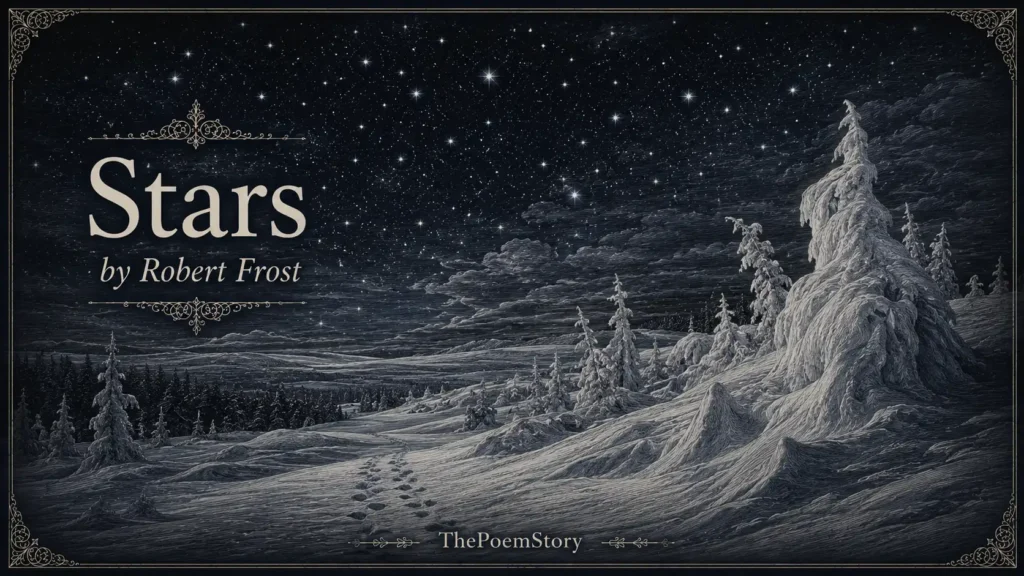
This Stars by Robert Frost analysis examines one of the most striking and enigmatic poems from his debut collection, A Boy’s Will (1913). “Stars” is a short, intensely visual lyric that captures a winter night sky viewed over a snow-covered landscape. Yet beneath its stark imagery lies a profound meditation on human insignificance, cosmic indifference, and the limits of perception.
The poem presents a paradox: the stars “congregate” over the “tumultuous snow” as if they are keenly interested in human fate. But in the final lines, Frost reveals that the stars are like “Minerva’s snow-white marble eyes / Without the gift of sight.” They appear to watch, but they cannot see. They seem to care, but they are blind. The poem is a meditation on the gap between appearance and reality—between what we project onto the universe and what the universe actually is.
In this comprehensive guide, we will dissect “Stars” with careful attention to its structure, language, and philosophical depth. We will provide a detailed Stars poem summary, explore the profound themes in Stars by Robert Frost, examine its masterful literary devices in Stars, and ultimately reflect on the Stars meaning and what it reveals about the human desire for meaning in an indifferent universe.
Read and explore ThePoemStory and go through Collected Poems of Robert Frost.
for more poems explore Poetry Section
Table of Contents
The Poem – Stars by Robert Frost
How countlessly they congregate
~ Stars by Robert Frost – Analysis and Summary
O’er our tumultuous snow,
Which flows in shapes as tall as trees
When wintry winds do blow!—
As if with keenness for our fate,
Our faltering few steps on
To white rest, and a place of rest
Invisible at dawn,—
And yet with neither love nor hate,
Those stars like some snow-white
Minerva’s snow-white marble eyes
Without the gift of sight.
Stars Poem Summary
Before delving into the thematic and literary depths, it is essential to establish a clear Stars poem summary to ensure every reader grasps the narrative and philosophical arc of this striking lyric. The poem is structured as a single, continuous stanza, creating a sense of unity and flow that mirrors the vastness of the night sky.
Line 1–4: The Stars and the Snow
The poem opens with a powerful image of stars “congregating” over the “tumultuous snow.” The word “countlessly” suggests an infinite number, overwhelming the human capacity to count or comprehend. The snow is “tumultuous,” meaning chaotic, agitated, and turbulent. This is not a calm, peaceful snow; it is snow driven by wind, shaped into drifts and waves.
The snow “flows in shapes as tall as trees / When wintry winds do blow!” The snowdrifts rise up, mimicking the forms of trees. The landscape is transformed by the wind, becoming something strange and fluid. The exclamation mark suggests a kind of wonder or awe at the power of nature.
Line 5–8: The Illusion of Concern
The speaker observes the stars “as if with keenness for our fate.” The stars appear to be intensely interested in human destiny. The word “keenness” suggests sharpness, eagerness, and attentive concern. The stars seem to watch over “our faltering few steps on / To white rest, and a place of rest / Invisible at dawn.”
“Faltering few steps” suggests human life as a hesitant, uncertain journey. The destination is “white rest”—a kind of peace, perhaps death, or perhaps simply the end of the journey. This place of rest is “invisible at dawn,” suggesting that it disappears with the coming of light. The stars seem to watch over this journey, as if they care about its outcome.
Line 9–12: The Revelation
But the final lines deliver a stark revelation. The stars are “with neither love nor hate.” They are utterly indifferent. The speaker then offers a powerful simile: the stars are “like some snow-white / Minerva’s snow-white marble eyes / Without the gift of sight.”
Minerva is the Roman goddess of wisdom, crafts, and strategic warfare—the equivalent of the Greek Athena. Her eyes are “snow-white marble,” suggesting coldness, hardness, and lifelessness. They are “without the gift of sight.” The stars appear to be eyes that watch us, but they are blind. They are the eyes of a goddess who cannot see.
This is the poem’s central paradox: the stars seem to care, but they do not. They seem to watch, but they are blind. The human projection of meaning onto the cosmos is revealed as an illusion. This completes our Stars poem summary, revealing a poem about cosmic indifference and the limits of human perception.
Major Themes in Stars by Robert Frost
Now that we have a clear understanding of the narrative, let us examine the profound themes in Stars by Robert Frost. This short, compact poem contains layers of philosophical and theological insight.
1. Cosmic Indifference
The central theme of “Stars” is cosmic indifference. The stars appear to watch over humanity, but they are blind. They appear to care, but they are without love or hate. The universe does not care about human fate. This theme challenges religious and philosophical assumptions that the cosmos is ordered by a benevolent or even attentive intelligence.
Frost’s vision is not hostile; it is simply indifferent. The stars are not malevolent; they are simply unconcerned. This is a more unsettling vision than active hostility. A hostile universe would at least acknowledge our existence. An indifferent universe simply does not notice us.
2. The Limits of Human Perception
The poem suggests that human perception is profoundly limited. We see the stars as eyes that watch us, but this is a projection. The stars are not eyes; they are balls of burning gas. We see meaning where there is none. The poem challenges our tendency to anthropomorphize the universe—to project human qualities onto non-human things.
The “gift of sight” is a human gift. The stars lack it. The poem invites us to recognize the limits of our own vision. We see what we want to see, not what is actually there.
3. The Illusion of Meaning
The poem explores the human need for meaning. The speaker describes the stars “as if with keenness for our fate.” The phrase “as if” is crucial. The stars do not actually have keenness; they only seem to. The human mind seeks patterns and significance where none exist.
This theme connects to broader existential questions. Do our lives have meaning? Does the universe care about us? Frost suggests that we must find meaning within ourselves, not in the cosmos.
4. The Journey Toward Rest
The poem describes human life as a journey toward “white rest.” This rest is “invisible at dawn”—it disappears when the light comes. This suggests that our ultimate destination is uncertain, perhaps even unknowable. We walk “faltering” steps toward something we cannot see clearly.
This theme reflects Frost’s skepticism about easy answers to the question of human purpose. We are walking, but we do not know where we are going. The destination remains invisible.
5. The Contrast Between Human and Cosmic Scale
The poem juxtaposes the infinite stars with the “faltering few steps” of human life. The stars are countless; our steps are few. The stars are vast and eternal; our lives are brief and uncertain. This contrast highlights human insignificance in the face of cosmic scale.
Yet the poem does not despair. It simply observes. There is a kind of dignity in the human ability to observe and reflect, even in the face of cosmic indifference. The speaker sees the stars and understands their blindness. This understanding is a form of wisdom.
6. The Paradox of the Eye
The poem centers on the paradox of the eye. The stars look like eyes, but they cannot see. The goddess of wisdom has marble eyes that are blind. The poem suggests that appearance and reality are often opposed. What looks like watching is actually blindness. What looks like wisdom is actually ignorance.
Literary Devices in Stars
To fully appreciate the craftsmanship of this poem, we must examine the rich array of literary devices in Stars. Frost employs these techniques with his characteristic precision and restraint, creating a poem that is both visually striking and philosophically profound.
1. Imagery
Frost’s imagery in this poem is stark and powerful:
- Visual: “countlessly they congregate,” “tumultuous snow,” “shapes as tall as trees,” “snow-white,” “marble eyes.”
- Kinetic: “flows,” “blow,” “faltering steps,” “to white rest.”
- Thermal: “wintry winds,” “white rest.”
The imagery consistently emphasizes whiteness, coldness, and vastness. The snow, the stars, the marble eyes—all are white. This creates a sense of purity, but also of coldness and distance.
2. Simile
The poem contains a striking simile in the final lines: the stars are “like some snow-white / Minerva’s snow-white marble eyes / Without the gift of sight.” This simile compares the stars to the blind eyes of a goddess, emphasizing their coldness, hardness, and inability to see.
3. Personification
The poem uses subtle personification. The stars “congregate,” suggesting a deliberate gathering. They are described “as if with keenness for our fate,” implying intention and concern. This personification is then revealed as false—the stars do not actually have these qualities.
4. Symbolism
Several symbols enrich the poem’s meaning:
- The Stars: Represent the cosmos, the divine, or fate. They appear to watch over humanity but are actually blind and indifferent.
- The Snow: Represents the human condition—turbulent, transient, shaped by forces beyond our control.
- The Wind: Represents the forces that shape human life—circumstance, fate, nature.
- White Rest: Represents death, peace, or the end of the journey.
- Minerva: Represents wisdom, the desire for knowledge and meaning. Her blind marble eyes suggest that wisdom without sight is useless.
5. Tone
The tone of the poem is contemplative and slightly melancholy. The speaker observes the stars with a kind of awe, but also with a sense of resignation. There is no anger or despair—only a quiet acceptance of cosmic indifference.
6. Enjambment
Frost uses enjambment—the continuation of a sentence without a pause beyond the end of a line—to create a sense of flow and movement. The lines run into each other, mirroring the flowing snow and the endless stars. This technique gives the poem a breathless, continuous quality.
7. Paradox
The central device of the poem is paradox. The stars appear to watch but are blind. They appear to care but are indifferent. The goddess of wisdom has eyes that cannot see. These paradoxes force the reader to question the nature of perception and meaning.
8. Allusion
The reference to “Minerva” is a classical allusion. Minerva is the Roman goddess of wisdom, the equivalent of the Greek Athena. By invoking Minerva, Frost connects the stars to the idea of wisdom. But the wisdom of the stars is cold, marble, and sightless—a hollow, lifeless wisdom.
The Deeper Meaning of Stars
Beyond its surface-level imagery, the Stars meaning reveals a profound meditation on the human desire for meaning in an indifferent universe. This is where the poem transcends its historical context and speaks directly to the human condition.
The Stars meaning centers on the recognition that the cosmos does not care about us. The stars are not watching over us. They are not concerned with our fate. They are blind, cold, and indifferent. This is a challenging idea, especially in a culture that often projects meaning onto the universe.
But the poem also suggests that the human tendency to see meaning is itself meaningful. The speaker sees the stars “as if with keenness for our fate.” The “as if” is important. We cannot help but see meaning. It is part of being human. The stars may be blind, but we are not. We see the stars and reflect on our own condition.
The Stars meaning also speaks to the limits of wisdom. Minerva is the goddess of wisdom, but her eyes are marble and blind. Wisdom without sight is useless. The stars may represent cosmic wisdom, but it is a wisdom that cannot see us, cannot understand us, cannot care for us. The poem suggests that true wisdom is human wisdom—the ability to see clearly, to accept the limits of our knowledge, and to find meaning in the act of observation itself.
Ultimately, the Stars meaning is that we are alone. The stars do not care. The universe does not care. But we have each other. We have our own vision. We can walk our “faltering few steps” together, even if the destination remains “invisible at dawn.” The poem is a call to accept the limits of the cosmos and to find meaning in our own human journey.
Reflection on Human Life
“Stars” offers a timeless mirror to the human condition, and its relevance only grows in our modern world of scientific discovery and existential questioning.
The Search for Cosmic Meaning
Human beings have always looked to the stars for meaning. We have used them for navigation, for timekeeping, and for spiritual guidance. We have projected our hopes and fears onto them. Frost’s poem reminds us that the stars do not return our gaze. They are not interested. They are simply there.
This is a humbling realization. We are not the center of the universe. The cosmos does not revolve around us. But rather than despair, Frost invites us to accept this reality with dignity. We can still find meaning, but we must find it within ourselves and our relationships, not in the stars.
The Limits of Human Understanding
The poem challenges our confidence in human understanding. We see the stars as eyes, but they are blind. We see meaning, but there is none. This theme resonates with modern science, which has revealed a universe that is vast, ancient, and indifferent to human concerns.
Yet the poem does not reject human understanding entirely. The speaker sees clearly. He understands that the stars are blind. This understanding is a form of wisdom—a wisdom that accepts the limits of knowledge and finds peace in that acceptance.
The Journey of Life
The poem describes human life as a journey toward “white rest.” This rest is “invisible at dawn.” We do not know where we are going. The destination is hidden from us. This theme invites us to accept the uncertainty of life. We do not know what lies ahead. We walk with “faltering” steps. But we continue.
In our goal-oriented culture, this is a radical idea. We are constantly told to set goals, achieve objectives, and reach destinations. Frost suggests that the journey itself is what matters. The “white rest” may be invisible, but the walking is real.
The Human Gaze
The poem is about seeing. The stars are eyes that cannot see. But the speaker sees. He sees the stars, the snow, the wind, the journey. His vision is a gift. The poem suggests that human vision is precious precisely because it is limited. We see what we can see, and we make meaning from what we see.
In a universe of blind stars, human vision is a miracle. We can see the beauty of the snow, the majesty of the stars, the sadness of our own journey. This vision is a gift, even if it is a gift we have given ourselves.
The Paradox of Wisdom
Minerva is the goddess of wisdom, but her eyes are blind. This paradox challenges our assumptions about wisdom. What is wisdom? Is it the accumulation of knowledge? Is it the ability to see clearly? Frost suggests that wisdom is the recognition of our own blindness. We do not know. We cannot see. But we can accept our limits.
This is a profound and humbling idea. True wisdom is not certainty; it is humility. The wise person knows that they do not know. The wise person sees the stars and understands that they are blind.
Conclusion
“Stars” is a quiet masterpiece of early Frost—a poem that rewards careful reading and deep reflection. It is a meditation on cosmic indifference, human perception, and the limits of meaning. Through its stark imagery, its classical allusion, and its powerful paradox, the poem invites us to accept the blindness of the stars and to find meaning in our own human vision.
Through our Stars by Robert Frost analysis, we have explored the poem’s structure, its Stars poem summary, the profound themes in Stars by Robert Frost, the masterful literary devices in Stars, and the enduring Stars meaning.
“Stars” does not offer comfort. It does not tell us that the universe cares. Instead, it offers something more valuable: an honest confrontation with reality. The stars are blind. The cosmos is indifferent. But we can see. We can walk. We can find meaning in our own vision and our own journey.
If you have ever looked up at the night sky and felt both awe and insignificance, then you have stood where Frost stood. And like him, you may find that the blindness of the stars is not a cause for despair but a call to see more clearly, to see what is actually there, and to find meaning in the act of seeing itself.
Enjoyed this deep dive into Frost’s poetry? If you want to explore more of his work, consider adding a complete collection to your library. There is no better companion for a quiet winter night than the timeless verses of Robert Frost.
Did this analysis illuminate a new perspective on “Stars” for you? Drop a comment below and let me know your thoughts. If you found this valuable, please share it with a fellow poetry enthusiast!
Read and explore ThePoemStory and go through Collected Poems of Robert Frost.
for more poems explore Poetry Section
Get the ThePoemStory App — Read Poems Anywhere