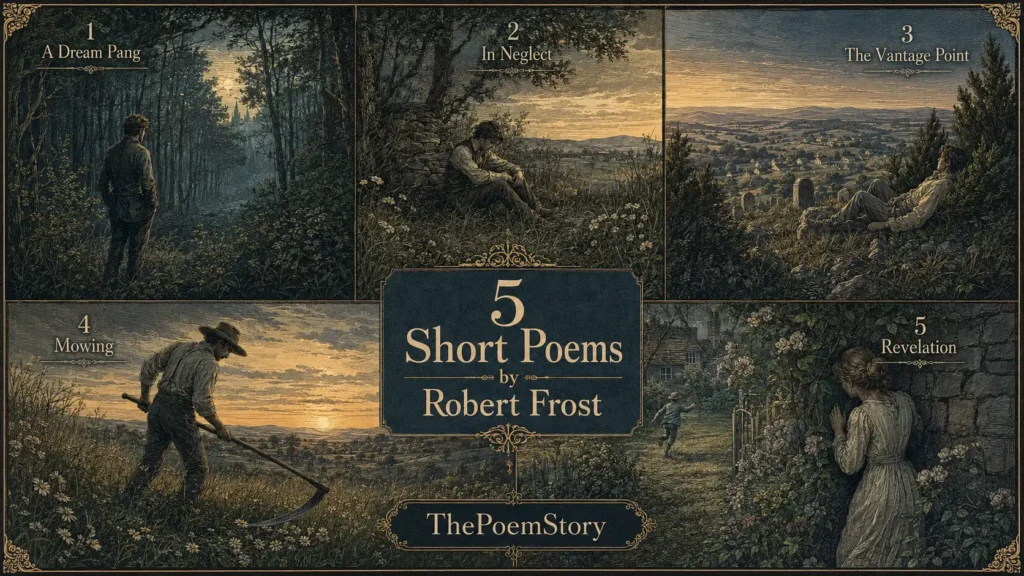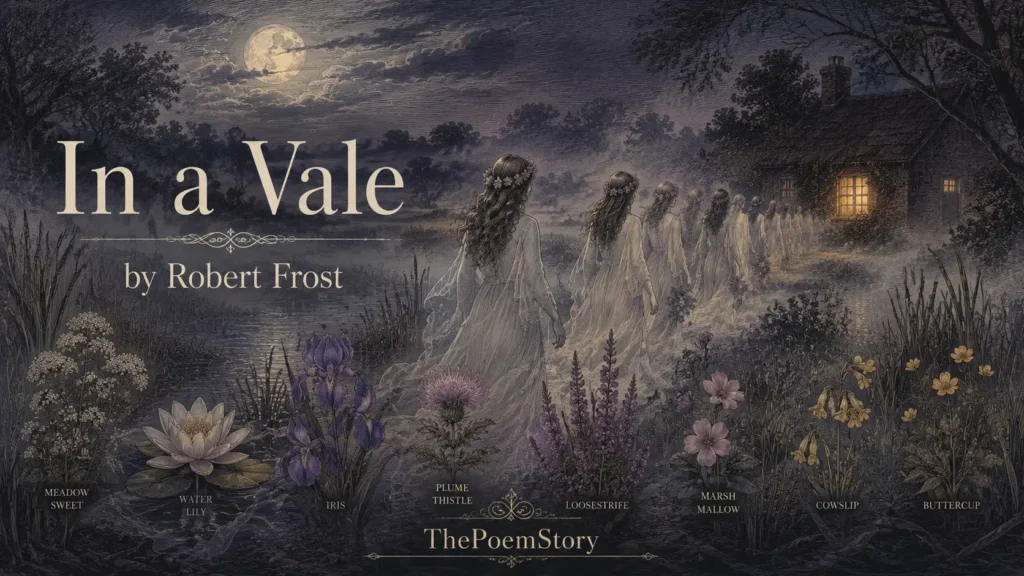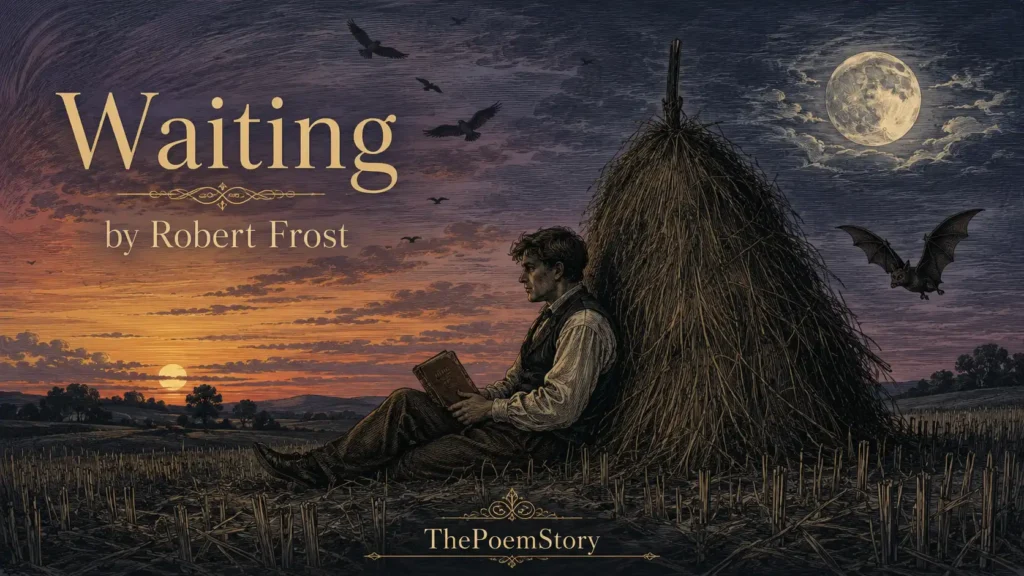
Robert Frost stands as one of the colossal figures of 20th-century American poetry. Known for his accessible yet profoundly layered verses, Frost often employed the rural landscapes of New England as a canvas for exploring the deepest crevices of the human psyche. While his later works, such as “The Road Not Taken” and “Stopping by Woods on a Snowy Evening,” cemented his place in the public consciousness, it is in his early collections that we find the raw, unpolished seeds of his genius.
This Ghost House by Robert Frost analysis begins with the poem’s publication in 1913 as part of Frost’s debut poetry collection, A Boy’s Will. This collection is significant not merely because it introduced Frost to the world but because it arrived at a crucial juncture in his life. At the age of 39, Frost had moved his family to England, frustrated by the lack of recognition in the United States. He was financially strained, battling personal tragedy (the loss of two of his children to illness), and desperate to prove his worth as a poet. It was in this state of emotional turmoil that he wrote many of the poems in A Boy’s Will, using them as a form of psychological excavation.
“Ghost House” is far more than a simple gothic poem. It is a profound meditation on the nature of dwelling—not in a physical structure, but within the architecture of memory. The poem’s speaker lives in a house that has literally disappeared from the landscape. This paradox immediately invites the reader into a world where the boundaries between the physical and the psychological, between the living and the dead, are blurred to the point of erasure.
Unlike the stereotypical haunted house of Victorian literature—filled with clanking chains, vengeful spirits, and terrifying apparitions—Frost’s house is haunted by absence. The ghosts here are not monsters; they are “mute folk” who are “slow and sad.” The poem suggests that the most potent hauntings are not external, but internal. We are haunted by who we were, by the places we have left behind, and by the people who no longer walk beside us.
In this comprehensive guide, we will dissect “Ghost House” with the precision of a literary surgeon. We will explore its historical context, break down its complex structure, provide a detailed Ghost House poem summary, analyze its rich tapestry of literary devices, delve deeply into the themes in Ghost House by Robert Frost, explore the Ghost House literary devices that make it a masterwork, and ultimately reflect on the Ghost House Robert Frost meaning and what this century-old poem tells us about the human condition today.
Read and explore ThePoemStory and go through Collected Poems of Robert Frost.
for more poems explore Poetry Section
Ghost House by Robert Frost Analysis and Summary
The Poem – Ghost House by Robert Frost
I dwell in a lonely house I know
~ Ghost House by Robert Frost Analysis and Summary
That vanished many a summer ago,
And left no trace but the cellar walls,
And a cellar in which the daylight falls,
And the purple-stemmed wild raspberries grow.
O’er ruined fences the grape-vines shield
The woods come back to the mowing field;
The orchard tree has grown one copse
Of new wood and old where the woodpecker chops;
The footpath down to the well is healed.
I dwell with a strangely aching heart
In that vanished abode there far apart
On that disused and forgotten road
That has no dust-bath now for the toad.
Night comes; the black bats tumble and dart;
The whippoorwill is coming to shout
And hush and cluck and flutter about:
I hear him begin far enough away
Full many a time to say his say
Before he arrives to say it out.
It is under the small, dim, summer star.
I know not who these mute folk are
Who share the unlit place with me—
Those stones out under the low-limbed tree
Doubtless bear names that the mosses mar.
They are tireless folk, but slow and sad,
Though two, close-keeping, are lass and lad,—
With none among them that ever sings,
And yet, in view of how many things,
As sweet companions as might be had.
Ghost House Poem Summary
Before diving into thematic and literary analysis, it is essential to establish a clear Ghost House poem summary to ensure every reader understands the narrative arc. This section provides an exhaustive, stanza-by-stanza, and nearly line-by-line breakdown of the poem.
Stanza 1: The Reclaimed Landscape and the Paradox of Dwelling
The poem opens with a paradox that immediately arrests the reader. The speaker declares, “I dwell in a lonely house I know / That vanished many a summer ago.” To “dwell” implies an active, present habitation, yet the house has “vanished.” Frost sets up the central philosophical question of the poem: What does it mean to live in something that no longer exists?
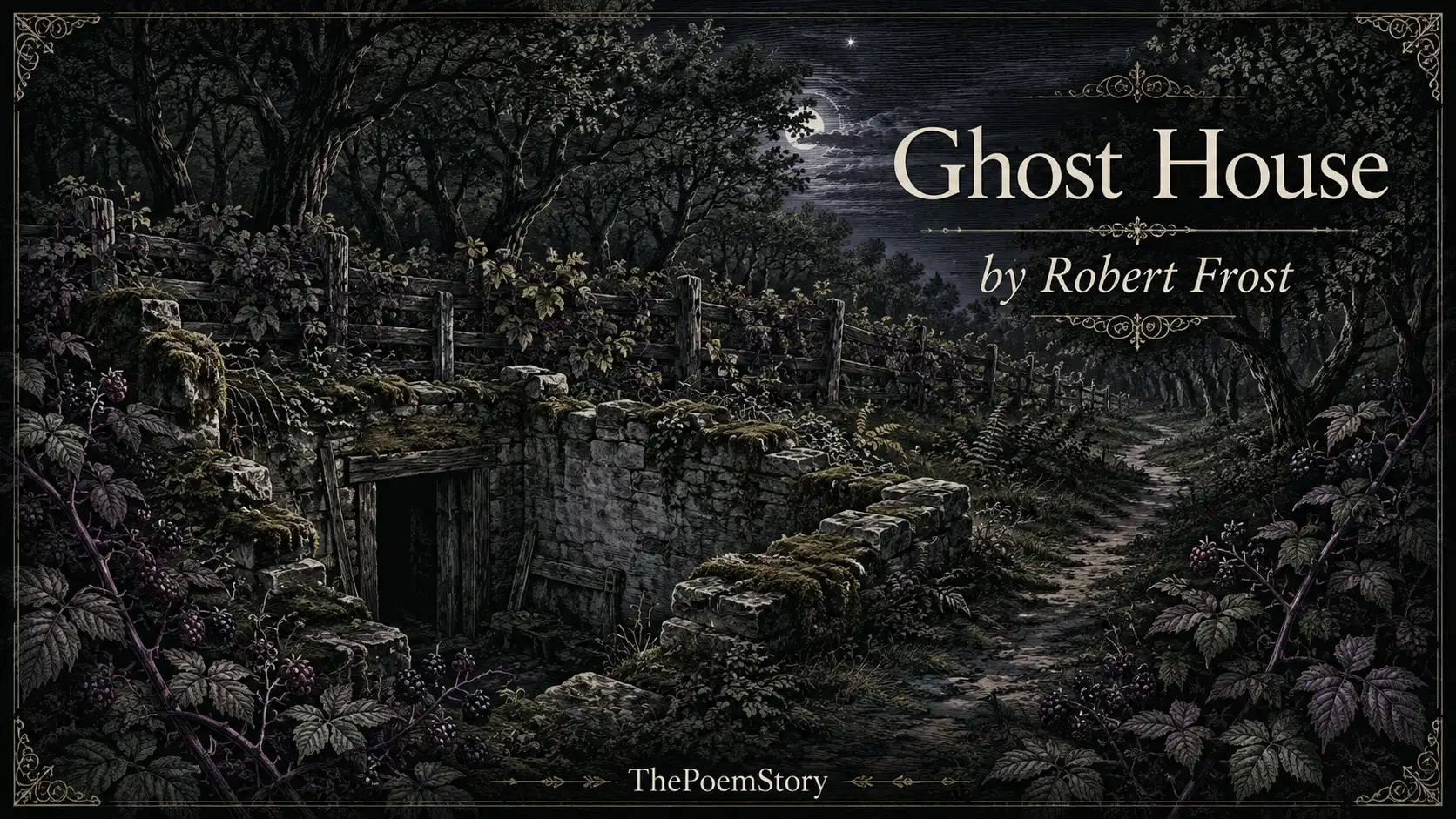
He clarifies that the physical house has left “no trace but the cellar walls.” This is a specific, grounding image—cellars are the foundational elements of a house, hidden from view, yet essential. The fact that “the daylight falls” into this cellar indicates that the roof and floors are completely gone. The house is a hollow pit, an open wound in the earth.
But Frost does not present this as a scene of total desolation. Nature moves in to fill the void. The “purple-stemmed wild raspberries” are a striking detail. The color purple often symbolizes royalty, spirituality, or penance, but here it represents wild, untamed fertility. From the ruins, sweet fruit emerges. This is a core Frostian belief: destruction and creation are inextricably linked.
The second half of the stanza expands the scope. We see “ruined fences” shielded by grape-vines. The fence, a symbol of human property and division, is being dismantled by the very vines meant to be cultivated. The “woods come back to the mowing field.” The word “back” is crucial—it was the woods first. Human civilization is merely a temporary interruption in a much longer natural cycle. This is an ecological statement decades ahead of its time.
The “orchard tree” has not died but has transformed into a “copse” (a dense thicket of small trees). It has gone feral, mixing “new wood and old.” The “woodpecker chops” here, a sound of life and persistence. Finally, the “footpath down to the well is healed.” The word “healed” is astonishing. It personifies the earth, suggesting that the footpath was a wound on the landscape, and nature has applied a remedy. Human presence is erased, and in its absence, the land recovers its wholeness. The speaker is describing a crime scene where nature has cleaned up the evidence of human existence.
Stanza 2: The Aching Heart and the Nocturnal Onslaught
The second stanza pivots from the objective to the deeply subjective. “I dwell with a strangely aching heart.” The adverb “strangely” is telling. It is not a sharp, acute pain, but a dull, persistent, inexplicable ache—the hallmark of melancholy and nostalgia. He dwells “far apart” on a “disused and forgotten road.” The isolation is complete. The road is so abandoned that it has no “dust-bath now for the toad.” Toads, humble creatures, cannot even find a patch of dust to roll in. This imagery conveys a sense of cosmic neglect. The world has not just forgotten this place; it has rendered it functionally irrelevant.
This is where Frost’s genius for atmospheric horror shines. As night falls, the scene becomes more unsettling. “The black bats tumble and dart.” Bats are classic gothic symbols of the supernatural and the demonic. Their flight is described as “tumble and dart”—chaotic, unpredictable, unsettling.
Then, we hear the whippoorwill. This bird is a staple of American folklore, often considered a harbinger of death. The whippoorwill’s call is a repetitive, three-syllable whistle that sounds like its name. Frost describes him as “coming to shout / And hush and cluck and flutter about.” The bird is not just singing; it is performing an anxious, restless ritual.
The speaker describes hearing the bird “begin far enough away / Full many a time to say his say / Before he arrives to say it out.” This is a masterclass in building suspense. The bird’s approach is agonizingly slow. We hear its call growing closer, a prelude to something ominous, but the “arrival” is delayed. This mirrors the speaker’s own life—waiting for a resolution, a conclusion, a death, that is perpetually postponed. The bird’s call is the voice of the night, and the speaker is trapped in a house of memory, listening to the soundtrack of his own isolation.
Stanza 3: The Mute Companions and the Acceptance of the Grave
The final stanza brings the poem to its quiet, melancholic resolution. The setting shifts to “under the small, dim, summer star.” The star is “dim,” not a bright guiding light, suggesting that even celestial guidance is faint and unreliable in this forsaken place.
The speaker acknowledges the “mute folk” who share his “unlit place.” He does not claim to know them intimately; he says, “I know not who these mute folk are.” However, he knows exactly what they are. They are the “stones out under the low-limbed tree” that “doubtless bear names that the mosses mar.” These are gravestones. Time (the moss) is actively erasing their identities. The names, the last vestiges of their existence, are being obscured by nature, just as the house was reclaimed.
He describes these residents as “tireless folk, but slow and sad.” This is a fascinating paradox. They are dead; they are eternal (“tireless” because they cannot tire), yet their emotional state remains one of sadness. He then singles out two stones that are “close-keeping,” identifying them as “lass and lad”—a young girl and boy. This is a classic romantic tragedy. They died young, perhaps lovers, bound together in death as they were in life. They are the ghosts.
The closing lines are the most poignant in the poem: “With none among them that ever sings, / And yet, in view of how many things, / As sweet companions as might be had.” This is a startling conclusion. The speaker acknowledges that these dead companions are silent, sorrowful, and cannot offer the warmth of the living. Yet, “in view of how many things”—considering the cruelty, the fickleness, the betrayal, and the relentless passage of time in the world of the living—these quiet, dead souls are “as sweet companions as might be had.”
He is making peace with the dead. He is choosing the cemetery, the silence, and the memory over the noisy, painful, transient world. It is not a joyful choice, but it is a dignified one. This completes our Ghost House poem summary, paving the way for a deeper exploration of its construction and meaning.
Major Themes in Ghost House by Robert Frost
Now that we have a firm grasp of the narrative, let us examine the themes in Ghost House by Robert Frost. “Ghost House” is a masterclass in weaving multiple deep themes into a short lyric. Here are the predominant ones:
1. The Transience of Human Endeavor
This is perhaps the most prominent theme. The poem is a direct assault on human vanity. We build houses, fences, orchards, and footpaths, believing they are permanent. Frost shows that they are mere sandcastles against the tide of nature. “The woods come back” is a chilling statement of ecological truth. Ultimately, nature is indifferent to our existence. The house didn’t just fall down; it vanished, swallowed whole by time. This theme invites the reader to humble themselves before the vast, non-judgmental power of the natural world.
2. Nature as a Restorative and Destructive Force
Frost refuses to take a simplistic stance on nature. Is nature the villain? It destroys the house. Is nature the hero? It grows raspberries and heals the footpath. Frost presents nature as neither good nor evil. It is simply a process. It takes what humans leave behind and repurposes it. The wild raspberries are a gift born from the rubble. This reflects a fundamentally ecological worldview that understands ecosystems as systems of beautiful, relentless recycling.
3. The Haunting Power of Memory and Nostalgia
The speaker refuses to leave the site of the vanished house. He is psychologically tethered to the past. This is the definition of nostalgia—the Greek “nostos” (return home) and “algia” (pain). He feels a “strangely aching heart” because he cannot let go. The poem suggests that our memories are not merely files in our minds; they are dwellings. If we are not careful, we can become permanent residents of the past, locked in a “vanished abode.” This is one of the most relatable themes in Ghost House by Robert Frost, as every reader has experienced the pull of a memory they cannot escape.
4. Isolation and the Search for Companionship
The speaker is profoundly alone on a forgotten road. Yet, in the final stanza, he actively seeks out and accepts the “mute folk” in the graveyard. This reveals a profound human need: we must have companions, even if they are dead, even if they are silent. The phrase “as sweet companions as might be had” is heartbreakingly pragmatic. It implies that the living world has failed to provide the connection the speaker craves, so he turns to the grave for solace.
5. The Dignity of the Dead
In many poems, death is a source of terror. In “Ghost House,” death is treated with solemn respect. The dead are not frightening; they are “slow and sad.” They are tired. They have been through the journey of existence and have found their rest. The speaker treats the gravestones as neighbors. This is a distinctively Frostian take: a stoic, democratic acceptance of mortality. Death is simply the final, quiet station on the long road of life.
6. Duality of Light and Dark
The poem is a study in contrasts. The daylight fills the cellar, illuminating the ruins. The night brings bats and the whippoorwill. The “summer star” is “dim,” offering only faint light. Frost uses this duality to explore the space between clarity and obscurity. The speaker lives in perpetual twilight—neither fully in the light of the present, nor fully consumed by the dark of despair.
Ghost House Literary Devices
Frost’s poetry is renowned for its craftsmanship, and this piece is no exception. To fully appreciate the Ghost House literary devices, we must examine the toolbox of techniques he employs to construct the poem’s haunting atmosphere and profound meaning.
1. Paradox
The foundational device of the poem is paradox. “I dwell in a lonely house I know / That vanished many a summer ago.” This logical impossibility forces the reader to understand the word “dwell” not as a physical act, but as a psychological or spiritual one. It establishes the core theme that we inhabit our memories as much as, if not more than, we inhabit our homes. This is perhaps the most significant of the Ghost House literary devices because it sets the entire philosophical framework of the poem.
2. Personification
Frost gives life and agency to inanimate objects and concepts to emphasize the power of nature.
- “The footpath down to the well is healed.” The path is treated as a living organism with a wound that closes.
- “The woods come back.” The woods are given volition; they are not just growing, they are returning to reclaim what is theirs.
- “The whippoorwill is coming to shout… and hush and cluck.” The bird is anthropomorphized, treated as a deliberate actor with a message to deliver.
3. Imagery (Visual and Auditory)
Frost paints with words.
- Visual: “Purple-stemmed wild raspberries,” “cellar in which the daylight falls,” “black bats tumble,” “mosses mar.” These are crisp, vivid, and sensory.
- Auditory: “The woodpecker chops,” the whippoorwill’s “shout” and “cluck,” “none among them that ever sings” (the silence of the dead). The contrast between the harsh sounds of nature and the silence of the graveyard is deliberately jarring.
4. The Elegiac Tone
The mood is one of dignified sadness. The meter, rhythm, and word choices (vanished, lonely, ache, forgotten, sad, mute) all combine to create a sustained, melancholic register that does not descend into self-pity. It is an elegy for the house, for the dead, and for the speaker’s own lost self.
5. Symbolism
The Ghost House literary devices list would be incomplete without examining its rich symbolism.
- The Whippoorwill: Traditionally, a symbol of death and ill-omen. Its repetitive call is the unstoppable march of fate.
- The Cellar: The foundation of the house, now exposed. It represents the subconscious, the buried history, and the raw elements beneath the surface of life.
- Raspberries: They grow wild from the ruins. They symbolize the sweetness that can emerge from decay and destruction. Life feeds on death.
- The Moss: Represents the slow, inexorable passage of time and the erasure of human identity. Memory is fading, just as the names on the stones are fading.
The Deeper Meaning of Ghost House
Beyond the surface-level narrative and literary techniques lies the profound Ghost House Robert Frost meaning. This is where the poem transcends its historical context and speaks directly to the human soul.
“Ghost House” offers a deeply moving reflection on the human condition: We are creatures anchored to what is no longer there.
How often do we, like the speaker, “dwell” in memories of people, places, or versions of ourselves that have long since vanished? The “strangely aching heart” is a universal emotion—the bittersweet pain of nostalgia, of longing for a time we cannot return to. Frost argues that this ache is not a weakness but a fundamental part of being human.
Furthermore, the Ghost House Robert Frost meaning invites us to examine our relationship with silence and solitude. In our modern world, we are constantly bombarded with noise and distraction. Frost presents the quiet, abandoned space not as something to flee, but as a place to find peace. If we can sit still with our memories, even the ghosts of the past can become “sweet companions.”
The poet suggests that we are surrounded by “mute folk”—the people who came before us, the ancestors, the lovers who never grew old. While they may not speak, their presence (in graveyards, in family photos, in inherited traits) is a constant companion. Ultimately, the poem teaches us that even in our deepest loneliness, we are never truly alone. The past walks with us, and if we embrace it gently, it offers a profound, quiet wisdom that the bustling world simply cannot provide.
The Ghost House Robert Frost meaning also carries an ecological message. The “healed” footpath and the returning woods suggest that nature offers a form of therapy that human society cannot. When we are hurt, we are often told to be productive, to move on, to build something new. Frost suggests the opposite. Sometimes, we need to let the “woods come back.” We need to let the wild grow over the wounds of our past. True healing is not about rebuilding the house; it is about accepting that the house is gone and allowing the wilderness to grow through the ruin.
Reflection on Human Life
“Ghost House” offers a timeless and poignant mirror to the human condition. Its relevance in the 21st century is startling, as it speaks directly to our increasingly atomized and nostalgic society.
The Architecture of the Self
The poem suggests that we are not just physical bodies moving through space; we are constructions of memory and emotion. The “vanished house” represents the past selves we leave behind. We may live in new houses, have new jobs, and meet new people, but a part of us forever remains in the “cellar” of our earlier years. The speaker teaches us that moving on is not always a linear process. Sometimes, we must acknowledge the “strangely aching heart” to truly understand ourselves.
The Modern Epidemic of Loneliness
Frost wrote this poem over a century ago, yet it feels acutely modern. We live in a hyper-connected world, yet rates of loneliness are skyrocketing. The speaker on the “disused and forgotten road” is a metaphor for the digital ghost town many of us experience. We scroll through social media, surrounded by the lives of others, and yet feel profoundly isolated. The speaker’s willingness to accept “mute folk” as companions may seem tragic, but it is a powerful act of psychological survival. He learns to find peace in solitude, a lesson we urgently need to relearn.
Healing and the Natural World
The concept of the footpath being “healed” is revolutionary. It implies that nature provides a form of therapy that human society cannot. When we are hurt, we are often told to be productive, to move on, to build something new. Frost suggests the opposite. Sometimes, we need to let the “woods come back.” We need to let the wild grow over the wounds of our past. True healing is not about rebuilding the house; it is about accepting that the house is gone and allowing the wilderness to grow through the ruin.
The Changing Definition of Companionship
In the final stanza, the speaker redefines what it means to have a companion. Companionship is not about loud conversation or constant activity. It is about shared presence, mutual understanding, and quiet endurance. The dead are “tireless” and “sad.” They share the speaker’s burden. This is a profound commentary on the nature of grief. When we lose loved ones, we do not lose them entirely. They become our “mute folk.” They dwell with us in our unlit places, and if we are wise, we recognize them as “sweet companions” who, even in their silence, guide us through the darkness.
Conclusion
Robert Frost’s “Ghost House” is a masterpiece of early modernist poetry, a text that rewards deep reading and careful thought. It is a poem that begins with the image of a crumbling cellar and expands to encompass the crumbling nature of human certainty.
Through our Ghost House by Robert Frost analysis, we have explored its masterful use of structure, rhythm, and haunting imagery. We provided a comprehensive Ghost House poem summary, dissected the profound themes in Ghost House by Robert Frost, cataloged the key Ghost House literary devices, and unpacked the enduring Ghost House Robert Frost meaning.
“Ghost House” is not a comfortable poem. It does not offer easy hope or simplistic resolutions. Instead, it offers something far more valuable: companionship in the face of despair. The speaker sits among the gravestones, under a dim star, and finds peace. He finds that the silence of the dead is more bearable than the noise of the living.
In a world obsessed with progress, productivity, and perpetual motion, Frost presents a radical alternative. He invites us to stop, to look at the ruins, and to acknowledge the ache in our hearts. He teaches us that the past does not vanish; it simply changes shape. It becomes the soil in which wild raspberries grow.
If you have ever felt the sting of nostalgia, the weight of isolation, or the strange comfort of a quiet memory, then you, too, have dwelt in a “Ghost House.” And like the speaker, you may find that within that vanished abode, there is a strange, melancholy beauty that rivals anything the bustling world can offer.
Enjoyed this deep dive into Frost’s poetry? If you want to explore more of his work, from the whimsical to the tragic, consider adding a complete collection to your library. There is no better companion for a quiet evening than the timeless verses of Robert Frost.
Did this analysis illuminate a new perspective on “Ghost House” for you? Drop a comment below and let me know your thoughts. If you found this valuable, please share it with a fellow poetry enthusiast!
Read and explore ThePoemStory and go through Collected Poems of Robert Frost.
for more poems explore Poetry Section
Get the ThePoemStory App — Read Poems Anywhere