Robert Frost stands as one of the colossal figures of 20th-century American poetry. Known for his accessible yet profoundly layered verses, Frost often employed the rural landscapes of New England as a canvas for exploring the deepest crevices of the human psyche. While his later works, such as “The Road Not Taken” and “Stopping by Woods on a Snowy Evening,” cemented his place in the public consciousness, it is in his early collections that we find the raw, unpolished seeds of his genius.
This My November Guest by Robert Frost analysis focuses on one of the most delicate and introspective poems from his debut collection, A Boy’s Will (1913). Unlike the dramatic narratives of “Mending Wall” or the philosophical musings of “The Road Not Taken,” “My November Guest” is a quiet, intimate meditation on melancholy, companionship, and the unexpected beauty found in desolation.
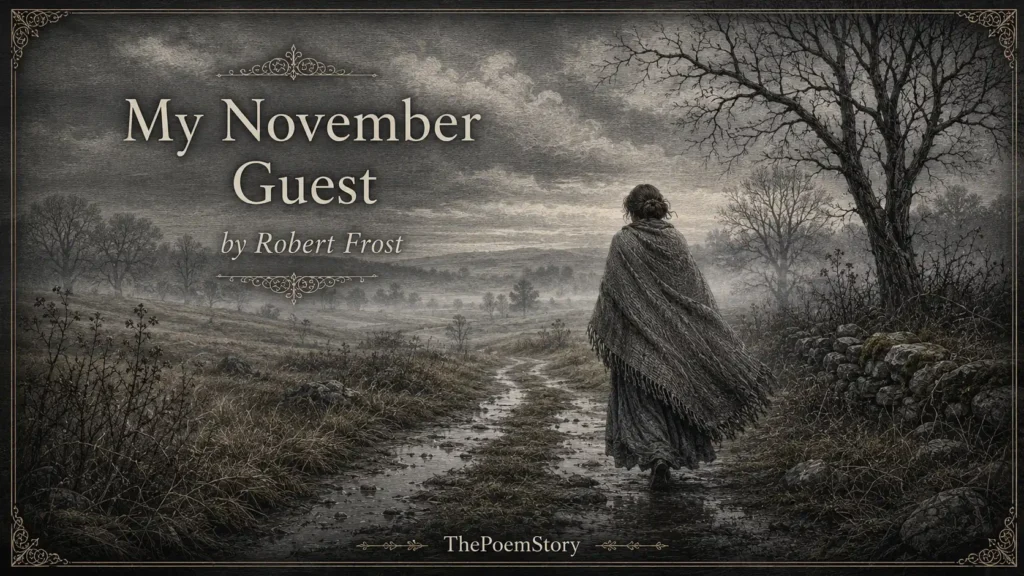
The poem personifies Sorrow as a female companion who visits the speaker during the bleak November days. Rather than being a burden, this sorrowful guest teaches the speaker to see beauty in the barren landscape. The poem challenges our modern obsession with happiness and productivity, suggesting that there is profound wisdom in embracing sadness.
In this comprehensive guide, we will dissect “My November Guest” with careful attention to its structure, language, and themes. We will provide a detailed My November Guest poem summary, explore the profound themes in My November Guest, examine its rich literary devices in My November Guest, and ultimately reflect on the My November Guest meaning and what it reveals about the human capacity to find light in darkness.
Read and explore ThePoemStory and go through Collected Poems of Robert Frost.
for more poems explore Poetry Section
Table of Contents
The Poem – My November Guest by Robert Frost
My Sorrow, when she’s here with me,
~ My November Guest by Robert Frost – Analysis and Summary
Thinks these dark days of autumn rain
Are beautiful as days can be;
She loves the bare, the withered tree;
She walks the sodden pasture lane.
Her pleasure will not let me stay.
She talks and I am fain to list:
She’s glad the birds are gone away,
She’s glad her simple worsted grey
Is silver now with clinging mist.
The desolate, deserted trees,
The faded earth, the heavy sky,
The beauties she so truly sees,
She thinks I have no eye for these,
And vexes me for reason why.
Not yesterday I learned to know
The love of bare November days
Before the coming of the snow,
But it were vain to tell her so,
And they are better for her praise.
My November Guest Poem Summary
Before delving into the thematic and literary depths, it is essential to establish a clear My November Guest poem summary to ensure every reader grasps the narrative and emotional arc of this delicate lyric. The poem is structured in three stanzas, each building upon the other to create a complete meditation on sorrow, perception, and beauty.
Stanza 1: The Arrival of Sorrow
The poem opens with the speaker personifying his sorrow as a female companion: “My Sorrow, when she’s here with me.” This immediately establishes an intimate, almost domestic relationship between the speaker and his melancholy. Sorrow is not an abstract feeling but a presence—a guest who visits and shares the speaker’s space.
The speaker observes that Sorrow finds the “dark days of autumn rain” to be “beautiful as days can be.” This is the poem’s central paradox: what most people would consider gloomy, depressing weather is, to Sorrow, the height of beauty. She loves the “bare, the withered tree” and walks through the “sodden pasture lane”—a path that is soaked, muddy, and uninviting to most.
Frost uses the word “sodden” deliberately. It conjures images of heavy, waterlogged earth—the kind of ground that sucks at your boots and makes walking difficult. Yet Sorrow walks there with pleasure. This first stanza establishes that Sorrow sees the world through a different lens, one that finds beauty in decay, emptiness, and dampness.
Stanza 2: The Voice of Sorrow
The second stanza deepens the relationship between the speaker and his melancholy. “Her pleasure will not let me stay.” Sorrow’s joy is so compelling that it prevents the speaker from leaving or withdrawing. She talks, and the speaker is “fain to list”—eager or willing to listen. The word “fain” is archaic and poetic, suggesting a gentle, willing submission to her voice.
Sorrow expresses gladness at the absence of birds. In most poetry, birdsong is a symbol of joy, hope, and life. But Sorrow is glad they are “gone away.” She prefers the silence of November to the chatter of spring. She is also glad that her “simple worsted grey”—her plain woolen clothing—is “silver now with clinging mist.” The mist transforms the ordinary grey into something precious, like silver. This is a striking image: even sorrow’s plainness is elevated by the atmospheric beauty of autumn.
This stanza reveals Sorrow’s aesthetic preference for muted, subtle beauty over bright, obvious splendor. She does not need gold or jewels; she finds value in the way mist clings to grey wool. It is a lesson in finding beauty in the understated and overlooked.
Stanza 3: The Misunderstanding and the Revelation
The third stanza introduces tension. The speaker describes “the desolate, deserted trees, / The faded earth, the heavy sky.” These are the beauties Sorrow “so truly sees.” But she “thinks I have no eye for these”—she believes the speaker is blind to the beauty she perceives. She “vexes” him, pressuring him to explain why he cannot see what she sees.
Then comes the poem’s quiet revelation: “Not yesterday I learned to know / The love of bare November days / Before the coming of the snow.” The speaker reveals that he has loved these desolate November days long before Sorrow arrived. He does not need her to teach him this beauty—he already knows it.
However, the final couplet adds a gentle twist: “But it were vain to tell her so, / And they are better for her praise.” It would be useless to tell Sorrow that he already loves November, because her praise of the season makes it “better.” Sorrow’s appreciation enhances the beauty of the days. The speaker allows Sorrow to believe she is teaching him, because her presence and her praise deepen his own appreciation.
This completes our My November Guest poem summary, revealing a poem about the gift of sorrow—not as a burden, but as a companion who teaches us to see beauty in the most unlikely places.
Major Themes in My November Guest
Now that we have a clear understanding of the narrative, let us examine the profound themes in My November Guest. This seemingly simple poem contains layers of philosophical and psychological insight.
1. The Personification of Sorrow
The most prominent theme is the personification of sorrow as a female guest. Frost treats melancholy not as an enemy to be defeated but as a companion to be welcomed. This is a radical departure from the Western cultural tendency to view sadness as something negative that must be overcome. By personifying Sorrow, Frost suggests that sadness has its own personality, its own preferences, and its own wisdom.
The speaker does not resist Sorrow or try to banish her. He listens to her, walks with her, and ultimately learns from her. This theme invites us to reconsider our relationship with our own sadness. Perhaps sorrow is not something to fix but something to befriend.
2. Finding Beauty in Desolation
The poem celebrates the aesthetic of autumn—the “bare, withered tree,” the “sodden pasture lane,” the “faded earth,” and the “heavy sky.” Most poets celebrate spring or summer as the seasons of beauty. Frost chooses November, the month of decay and preparation for winter.
This theme challenges conventional notions of beauty. Frost suggests that true aesthetic appreciation extends beyond the obviously beautiful to embrace the melancholy, the faded, and the barren. There is a quiet, subtle beauty in the dying of the year that rivals the glory of spring.
3. The Wisdom of Melancholy
Sorrow, as personified in this poem, possesses a special wisdom. She sees beauty where others see only gloom. She finds silver in grey mist. She loves what is bare and withered. The speaker, though he already shares this appreciation, benefits from Sorrow’s presence. Her praise makes the November days “better.”
This theme suggests that melancholy has its own intelligence and insight. A sorrowful person may see the world more clearly, unclouded by the superficial optimism that ignores life’s difficulties. This is a deeply Romantic and also psychologically sophisticated idea: that sadness can sharpen our perception.
4. The Paradox of Shared Perception
The poem presents a fascinating paradox: Sorrow believes she is teaching the speaker to appreciate November, but he already does. He chooses not to correct her because her presence and enthusiasm make the experience richer. This theme explores the idea that shared appreciation is more valuable than solitary appreciation.
It also touches on the nature of relationships. Sometimes we allow others to believe they are teaching us because their enthusiasm enhances our own experience. There is generosity and tenderness in this gesture—a recognition that connection matters more than being right.
5. The Comfort of Seasonal Cycles
The poem mentions “November days / Before the coming of the snow.” This references the cyclical nature of seasons. November is not an end but a transition—a pause before winter. The speaker loves these days precisely because they are transitional. This theme invites us to appreciate life’s transitions and liminal spaces. Not every moment must be a climax; there is beauty in the quiet, in-between times.
6. The Dignity of Simplicity
Sorrow wears “simple worsted grey” – plain, practical wool – and it becomes “silver” with mist. This theme celebrates the transformation of the ordinary into the precious. Frost suggests that simplicity, when viewed through the right lens, takes on a kind of radiance. The poem values the understated over the flashy, the quiet over the loud.
Literary Devices in My November Guest
To fully appreciate the craftsmanship of this poem, we must examine the rich array of literary devices in My November Guest. Frost employs these techniques with his characteristic subtlety and precision.
1. Personification
The central literary device of the poem is personification. Sorrow is treated as a living, breathing person with thoughts, feelings, and preferences. She “thinks,” “loves,” “walks,” “talks,” and is “glad.” Frost extends this personification throughout the poem, never allowing the reader to forget that Sorrow is a presence, not an abstraction.
This technique makes the abstract concept of melancholy concrete and relatable. The reader can imagine this sorrowful companion walking through the misty pasture, finding delight in the decay. Personification transforms the poem from a philosophical meditation into an intimate relationship drama.
2. Imagery
Frost’s imagery in this poem is deceptively simple but powerfully evocative.
- Visual: “dark days of autumn rain,” “bare, the withered tree,” “sodden pasture lane,” “simple worsted grey,” “silver now with clinging mist,” “desolate, deserted trees,” “faded earth,” “heavy sky.”
- Tactile: “sodden pasture lane” – the feel of wet, muddy ground underfoot.
- Auditory: Implied in “she talks” and “fain to list” – the speaker listening to Sorrow’s voice.
The imagery consistently emphasizes decay, dampness, and muted tones. There are no bright colors—only grey, silver, and faded earth. This creates a cohesive atmospheric mood that reinforces the poem’s theme.
3. Paradox
The poem is built on a paradox: Sorrow finds beauty in what most people find ugly. The “dark days of autumn rain” are “beautiful as days can be.” The “bare, the withered tree” is loved. This paradox challenges the reader’s assumptions and invites a deeper reflection on the nature of beauty.
4. Metaphor
The metaphor of Sorrow as a “guest” is implicit throughout. She is a visitor who arrives, stays, and eventually leaves. This metaphor reframes sadness as something temporary and even welcome—a guest who brings gifts of perception and appreciation.
5. Symbolism
Several symbols enrich the poem’s meaning:
- November: Symbolizes decay, transition, and the approach of death (winter). Yet the speaker loves it.
- Mist: Represents the blurring of boundaries and the transformation of the ordinary into something precious.
- Silver: Symbolizes value, purity, and beauty. The grey wool becomes silver through the mist.
- Birds: Their absence represents silence, stillness, and the withdrawal of life.
6. Tone and Mood
The tone is gentle, introspective, and slightly wistful. The speaker does not resist Sorrow but accepts her presence with a kind of quiet tenderness. The mood is melancholic but not despairing—a reflection on the beauty of sadness rather than a cry of pain.
7. Rhyme and Meter
The poem follows a consistent AABB rhyme scheme in the first two stanzas, with subtle variations in the third. The meter is predominantly iambic tetrameter, giving the poem a gentle, rocking rhythm that mirrors the speaker’s contemplative mood. This regular meter creates a sense of calm and stability, even as the poem explores sorrow and decay.
The Deeper Meaning of My November Guest
Beyond its surface-level narrative, the My November Guest meaning reveals a profound meditation on the relationship between sadness and perception. This is where the poem transcends its historical context and speaks directly to the human condition.
The My November Guest meaning centers on the idea that sorrow is not an enemy but a teacher. The speaker’s sorrowful companion sees beauty where others see only gloom. She teaches—or rather, she believes she teaches—the speaker to appreciate the bare, the withered, and the faded. The poem suggests that sadness sharpens our perception, allowing us to see truths that optimism obscures.
But the poem adds a crucial twist: the speaker already knows these truths. He has loved November before Sorrow arrived. Yet he allows Sorrow to believe she is teaching him, because her praise enhances the beauty of the days. This reveals a deeper wisdom: sometimes, we allow others to feel valuable and needed, even when we already possess their insight. There is generosity in this gesture—a willingness to let connection matter more than being right.
The My November Guest meaning also challenges our modern obsession with happiness. We are constantly told to be positive, to look on the bright side, to overcome our sadness. Frost suggests that sadness has its own gifts, its own wisdom. To befriend sorrow is not to wallow in despair but to embrace a deeper, more nuanced appreciation of life—one that includes decay, silence, and the “heavy sky.”
Finally, the poem reflects on the nature of companionship. Sorrow is a guest, not a permanent resident. She arrives and departs. The speaker does not cling to her or push her away. He simply accepts her presence and listens to her. This is a mature, balanced relationship with our own emotions—an acceptance of the full range of human feeling, from joy to sorrow.
Reflection on Human Life
“My November Guest” offers a timeless mirror to the human condition, and its relevance only grows in our modern world of constant stimulation and superficial positivity.
The Wisdom of Embracing Melancholy
In a culture that pathologizes sadness and medicates grief, Frost presents a radical alternative: welcome your sorrow as a guest. The poem suggests that melancholy is not a disease to be cured but a companion to be heard. When we resist sadness, we resist a part of ourselves. When we embrace it, we may discover a deeper appreciation for the world.
Modern psychology increasingly supports this view. Research shows that suppressing negative emotions leads to greater distress, while accepting them allows them to pass more quickly. Frost’s poem is a poetic anticipation of this psychological wisdom.
Beauty in the Marginal and Overlooked
The poem invites us to find beauty in what is marginal and overlooked—the bare tree, the faded earth, the heavy sky. In our consumer culture, we are constantly sold the bright, the shiny, and the new. Frost offers an alternative aesthetic: the value of decay, silence, and simplicity.
This resonates with contemporary movements toward minimalism, sustainability, and mindfulness. There is a growing recognition that the pursuit of ever more stimulation and consumption leads to exhaustion. Frost reminds us that there is beauty in absence, peace in quiet, and wisdom in the “heavy sky.”
The Generosity of Letting Others Teach
The speaker’s decision not to correct Sorrow reveals a profound interpersonal wisdom. Sometimes, we allow others to believe they are teaching us because their enthusiasm enriches our own experience. This is a form of generosity—a recognition that connection and shared enthusiasm are more valuable than being right.
In our competitive, individualistic society, we are often more concerned with proving our knowledge than with deepening our connections. Frost suggests a different approach: sometimes, the best response is simply to listen and allow the other person’s joy to enhance our own.
The Comfort of Seasonal Transitions
The poem celebrates November—a transitional month of decay before the coming of snow. This invites us to appreciate life’s transitional moments: the pause between youth and adulthood, the quiet between grief and recovery. Not every moment must be a peak experience. There is value in the in-between, the liminal, the threshold.
The Gift of Sorrow
Ultimately, “My November Guest” teaches us that sorrow is not a punishment but a gift. It sharpens our vision, deepens our appreciation, and connects us to the cycles of nature. To love November is to love the whole of life—including its inevitable decline.
This is not a sentimental or naive optimism. It is a hard-won wisdom—the recognition that beauty and decay are not opposites but partners in the dance of existence.
Conclusion
“My November Guest” is a quiet masterpiece of early Frost—a poem that rewards careful reading and deep reflection. It is a meditation on melancholy, perception, and the hidden beauty of decay. Through its personification of Sorrow, its rich imagery, and its gentle wisdom, the poem invites us to reconsider our relationship with sadness and with the world.
Through our My November Guest by Robert Frost analysis, we have explored the poem’s structure, its My November Guest poem summary, the profound themes in My November Guest, the masterful literary devices in My November Guest, and the enduring My November Guest meaning.
“My November Guest” does not offer grand gestures or dramatic resolutions. Instead, it offers something more valuable: a quiet companionship with sorrow, a gentle appreciation for the bare and faded, and a deep wisdom about the nature of beauty.
In a world that constantly urges us to be happy, productive, and optimistic, Frost invites us to pause and listen to our sorrow. Perhaps she has something to teach us. Perhaps the heavy sky, the faded earth, and the bare tree hold a beauty that the bright sunshine cannot match.
If you have ever found comfort in a rainy day, felt peace in the silence of autumn, or discovered beauty in the midst of sadness, then you, too, have been visited by your November Guest. And like Frost, you may find that her presence makes the desolate days “better.”
Enjoyed this deep dive into Frost’s poetry? If you want to explore more of his work, consider adding a complete collection to your library. There is no better companion for a quiet autumn evening than the timeless verses of Robert Frost.
Did this analysis illuminate a new perspective on “My November Guest” for you? Drop a comment below and let me know your thoughts. If you found this valuable, please share it with a fellow poetry enthusiast!
Read and explore ThePoemStory and go through Collected Poems of Robert Frost.
for more poems explore Poetry Section

Get the ThePoemStory App — Read Poems Anywhere