Robert Frost stands as one of the colossal figures of 20th-century American poetry. Known for his accessible yet profoundly layered verses, Frost often employed the rural landscapes of New England as a canvas for exploring the deepest crevices of the human psyche. While his later works, such as “The Road Not Taken” and “Stopping by Woods on a Snowy Evening,” cemented his place in the public consciousness, it is in his early collections that we find the raw, unpolished seeds of his genius.
This Storm Fear by Robert Frost analysis examines one of the most intense and psychologically charged poems from his debut collection, A Boy’s Will (1913). “Storm Fear” is a dramatic lyric that captures the terror of a family trapped in their farmhouse during a violent winter blizzard. Yet beneath its surface of physical threat lies a deeper meditation on human vulnerability, isolation, and the existential fear of being unable to save oneself.
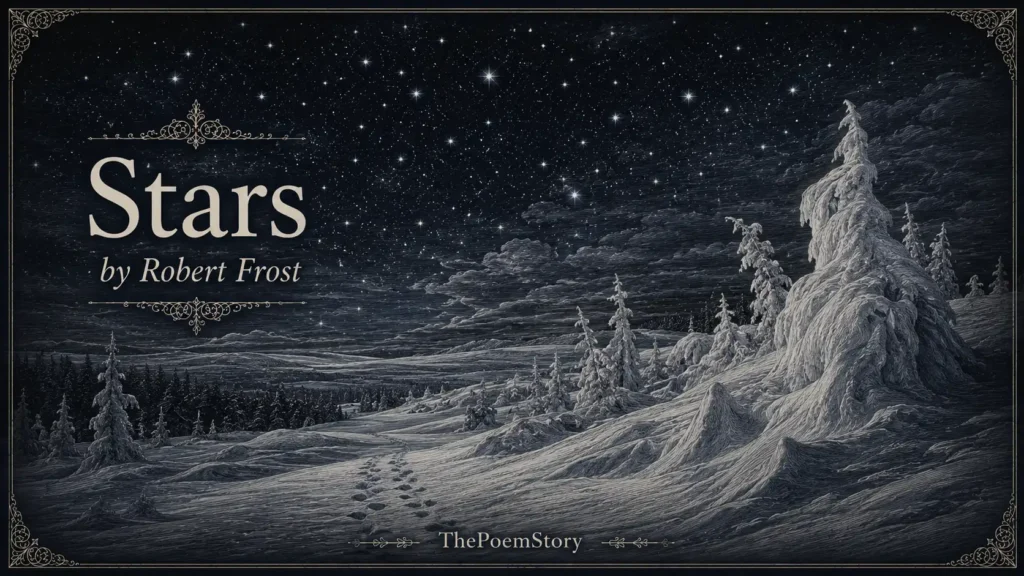
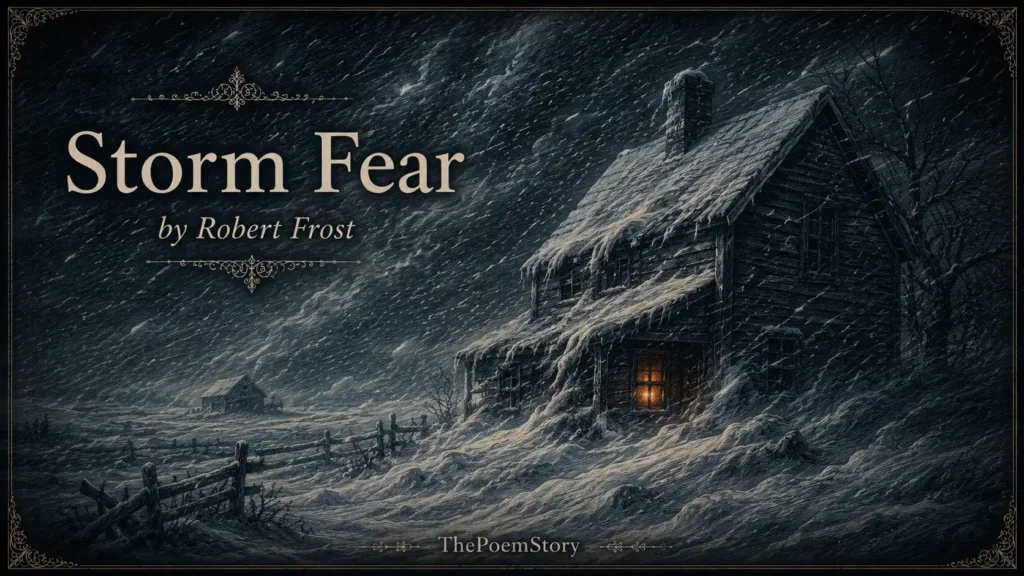
The poem presents a stark scene: a family huddled in their home while a storm rages outside. The wind pelts the windows with snow, whispering and barking like a beast, calling them to “Come out! Come out!” The family is small—”Two and a child”—and their strength is limited. The fire dies, the cold creeps in, the drifts pile up, and the barn grows “far away.” The speaker’s heart “owns a doubt” about whether they can survive until dawn.
In this comprehensive guide, we will dissect “Storm Fear” with careful attention to its structure, language, and psychological depth. We will provide a detailed Storm Fear poem summary, explore the profound themes in Storm Fear by Robert Frost, examine its masterful literary devices in Storm Fear, and ultimately reflect on the Storm Fear meaning and what it reveals about the human experience of fear, isolation, and the struggle for survival.
Read and explore ThePoemStory and go through Collected Poems of Robert Frost.
for more poems explore Poetry Section
Table of Contents
The Poem – Storm Fear by Robert Frost
When the wind works against us in the dark,
~ Storm Fear by Robert Frost – Analysis and Summary
And pelts with snow
The lower chamber window on the east,
And whispers with a sort of stifled bark,
The beast,
‘Come out! Come out!’—
It costs no inward struggle not to go,
Ah, no!
I count our strength,
Two and a child,
Those of us not asleep subdued to mark
How the cold creeps as the fire dies at length,—
How drifts are piled,
Dooryard and road ungraded,
Till even the comforting barn grows far away,
And my heart owns a doubt
Whether ’tis in us to arise with day
And save ourselves unaided.
Storm Fear Poem Summary
Before delving into the thematic and literary depths, it is essential to establish a clear Storm Fear poem summary to ensure every reader grasps the narrative and psychological arc of this intense lyric. The poem is structured as a single, continuous stanza, creating a sense of urgency and breathlessness that mirrors the speaker’s mounting fear.
Lines 1–6: The Storm and the Beast
The poem opens with the wind “working against us in the dark.” The word “working” suggests deliberate, purposeful action—the wind is not merely blowing; it is actively opposing the family. The wind pelts snow against “the lower chamber window on the east,” a specific, grounded detail that places us in a particular room of a particular house.
Then comes the most striking image: the wind “whispers with a sort of stifled bark, / The beast, / ‘Come out! Come out!’—” The wind is personified as a beast—an animal, something wild and predatory. It whispers, but its whisper is a “stifled bark,” a sound that is both restrained and threatening. The beast calls to the family, inviting them to leave the safety of their home.
This is a terrifying invitation. The storm is not just a natural phenomenon; it is a living, malevolent force that wants the family to come out and face it. The repetition of “Come out!” emphasizes the urgency and the threat.
Lines 7–8: The Refusal
The speaker responds: “It costs no inward struggle not to go, / Ah, no!” There is no temptation to leave the house. The decision to stay is automatic, instinctive. The “Ah, no!” is almost a sigh of relief—the speaker is grateful that there is no internal conflict. Staying inside is the only sane choice.
But the speaker’s refusal is not a sign of courage; it is a sign of fear. The family stays inside not because they are brave but because they are terrified of what is outside.
Lines 9–13: Counting Strength
The speaker counts their strength: “Two and a child.” The family is small—only three people. They are not a large, powerful group. They are vulnerable. The speaker “subdued to mark” how the cold creeps in as the fire dies. The word “subdued” suggests a passive, helpless observation. They are watching their own decline.
The cold creeps “as the fire dies at length.” The fire is their only source of warmth and comfort, and it is dying. The snow drifts are piling up, covering the dooryard and the road. The road is “ungraded”—unplowed, impassable. They are trapped.
Lines 14–18: The Doubt
The final lines deliver the poem’s devastating conclusion. The barn, which should be a source of comfort and security, grows “far away.” The family cannot reach it. The speaker’s heart “owns a doubt”—he is not sure whether they can survive.
The speaker questions: “Whether ’tis in us to arise with day / And save ourselves unaided.” Will they be able to get up in the morning and save themselves? The word “unaided” is crucial. There is no one coming to help them. They are alone. The poem ends on this note of uncertainty, leaving the reader to wonder about the family’s fate.
This completes our Storm Fear poem summary, revealing a poem about primal fear, human vulnerability, and the terrifying possibility of being unable to save oneself.
Major Themes in Storm Fear by Robert Frost
Now that we have a clear understanding of the narrative, let us examine the profound themes in Storm Fear by Robert Frost. This intense, compact poem contains layers of psychological and existential insight.
1. Primal Fear
The central theme of “Storm Fear” is primal fear—the raw, instinctive terror that arises when humans face the forces of nature. The family is trapped, vulnerable, and helpless. The storm is not just weather; it is a “beast” that calls to them. This fear is not intellectual or abstract; it is visceral, physical, and overwhelming.
Frost captures this fear with remarkable economy. The poem does not describe the fear; it enacts it through its short, breathless lines, its vivid imagery, and its uncertain conclusion.
2. Human Vulnerability
The poem emphasizes human vulnerability. The family is small—”Two and a child.” They are not powerful. They cannot control the storm. They cannot stop the cold. They cannot clear the drifts. Their strength is limited, and their resources are diminishing.
This theme challenges the modern belief in human mastery over nature. We like to think that we have conquered the natural world, but Frost reminds us that nature is still powerful, still threatening, and still capable of overwhelming us.
3. Isolation
The family is profoundly isolated. The road is “ungraded,” meaning no one can reach them. The barn grows “far away.” The word “unaided” in the final line emphasizes that they are completely alone. There is no rescue, no help, no outside intervention.
This isolation is both physical and psychological. The family is cut off from the world, but they are also cut off from each other—the speaker counts “Two and a child,” but there is no sense of connection or support. They are together, but each is alone with their own fear.
4. The Beast Within
The wind is personified as a “beast” that calls to the family. But the beast is also within. The fear that the family feels is a kind of beast—a primal, instinctive terror that cannot be reasoned away. The call to “Come out! Come out!” is not just an external threat; it is an internal temptation to give up, to surrender, to stop fighting.
This theme connects to Frost’s broader interest in the human psyche. We are not purely rational beings; we are also creatures of instinct and fear.
5. The Struggle for Survival
The poem is a meditation on the struggle for survival. The family fights to stay alive, but their resources are limited. The fire dies, the cold creeps in, the drifts pile up. The speaker questions whether they can “arise with day / And save ourselves unaided.”
This theme invites us to consider our own capacity for survival. What would we do in a life-threatening situation? Would we be able to save ourselves, or would we be overwhelmed? Frost does not provide an easy answer.
6. The Uncertainty of the Future
The poem ends with doubt. The speaker does not know if they will survive. This uncertainty is the essence of existential fear. We do not know what the future holds. We may be safe today, but tomorrow is unknown. The storm is a metaphor for the unpredictability of life.
7. The Fragility of Home
The house, which should be a place of safety, becomes a trap. The family is inside, but they are not safe. The cold creeps in, the fire dies, and the storm batters the windows. The home is fragile, and the illusion of security is shattered. This theme challenges the idea that we can create permanent, invulnerable spaces in an unpredictable world.
Literary Devices in Storm Fear
To fully appreciate the craftsmanship of this poem, we must examine the rich array of literary devices in Storm Fear. Frost employs these techniques with his characteristic precision and power, creating a poem that is both viscerally immediate and psychologically profound.
1. Personification
The central device of the poem is personification. The wind is personified as a “beast” that “works against us,” “pelts” the window, and “whispers with a sort of stifled bark.” The wind is not just a natural force; it is a living, malevolent presence that actively threatens the family. This personification transforms the storm from a weather event into a psychological antagonist.
2. Imagery
Frost’s imagery in this poem is stark, precise, and intensely sensory:
- Visual: “pelts with snow,” “lower chamber window,” “drifts are piled,” “fire dies.”
- Auditory: “whispers,” “stifled bark,” “Come out! Come out!”
- Tactile: “cold creeps.”
- Thermal: “fire dies,” “cold creeps.”
The imagery consistently emphasizes threat, coldness, and entrapment. The storm is not just seen; it is heard, felt, and feared.
3. Symbolism
Several symbols enrich the poem’s meaning:
- The Storm: Represents the uncontrollable forces of nature, fate, and the existential threats that surround human life.
- The Beast: Represents primal fear, the dark forces of the unconscious, and the temptation to surrender.
- The House: Represents the illusion of safety and the fragility of human security.
- The Fire: Represents warmth, hope, and the diminishing resources of human strength.
- The Barn: Represents comfort, security, and the things that grow “far away” in times of crisis.
- The Child: Represents vulnerability, innocence, and what is most precious—and most endangered.
4. Tone
The tone of the poem is tense, fearful, and uncertain. The speaker is not calm or detached; he is in the grip of fear. The short, fragmented lines and the breathless rhythm convey the speaker’s anxiety. The final doubt is not resolved—it is left hanging, deepening the sense of unease.
5. Rhythm and Meter
Frost uses a fragmented, irregular rhythm that mirrors the speaker’s emotional state. The lines vary in length from a single word (“The beast,” “Ah, no!”) to longer, more complex lines. This variation creates a sense of instability and unpredictability. The reader cannot settle into a comfortable rhythm, just as the speaker cannot find comfort in his situation.
6. Enjambment
Frost uses enjambment to create a sense of flow and urgency. The lines run into each other, mimicking the relentless onslaught of the storm. The poem does not pause; it pushes forward, just as the storm pushes against the house.
7. Repetition
The repetition of “Come out! Come out!” is a powerful rhetorical device. It emphasizes the urgency of the beast’s call and the terror it inspires. The repetition also creates a sense of inescapability—the call is relentless, just like the storm.
8. Rhetorical Question
The poem ends with a rhetorical question: “Whether ’tis in us to arise with day / And save ourselves unaided.” This question is not answered. It is left hanging, forcing the reader to confront the same uncertainty that the speaker faces.
The Deeper Meaning of Storm Fear
Beyond its surface-level narrative, the Storm Fear meaning reveals a profound meditation on the human experience of fear, vulnerability, and the struggle for survival. This is where the poem transcends its historical context and speaks directly to the human condition.
The Storm Fear meaning centers on the recognition that human beings are fundamentally vulnerable. We like to think that we are in control of our lives, but the storm reminds us that we are not. Nature is more powerful than we are. Fate is unpredictable. Our resources are limited. The poem invites us to confront this vulnerability without illusion.
The poem also explores the nature of fear. Fear is not just a response to external threat; it is a psychological state that can paralyze and overwhelm us. The speaker is not just afraid of the storm; he is afraid of his own inability to cope with it. He doubts whether he can “save ourselves unaided.” This is the deepest fear: the fear that we are not strong enough, not resourceful enough, not capable enough.
The Storm Fear meaning also speaks to the isolation of the human condition. The family is alone. There is no rescue, no help, no outside intervention. We are ultimately alone in our struggles. This is a difficult truth, but Frost does not flinch from it. He presents the family’s isolation with honesty and compassion.
Finally, the poem raises the question of whether survival is possible. The speaker does not know if they will live through the night. This uncertainty is the essence of existential fear. We do not know what the future holds. We may survive, or we may not. The poem invites us to live with this uncertainty, to accept it as part of being human.
Ultimately, the Storm Fear meaning is that fear is a fundamental part of the human condition. We cannot eliminate it. We can only face it, acknowledge it, and hope that we are strong enough to survive.
Reflection on Human Life
“Storm Fear” offers a timeless mirror to the human condition, and its relevance only grows in our modern world of anxiety, uncertainty, and existential dread.
The Illusion of Control
We live in a world that values control. We plan, we prepare, we organize. We believe that if we are careful enough, we can avoid disaster. “Storm Fear” reminds us that this belief is an illusion. The storm comes whether we are ready or not. The fire dies despite our efforts. The drifts pile up, blocking our escape. There are forces that we cannot control, and the sooner we accept this, the more honestly we can live.
The Reality of Fear
In our culture, fear is often stigmatized. We are told to be brave, to be strong, to overcome our fears. “Storm Fear” acknowledges that fear is a natural, legitimate response to threat. The speaker is afraid, and he does not apologize for it. He counts his strength, observes the dying fire, and doubts his survival. This honesty is a form of courage—the courage to admit that we are afraid.
The Fragility of Home
The home is supposed to be a sanctuary, a place of safety and comfort. But the storm turns the home into a trap. The family cannot leave, and they cannot feel safe. This is a powerful reminder that our sense of security is fragile. The things we build to protect ourselves can also confine us. The barn, which should be a source of comfort, grows “far away.” The things we rely on can disappear in times of crisis.
The Strength of the Small
The family is small—”Two and a child.” They are not a large, powerful group. But they are still fighting. They are still trying to survive. This is a powerful image of human resilience. Even the smallest, most vulnerable among us have the capacity to struggle, to endure, to hope.
The Uncertainty of Survival
The poem ends with doubt. Will they survive? The speaker does not know. This uncertainty is the essence of life. We do not know what will happen tomorrow. We may be safe today, but the storm is always coming. The poem invites us to live with this uncertainty, to accept it as part of the human condition, and to find meaning in the struggle itself.
The Call of the Beast
The beast calls, “Come out! Come out!” This is the voice of despair, the temptation to give up. The family refuses. They stay inside. This refusal is a small act of defiance—a decision to keep fighting even when the odds are against them. The poem reminds us that the call to surrender is always there, but we do not have to answer it.
Conclusion
“Storm Fear” is a powerful and intense poem—a masterpiece of early Frost that captures the raw, primal terror of human vulnerability in the face of nature’s power. Through its vivid personification, its stark imagery, and its uncertain conclusion, the poem invites us to confront our own fears and to acknowledge the limits of our control.
Through our Storm Fear by Robert Frost analysis, we have explored the poem’s structure, its Storm Fear poem summary, the profound themes in Storm Fear by Robert Frost, the masterful literary devices in Storm Fear, and the enduring Storm Fear meaning.
“Storm Fear” does not offer comfort. It does not tell us that everything will be okay. Instead, it offers something more valuable: an honest confrontation with fear. The speaker is afraid. He doubts his survival. But he continues to observe, to count, to hope. This is the essence of human resilience—the ability to keep going even when we are not sure we will make it.
If you have ever been afraid—truly, deeply afraid—then you have stood where Frost stood. You have heard the beast call to you. And like the speaker, you have refused to answer.
Enjoyed this deep dive into Frost’s poetry? If you want to explore more of his work, consider adding a complete collection to your library. There is no better companion for a stormy night than the timeless verses of Robert Frost.
Did this analysis illuminate a new perspective on “Storm Fear” for you? Drop a comment below and let me know your thoughts. If you found this valuable, please share it with a fellow poetry enthusiast!
Read and explore ThePoemStory and go through Collected Poems of Robert Frost.
for more poems explore Poetry Section
Get the ThePoemStory App — Read Poems Anywhere